





Mahaparinirvan Diwas: Honoring Dr. BR Ambedkar, Architect of the Indian Constitution, Observed on December 6
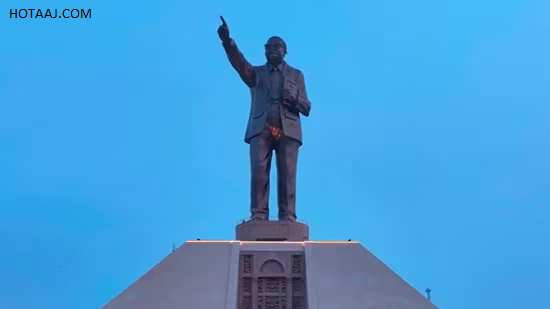
The Maharashtra government has declared a local holiday on Friday, December 6, to observe the death anniversary of Bharat Ratna Dr. BR Ambedkar, widely known as Mahaparinirvan Diwas. This significant day is observed annually across the country to honor the legacy of Dr. Bhimrao Ramji Ambedkar, affectionately called Babasaheb Ambedkar.
Dr. Ambedkar, the principal architect of the Indian Constitution, played a pivotal role in shaping the nation’s democratic structure and advocating for social justice and equality. His contributions to the upliftment of marginalized communities, particularly the Dalits, have left an indelible mark on India’s social and political landscape.
On this day, numerous events are held across the country, especially in Maharashtra, where people gather at important locations such as Chaitya Bhoomi in Mumbai, the resting place of Dr. Ambedkar, to pay their respects. Public institutions, including schools, banks, and government offices, remain closed in Maharashtra to commemorate the life and work of this great leader.
Mahaparinirvan Diwas serves as a reminder of Dr. Ambedkar’s unwavering commitment to social reform and equality, and it continues to inspire generations to work toward a more inclusive society.
On Thursday, Maharashtra Deputy Chief Minister Eknath Shinde paid homage to Dr. BR Ambedkar by garlanding his statue in Thane’s Court Naka area, marking the observance of the 69th Mahaparinirvan Diwas. The event, which commemorates the death anniversary of the Bharat Ratna awardee and architect of the Indian Constitution, will also be observed at Prerna Sthal in the Parliament House Complex.
The ceremony at Parliament House will be organized by the Dr. Ambedkar Foundation, under the Union Ministry of Social Justice and Empowerment. This event will pay tribute to Dr. Ambedkar’s monumental contributions to India’s democracy and social justice. Dr. Ambedkar’s legacy continues to inspire the nation’s ongoing fight for equality and empowerment of marginalized communities.
The commemoration event for the 69th Mahaparinirvan Diwas will begin in the morning with floral tributes from key dignitaries, including Vice President Jagdeep Dhankhar, Prime Minister Narendra Modi, Lok Sabha Speaker Om Birla, Rajya Sabha Deputy Chairperson Harivansh, and other prominent leaders. This ceremony, held at Prerna Sthal in the Parliament House Complex, is a mark of respect to Dr. BR Ambedkar, honoring his legacy as the principal architect of the Indian Constitution and his monumental role in advancing social justice and equality in India.
Each year, thousands of people from across Maharashtra travel to Mumbai to pay their respects to Dr. BR Ambedkar at Chaityabhoomi in Dadar’s Shivaji Park, where he was cremated. In light of the large number of visitors expected for the 69th Mahaparinirvan Diwas, the Railways have arranged special trains to manage the increased passenger traffic. These services will ensure smooth travel for the pilgrims, allowing them to participate in the commemorative events and honor Ambedkar’s enduring legacy.
Dr. BR Ambedkar, a key member of the seven-person committee that drafted the Indian Constitution, was posthumously awarded the Bharat Ratna, India’s highest civilian honor, in 1990. He passed away on December 6, 1956, at his residence in Delhi. His contributions to the nation, especially in the fields of social justice, equality, and the shaping of India’s democratic framework, continue to be celebrated every year on Mahaparinirvan Diwas, a day dedicated to honoring his life and legacy.
‘Mahaparinirvan Diwas’ Holiday: What’s Closed and What’s Open
On December 6, Maharashtra will observe Mahaparinirvan Diwas in honor of Dr. BR Ambedkar. Here’s a breakdown of what’s open and what’s closed across Mumbai:
Closed:
- State and Semi-Government Offices: Government offices in Mumbai and its suburbs will remain closed.
- Liquor Shops: As it is a dry day, alcohol sales will be prohibited, and liquor shops will be closed.
- Schools: All schools in Mumbai will be closed, as confirmed by the Education Department’s Cluster Resource Center (CRC) and a notice from the deputy director of education.
- Public Sector and Private Banks: Public and private sector banks will remain open, as per the Reserve Bank of India’s holiday calendar, which does not recognize December 6 as a bank holiday in Mumbai.
Open:
- Public and Private Banks: While government offices are closed, public and private banks will operate as usual.
- Stock Exchanges: The Bombay Stock Exchange (BSE) and the National Stock Exchange (NSE) have not announced a holiday for December 6, meaning trading will likely continue unless otherwise decided.
Special Trains and Transport Arrangements:
- Special Trains: To manage the heavy influx of visitors heading to Mumbai for Mahaparinirvan Diwas, the Central Railway has announced 14 additional trains arriving at Chhatrapati Shivaji Maharaj Terminus on December 6. These trains will originate from cities like Aurangabad, Adilabad, Nagpur, and Sholapur.
- Suburban Trains: In addition, 12 extra suburban trains (six each on the main and harbour lines) will run during the nights of December 5 and 6 to accommodate increased passenger traffic.
Security Measures:
- To ensure smooth operations and safety, around 300 additional Railway Police Force (RPF) personnel have been deployed across key stations, including Dadar, Chhatrapati Shivaji Terminus, Kalyan, and Thane. Over 300 additional staff from the Government Railway Police (GRP) will also assist. Additionally, ‘May I Help You’ booths have been set up at various stations for passenger support.
This comprehensive arrangement aims to manage the large crowd visiting the city to honor Dr. Ambedkar’s legacy on Mahaparinirvan Diwas.
Traffic restrictions in Mumbai
Many people are expected to gather at Chaityabhoomi in Shivaji Park, Mumbai, on December 6, to pay their respects to Dr. BR Ambedkar, who was cremated there. This location holds immense significance for his followers, as it has become a major site for commemorating Mahaparinirvan Diwas. Pilgrims from across Maharashtra and beyond will visit Chaityabhoomi to honor Ambedkar’s contributions to India’s Constitution and social justice. The gathering is a poignant reminder of his legacy and the ongoing fight for equality and empowerment.
To manage the crowd and ensure smooth movement for Mahaparinirvan Diwas, the traffic police have imposed restrictions on vehicular movement in central Mumbai from December 5 to 7. These measures are aimed at managing the large influx of visitors heading to Chaityabhoomi in Shivaji Park and other key locations. Drivers are advised to follow alternate routes, and additional traffic personnel will be deployed to maintain order and minimize disruptions during this busy period. The restrictions will help ensure safety and facilitate the smooth flow of both pedestrians and vehicles in the area.
As part of the traffic management for Mahaparinirvan Diwas, several road closures and diversions have been implemented in central Mumbai from December 5 to 7:
- Veer Savarkar Road will remain closed to traffic from Siddhivinayak Temple Junction to Hinduja Hospital.
- Local residents can still access the area by taking a left turn from Yes Bank Junction and proceeding through Pandurang Naik Road towards Raja Badhe Chowk.
These measures are being put in place to manage the increased traffic and ensure the safety of the large number of people expected to gather for the observance of Mahaparinirvan Diwas.
COURTESY: ABP MAJHA
References
- ^ Duara, Juliette G. (2018). Gender Justice and Proportionality in India: Comparative Perspectives. Routledge Advances in South Asian Studies. London and New York: Routledge. ISBN 978-1-138-70669-9.
As the Constitutional Advisor to the Constituent Assembly, B.N. Rau was the principal author of the first draft of India’s Constitution based on the deliberations of that Assembly and its various subcommittees. In all subsequent deliberations of the drafting committee “this draft constituted the basic document and its working paper”. B.N. Rau’s work as principal drafter placed him in a good position to address his concerns about the need for “special protection” for women. Thus, it is in the Text of the Draft Constitution dated October 1947 that the phrase about “special provision for women and children” makes its first appearance.
- ^ Elangovan, Arvind (2019). Norms and Politics: Sir Benegal Narsing Rau in the Making of the Indian Constitution, 1935–1950. Oxford, UK: Oxford University Press. pp. 22–23. ISBN 978-0-19-949144-5.
In his role as Constitutional Adviser, Rau’s contributions consisted of not only advising the Constituent Assembly but also members of the Indian National Congress, and the All-India Muslim League. In the Constituent Assembly itself, Rau’s influence was substantive. Significantly, Rau produced the draft constitution, which the drafting committee chaired by B. R. Ambedkar went on to deliberate. Subsequently, Rau was involved in evaluating the comments received on the draft constitution and incorporating them before it was submitted to the Constituent Assembly in late 1948.
- ^ Ewing, Cindy (2020). “Codifying Minority Rights: Postcolonial Constitutionalism in Burma, Ceylon, and India”. In Moses, A. Dirk; Duranti, Marco; Burke, Roland (eds.). Decolonization, Self-Determination, and the rise of Global Human Rights Politics. Cambridge University Press. pp. 179–206. ISBN 978-1-108-47935-6.
(p. 190) In order to protect both individual and group rights, India’s constitutional adviser B. N. Rau prepared a key brief that changed how nights were expressed and enumerated in the constitution. His September 1946 note on fundamental rights expounded on justiciability and the need to identify which rights would be enforceable in court. Justiciability thus became a way to bridge the gap between committee members who wanted to write in as many rights as possible and those who wanted a more narrow set of rights. Rau laid out a scheme to divide fundamental rights into two categories: legally enforceable and not enforceable, pointing to the Irish constitution as a model for framing “a distinction between two broad classes of rights,” referring to “certain rights which require positive action by the State and which can be guaranteed only so far as such action is practicable, while others merely require that the State shall abstain from prejudicial action.” The fundamental rights subcommittee debated Rau’s proposal in February 1947, with committee members K. M. Munshi and B. R. Ambedkar initially opposing splitting these rights. … (p. 191) In March 1947, after the subcommittee concluded debate, the assembly agreed to the expansive bill of rights and divided fundamental rights into two sections based on Rau’s original proposal. … (pp. 192–193) In early April 1947, Rau completed the fundamental rights report. The constituent assembly convened for its third session later that month and each subcommittee presented its findings over a series of raucous debates. Patel presented the new draft bill of rights, which was adopted by the assembly on August 28, 1947. Observing these sessions at Constitution House was Chan Htoon, the Burmese constitutional adviser. Aung San tasked Chan Htoon with studying the constitutions of different countries and developing relationships with members of the Indian legal academy. Having developed a friendship with Rau, Chan Htoon discussed the draft constitution with Rau in the setting of the constituent assembly. The cross-border consultations between India and Burma led to the intertwining of their constitutional ideas, best exemplified by their provisions on individual rights and state duties.
- ^ Prasse-Freeman, Elliott (2023). Rights Refused: Grassroots Activism and State Violence in Myanmar. Stanford University Press. ISBN 9781503634725.
Cindy Ewing reveals that the statements in Burma’s constitution about citizen rights were imported wholesale from other sources—either India or Ireland (2020, 193). The section on fundamental rights copies word for word from the Advisory Committee of the Indian Constituent Assembly. This mimicry was not coincidental. Chan Htoon, the author of Burma’s constitution, “developed a friendship with [B. N.] Rau,” the author of India’s constitution, when visiting New Delhi “to observe [India’s] constitutional debates.” While there, “Rau reviewed Chan Htoon’s draft constitution and assisted in collecting materials for the Burmese constituent assembly. Rau ensured significant areas of commonality between the two constitutions” (Ewing 2020, 193).
- ^ “Sir Benegal Narsing Rau Indian jurist“. Encyclopaedia Britannica.
Sir Benegal Narsing Rau (born February 26, 1887, Karkala or Mangalore, Mysore [now Karnataka], India—died November 30, 1953, Zürich, Switzerland) was one of the foremost Indian jurists of his time. He helped draft the constitutions of Burma (Myanmar) in 1947 and India in 1950
- ^ “B. R. Ambedkar Indian Political Leader“. Encyclopaedia Britannica.
Bhimrao Ramji Ambedkar (born April 14, 1891, Mhow, India—died December 6, 1956, New Delhi) was a leader of the Dalits (Scheduled Castes; formerly called untouchables) and law minister of the government of India (1947–51). In 1947 Ambedkar became the law minister of the government of India. He took a leading part in the framing of the Indian constitution, outlawing discrimination against untouchables, and skillfully helped to steer it through the assembly; the adoption of the constitution on January 26, 1950, is today celebrated as Republic Day, a national holiday. He resigned in 1951, disappointed at his lack of influence in the government. In October 1956, in despair because of the perpetuation of untouchability in Hindu doctrine, he renounced Hinduism and became a Buddhist, together with about 200,000 fellow Dalits, at a ceremony in Nagpur.
- ^ Jump up to:a b c Krishnamurty, J. (2020), “Ambedkar’s Educational Odyssey, 1913–1927”, Journal of Social Inclusion Studies, 5 (2), SAGE: 1–11, doi:10.1177/2394481119900074, ISSN 2394-4811, S2CID 212824611,
(p. 2) Ambedkar obtained his London DSc degree in 1923 for his thesis ‘Problem of the Rupee’ (University of London, 1926). However, he was not the first Indian to achieve this feat. Records of the London University clearly show that John Matthai and Pramathanath Bandyopadhyay (more popularly known as Pramathanath Banerjea) obtained their DSc degrees from the university in 1916. … (p. 3) Turning to US doctorates, while Ambedkar was one of the early Indians to work for a PhD in the USA, he was awarded his degree by Columbia University only in 1927. The first Indian PhD in Economics in the USA was probably Rajani Kanta Das, a labour economist, who worked with Professor John Commons and was awarded the PhD degree by the University of Wisconsin in 1917.
- ^ Buswell, Robert Jr; Lopez, Donald S. Jr., eds. (2013). Princeton Dictionary of Buddhism. Princeton, NJ: Princeton University Press. p. 34. ISBN 978-0691157863.
- ^ Jaffrelot, Christophe (2005). Ambedkar and Untouchability: Fighting the Indian Caste System. New York: Columbia University Press. p. 2. ISBN 0-231-13602-1.
- ^ Pritchett, Frances. “In the 1890s” (PHP). Archived from the original on 7 September 2006. Retrieved 2 August 2006.
- ^ “Mahar”. Encyclopædia Britannica. britannica.com. Archived from the original on 30 November 2011. Retrieved 12 January 2012.
- ^ Ahuja, M. L. (2007). “Babasaheb Ambedkar”. Eminent Indians: administrators and political thinkers. New Delhi: Rupa. pp. 1922–1923. ISBN 978-8129111074. Archived from the original on 23 December 2016. Retrieved 17 July 2013.
- ^ Ambedkar, B. R. “Waiting for a Visa”. Frances Pritchett, translator. Columbia.edu. Archived from the original on 24 June 2010. Retrieved 17 July 2010.
- ^ Kurian, Sangeeth (23 February 2007). “Human rights education in schools”. The Hindu. Archived from the original on 3 November 2013.
- ^ “आंबडवे नाव योग्यच – खासदार अमर साबळे”. 14 April 2016. Retrieved 20 August 2021.
- ^ “डॉ. बाबासाहेब आंबेडकर यांचे मूळ गाव आंबवडे येथे आंतरराष्ट्रीय दर्जाचे शैक्षणिक संकुल”. 18 April 2014. Retrieved 20 August 2021.
- ^ “आंबेडकर गुरुजींचं कुटुंब जपतंय सामाजिक वसा, कुटुंबानं सांभाळल्या ‘त्या’ आठवणी”.[permanent dead link]
- ^ “Bhim, Eklavya”. outlookindia.com. Archived from the original on 11 August 2010. Retrieved 17 July 2010.
- ^ “आपने देखा आंबेडकर का जर्जर होता स्कूल?”. BBC. BBC Hindi. 7 November 2017. Retrieved 20 August 2021.
- ^ Adshul, Ashok (26 December 2016). “आंबेडकर गुरुजींचं कुटुंब जपतंय सामाजिक वसा, कुटुंबानं सांभाळल्या ‘त्या’ आठवणी”. Divyamarathi.com. Divya Marathi. Archived from the original on 28 May 2019. Retrieved 20 August 2021.
- ^ Prasad, Kamta (4 July 2020). “डॉ. भीम राव आम्बेडकर को उनके गुरु कृष्ण केशव आम्बेडकर ने दिया था अपना सरनेम”. LiveHindustan.com. Live Hindustan. Retrieved 20 August 2021.
- ^ S. N. Mishra (2010). Socio-economic and Political Vision of Dr. B.R. Ambedkar. Concept Publishing Company. p. 96. ISBN 978-8180696749.
- ^ “ऐसे हुआ डॉ आंबेडकर का नाम परिवर्तन… तकनीक से सशक्तीकरण का सपना होगा साकार”. NDTV. 14 April 2017.
- ^ Keer, Dhananjay (1971). Dr. Ambedkar: life and mission (3rd ed.). Mumbai: Popular Prakashan. p. 20. ISBN 81-7154-237-9.
- ^ Pritchett, Frances. “In the 1890s” (PHP). Archived from the original on 7 September 2006. Retrieved 2 August 2006.
- ^ Jump up to:a b Pritchett, Frances. “In the 1910s” (PHP). Archived from the original on 23 November 2011. Retrieved 5 January 2012.
- ^ “Ambedkar teacher”. 31 March 2016. Archived from the original on 3 April 2016.
- ^ “Bhimrao Ambedkar”. columbia.edu. Archived from the original on 10 February 2014.
- ^ “Rescuing Ambedkar from pure Dalitism: He would’ve been India’s best Prime Minister”. 15 April 2015. Archived from the original on 6 November 2015.
- ^ Ambedkar, Dr. B.R. “Waiting for a Visa”. columbia.edu. Columbia University. Archived from the original on 24 June 2010. Retrieved 15 April 2015.
- ^ Keer, Dhananjay (1971) [1954]. Dr. Ambedkar: Life and Mission. Mumbai: Popular Prakashan. pp. 37–38. ISBN 8171542379. OCLC 123913369.
- ^ Harris, Ian, ed. (2001). Buddhism and politics in twentieth-century Asia. Continuum International Group. ISBN 978-0826451781.
- ^ Tejani, Shabnum (2008). “From Untouchable to Hindu Gandhi, Ambedkar and Depressed class question 1932”. Indian secularism: a social and intellectual history, 1890–1950. Bloomington: Indiana University Press. pp. 205–210. ISBN 978-0253220448. Retrieved 17 July 2013.
- ^ Jaffrelot, Christophe (2005). Dr Ambedkar and Untouchability: Analysing and Fighting Caste. London: C. Hurst & Co. Publishers. p. 4. ISBN 1850654492.
- ^ Dhananjay Keer (1995). Dr. Ambedkar: Life and Mission. Popular Prakashan. pp. 63–64. ISBN 978-81-7154-237-6.
- ^ “Dr. Ambedkar”. National Campaign on Dalit Human Rights. Archived from the original on 8 October 2012. Retrieved 12 January 2012.
- ^ Benjamin, Joseph (June 2009). “B. R. Ambedkar: An Indefatigable Defender of Human Rights”. Focus. 56. Japan: Asia-Pacific Human Rights Information Center (HURIGHTS OSAKA).
- ^ Thorat, Sukhadeo; Kumar, Narender (2008). B. R. Ambedkar:perspectives on social exclusion and inclusive policies. New Delhi: Oxford University Press.
- ^ Ambedkar, B. R. (1979). Writings and Speeches. Vol. 1. Education Dept., Govt. of Maharashtra.
- ^ “Dr. Babasaheb Ambedkar”. Maharashtra Navanirman Sena. Archived from the original on 10 May 2011. Retrieved 26 December 2010.
- ^ Kumar, Aishwary. “The Lies Of Manu”. outlookindia.com. Archived from the original on 18 October 2015.
- ^ “Annihilating caste”. frontline.in. Archived from the original on 28 May 2014.
- ^ Menon, Nivedita (25 December 2014). “Meanwhile, for Dalits and Ambedkarites in India, December 25th is Manusmriti Dahan Din, the day on which B R Ambedkar publicly and ceremoniously in 1927”. Kafila. Retrieved 21 October 2015.
- ^ “11. Manusmriti Dahan Day celebrated as Indian Women’s Liberation Day” (PDF). Archived (PDF) from the original on 17 November 2015.
- ^ Keer, Dhananjay (1990). Dr. Ambedkar: life and mission (3rd ed.). Bombay: Popular Prakashan Private Limited. pp. 136–140. ISBN 8171542379.
- ^ “Poona Pact – 1932”. Britannica.com. Encyclopædia Britannica. Archived from the original on 18 May 2015. Retrieved 29 April 2015.
- ^ “Ambekar vs Gandhi: A Part That Parted”. Outlook. 20 August 2012. Archived from the original on 27 April 2015. Retrieved 29 April 2015.
- ^ “Museum to showcase Poona Pact”. The Times of India. 25 September 2007. Archived from the original on 17 October 2015. Retrieved 29 April 2015.
Read 8th Paragraph
- ^ Omvedt, Gail (2012). “A Part That Parted”. Outlook India. The Outlook Group. Archived from the original on 12 August 2012. Retrieved 12 August 2012.
- ^ “Gandhi’s Epic Fast”. Archived from the original on 12 November 2011.
- ^ Kumar, Ravinder (1985). “Gandhi, Ambedkar and the Poona pact, 1932”. South Asia: Journal of South Asian Studies. 8 (1–2): 87–101. doi:10.1080/00856408508723068.
- ^ “7 Unknown Historical Facts About Ramjas College, University of Delhi | the Campus Connect”. Archived from the original on 30 May 2015. Retrieved 4 October 2015.
- ^ Jump up to:a b Pritchett, Frances. “In the 1930s” (PHP). Archived from the original on 6 September 2006. Retrieved 2 August 2006.
- ^ Jaffrelot, Christophe (2005). Dr Ambedkar and Untouchability: Analysing and Fighting Caste. London: C. Hurst & Co. Publishers. pp. 76–77. ISBN 1850654492.
- ^ “May 15: It was 79 years ago today that Ambedkar’s ‘Annihilation Of Caste’ was published”. 15 May 2015. Archived from the original on 29 May 2016.
- ^ Mungekar, Bhalchandra (16–29 July 2011). “Annihilating caste”. Frontline. 28 (11). Archived from the original on 1 November 2013. Retrieved 18 July 2013.
- ^ Deb, Siddhartha, “Arundhati Roy, the Not-So-Reluctant Renegade” Archived 6 July 2017 at the Wayback Machine, New York Times Magazine, 5 March 2014. Retrieved 5 March 2014.
- ^ “A for Ambedkar: As Gujarat’s freedom march nears tryst, an assertive Dalit culture spreads”. 13 August 2016. Archived from the original on 16 September 2016.
- ^ Bhimrao Ramji Ambedkar, Valerian Rodrigues (2002). The Essential Writings of B.R. Ambedkar. Oxford University Press. p. 139.
- ^ Wankhede, Deepak Mahadeo Rao (2009). Geographical Thought of Dr. B.R. Ambedkar. Gautam Book Center. p. 55. ISBN 978-81-87733-88-1.
- ^ Jump up to:a b Jaffrelot, Christophe (2005). Dr Ambedkar and Untouchability: Analysing and Fighting Caste. London: C. Hurst & Co. Publishers. p. 5. ISBN 1850654492.
- ^ Jump up to:a b Keer, Dhananjay (2005). Dr. Ambedkar: Life and Mission. Mumbai: Popular Prakashan. p. 330. ISBN 81-7154-237-9. Retrieved 4 December 2007.
- ^ Zakaria, Rafiq (2001). The Man Who Divided India: An Insight Into Jinnah’s Leadership and Its Aftermath. Mumbai: Popular Prakashan. p. 79. ISBN 81-7154-892-X. Retrieved 4 December 2007.
- ^ Sialkoti, Zulfiqar Ali (2014), “An Analytical Study of the Punjab Boundary Line Issue during the Last Two Decades of the British Raj until the Declaration of 3 June 1947” (PDF), Pakistan Journal of History and Culture, vol. XXXV, no. 2, pp. 73–76
- ^ Dhulipala, Venkat (2015), Creating a New Medina, Cambridge University Press, pp. 124, 134, 142–144, 149, ISBN 978-1-107-05212-3
- ^ Usuda, Masayuki (1997), “Pushed towards the partition: Jogendranath Mandal and the Constrained Namasudra Movement”, in Hiroyuki Kotani (ed.), Caste System, Untouchability, and the Depressed, Manohar Publishers & Distributors, pp. 253–254, ISBN 9788173042041,
Polling was taken on 18 July and the votes were counted on the following day. Ambedkar was found to be elected by the greatest majority.[157] This is dealt with as a mere episode as well as a matter of course in Ambedkar’s biographies. Yet it had not come to pass without the dedicated canvassing of the educated youths of the Bengali Scheduled Castes. (p. 273) Those who actually voted for Ambedkar were the following six MLAs: (l) Jogen Mandal (Barisal), (2) Dwarikanath Baruri (Faridpur), (3) Gayanath Biswas (Tangail), (4) Nagendranarayan Ray (Rangpur), (5) Kshetranath Sinha (Rangpur), and (6) Mukunda Behari Mullick (Khulna).
- ^ Bandyopadhyay, Sekhar; Ray Chaudhury, Anasua Basu (2022), Caste and Partition in Bengal: The Story of Dalit Refugees, 1946-1961, Oxford University Press, ISBN 9780192859723,
[Ambedkar] came to Calcutta in late June—early July and made a fervent appeal to the Congress [Scheduled Caste] legislators to gather enough courage to break the ranks and rectify the injustices inflicted by the Cabinet Mission and the Congress… While both [Radhanath Das] and [P. R. Thakur] were elected, [Jogendranath Mandal], through his initiative, ensured Ambedkar’s victory, with five (four required) first preference votes.
- ^ Indrani Jagjivan Ram (2010). Milestones: A Memoir (in French). Penguin Books India. p. 122. ISBN 978-0-670-08187-5.
- ^ Haynes, Jeffrey (2020). Peace, Politics, and Religion. MDPI. p. 83. ISBN 978-3-03936-664-4.
- ^ Hande, H.V.; Ambedkar, B.R. (2009). Ambedkar & the Making of the Indian Constitution: A Tribute to Babasaheb B.R. Ambedkar. Macmillan Publishers India. p. 18. ISBN 978-0-230-63744-3.
- ^ Ambedkar, Bhimrao Ramji (1946). “Chapter X: Social Stagnation”. Pakistan or the Partition of India (3rd ed.). Bombay: Thackers Publishers. pp. 215–219. OCLC 809536353. Retrieved 3 August 2024 – via Columbia.edu.
- ^ Guha, R. (2013). Makers of Modern India. Harvard University Press. p. 292. ISBN 978-0-674-72596-6. Retrieved 18 November 2022.
- ^ Sheth, D. L. (November 1987). “Reservations Policy Revisited”. Economic and Political Weekly. 22 (46): 1957–1962. JSTOR 4377730.
- ^ “Constitution of India”. Ministry of Law and Justice of India. Archived from the original on 22 October 2014. Retrieved 10 October 2013.
- ^ Dhamija, Bhanu (13 April 2018). “Ambedkar Jayanti 2018: Why BR Ambedkar Didn’t Like India’s Constitution?”. TheQuint.
- ^ A.G. Noorani (2005). Constitutional Questions and Citizens’ Rights: An Omnibus comprising Constitutional Questions in India: The President, Parliament and the States and Citizens’ Rights, Judges and State Accountability. Oxford University Press. p. 76. ISBN 978-0-19-908778-5.
- ^ “Dr. B.R. Ambedkar’s Economic and Social Thoughts and Their Contemporary Relevance” (PDF). IEA Newsletter – The Indian Economic Association (IEA). India: IEA publications. p. 10. Archived (PDF) from the original on 16 October 2013.
- ^ Jump up to:a b Mishra, S.N., ed. (2010). Socio-economic and political vision of Dr. B.R. Ambedkar. New Delhi: Concept Publishing Company. pp. 173–174. ISBN 978-8180696749.
- ^ Jump up to:a b c Jadhav, Narendra (1991). “Neglected Economic Thought of Babasaheb Ambedkar”. Economic and Political Weekly. 26 (15): 980–982. ISSN 0012-9976. JSTOR 4397927.
- ^ Zelliot, Eleanor (1991). “Dr. Ambedkar and America”. A talk at the Columbia University Ambedkar Centenary. Archived from the original on 3 November 2013. Retrieved 15 October 2013.
- ^ Ambirajan, S. (1999). “Ambedkar’s Contributions to Indian Economics”. Economic and Political Weekly. 34 (46/47): 3280–3285. ISSN 0012-9976. JSTOR 4408623.
- ^ Jump up to:a b Barnett, V. (2014). Routledge Handbook of the History of Global Economic Thought. Routledge International Handbooks. Taylor & Francis. p. 329. ISBN 978-1-317-64412-5. Retrieved 19 April 2023.
- ^ Rainer Kattel; J. A. Kregel; Erik S. Reinert (2011). Ragnar Nurkse (1907-2007): Classical Development Economics and Its Relevance for Today. Anthem Other Canon Economics, Anthem Frontiers of Global Political Economy and Development Series. Anthem Press. p. 316. ISBN 978-0-85728-396-2.
- ^ “अभिगमन तिथि” (PDF). Archived from the original (PDF) on 24 February 2021. Retrieved 28 November 2012.
- ^ “Dr. B. R. AMBEDKAR” (PDF). Archived from the original (PDF) on 28 February 2013. Retrieved 28 November 2012.
- ^ Keer, Dhananjay (2005) [1954]. Dr. Ambedkar: life and mission. Mumbai: Popular Prakashan. pp. 403–404. ISBN 81-7154-237-9. Retrieved 13 June 2012.
- ^ Pritchett, Frances. “In the 1940s”. Archived from the original on 23 June 2012. Retrieved 13 June 2012.
- ^ “Ambedkar’s wife passes away”. Archived from the original on 10 December 2016. Retrieved 20 June 2017.
- ^ Cohen, Stephen P. (May 1969). “The Untouchable Soldier: Caste, Politics, and the Indian Army”. The Journal of Asian Studies. 28 (3): 460. doi:10.2307/2943173. JSTOR 2943173. S2CID 145769248. (subscription required)
- ^ Sangharakshita (2006). “Milestone on the Road to conversion”. Ambedkar and Buddhism (1st South Asian ed.). New Delhi: Motilal Banarsidass Publishers. p. 72. ISBN 8120830237. Retrieved 17 July 2013.
- ^ Jump up to:a b c d Pritchett, Frances. “In the 1950s” (PHP). Archived from the original on 20 June 2006. Retrieved 2 August 2006.
- ^ Jump up to:a b Ganguly, Debjani; Docker, John, eds. (2007). Rethinking Gandhi and Nonviolent Relationality: Global Perspectives. Routledge studies in the modern history of Asia. Vol. 46. London: Routledge. p. 257. ISBN 978-0415437400. OCLC 123912708.
- ^ Jump up to:a b Quack, Johannes (2011). Disenchanting India: Organized Rationalism and Criticism of Religion in India. Oxford University Press. p. 88. ISBN 978-0199812608. OCLC 704120510.
- ^ Online edition of Sunday Observer – Features . Sundayobserver.lk. Retrieved on 12 August 2012.
- ^ Sinha, Arunav (15 April 2015). “Monk who witnessed Ambedkar’s conversion to Buddhism”. The Times of India. Archived from the original on 17 April 2015.
- ^ Shashi, S.S. (1996). Encyclopaedia Indica: Great political personalities of Post Colonial Era-I. Encyclopaedia Indica: India, Pakistan, Bangladesh. Anmol Publications. p. 147. ISBN 978-81-7041-859-7.
- ^ Sangharakshita (2006) [1986]. “After Ambedkar”. Ambedkar and Buddhism (1st South Asian ed.). New Delhi: Motilal Banarsidass Publishers Pvt. Ltd. pp. 162–163. ISBN 81-208-3023-7.
- ^ Smith, Bardwell L., ed. (1976). Religion and social conflict in South Asia. Leiden: Brill. p. 16. ISBN 9004045104.
- ^ Jump up to:a b Kantowsky, Detlef (2003). Buddhists in India today:descriptions, pictures, and documents. Manohar Publishers & Distributors.
- ^ “President, PM condole Savita Ambedkar’s death”. The Hindu. 30 May 2003. Archived from the original on 19 January 2012.
- ^ Kshīrasāgara, Rāmacandra (1994). Dalit movement in India and its leaders, 1857–1956. New Delhi: M D Publications pvt Ltd. ISBN 978-8185880433.
- ^ Karunyakara, Lella (2002). Modernisation of Buddhism: Contributions of Ambedkar and Dalai Lama XIV. Gyan Publishing House. ISBN 978-8121208130.
- ^ Khobragade, Fulchand (2014). Suryaputra Yashwantrao Ambedkar (in Marathi). Nagpur: Sanket Prakashan. p. 41.
- ^ “maharashtrapoliticalparties”. Archived from the original on 18 August 2012.
- ^ “अखेर भारिप-बमसं ‘वंचित’मध्ये विलीन!”. Lokmat.com. Lokmat. 9 November 2019. Retrieved 20 August 2021.
- ^ Jump up to:a b “Biographical Sketch, Member of Parliament, 13th Lok Sabha”. parliamentofindia.nic.in. Archived from the original on 20 May 2011.
- ^ “Ambedkar grandson targets Buddhist caves”. The New Indian Express. Mumbai: Express Publications. 8 January 2012. Retrieved 20 August 2021.
- ^ “Baba Saheb”. Archived from the original on 5 May 2006.
- ^ “Homage to Dr Ambedkar: When all roads led to Chaityabhoomi”. Archived from the original on 24 March 2012.
- ^ Ganguly, Debanji (2005). “Buddha, bhakti and ‘superstition’: a post-secular reading of dalit conversion”. Caste, Colonialism and Counter-Modernity:: notes on a postcolonial hermeneutics of caste. Oxon: Routledge. pp. 172–173. ISBN 0-415-34294-5.
- ^ Joshi, Barbara R. (1986). Untouchable!: Voices of the Dalit Liberation Movement. Zed Books. pp. 11–14. ISBN 978-0862324605. Archived from the original on 29 July 2016.
- ^ Keer, D. (1990). Dr. Ambedkar: Life and Mission. Popular Prakashan. p. 61. ISBN 978-8171542376. Archived from the original on 30 July 2016.
- ^ Bayly, Susan (2001). Caste, Society and Politics in India from the Eighteenth Century to the Modern Age. Cambridge University Press. p. 259. ISBN 9780521798426. Archived from the original on 1 August 2016.
- ^ Naik, C.D (2003). “Buddhist Developments in East and West Since 1950: An Outline of World Buddhism and Ambedkarism Today in Nutshell”. Thoughts and philosophy of Doctor B.R. Ambedkar. New Delhi: Sarup & Sons. p. 12. ISBN 81-7625-418-5. OCLC 53950941.
- ^ “सामाजिक न्याय विभागाचे पुरस्कार जाहीर”. Lokmat (in Marathi). 23 May 2017. Retrieved 13 March 2021.
- ^ “PM inaugurates Ambedkar memorial in London”. The Hindy. 22 January 2018. Archived from the original on 17 December 2018. Retrieved 17 December 2018.
- ^ “A Measure Of The Man | Outlook India Magazine”. Outlook India. Retrieved 13 March 2021.
- ^ “Member’s Profile: Dr. Narendra Jadhav”. Government of India. Archived from the original on 23 October 2013. Retrieved 17 October 2013.
- ^ Pisharoty, Sangeeta Barooah (26 May 2013). “Words that were”. The Hindu. Archived from the original on 17 October 2013. Retrieved 17 October 2013.
- ^ Face the People – FTP: Nobel laureate Amartya Sen on economic growth, Indian politics. YouTube. 22 July 2013. Archived from the original on 7 March 2016.
- ^ “Ambedkar my father in Economics: Dr Amartya Sen”. Atrocity News. Archived from the original on 3 September 2012.
- ^ “Rajya Sabha – Dr. B. R. Ambedkar”. rajyasabha.nic.in. Archived from the original on 5 July 2010. Retrieved 13 March 2021.
- ^ “Rajya Sabha – Photographs Of Parliament House Complex”. rajyasabha.nic.in. Archived from the original on 27 June 2010. Retrieved 13 March 2021.
- ^ “Photo Gallery: Lok Sabha”. 164.100.47.193. Retrieved 13 March 2021.
- ^ Jump up to:a b “Rajya Sabha”. rajyasabha.nic.in. Retrieved 13 March 2021.
- ^ “Photo Gallery: Lok Sabha”. loksabhaph.nic.in. Retrieved 13 March 2021.
- ^ “The Office of Speaker Lok Sabha”. speakerloksabha.nic.in. Retrieved 13 March 2021.
- ^ “Rajya Sabha – Portraits In The Parliamentary Museum And Archives”. rajyasabha.nic.in. Archived from the original on 5 July 2010. Retrieved 13 March 2021.
- ^ “Rajya Sabha – Picture Gallery – Dr B. R. Ambedkar”. rajyasabha.nic.in. Archived from the original on 11 July 2010. Retrieved 13 March 2021.
- ^ Menski, W. F. (February 1989). “The role of the judiciary in plural societies”. Bulletin of the School of Oriental and African Studies. 52 (1). Cambridge University: 172–174. doi:10.1017/S0041977X00023600. S2CID 161754777.
- ^ Omvedt, Gail (1994). Dalits and the Democratic Revolution: Dr Ambedkar and the Dalit Movement in Colonial India. SAGE Publications. p. 185. ISBN 978-8132119838.
- ^ “One lakh people convert to Buddhism”. The Hindu. 28 May 2007. Archived from the original on 29 August 2010.
- ^ Michael (1999), p. 65, notes that “The concept of Ambedkar as a Bodhisattva or enlightened being who brings liberation to all backward classes is widespread among Buddhists.” He also notes how Ambedkar’s pictures are enshrined side-to-side in Buddhist Vihars and households in India|office=Labour Member in Viceroy’s Executive Counciln Buddhist homes.
- ^ “Magazine / Land & People: Ambedkar in Hungary”. The Hindu. Chennai. 22 November 2009. Archived from the original on 17 April 2010. Retrieved 17 July 2010.
- ^ Janyala, Sreenivas (14 April 2023). “KCR unveils 125-ft tall bronze statue of Dr B R Ambedkar on his 132nd birth anniversary”. The Indian Express. Retrieved 30 April 2023.
- ^ “125 feet Dr BR Ambedkar: Know trivia of Hyderabad’s new monument”. The Siasat Daily. 14 April 2023. Retrieved 30 April 2023.
- ^ “Stage set for inauguration of 125-ft Dr. B.R. Ambedkar statue today”. The Hindu. 13 April 2023. ISSN 0971-751X. Retrieved 30 April 2023.
- ^ Ali, Roushan (14 April 2023). “K Chandrasekhar Rao to unveil India’s tallest Ambedkar statue in Hyderabad today”. The Times of India. ISSN 0971-8257. Retrieved 30 April 2023.
- ^ Jayachandran, Apoorva (14 April 2023). “Telangana CM KCR unveils 125-ft-tall Ambedkar statue in Hyderabad”. India Today. Retrieved 30 April 2023.
- ^ “CM Jagan Mohan Reddy to unveil statue of social justice on January 19”. The Hindu. 17 January 2024.
- ^ “Ambedkar memorial project at Mumbai’s Indu Mill to be ready by May 2026”. 5 December 2023.
- ^ “Ambedkar memorial project at Mumbai’s Indu Mill to be ready by May 2026”. 5 December 2023.
- ^ Anupama P. Rao (1999). Undoing Untouchability?: Violence, Democracy, and Discourses of State in Maharashtra, 1932–1991. University of Michigan. pp. 49–74. ISBN 978-0-599-39817-7.
- ^ Guru, Gopal (1991). “Appropriating Ambedkar”. Economic and Political Weekly. 26 (27/28): 1697–1699. ISSN 0012-9976. JSTOR 4398126.
- ^ “The Mahishasura debate: alternative traditions”. The Hindu. 28 February 2016. Retrieved 1 August 2021.
- ^ Stroud, Scott R. (1 June 2019). “Pragmatist riddles in Ambedkar’s ‘Riddles in Hinduism'”. ForwardPress.in. Retrieved 1 August 2021.
- ^ Vaidyanathan, T. G. (1989). “Authority and Identity in India”. Daedalus. 118 (4): 147–169. JSTOR 20025268.
- ^ Ranganayakamma. For the Solution of the “Caste” Question, Buddha is Not Enough, Ambedkar is Not Enough Either, Marx is a Must. p. 404.
- ^ Anupama Roy; Michael Becker (1 June 2020). Dimensions of Constitutional Democracy: India and Germany. Springer Nature. p. 120. ISBN 978-9811538995.
- ^ Dhananjay Keer (1971). Dr. Ambedkar: Life and Mission. Popular Prakashan. pp. 280–. ISBN 978-81-7154-237-6.
- ^ Geoffrey A. Oddie (1991). Religion in South Asia: Religious Conversion and Revival Movements in South Asia in Medieval and Modern Times. Manohar. p. 198. ISBN 978-81-85425-46-7.
- ^ Gauri Viswanathan (2021). Outside the Fold: Conversion, Modernity, and Belief. Princeton University Press. pp. 224–. ISBN 978-1-4008-4348-0.
- ^ Bryant, Edwin (2001). The Quest for the Origins of Vedic Culture, Oxford: Oxford University Press. pp. 50–51. ISBN 9780195169478
- ^ Bryant, Edwin. The Quest for the Origins of Vedic Culture, Oxford: Oxford University Press, 2001. pp. 50.
- ^ Jump up to:a b Sharma, Arvind (2005), “Dr. B. R. Ambedkar on the Aryan Invasion and the Emergence of the Caste System in India”, J Am Acad Relig (September 2005) 73 (3): 849.
- ^ Sharma, Arvind (2005). “Dr. B. R. Ambedkar on the Aryan Invasion and the Emergence of the Caste System in India”. Journal of the American Academy of Religion. 73 (3): 843–870. doi:10.1093/jaarel/lfi081. ISSN 0002-7189. JSTOR 4139922.
- ^ Kirby, Julian (2008). Ambedkar and the Indian Communists: The Absence of Conciliation (PDF) (MA thesis). University of Manitoba. hdl:1993/3135. Retrieved 7 December 2022.
- ^ Haq, Zia (26 April 2019). “Review: The Great March of Democracy edited by SY Quraishi”. Hindustan Times.
- ^ Kumar, Vivek (20 January 2018). “Resurgence of an icon”. Business Line. Kasturi & Sons.
- ^ Viswanathan, S (24 May 2010). “Ambedkar film: better late than never”. The Hindu. Archived from the original on 10 September 2011.
- ^ Blundell, David (2006). “Arising Light: Making a Documentary Life History Motion Picture on Dr B. R. Ambedkar in India”. Hsi Lai Journal of Humanistic Buddhism. 7. Archived from the original on 6 November 2013. Retrieved 17 July 2013.
- ^ Ramnara (5 March 2014). “Samvidhaan: The Making of the Constitution of India (TV Mini-Series 2014)”. IMDb. Archived from the original on 27 May 2015.
- ^ Anima, P. (17 July 2009). “A spirited adventure”. The Hindu. Chennai. Archived from the original on 2 January 2011. Retrieved 14 August 2009.
- ^ Calvi, Nuala (23 May 2011). “The top five political comic books”. CNN. Archived from the original on 9 January 2013. Retrieved 14 April 2013.
- ^ “Dr. B.R. Ambedkar Samajik Parivartan Sthal”. Department of Tourism, Government of UP, Uttar Pradesh. Archived from the original on 19 July 2013. Retrieved 17 July 2013.
New Attractions
- ^ “Ambedkar Memorial, Lucknow/India” (PDF). Remmers India Pvt. Ltd. Archived (PDF) from the original on 2 November 2013. Retrieved 17 July 2013.
Brief Description
- ^ Tripathi, Ashish; Sinha, Arunav (18 April 2016). “Chronologically ‘Jai Bhim’ is older than ‘Jai Hind’: Experts”. The Times of India. Retrieved 13 March 2021.
- ^ “<image>”. Archived from the original on 14 April 2015. Retrieved 14 April 2015.
- ^ Gibbs, Jonathan (14 April 2015). “B. R. Ambedkar’s 124th Birthday: Indian social reformer and politician honoured with a Google Doodle”. The Independent. Archived from the original on 14 April 2015. Retrieved 14 April 2015.
- ^ “B R Ambedkar 124th birth anniversary: Google doodle changes in 7 countries as tribute”. The Indian Express. 14 April 2015. Archived from the original on 7 July 2015.
- ^ “Google’s BR Ambedkar birth anniversary doodle on 7 other countries apart from India”. dna. 14 April 2015. Archived from the original on 7 July 2015.
- ^ Nelson, Dean (14 April 2015). “B.R. Ambedkar, a hero of India’s independence movement, honoured by Google Doodle”. The Telegraph. Archived from the original on 5 January 2016.
- ^ Jha, Fiza; Krishnan, Revathi (6 December 2019). “A new TV show on B.R. Ambedkar raises questions of responsible representation”. ThePrint.in. The Print. Retrieved 20 August 2021.
- ^ “A new show based on the life of Babasaheb Bhimrao Ambedkar to go on-air soon”. The Times of India. 16 February 2019. Retrieved 13 March 2021.
- ^ Ambedkar, B. R. (1979). Dr. Babasaheb Ambedkar, writings and speeches. Bombay: Education Dept., Govt. of Maharashtra. OL 4080132M.
- ^ Ambedkar, B. R. (1987). Vasant Moon (ed.). Dr. Babasaheb Ambedkar Writings and Speeches, Vol 4 (PDF). New Delhi: Dr. Ambedkar Foundation, Ministry of Social Justice & Empowerment, Govt. of India. ISBN 978-81-89059-77-4. Retrieved 14 April 2023. Contains “Riddles in Hinduism”, the first publication of a hitherto unpublished work.
- ^ Ambedkar, B. R. (1946). Pakistan Or The Partition Of India (3rd ed.). Bombay: Thacker & Co. Ltd. p. copyright page. OCLC 809536353. Retrieved 3 August 2024 – via Internet Archive.
- ^ Ambedkar, B. R. (1941). Thoughts on Pakistan. Bombay: Thacker & Co. Ltd. p. title and copyright page. Retrieved 3 August 2024 – via Internet Archive.
- ^ Ambedkar, B. R. (1998). Vasant Moon (ed.). Dr. Babasaheb Ambedkar Writings and Speeches, Vol 16. Mumbai: Education Department, Government of Maharashtra. pp. 1, 437, 631 & 723. Retrieved 14 April 2023. Contains “Dictionary of the Pali language” and “Pali Grammar”.
- References
- ^ Duara, Juliette G. (2018). Gender Justice and Proportionality in India: Comparative Perspectives. Routledge Advances in South Asian Studies. London and New York: Routledge. ISBN 978-1-138-70669-9.
As the Constitutional Advisor to the Constituent Assembly, B.N. Rau was the principal author of the first draft of India’s Constitution based on the deliberations of that Assembly and its various subcommittees. In all subsequent deliberations of the drafting committee “this draft constituted the basic document and its working paper”. B.N. Rau’s work as principal drafter placed him in a good position to address his concerns about the need for “special protection” for women. Thus, it is in the Text of the Draft Constitution dated October 1947 that the phrase about “special provision for women and children” makes its first appearance.
- ^ Elangovan, Arvind (2019). Norms and Politics: Sir Benegal Narsing Rau in the Making of the Indian Constitution, 1935–1950. Oxford, UK: Oxford University Press. pp. 22–23. ISBN 978-0-19-949144-5.
In his role as Constitutional Adviser, Rau’s contributions consisted of not only advising the Constituent Assembly but also members of the Indian National Congress, and the All-India Muslim League. In the Constituent Assembly itself, Rau’s influence was substantive. Significantly, Rau produced the draft constitution, which the drafting committee chaired by B. R. Ambedkar went on to deliberate. Subsequently, Rau was involved in evaluating the comments received on the draft constitution and incorporating them before it was submitted to the Constituent Assembly in late 1948.
- ^ Ewing, Cindy (2020). “Codifying Minority Rights: Postcolonial Constitutionalism in Burma, Ceylon, and India”. In Moses, A. Dirk; Duranti, Marco; Burke, Roland (eds.). Decolonization, Self-Determination, and the rise of Global Human Rights Politics. Cambridge University Press. pp. 179–206. ISBN 978-1-108-47935-6.
(p. 190) In order to protect both individual and group rights, India’s constitutional adviser B. N. Rau prepared a key brief that changed how nights were expressed and enumerated in the constitution. His September 1946 note on fundamental rights expounded on justiciability and the need to identify which rights would be enforceable in court. Justiciability thus became a way to bridge the gap between committee members who wanted to write in as many rights as possible and those who wanted a more narrow set of rights. Rau laid out a scheme to divide fundamental rights into two categories: legally enforceable and not enforceable, pointing to the Irish constitution as a model for framing “a distinction between two broad classes of rights,” referring to “certain rights which require positive action by the State and which can be guaranteed only so far as such action is practicable, while others merely require that the State shall abstain from prejudicial action.” The fundamental rights subcommittee debated Rau’s proposal in February 1947, with committee members K. M. Munshi and B. R. Ambedkar initially opposing splitting these rights. … (p. 191) In March 1947, after the subcommittee concluded debate, the assembly agreed to the expansive bill of rights and divided fundamental rights into two sections based on Rau’s original proposal. … (pp. 192–193) In early April 1947, Rau completed the fundamental rights report. The constituent assembly convened for its third session later that month and each subcommittee presented its findings over a series of raucous debates. Patel presented the new draft bill of rights, which was adopted by the assembly on August 28, 1947. Observing these sessions at Constitution House was Chan Htoon, the Burmese constitutional adviser. Aung San tasked Chan Htoon with studying the constitutions of different countries and developing relationships with members of the Indian legal academy. Having developed a friendship with Rau, Chan Htoon discussed the draft constitution with Rau in the setting of the constituent assembly. The cross-border consultations between India and Burma led to the intertwining of their constitutional ideas, best exemplified by their provisions on individual rights and state duties.
- ^ Prasse-Freeman, Elliott (2023). Rights Refused: Grassroots Activism and State Violence in Myanmar. Stanford University Press. ISBN 9781503634725.
Cindy Ewing reveals that the statements in Burma’s constitution about citizen rights were imported wholesale from other sources—either India or Ireland (2020, 193). The section on fundamental rights copies word for word from the Advisory Committee of the Indian Constituent Assembly. This mimicry was not coincidental. Chan Htoon, the author of Burma’s constitution, “developed a friendship with [B. N.] Rau,” the author of India’s constitution, when visiting New Delhi “to observe [India’s] constitutional debates.” While there, “Rau reviewed Chan Htoon’s draft constitution and assisted in collecting materials for the Burmese constituent assembly. Rau ensured significant areas of commonality between the two constitutions” (Ewing 2020, 193).
- ^ “Sir Benegal Narsing Rau Indian jurist“. Encyclopaedia Britannica.
Sir Benegal Narsing Rau (born February 26, 1887, Karkala or Mangalore, Mysore [now Karnataka], India—died November 30, 1953, Zürich, Switzerland) was one of the foremost Indian jurists of his time. He helped draft the constitutions of Burma (Myanmar) in 1947 and India in 1950
- ^ “B. R. Ambedkar Indian Political Leader“. Encyclopaedia Britannica.
Bhimrao Ramji Ambedkar (born April 14, 1891, Mhow, India—died December 6, 1956, New Delhi) was a leader of the Dalits (Scheduled Castes; formerly called untouchables) and law minister of the government of India (1947–51). In 1947 Ambedkar became the law minister of the government of India. He took a leading part in the framing of the Indian constitution, outlawing discrimination against untouchables, and skillfully helped to steer it through the assembly; the adoption of the constitution on January 26, 1950, is today celebrated as Republic Day, a national holiday. He resigned in 1951, disappointed at his lack of influence in the government. In October 1956, in despair because of the perpetuation of untouchability in Hindu doctrine, he renounced Hinduism and became a Buddhist, together with about 200,000 fellow Dalits, at a ceremony in Nagpur.
- ^ Jump up to:a b c Krishnamurty, J. (2020), “Ambedkar’s Educational Odyssey, 1913–1927”, Journal of Social Inclusion Studies, 5 (2), SAGE: 1–11, doi:10.1177/2394481119900074, ISSN 2394-4811, S2CID 212824611,
(p. 2) Ambedkar obtained his London DSc degree in 1923 for his thesis ‘Problem of the Rupee’ (University of London, 1926). However, he was not the first Indian to achieve this feat. Records of the London University clearly show that John Matthai and Pramathanath Bandyopadhyay (more popularly known as Pramathanath Banerjea) obtained their DSc degrees from the university in 1916. … (p. 3) Turning to US doctorates, while Ambedkar was one of the early Indians to work for a PhD in the USA, he was awarded his degree by Columbia University only in 1927. The first Indian PhD in Economics in the USA was probably Rajani Kanta Das, a labour economist, who worked with Professor John Commons and was awarded the PhD degree by the University of Wisconsin in 1917.
- ^ Buswell, Robert Jr; Lopez, Donald S. Jr., eds. (2013). Princeton Dictionary of Buddhism. Princeton, NJ: Princeton University Press. p. 34. ISBN 978-0691157863.
- ^ Jaffrelot, Christophe (2005). Ambedkar and Untouchability: Fighting the Indian Caste System. New York: Columbia University Press. p. 2. ISBN 0-231-13602-1.
- ^ Pritchett, Frances. “In the 1890s” (PHP). Archived from the original on 7 September 2006. Retrieved 2 August 2006.
- ^ “Mahar”. Encyclopædia Britannica. britannica.com. Archived from the original on 30 November 2011. Retrieved 12 January 2012.
- ^ Ahuja, M. L. (2007). “Babasaheb Ambedkar”. Eminent Indians: administrators and political thinkers. New Delhi: Rupa. pp. 1922–1923. ISBN 978-8129111074. Archived from the original on 23 December 2016. Retrieved 17 July 2013.
- ^ Ambedkar, B. R. “Waiting for a Visa”. Frances Pritchett, translator. Columbia.edu. Archived from the original on 24 June 2010. Retrieved 17 July 2010.
- ^ Kurian, Sangeeth (23 February 2007). “Human rights education in schools”. The Hindu. Archived from the original on 3 November 2013.
- ^ “आंबडवे नाव योग्यच – खासदार अमर साबळे”. 14 April 2016. Retrieved 20 August 2021.
- ^ “डॉ. बाबासाहेब आंबेडकर यांचे मूळ गाव आंबवडे येथे आंतरराष्ट्रीय दर्जाचे शैक्षणिक संकुल”. 18 April 2014. Retrieved 20 August 2021.
- ^ “आंबेडकर गुरुजींचं कुटुंब जपतंय सामाजिक वसा, कुटुंबानं सांभाळल्या ‘त्या’ आठवणी”.[permanent dead link]
- ^ “Bhim, Eklavya”. outlookindia.com. Archived from the original on 11 August 2010. Retrieved 17 July 2010.
- ^ “आपने देखा आंबेडकर का जर्जर होता स्कूल?”. BBC. BBC Hindi. 7 November 2017. Retrieved 20 August 2021.
- ^ Adshul, Ashok (26 December 2016). “आंबेडकर गुरुजींचं कुटुंब जपतंय सामाजिक वसा, कुटुंबानं सांभाळल्या ‘त्या’ आठवणी”. Divyamarathi.com. Divya Marathi. Archived from the original on 28 May 2019. Retrieved 20 August 2021.
- ^ Prasad, Kamta (4 July 2020). “डॉ. भीम राव आम्बेडकर को उनके गुरु कृष्ण केशव आम्बेडकर ने दिया था अपना सरनेम”. LiveHindustan.com. Live Hindustan. Retrieved 20 August 2021.
- ^ S. N. Mishra (2010). Socio-economic and Political Vision of Dr. B.R. Ambedkar. Concept Publishing Company. p. 96. ISBN 978-8180696749.
- ^ “ऐसे हुआ डॉ आंबेडकर का नाम परिवर्तन… तकनीक से सशक्तीकरण का सपना होगा साकार”. NDTV. 14 April 2017.
- ^ Keer, Dhananjay (1971). Dr. Ambedkar: life and mission (3rd ed.). Mumbai: Popular Prakashan. p. 20. ISBN 81-7154-237-9.
- ^ Pritchett, Frances. “In the 1890s” (PHP). Archived from the original on 7 September 2006. Retrieved 2 August 2006.
- ^ Jump up to:a b Pritchett, Frances. “In the 1910s” (PHP). Archived from the original on 23 November 2011. Retrieved 5 January 2012.
- ^ “Ambedkar teacher”. 31 March 2016. Archived from the original on 3 April 2016.
- ^ “Bhimrao Ambedkar”. columbia.edu. Archived from the original on 10 February 2014.
- ^ “Rescuing Ambedkar from pure Dalitism: He would’ve been India’s best Prime Minister”. 15 April 2015. Archived from the original on 6 November 2015.
- ^ Ambedkar, Dr. B.R. “Waiting for a Visa”. columbia.edu. Columbia University. Archived from the original on 24 June 2010. Retrieved 15 April 2015.
- ^ Keer, Dhananjay (1971) [1954]. Dr. Ambedkar: Life and Mission. Mumbai: Popular Prakashan. pp. 37–38. ISBN 8171542379. OCLC 123913369.
- ^ Harris, Ian, ed. (2001). Buddhism and politics in twentieth-century Asia. Continuum International Group. ISBN 978-0826451781.
- ^ Tejani, Shabnum (2008). “From Untouchable to Hindu Gandhi, Ambedkar and Depressed class question 1932”. Indian secularism: a social and intellectual history, 1890–1950. Bloomington: Indiana University Press. pp. 205–210. ISBN 978-0253220448. Retrieved 17 July 2013.
- ^ Jaffrelot, Christophe (2005). Dr Ambedkar and Untouchability: Analysing and Fighting Caste. London: C. Hurst & Co. Publishers. p. 4. ISBN 1850654492.
- ^ Dhananjay Keer (1995). Dr. Ambedkar: Life and Mission. Popular Prakashan. pp. 63–64. ISBN 978-81-7154-237-6.
- ^ “Dr. Ambedkar”. National Campaign on Dalit Human Rights. Archived from the original on 8 October 2012. Retrieved 12 January 2012.
- ^ Benjamin, Joseph (June 2009). “B. R. Ambedkar: An Indefatigable Defender of Human Rights”. Focus. 56. Japan: Asia-Pacific Human Rights Information Center (HURIGHTS OSAKA).
- ^ Thorat, Sukhadeo; Kumar, Narender (2008). B. R. Ambedkar:perspectives on social exclusion and inclusive policies. New Delhi: Oxford University Press.
- ^ Ambedkar, B. R. (1979). Writings and Speeches. Vol. 1. Education Dept., Govt. of Maharashtra.
- ^ “Dr. Babasaheb Ambedkar”. Maharashtra Navanirman Sena. Archived from the original on 10 May 2011. Retrieved 26 December 2010.
- ^ Kumar, Aishwary. “The Lies Of Manu”. outlookindia.com. Archived from the original on 18 October 2015.
- ^ “Annihilating caste”. frontline.in. Archived from the original on 28 May 2014.
- ^ Menon, Nivedita (25 December 2014). “Meanwhile, for Dalits and Ambedkarites in India, December 25th is Manusmriti Dahan Din, the day on which B R Ambedkar publicly and ceremoniously in 1927”. Kafila. Retrieved 21 October 2015.
- ^ “11. Manusmriti Dahan Day celebrated as Indian Women’s Liberation Day” (PDF). Archived (PDF) from the original on 17 November 2015.
- ^ Keer, Dhananjay (1990). Dr. Ambedkar: life and mission (3rd ed.). Bombay: Popular Prakashan Private Limited. pp. 136–140. ISBN 8171542379.
- ^ “Poona Pact – 1932”. Britannica.com. Encyclopædia Britannica. Archived from the original on 18 May 2015. Retrieved 29 April 2015.
- ^ “Ambekar vs Gandhi: A Part That Parted”. Outlook. 20 August 2012. Archived from the original on 27 April 2015. Retrieved 29 April 2015.
- ^ “Museum to showcase Poona Pact”. The Times of India. 25 September 2007. Archived from the original on 17 October 2015. Retrieved 29 April 2015.
Read 8th Paragraph
- ^ Omvedt, Gail (2012). “A Part That Parted”. Outlook India. The Outlook Group. Archived from the original on 12 August 2012. Retrieved 12 August 2012.
- ^ “Gandhi’s Epic Fast”. Archived from the original on 12 November 2011.
- ^ Kumar, Ravinder (1985). “Gandhi, Ambedkar and the Poona pact, 1932”. South Asia: Journal of South Asian Studies. 8 (1–2): 87–101. doi:10.1080/00856408508723068.
- ^ “7 Unknown Historical Facts About Ramjas College, University of Delhi | the Campus Connect”. Archived from the original on 30 May 2015. Retrieved 4 October 2015.
- ^ Jump up to:a b Pritchett, Frances. “In the 1930s” (PHP). Archived from the original on 6 September 2006. Retrieved 2 August 2006.
- ^ Jaffrelot, Christophe (2005). Dr Ambedkar and Untouchability: Analysing and Fighting Caste. London: C. Hurst & Co. Publishers. pp. 76–77. ISBN 1850654492.
- ^ “May 15: It was 79 years ago today that Ambedkar’s ‘Annihilation Of Caste’ was published”. 15 May 2015. Archived from the original on 29 May 2016.
- ^ Mungekar, Bhalchandra (16–29 July 2011). “Annihilating caste”. Frontline. 28 (11). Archived from the original on 1 November 2013. Retrieved 18 July 2013.
- ^ Deb, Siddhartha, “Arundhati Roy, the Not-So-Reluctant Renegade” Archived 6 July 2017 at the Wayback Machine, New York Times Magazine, 5 March 2014. Retrieved 5 March 2014.
- ^ “A for Ambedkar: As Gujarat’s freedom march nears tryst, an assertive Dalit culture spreads”. 13 August 2016. Archived from the original on 16 September 2016.
- ^ Bhimrao Ramji Ambedkar, Valerian Rodrigues (2002). The Essential Writings of B.R. Ambedkar. Oxford University Press. p. 139.
- ^ Wankhede, Deepak Mahadeo Rao (2009). Geographical Thought of Dr. B.R. Ambedkar. Gautam Book Center. p. 55. ISBN 978-81-87733-88-1.
- ^ Jump up to:a b Jaffrelot, Christophe (2005). Dr Ambedkar and Untouchability: Analysing and Fighting Caste. London: C. Hurst & Co. Publishers. p. 5. ISBN 1850654492.
- ^ Jump up to:a b Keer, Dhananjay (2005). Dr. Ambedkar: Life and Mission. Mumbai: Popular Prakashan. p. 330. ISBN 81-7154-237-9. Retrieved 4 December 2007.
- ^ Zakaria, Rafiq (2001). The Man Who Divided India: An Insight Into Jinnah’s Leadership and Its Aftermath. Mumbai: Popular Prakashan. p. 79. ISBN 81-7154-892-X. Retrieved 4 December 2007.
- ^ Sialkoti, Zulfiqar Ali (2014), “An Analytical Study of the Punjab Boundary Line Issue during the Last Two Decades of the British Raj until the Declaration of 3 June 1947” (PDF), Pakistan Journal of History and Culture, vol. XXXV, no. 2, pp. 73–76
- ^ Dhulipala, Venkat (2015), Creating a New Medina, Cambridge University Press, pp. 124, 134, 142–144, 149, ISBN 978-1-107-05212-3
- ^ Usuda, Masayuki (1997), “Pushed towards the partition: Jogendranath Mandal and the Constrained Namasudra Movement”, in Hiroyuki Kotani (ed.), Caste System, Untouchability, and the Depressed, Manohar Publishers & Distributors, pp. 253–254, ISBN 9788173042041,
Polling was taken on 18 July and the votes were counted on the following day. Ambedkar was found to be elected by the greatest majority.[157] This is dealt with as a mere episode as well as a matter of course in Ambedkar’s biographies. Yet it had not come to pass without the dedicated canvassing of the educated youths of the Bengali Scheduled Castes. (p. 273) Those who actually voted for Ambedkar were the following six MLAs: (l) Jogen Mandal (Barisal), (2) Dwarikanath Baruri (Faridpur), (3) Gayanath Biswas (Tangail), (4) Nagendranarayan Ray (Rangpur), (5) Kshetranath Sinha (Rangpur), and (6) Mukunda Behari Mullick (Khulna).
- ^ Bandyopadhyay, Sekhar; Ray Chaudhury, Anasua Basu (2022), Caste and Partition in Bengal: The Story of Dalit Refugees, 1946-1961, Oxford University Press, ISBN 9780192859723,
[Ambedkar] came to Calcutta in late June—early July and made a fervent appeal to the Congress [Scheduled Caste] legislators to gather enough courage to break the ranks and rectify the injustices inflicted by the Cabinet Mission and the Congress… While both [Radhanath Das] and [P. R. Thakur] were elected, [Jogendranath Mandal], through his initiative, ensured Ambedkar’s victory, with five (four required) first preference votes.
- ^ Indrani Jagjivan Ram (2010). Milestones: A Memoir (in French). Penguin Books India. p. 122. ISBN 978-0-670-08187-5.
- ^ Haynes, Jeffrey (2020). Peace, Politics, and Religion. MDPI. p. 83. ISBN 978-3-03936-664-4.
- ^ Hande, H.V.; Ambedkar, B.R. (2009). Ambedkar & the Making of the Indian Constitution: A Tribute to Babasaheb B.R. Ambedkar. Macmillan Publishers India. p. 18. ISBN 978-0-230-63744-3.
- ^ Ambedkar, Bhimrao Ramji (1946). “Chapter X: Social Stagnation”. Pakistan or the Partition of India (3rd ed.). Bombay: Thackers Publishers. pp. 215–219. OCLC 809536353. Retrieved 3 August 2024 – via Columbia.edu.
- ^ Guha, R. (2013). Makers of Modern India. Harvard University Press. p. 292. ISBN 978-0-674-72596-6. Retrieved 18 November 2022.
- ^ Sheth, D. L. (November 1987). “Reservations Policy Revisited”. Economic and Political Weekly. 22 (46): 1957–1962. JSTOR 4377730.
- ^ “Constitution of India”. Ministry of Law and Justice of India. Archived from the original on 22 October 2014. Retrieved 10 October 2013.
- ^ Dhamija, Bhanu (13 April 2018). “Ambedkar Jayanti 2018: Why BR Ambedkar Didn’t Like India’s Constitution?”. TheQuint.
- ^ A.G. Noorani (2005). Constitutional Questions and Citizens’ Rights: An Omnibus comprising Constitutional Questions in India: The President, Parliament and the States and Citizens’ Rights, Judges and State Accountability. Oxford University Press. p. 76. ISBN 978-0-19-908778-5.
- ^ “Dr. B.R. Ambedkar’s Economic and Social Thoughts and Their Contemporary Relevance” (PDF). IEA Newsletter – The Indian Economic Association (IEA). India: IEA publications. p. 10. Archived (PDF) from the original on 16 October 2013.
- ^ Jump up to:a b Mishra, S.N., ed. (2010). Socio-economic and political vision of Dr. B.R. Ambedkar. New Delhi: Concept Publishing Company. pp. 173–174. ISBN 978-8180696749.
- ^ Jump up to:a b c Jadhav, Narendra (1991). “Neglected Economic Thought of Babasaheb Ambedkar”. Economic and Political Weekly. 26 (15): 980–982. ISSN 0012-9976. JSTOR 4397927.
- ^ Zelliot, Eleanor (1991). “Dr. Ambedkar and America”. A talk at the Columbia University Ambedkar Centenary. Archived from the original on 3 November 2013. Retrieved 15 October 2013.
- ^ Ambirajan, S. (1999). “Ambedkar’s Contributions to Indian Economics”. Economic and Political Weekly. 34 (46/47): 3280–3285. ISSN 0012-9976. JSTOR 4408623.
- ^ Jump up to:a b Barnett, V. (2014). Routledge Handbook of the History of Global Economic Thought. Routledge International Handbooks. Taylor & Francis. p. 329. ISBN 978-1-317-64412-5. Retrieved 19 April 2023.
- ^ Rainer Kattel; J. A. Kregel; Erik S. Reinert (2011). Ragnar Nurkse (1907-2007): Classical Development Economics and Its Relevance for Today. Anthem Other Canon Economics, Anthem Frontiers of Global Political Economy and Development Series. Anthem Press. p. 316. ISBN 978-0-85728-396-2.
- ^ “अभिगमन तिथि” (PDF). Archived from the original (PDF) on 24 February 2021. Retrieved 28 November 2012.
- ^ “Dr. B. R. AMBEDKAR” (PDF). Archived from the original (PDF) on 28 February 2013. Retrieved 28 November 2012.
- ^ Keer, Dhananjay (2005) [1954]. Dr. Ambedkar: life and mission. Mumbai: Popular Prakashan. pp. 403–404. ISBN 81-7154-237-9. Retrieved 13 June 2012.
- ^ Pritchett, Frances. “In the 1940s”. Archived from the original on 23 June 2012. Retrieved 13 June 2012.
- ^ “Ambedkar’s wife passes away”. Archived from the original on 10 December 2016. Retrieved 20 June 2017.
- ^ Cohen, Stephen P. (May 1969). “The Untouchable Soldier: Caste, Politics, and the Indian Army”. The Journal of Asian Studies. 28 (3): 460. doi:10.2307/2943173. JSTOR 2943173. S2CID 145769248. (subscription required)
- ^ Sangharakshita (2006). “Milestone on the Road to conversion”. Ambedkar and Buddhism (1st South Asian ed.). New Delhi: Motilal Banarsidass Publishers. p. 72. ISBN 8120830237. Retrieved 17 July 2013.
- ^ Jump up to:a b c d Pritchett, Frances. “In the 1950s” (PHP). Archived from the original on 20 June 2006. Retrieved 2 August 2006.
- ^ Jump up to:a b Ganguly, Debjani; Docker, John, eds. (2007). Rethinking Gandhi and Nonviolent Relationality: Global Perspectives. Routledge studies in the modern history of Asia. Vol. 46. London: Routledge. p. 257. ISBN 978-0415437400. OCLC 123912708.
- ^ Jump up to:a b Quack, Johannes (2011). Disenchanting India: Organized Rationalism and Criticism of Religion in India. Oxford University Press. p. 88. ISBN 978-0199812608. OCLC 704120510.
- ^ Online edition of Sunday Observer – Features . Sundayobserver.lk. Retrieved on 12 August 2012.
- ^ Sinha, Arunav (15 April 2015). “Monk who witnessed Ambedkar’s conversion to Buddhism”. The Times of India. Archived from the original on 17 April 2015.
- ^ Shashi, S.S. (1996). Encyclopaedia Indica: Great political personalities of Post Colonial Era-I. Encyclopaedia Indica: India, Pakistan, Bangladesh. Anmol Publications. p. 147. ISBN 978-81-7041-859-7.
- ^ Sangharakshita (2006) [1986]. “After Ambedkar”. Ambedkar and Buddhism (1st South Asian ed.). New Delhi: Motilal Banarsidass Publishers Pvt. Ltd. pp. 162–163. ISBN 81-208-3023-7.
- ^ Smith, Bardwell L., ed. (1976). Religion and social conflict in South Asia. Leiden: Brill. p. 16. ISBN 9004045104.
- ^ Jump up to:a b Kantowsky, Detlef (2003). Buddhists in India today:descriptions, pictures, and documents. Manohar Publishers & Distributors.
- ^ “President, PM condole Savita Ambedkar’s death”. The Hindu. 30 May 2003. Archived from the original on 19 January 2012.
- ^ Kshīrasāgara, Rāmacandra (1994). Dalit movement in India and its leaders, 1857–1956. New Delhi: M D Publications pvt Ltd. ISBN 978-8185880433.
- ^ Karunyakara, Lella (2002). Modernisation of Buddhism: Contributions of Ambedkar and Dalai Lama XIV. Gyan Publishing House. ISBN 978-8121208130.
- ^ Khobragade, Fulchand (2014). Suryaputra Yashwantrao Ambedkar (in Marathi). Nagpur: Sanket Prakashan. p. 41.
- ^ “maharashtrapoliticalparties”. Archived from the original on 18 August 2012.
- ^ “अखेर भारिप-बमसं ‘वंचित’मध्ये विलीन!”. Lokmat.com. Lokmat. 9 November 2019. Retrieved 20 August 2021.
- ^ Jump up to:a b “Biographical Sketch, Member of Parliament, 13th Lok Sabha”. parliamentofindia.nic.in. Archived from the original on 20 May 2011.
- ^ “Ambedkar grandson targets Buddhist caves”. The New Indian Express. Mumbai: Express Publications. 8 January 2012. Retrieved 20 August 2021.
- ^ “Baba Saheb”. Archived from the original on 5 May 2006.
- ^ “Homage to Dr Ambedkar: When all roads led to Chaityabhoomi”. Archived from the original on 24 March 2012.
- ^ Ganguly, Debanji (2005). “Buddha, bhakti and ‘superstition’: a post-secular reading of dalit conversion”. Caste, Colonialism and Counter-Modernity:: notes on a postcolonial hermeneutics of caste. Oxon: Routledge. pp. 172–173. ISBN 0-415-34294-5.
- ^ Joshi, Barbara R. (1986). Untouchable!: Voices of the Dalit Liberation Movement. Zed Books. pp. 11–14. ISBN 978-0862324605. Archived from the original on 29 July 2016.
- ^ Keer, D. (1990). Dr. Ambedkar: Life and Mission. Popular Prakashan. p. 61. ISBN 978-8171542376. Archived from the original on 30 July 2016.
- ^ Bayly, Susan (2001). Caste, Society and Politics in India from the Eighteenth Century to the Modern Age. Cambridge University Press. p. 259. ISBN 9780521798426. Archived from the original on 1 August 2016.
- ^ Naik, C.D (2003). “Buddhist Developments in East and West Since 1950: An Outline of World Buddhism and Ambedkarism Today in Nutshell”. Thoughts and philosophy of Doctor B.R. Ambedkar. New Delhi: Sarup & Sons. p. 12. ISBN 81-7625-418-5. OCLC 53950941.
- ^ “सामाजिक न्याय विभागाचे पुरस्कार जाहीर”. Lokmat (in Marathi). 23 May 2017. Retrieved 13 March 2021.
- ^ “PM inaugurates Ambedkar memorial in London”. The Hindy. 22 January 2018. Archived from the original on 17 December 2018. Retrieved 17 December 2018.
- ^ “A Measure Of The Man | Outlook India Magazine”. Outlook India. Retrieved 13 March 2021.
- ^ “Member’s Profile: Dr. Narendra Jadhav”. Government of India. Archived from the original on 23 October 2013. Retrieved 17 October 2013.
- ^ Pisharoty, Sangeeta Barooah (26 May 2013). “Words that were”. The Hindu. Archived from the original on 17 October 2013. Retrieved 17 October 2013.
- ^ Face the People – FTP: Nobel laureate Amartya Sen on economic growth, Indian politics. YouTube. 22 July 2013. Archived from the original on 7 March 2016.
- ^ “Ambedkar my father in Economics: Dr Amartya Sen”. Atrocity News. Archived from the original on 3 September 2012.
- ^ “Rajya Sabha – Dr. B. R. Ambedkar”. rajyasabha.nic.in. Archived from the original on 5 July 2010. Retrieved 13 March 2021.
- ^ “Rajya Sabha – Photographs Of Parliament House Complex”. rajyasabha.nic.in. Archived from the original on 27 June 2010. Retrieved 13 March 2021.
- ^ “Photo Gallery: Lok Sabha”. 164.100.47.193. Retrieved 13 March 2021.
- ^ Jump up to:a b “Rajya Sabha”. rajyasabha.nic.in. Retrieved 13 March 2021.
- ^ “Photo Gallery: Lok Sabha”. loksabhaph.nic.in. Retrieved 13 March 2021.
- ^ “The Office of Speaker Lok Sabha”. speakerloksabha.nic.in. Retrieved 13 March 2021.
- ^ “Rajya Sabha – Portraits In The Parliamentary Museum And Archives”. rajyasabha.nic.in. Archived from the original on 5 July 2010. Retrieved 13 March 2021.
- ^ “Rajya Sabha – Picture Gallery – Dr B. R. Ambedkar”. rajyasabha.nic.in. Archived from the original on 11 July 2010. Retrieved 13 March 2021.
- ^ Menski, W. F. (February 1989). “The role of the judiciary in plural societies”. Bulletin of the School of Oriental and African Studies. 52 (1). Cambridge University: 172–174. doi:10.1017/S0041977X00023600. S2CID 161754777.
- ^ Omvedt, Gail (1994). Dalits and the Democratic Revolution: Dr Ambedkar and the Dalit Movement in Colonial India. SAGE Publications. p. 185. ISBN 978-8132119838.
- ^ “One lakh people convert to Buddhism”. The Hindu. 28 May 2007. Archived from the original on 29 August 2010.
- ^ Michael (1999), p. 65, notes that “The concept of Ambedkar as a Bodhisattva or enlightened being who brings liberation to all backward classes is widespread among Buddhists.” He also notes how Ambedkar’s pictures are enshrined side-to-side in Buddhist Vihars and households in India|office=Labour Member in Viceroy’s Executive Counciln Buddhist homes.
- ^ “Magazine / Land & People: Ambedkar in Hungary”. The Hindu. Chennai. 22 November 2009. Archived from the original on 17 April 2010. Retrieved 17 July 2010.
- ^ Janyala, Sreenivas (14 April 2023). “KCR unveils 125-ft tall bronze statue of Dr B R Ambedkar on his 132nd birth anniversary”. The Indian Express. Retrieved 30 April 2023.
- ^ “125 feet Dr BR Ambedkar: Know trivia of Hyderabad’s new monument”. The Siasat Daily. 14 April 2023. Retrieved 30 April 2023.
- ^ “Stage set for inauguration of 125-ft Dr. B.R. Ambedkar statue today”. The Hindu. 13 April 2023. ISSN 0971-751X. Retrieved 30 April 2023.
- ^ Ali, Roushan (14 April 2023). “K Chandrasekhar Rao to unveil India’s tallest Ambedkar statue in Hyderabad today”. The Times of India. ISSN 0971-8257. Retrieved 30 April 2023.
- ^ Jayachandran, Apoorva (14 April 2023). “Telangana CM KCR unveils 125-ft-tall Ambedkar statue in Hyderabad”. India Today. Retrieved 30 April 2023.
- ^ “CM Jagan Mohan Reddy to unveil statue of social justice on January 19”. The Hindu. 17 January 2024.
- ^ “Ambedkar memorial project at Mumbai’s Indu Mill to be ready by May 2026”. 5 December 2023.
- ^ “Ambedkar memorial project at Mumbai’s Indu Mill to be ready by May 2026”. 5 December 2023.
- ^ Anupama P. Rao (1999). Undoing Untouchability?: Violence, Democracy, and Discourses of State in Maharashtra, 1932–1991. University of Michigan. pp. 49–74. ISBN 978-0-599-39817-7.
- ^ Guru, Gopal (1991). “Appropriating Ambedkar”. Economic and Political Weekly. 26 (27/28): 1697–1699. ISSN 0012-9976. JSTOR 4398126.
- ^ “The Mahishasura debate: alternative traditions”. The Hindu. 28 February 2016. Retrieved 1 August 2021.
- ^ Stroud, Scott R. (1 June 2019). “Pragmatist riddles in Ambedkar’s ‘Riddles in Hinduism'”. ForwardPress.in. Retrieved 1 August 2021.
- ^ Vaidyanathan, T. G. (1989). “Authority and Identity in India”. Daedalus. 118 (4): 147–169. JSTOR 20025268.
- ^ Ranganayakamma. For the Solution of the “Caste” Question, Buddha is Not Enough, Ambedkar is Not Enough Either, Marx is a Must. p. 404.
- ^ Anupama Roy; Michael Becker (1 June 2020). Dimensions of Constitutional Democracy: India and Germany. Springer Nature. p. 120. ISBN 978-9811538995.
- ^ Dhananjay Keer (1971). Dr. Ambedkar: Life and Mission. Popular Prakashan. pp. 280–. ISBN 978-81-7154-237-6.
- ^ Geoffrey A. Oddie (1991). Religion in South Asia: Religious Conversion and Revival Movements in South Asia in Medieval and Modern Times. Manohar. p. 198. ISBN 978-81-85425-46-7.
- ^ Gauri Viswanathan (2021). Outside the Fold: Conversion, Modernity, and Belief. Princeton University Press. pp. 224–. ISBN 978-1-4008-4348-0.
- ^ Bryant, Edwin (2001). The Quest for the Origins of Vedic Culture, Oxford: Oxford University Press. pp. 50–51. ISBN 9780195169478
- ^ Bryant, Edwin. The Quest for the Origins of Vedic Culture, Oxford: Oxford University Press, 2001. pp. 50.
- ^ Jump up to:a b Sharma, Arvind (2005), “Dr. B. R. Ambedkar on the Aryan Invasion and the Emergence of the Caste System in India”, J Am Acad Relig (September 2005) 73 (3): 849.
- ^ Sharma, Arvind (2005). “Dr. B. R. Ambedkar on the Aryan Invasion and the Emergence of the Caste System in India”. Journal of the American Academy of Religion. 73 (3): 843–870. doi:10.1093/jaarel/lfi081. ISSN 0002-7189. JSTOR 4139922.
- ^ Kirby, Julian (2008). Ambedkar and the Indian Communists: The Absence of Conciliation (PDF) (MA thesis). University of Manitoba. hdl:1993/3135. Retrieved 7 December 2022.
- ^ Haq, Zia (26 April 2019). “Review: The Great March of Democracy edited by SY Quraishi”. Hindustan Times.
- ^ Kumar, Vivek (20 January 2018). “Resurgence of an icon”. Business Line. Kasturi & Sons.
- ^ Viswanathan, S (24 May 2010). “Ambedkar film: better late than never”. The Hindu. Archived from the original on 10 September 2011.
- ^ Blundell, David (2006). “Arising Light: Making a Documentary Life History Motion Picture on Dr B. R. Ambedkar in India”. Hsi Lai Journal of Humanistic Buddhism. 7. Archived from the original on 6 November 2013. Retrieved 17 July 2013.
- ^ Ramnara (5 March 2014). “Samvidhaan: The Making of the Constitution of India (TV Mini-Series 2014)”. IMDb. Archived from the original on 27 May 2015.
- ^ Anima, P. (17 July 2009). “A spirited adventure”. The Hindu. Chennai. Archived from the original on 2 January 2011. Retrieved 14 August 2009.
- ^ Calvi, Nuala (23 May 2011). “The top five political comic books”. CNN. Archived from the original on 9 January 2013. Retrieved 14 April 2013.
- ^ “Dr. B.R. Ambedkar Samajik Parivartan Sthal”. Department of Tourism, Government of UP, Uttar Pradesh. Archived from the original on 19 July 2013. Retrieved 17 July 2013.
New Attractions
- ^ “Ambedkar Memorial, Lucknow/India” (PDF). Remmers India Pvt. Ltd. Archived (PDF) from the original on 2 November 2013. Retrieved 17 July 2013.
Brief Description
- ^ Tripathi, Ashish; Sinha, Arunav (18 April 2016). “Chronologically ‘Jai Bhim’ is older than ‘Jai Hind’: Experts”. The Times of India. Retrieved 13 March 2021.
- ^ “<image>”. Archived from the original on 14 April 2015. Retrieved 14 April 2015.
- ^ Gibbs, Jonathan (14 April 2015). “B. R. Ambedkar’s 124th Birthday: Indian social reformer and politician honoured with a Google Doodle”. The Independent. Archived from the original on 14 April 2015. Retrieved 14 April 2015.
- ^ “B R Ambedkar 124th birth anniversary: Google doodle changes in 7 countries as tribute”. The Indian Express. 14 April 2015. Archived from the original on 7 July 2015.
- ^ “Google’s BR Ambedkar birth anniversary doodle on 7 other countries apart from India”. dna. 14 April 2015. Archived from the original on 7 July 2015.
- ^ Nelson, Dean (14 April 2015). “B.R. Ambedkar, a hero of India’s independence movement, honoured by Google Doodle”. The Telegraph. Archived from the original on 5 January 2016.
- ^ Jha, Fiza; Krishnan, Revathi (6 December 2019). “A new TV show on B.R. Ambedkar raises questions of responsible representation”. ThePrint.in. The Print. Retrieved 20 August 2021.
- ^ “A new show based on the life of Babasaheb Bhimrao Ambedkar to go on-air soon”. The Times of India. 16 February 2019. Retrieved 13 March 2021.
- ^ Ambedkar, B. R. (1979). Dr. Babasaheb Ambedkar, writings and speeches. Bombay: Education Dept., Govt. of Maharashtra. OL 4080132M.
- ^ Ambedkar, B. R. (1987). Vasant Moon (ed.). Dr. Babasaheb Ambedkar Writings and Speeches, Vol 4 (PDF). New Delhi: Dr. Ambedkar Foundation, Ministry of Social Justice & Empowerment, Govt. of India. ISBN 978-81-89059-77-4. Retrieved 14 April 2023. Contains “Riddles in Hinduism”, the first publication of a hitherto unpublished work.
- ^ Ambedkar, B. R. (1946). Pakistan Or The Partition Of India (3rd ed.). Bombay: Thacker & Co. Ltd. p. copyright page. OCLC 809536353. Retrieved 3 August 2024 – via Internet Archive.
- ^ Ambedkar, B. R. (1941). Thoughts on Pakistan. Bombay: Thacker & Co. Ltd. p. title and copyright page. Retrieved 3 August 2024 – via Internet Archive.
- ^ Ambedkar, B. R. (1998). Vasant Moon (ed.). Dr. Babasaheb Ambedkar Writings and Speeches, Vol 16. Mumbai: Education Department, Government of Maharashtra. pp. 1, 437, 631 & 723. Retrieved 14 April 2023. Contains “Dictionary of the Pali language” and “Pali Grammar”.
- References
- ^ Duara, Juliette G. (2018). Gender Justice and Proportionality in India: Comparative Perspectives. Routledge Advances in South Asian Studies. London and New York: Routledge. ISBN 978-1-138-70669-9.
As the Constitutional Advisor to the Constituent Assembly, B.N. Rau was the principal author of the first draft of India’s Constitution based on the deliberations of that Assembly and its various subcommittees. In all subsequent deliberations of the drafting committee “this draft constituted the basic document and its working paper”. B.N. Rau’s work as principal drafter placed him in a good position to address his concerns about the need for “special protection” for women. Thus, it is in the Text of the Draft Constitution dated October 1947 that the phrase about “special provision for women and children” makes its first appearance.
- ^ Elangovan, Arvind (2019). Norms and Politics: Sir Benegal Narsing Rau in the Making of the Indian Constitution, 1935–1950. Oxford, UK: Oxford University Press. pp. 22–23. ISBN 978-0-19-949144-5.
In his role as Constitutional Adviser, Rau’s contributions consisted of not only advising the Constituent Assembly but also members of the Indian National Congress, and the All-India Muslim League. In the Constituent Assembly itself, Rau’s influence was substantive. Significantly, Rau produced the draft constitution, which the drafting committee chaired by B. R. Ambedkar went on to deliberate. Subsequently, Rau was involved in evaluating the comments received on the draft constitution and incorporating them before it was submitted to the Constituent Assembly in late 1948.
- ^ Ewing, Cindy (2020). “Codifying Minority Rights: Postcolonial Constitutionalism in Burma, Ceylon, and India”. In Moses, A. Dirk; Duranti, Marco; Burke, Roland (eds.). Decolonization, Self-Determination, and the rise of Global Human Rights Politics. Cambridge University Press. pp. 179–206. ISBN 978-1-108-47935-6.
(p. 190) In order to protect both individual and group rights, India’s constitutional adviser B. N. Rau prepared a key brief that changed how nights were expressed and enumerated in the constitution. His September 1946 note on fundamental rights expounded on justiciability and the need to identify which rights would be enforceable in court. Justiciability thus became a way to bridge the gap between committee members who wanted to write in as many rights as possible and those who wanted a more narrow set of rights. Rau laid out a scheme to divide fundamental rights into two categories: legally enforceable and not enforceable, pointing to the Irish constitution as a model for framing “a distinction between two broad classes of rights,” referring to “certain rights which require positive action by the State and which can be guaranteed only so far as such action is practicable, while others merely require that the State shall abstain from prejudicial action.” The fundamental rights subcommittee debated Rau’s proposal in February 1947, with committee members K. M. Munshi and B. R. Ambedkar initially opposing splitting these rights. … (p. 191) In March 1947, after the subcommittee concluded debate, the assembly agreed to the expansive bill of rights and divided fundamental rights into two sections based on Rau’s original proposal. … (pp. 192–193) In early April 1947, Rau completed the fundamental rights report. The constituent assembly convened for its third session later that month and each subcommittee presented its findings over a series of raucous debates. Patel presented the new draft bill of rights, which was adopted by the assembly on August 28, 1947. Observing these sessions at Constitution House was Chan Htoon, the Burmese constitutional adviser. Aung San tasked Chan Htoon with studying the constitutions of different countries and developing relationships with members of the Indian legal academy. Having developed a friendship with Rau, Chan Htoon discussed the draft constitution with Rau in the setting of the constituent assembly. The cross-border consultations between India and Burma led to the intertwining of their constitutional ideas, best exemplified by their provisions on individual rights and state duties.
- ^ Prasse-Freeman, Elliott (2023). Rights Refused: Grassroots Activism and State Violence in Myanmar. Stanford University Press. ISBN 9781503634725.
Cindy Ewing reveals that the statements in Burma’s constitution about citizen rights were imported wholesale from other sources—either India or Ireland (2020, 193). The section on fundamental rights copies word for word from the Advisory Committee of the Indian Constituent Assembly. This mimicry was not coincidental. Chan Htoon, the author of Burma’s constitution, “developed a friendship with [B. N.] Rau,” the author of India’s constitution, when visiting New Delhi “to observe [India’s] constitutional debates.” While there, “Rau reviewed Chan Htoon’s draft constitution and assisted in collecting materials for the Burmese constituent assembly. Rau ensured significant areas of commonality between the two constitutions” (Ewing 2020, 193).
- ^ “Sir Benegal Narsing Rau Indian jurist“. Encyclopaedia Britannica.
Sir Benegal Narsing Rau (born February 26, 1887, Karkala or Mangalore, Mysore [now Karnataka], India—died November 30, 1953, Zürich, Switzerland) was one of the foremost Indian jurists of his time. He helped draft the constitutions of Burma (Myanmar) in 1947 and India in 1950
- ^ “B. R. Ambedkar Indian Political Leader“. Encyclopaedia Britannica.
Bhimrao Ramji Ambedkar (born April 14, 1891, Mhow, India—died December 6, 1956, New Delhi) was a leader of the Dalits (Scheduled Castes; formerly called untouchables) and law minister of the government of India (1947–51). In 1947 Ambedkar became the law minister of the government of India. He took a leading part in the framing of the Indian constitution, outlawing discrimination against untouchables, and skillfully helped to steer it through the assembly; the adoption of the constitution on January 26, 1950, is today celebrated as Republic Day, a national holiday. He resigned in 1951, disappointed at his lack of influence in the government. In October 1956, in despair because of the perpetuation of untouchability in Hindu doctrine, he renounced Hinduism and became a Buddhist, together with about 200,000 fellow Dalits, at a ceremony in Nagpur.
- ^ Jump up to:a b c Krishnamurty, J. (2020), “Ambedkar’s Educational Odyssey, 1913–1927”, Journal of Social Inclusion Studies, 5 (2), SAGE: 1–11, doi:10.1177/2394481119900074, ISSN 2394-4811, S2CID 212824611,
(p. 2) Ambedkar obtained his London DSc degree in 1923 for his thesis ‘Problem of the Rupee’ (University of London, 1926). However, he was not the first Indian to achieve this feat. Records of the London University clearly show that John Matthai and Pramathanath Bandyopadhyay (more popularly known as Pramathanath Banerjea) obtained their DSc degrees from the university in 1916. … (p. 3) Turning to US doctorates, while Ambedkar was one of the early Indians to work for a PhD in the USA, he was awarded his degree by Columbia University only in 1927. The first Indian PhD in Economics in the USA was probably Rajani Kanta Das, a labour economist, who worked with Professor John Commons and was awarded the PhD degree by the University of Wisconsin in 1917.
- ^ Buswell, Robert Jr; Lopez, Donald S. Jr., eds. (2013). Princeton Dictionary of Buddhism. Princeton, NJ: Princeton University Press. p. 34. ISBN 978-0691157863.
- ^ Jaffrelot, Christophe (2005). Ambedkar and Untouchability: Fighting the Indian Caste System. New York: Columbia University Press. p. 2. ISBN 0-231-13602-1.
- ^ Pritchett, Frances. “In the 1890s” (PHP). Archived from the original on 7 September 2006. Retrieved 2 August 2006.
- ^ “Mahar”. Encyclopædia Britannica. britannica.com. Archived from the original on 30 November 2011. Retrieved 12 January 2012.
- ^ Ahuja, M. L. (2007). “Babasaheb Ambedkar”. Eminent Indians: administrators and political thinkers. New Delhi: Rupa. pp. 1922–1923. ISBN 978-8129111074. Archived from the original on 23 December 2016. Retrieved 17 July 2013.
- ^ Ambedkar, B. R. “Waiting for a Visa”. Frances Pritchett, translator. Columbia.edu. Archived from the original on 24 June 2010. Retrieved 17 July 2010.
- ^ Kurian, Sangeeth (23 February 2007). “Human rights education in schools”. The Hindu. Archived from the original on 3 November 2013.
- ^ “आंबडवे नाव योग्यच – खासदार अमर साबळे”. 14 April 2016. Retrieved 20 August 2021.
- ^ “डॉ. बाबासाहेब आंबेडकर यांचे मूळ गाव आंबवडे येथे आंतरराष्ट्रीय दर्जाचे शैक्षणिक संकुल”. 18 April 2014. Retrieved 20 August 2021.
- ^ “आंबेडकर गुरुजींचं कुटुंब जपतंय सामाजिक वसा, कुटुंबानं सांभाळल्या ‘त्या’ आठवणी”.[permanent dead link]
- ^ “Bhim, Eklavya”. outlookindia.com. Archived from the original on 11 August 2010. Retrieved 17 July 2010.
- ^ “आपने देखा आंबेडकर का जर्जर होता स्कूल?”. BBC. BBC Hindi. 7 November 2017. Retrieved 20 August 2021.
- ^ Adshul, Ashok (26 December 2016). “आंबेडकर गुरुजींचं कुटुंब जपतंय सामाजिक वसा, कुटुंबानं सांभाळल्या ‘त्या’ आठवणी”. Divyamarathi.com. Divya Marathi. Archived from the original on 28 May 2019. Retrieved 20 August 2021.
- ^ Prasad, Kamta (4 July 2020). “डॉ. भीम राव आम्बेडकर को उनके गुरु कृष्ण केशव आम्बेडकर ने दिया था अपना सरनेम”. LiveHindustan.com. Live Hindustan. Retrieved 20 August 2021.
- ^ S. N. Mishra (2010). Socio-economic and Political Vision of Dr. B.R. Ambedkar. Concept Publishing Company. p. 96. ISBN 978-8180696749.
- ^ “ऐसे हुआ डॉ आंबेडकर का नाम परिवर्तन… तकनीक से सशक्तीकरण का सपना होगा साकार”. NDTV. 14 April 2017.
- ^ Keer, Dhananjay (1971). Dr. Ambedkar: life and mission (3rd ed.). Mumbai: Popular Prakashan. p. 20. ISBN 81-7154-237-9.
- ^ Pritchett, Frances. “In the 1890s” (PHP). Archived from the original on 7 September 2006. Retrieved 2 August 2006.
- ^ Jump up to:a b Pritchett, Frances. “In the 1910s” (PHP). Archived from the original on 23 November 2011. Retrieved 5 January 2012.
- ^ “Ambedkar teacher”. 31 March 2016. Archived from the original on 3 April 2016.
- ^ “Bhimrao Ambedkar”. columbia.edu. Archived from the original on 10 February 2014.
- ^ “Rescuing Ambedkar from pure Dalitism: He would’ve been India’s best Prime Minister”. 15 April 2015. Archived from the original on 6 November 2015.
- ^ Ambedkar, Dr. B.R. “Waiting for a Visa”. columbia.edu. Columbia University. Archived from the original on 24 June 2010. Retrieved 15 April 2015.
- ^ Keer, Dhananjay (1971) [1954]. Dr. Ambedkar: Life and Mission. Mumbai: Popular Prakashan. pp. 37–38. ISBN 8171542379. OCLC 123913369.
- ^ Harris, Ian, ed. (2001). Buddhism and politics in twentieth-century Asia. Continuum International Group. ISBN 978-0826451781.
- ^ Tejani, Shabnum (2008). “From Untouchable to Hindu Gandhi, Ambedkar and Depressed class question 1932”. Indian secularism: a social and intellectual history, 1890–1950. Bloomington: Indiana University Press. pp. 205–210. ISBN 978-0253220448. Retrieved 17 July 2013.
- ^ Jaffrelot, Christophe (2005). Dr Ambedkar and Untouchability: Analysing and Fighting Caste. London: C. Hurst & Co. Publishers. p. 4. ISBN 1850654492.
- ^ Dhananjay Keer (1995). Dr. Ambedkar: Life and Mission. Popular Prakashan. pp. 63–64. ISBN 978-81-7154-237-6.
- ^ “Dr. Ambedkar”. National Campaign on Dalit Human Rights. Archived from the original on 8 October 2012. Retrieved 12 January 2012.
- ^ Benjamin, Joseph (June 2009). “B. R. Ambedkar: An Indefatigable Defender of Human Rights”. Focus. 56. Japan: Asia-Pacific Human Rights Information Center (HURIGHTS OSAKA).
- ^ Thorat, Sukhadeo; Kumar, Narender (2008). B. R. Ambedkar:perspectives on social exclusion and inclusive policies. New Delhi: Oxford University Press.
- ^ Ambedkar, B. R. (1979). Writings and Speeches. Vol. 1. Education Dept., Govt. of Maharashtra.
- ^ “Dr. Babasaheb Ambedkar”. Maharashtra Navanirman Sena. Archived from the original on 10 May 2011. Retrieved 26 December 2010.
- ^ Kumar, Aishwary. “The Lies Of Manu”. outlookindia.com. Archived from the original on 18 October 2015.
- ^ “Annihilating caste”. frontline.in. Archived from the original on 28 May 2014.
- ^ Menon, Nivedita (25 December 2014). “Meanwhile, for Dalits and Ambedkarites in India, December 25th is Manusmriti Dahan Din, the day on which B R Ambedkar publicly and ceremoniously in 1927”. Kafila. Retrieved 21 October 2015.
- ^ “11. Manusmriti Dahan Day celebrated as Indian Women’s Liberation Day” (PDF). Archived (PDF) from the original on 17 November 2015.
- ^ Keer, Dhananjay (1990). Dr. Ambedkar: life and mission (3rd ed.). Bombay: Popular Prakashan Private Limited. pp. 136–140. ISBN 8171542379.
- ^ “Poona Pact – 1932”. Britannica.com. Encyclopædia Britannica. Archived from the original on 18 May 2015. Retrieved 29 April 2015.
- ^ “Ambekar vs Gandhi: A Part That Parted”. Outlook. 20 August 2012. Archived from the original on 27 April 2015. Retrieved 29 April 2015.
- ^ “Museum to showcase Poona Pact”. The Times of India. 25 September 2007. Archived from the original on 17 October 2015. Retrieved 29 April 2015.
Read 8th Paragraph
- ^ Omvedt, Gail (2012). “A Part That Parted”. Outlook India. The Outlook Group. Archived from the original on 12 August 2012. Retrieved 12 August 2012.
- ^ “Gandhi’s Epic Fast”. Archived from the original on 12 November 2011.
- ^ Kumar, Ravinder (1985). “Gandhi, Ambedkar and the Poona pact, 1932”. South Asia: Journal of South Asian Studies. 8 (1–2): 87–101. doi:10.1080/00856408508723068.
- ^ “7 Unknown Historical Facts About Ramjas College, University of Delhi | the Campus Connect”. Archived from the original on 30 May 2015. Retrieved 4 October 2015.
- ^ Jump up to:a b Pritchett, Frances. “In the 1930s” (PHP). Archived from the original on 6 September 2006. Retrieved 2 August 2006.
- ^ Jaffrelot, Christophe (2005). Dr Ambedkar and Untouchability: Analysing and Fighting Caste. London: C. Hurst & Co. Publishers. pp. 76–77. ISBN 1850654492.
- ^ “May 15: It was 79 years ago today that Ambedkar’s ‘Annihilation Of Caste’ was published”. 15 May 2015. Archived from the original on 29 May 2016.
- ^ Mungekar, Bhalchandra (16–29 July 2011). “Annihilating caste”. Frontline. 28 (11). Archived from the original on 1 November 2013. Retrieved 18 July 2013.
- ^ Deb, Siddhartha, “Arundhati Roy, the Not-So-Reluctant Renegade” Archived 6 July 2017 at the Wayback Machine, New York Times Magazine, 5 March 2014. Retrieved 5 March 2014.
- ^ “A for Ambedkar: As Gujarat’s freedom march nears tryst, an assertive Dalit culture spreads”. 13 August 2016. Archived from the original on 16 September 2016.
- ^ Bhimrao Ramji Ambedkar, Valerian Rodrigues (2002). The Essential Writings of B.R. Ambedkar. Oxford University Press. p. 139.
- ^ Wankhede, Deepak Mahadeo Rao (2009). Geographical Thought of Dr. B.R. Ambedkar. Gautam Book Center. p. 55. ISBN 978-81-87733-88-1.
- ^ Jump up to:a b Jaffrelot, Christophe (2005). Dr Ambedkar and Untouchability: Analysing and Fighting Caste. London: C. Hurst & Co. Publishers. p. 5. ISBN 1850654492.
- ^ Jump up to:a b Keer, Dhananjay (2005). Dr. Ambedkar: Life and Mission. Mumbai: Popular Prakashan. p. 330. ISBN 81-7154-237-9. Retrieved 4 December 2007.
- ^ Zakaria, Rafiq (2001). The Man Who Divided India: An Insight Into Jinnah’s Leadership and Its Aftermath. Mumbai: Popular Prakashan. p. 79. ISBN 81-7154-892-X. Retrieved 4 December 2007.
- ^ Sialkoti, Zulfiqar Ali (2014), “An Analytical Study of the Punjab Boundary Line Issue during the Last Two Decades of the British Raj until the Declaration of 3 June 1947” (PDF), Pakistan Journal of History and Culture, vol. XXXV, no. 2, pp. 73–76
- ^ Dhulipala, Venkat (2015), Creating a New Medina, Cambridge University Press, pp. 124, 134, 142–144, 149, ISBN 978-1-107-05212-3
- ^ Usuda, Masayuki (1997), “Pushed towards the partition: Jogendranath Mandal and the Constrained Namasudra Movement”, in Hiroyuki Kotani (ed.), Caste System, Untouchability, and the Depressed, Manohar Publishers & Distributors, pp. 253–254, ISBN 9788173042041,
Polling was taken on 18 July and the votes were counted on the following day. Ambedkar was found to be elected by the greatest majority.[157] This is dealt with as a mere episode as well as a matter of course in Ambedkar’s biographies. Yet it had not come to pass without the dedicated canvassing of the educated youths of the Bengali Scheduled Castes. (p. 273) Those who actually voted for Ambedkar were the following six MLAs: (l) Jogen Mandal (Barisal), (2) Dwarikanath Baruri (Faridpur), (3) Gayanath Biswas (Tangail), (4) Nagendranarayan Ray (Rangpur), (5) Kshetranath Sinha (Rangpur), and (6) Mukunda Behari Mullick (Khulna).
- ^ Bandyopadhyay, Sekhar; Ray Chaudhury, Anasua Basu (2022), Caste and Partition in Bengal: The Story of Dalit Refugees, 1946-1961, Oxford University Press, ISBN 9780192859723,
[Ambedkar] came to Calcutta in late June—early July and made a fervent appeal to the Congress [Scheduled Caste] legislators to gather enough courage to break the ranks and rectify the injustices inflicted by the Cabinet Mission and the Congress… While both [Radhanath Das] and [P. R. Thakur] were elected, [Jogendranath Mandal], through his initiative, ensured Ambedkar’s victory, with five (four required) first preference votes.
- ^ Indrani Jagjivan Ram (2010). Milestones: A Memoir (in French). Penguin Books India. p. 122. ISBN 978-0-670-08187-5.
- ^ Haynes, Jeffrey (2020). Peace, Politics, and Religion. MDPI. p. 83. ISBN 978-3-03936-664-4.
- ^ Hande, H.V.; Ambedkar, B.R. (2009). Ambedkar & the Making of the Indian Constitution: A Tribute to Babasaheb B.R. Ambedkar. Macmillan Publishers India. p. 18. ISBN 978-0-230-63744-3.
- ^ Ambedkar, Bhimrao Ramji (1946). “Chapter X: Social Stagnation”. Pakistan or the Partition of India (3rd ed.). Bombay: Thackers Publishers. pp. 215–219. OCLC 809536353. Retrieved 3 August 2024 – via Columbia.edu.
- ^ Guha, R. (2013). Makers of Modern India. Harvard University Press. p. 292. ISBN 978-0-674-72596-6. Retrieved 18 November 2022.
- ^ Sheth, D. L. (November 1987). “Reservations Policy Revisited”. Economic and Political Weekly. 22 (46): 1957–1962. JSTOR 4377730.
- ^ “Constitution of India”. Ministry of Law and Justice of India. Archived from the original on 22 October 2014. Retrieved 10 October 2013.
- ^ Dhamija, Bhanu (13 April 2018). “Ambedkar Jayanti 2018: Why BR Ambedkar Didn’t Like India’s Constitution?”. TheQuint.
- ^ A.G. Noorani (2005). Constitutional Questions and Citizens’ Rights: An Omnibus comprising Constitutional Questions in India: The President, Parliament and the States and Citizens’ Rights, Judges and State Accountability. Oxford University Press. p. 76. ISBN 978-0-19-908778-5.
- ^ “Dr. B.R. Ambedkar’s Economic and Social Thoughts and Their Contemporary Relevance” (PDF). IEA Newsletter – The Indian Economic Association (IEA). India: IEA publications. p. 10. Archived (PDF) from the original on 16 October 2013.
- ^ Jump up to:a b Mishra, S.N., ed. (2010). Socio-economic and political vision of Dr. B.R. Ambedkar. New Delhi: Concept Publishing Company. pp. 173–174. ISBN 978-8180696749.
- ^ Jump up to:a b c Jadhav, Narendra (1991). “Neglected Economic Thought of Babasaheb Ambedkar”. Economic and Political Weekly. 26 (15): 980–982. ISSN 0012-9976. JSTOR 4397927.
- ^ Zelliot, Eleanor (1991). “Dr. Ambedkar and America”. A talk at the Columbia University Ambedkar Centenary. Archived from the original on 3 November 2013. Retrieved 15 October 2013.
- ^ Ambirajan, S. (1999). “Ambedkar’s Contributions to Indian Economics”. Economic and Political Weekly. 34 (46/47): 3280–3285. ISSN 0012-9976. JSTOR 4408623.
- ^ Jump up to:a b Barnett, V. (2014). Routledge Handbook of the History of Global Economic Thought. Routledge International Handbooks. Taylor & Francis. p. 329. ISBN 978-1-317-64412-5. Retrieved 19 April 2023.
- ^ Rainer Kattel; J. A. Kregel; Erik S. Reinert (2011). Ragnar Nurkse (1907-2007): Classical Development Economics and Its Relevance for Today. Anthem Other Canon Economics, Anthem Frontiers of Global Political Economy and Development Series. Anthem Press. p. 316. ISBN 978-0-85728-396-2.
- ^ “अभिगमन तिथि” (PDF). Archived from the original (PDF) on 24 February 2021. Retrieved 28 November 2012.
- ^ “Dr. B. R. AMBEDKAR” (PDF). Archived from the original (PDF) on 28 February 2013. Retrieved 28 November 2012.
- ^ Keer, Dhananjay (2005) [1954]. Dr. Ambedkar: life and mission. Mumbai: Popular Prakashan. pp. 403–404. ISBN 81-7154-237-9. Retrieved 13 June 2012.
- ^ Pritchett, Frances. “In the 1940s”. Archived from the original on 23 June 2012. Retrieved 13 June 2012.
- ^ “Ambedkar’s wife passes away”. Archived from the original on 10 December 2016. Retrieved 20 June 2017.
- ^ Cohen, Stephen P. (May 1969). “The Untouchable Soldier: Caste, Politics, and the Indian Army”. The Journal of Asian Studies. 28 (3): 460. doi:10.2307/2943173. JSTOR 2943173. S2CID 145769248. (subscription required)
- ^ Sangharakshita (2006). “Milestone on the Road to conversion”. Ambedkar and Buddhism (1st South Asian ed.). New Delhi: Motilal Banarsidass Publishers. p. 72. ISBN 8120830237. Retrieved 17 July 2013.
- ^ Jump up to:a b c d Pritchett, Frances. “In the 1950s” (PHP). Archived from the original on 20 June 2006. Retrieved 2 August 2006.
- ^ Jump up to:a b Ganguly, Debjani; Docker, John, eds. (2007). Rethinking Gandhi and Nonviolent Relationality: Global Perspectives. Routledge studies in the modern history of Asia. Vol. 46. London: Routledge. p. 257. ISBN 978-0415437400. OCLC 123912708.
- ^ Jump up to:a b Quack, Johannes (2011). Disenchanting India: Organized Rationalism and Criticism of Religion in India. Oxford University Press. p. 88. ISBN 978-0199812608. OCLC 704120510.
- ^ Online edition of Sunday Observer – Features . Sundayobserver.lk. Retrieved on 12 August 2012.
- ^ Sinha, Arunav (15 April 2015). “Monk who witnessed Ambedkar’s conversion to Buddhism”. The Times of India. Archived from the original on 17 April 2015.
- ^ Shashi, S.S. (1996). Encyclopaedia Indica: Great political personalities of Post Colonial Era-I. Encyclopaedia Indica: India, Pakistan, Bangladesh. Anmol Publications. p. 147. ISBN 978-81-7041-859-7.
- ^ Sangharakshita (2006) [1986]. “After Ambedkar”. Ambedkar and Buddhism (1st South Asian ed.). New Delhi: Motilal Banarsidass Publishers Pvt. Ltd. pp. 162–163. ISBN 81-208-3023-7.
- ^ Smith, Bardwell L., ed. (1976). Religion and social conflict in South Asia. Leiden: Brill. p. 16. ISBN 9004045104.
- ^ Jump up to:a b Kantowsky, Detlef (2003). Buddhists in India today:descriptions, pictures, and documents. Manohar Publishers & Distributors.
- ^ “President, PM condole Savita Ambedkar’s death”. The Hindu. 30 May 2003. Archived from the original on 19 January 2012.
- ^ Kshīrasāgara, Rāmacandra (1994). Dalit movement in India and its leaders, 1857–1956. New Delhi: M D Publications pvt Ltd. ISBN 978-8185880433.
- ^ Karunyakara, Lella (2002). Modernisation of Buddhism: Contributions of Ambedkar and Dalai Lama XIV. Gyan Publishing House. ISBN 978-8121208130.
- ^ Khobragade, Fulchand (2014). Suryaputra Yashwantrao Ambedkar (in Marathi). Nagpur: Sanket Prakashan. p. 41.
- ^ “maharashtrapoliticalparties”. Archived from the original on 18 August 2012.
- ^ “अखेर भारिप-बमसं ‘वंचित’मध्ये विलीन!”. Lokmat.com. Lokmat. 9 November 2019. Retrieved 20 August 2021.
- ^ Jump up to:a b “Biographical Sketch, Member of Parliament, 13th Lok Sabha”. parliamentofindia.nic.in. Archived from the original on 20 May 2011.
- ^ “Ambedkar grandson targets Buddhist caves”. The New Indian Express. Mumbai: Express Publications. 8 January 2012. Retrieved 20 August 2021.
- ^ “Baba Saheb”. Archived from the original on 5 May 2006.
- ^ “Homage to Dr Ambedkar: When all roads led to Chaityabhoomi”. Archived from the original on 24 March 2012.
- ^ Ganguly, Debanji (2005). “Buddha, bhakti and ‘superstition’: a post-secular reading of dalit conversion”. Caste, Colonialism and Counter-Modernity:: notes on a postcolonial hermeneutics of caste. Oxon: Routledge. pp. 172–173. ISBN 0-415-34294-5.
- ^ Joshi, Barbara R. (1986). Untouchable!: Voices of the Dalit Liberation Movement. Zed Books. pp. 11–14. ISBN 978-0862324605. Archived from the original on 29 July 2016.
- ^ Keer, D. (1990). Dr. Ambedkar: Life and Mission. Popular Prakashan. p. 61. ISBN 978-8171542376. Archived from the original on 30 July 2016.
- ^ Bayly, Susan (2001). Caste, Society and Politics in India from the Eighteenth Century to the Modern Age. Cambridge University Press. p. 259. ISBN 9780521798426. Archived from the original on 1 August 2016.
- ^ Naik, C.D (2003). “Buddhist Developments in East and West Since 1950: An Outline of World Buddhism and Ambedkarism Today in Nutshell”. Thoughts and philosophy of Doctor B.R. Ambedkar. New Delhi: Sarup & Sons. p. 12. ISBN 81-7625-418-5. OCLC 53950941.
- ^ “सामाजिक न्याय विभागाचे पुरस्कार जाहीर”. Lokmat (in Marathi). 23 May 2017. Retrieved 13 March 2021.
- ^ “PM inaugurates Ambedkar memorial in London”. The Hindy. 22 January 2018. Archived from the original on 17 December 2018. Retrieved 17 December 2018.
- ^ “A Measure Of The Man | Outlook India Magazine”. Outlook India. Retrieved 13 March 2021.
- ^ “Member’s Profile: Dr. Narendra Jadhav”. Government of India. Archived from the original on 23 October 2013. Retrieved 17 October 2013.
- ^ Pisharoty, Sangeeta Barooah (26 May 2013). “Words that were”. The Hindu. Archived from the original on 17 October 2013. Retrieved 17 October 2013.
- ^ Face the People – FTP: Nobel laureate Amartya Sen on economic growth, Indian politics. YouTube. 22 July 2013. Archived from the original on 7 March 2016.
- ^ “Ambedkar my father in Economics: Dr Amartya Sen”. Atrocity News. Archived from the original on 3 September 2012.
- ^ “Rajya Sabha – Dr. B. R. Ambedkar”. rajyasabha.nic.in. Archived from the original on 5 July 2010. Retrieved 13 March 2021.
- ^ “Rajya Sabha – Photographs Of Parliament House Complex”. rajyasabha.nic.in. Archived from the original on 27 June 2010. Retrieved 13 March 2021.
- ^ “Photo Gallery: Lok Sabha”. 164.100.47.193. Retrieved 13 March 2021.
- ^ Jump up to:a b “Rajya Sabha”. rajyasabha.nic.in. Retrieved 13 March 2021.
- ^ “Photo Gallery: Lok Sabha”. loksabhaph.nic.in. Retrieved 13 March 2021.
- ^ “The Office of Speaker Lok Sabha”. speakerloksabha.nic.in. Retrieved 13 March 2021.
- ^ “Rajya Sabha – Portraits In The Parliamentary Museum And Archives”. rajyasabha.nic.in. Archived from the original on 5 July 2010. Retrieved 13 March 2021.
- ^ “Rajya Sabha – Picture Gallery – Dr B. R. Ambedkar”. rajyasabha.nic.in. Archived from the original on 11 July 2010. Retrieved 13 March 2021.
- ^ Menski, W. F. (February 1989). “The role of the judiciary in plural societies”. Bulletin of the School of Oriental and African Studies. 52 (1). Cambridge University: 172–174. doi:10.1017/S0041977X00023600. S2CID 161754777.
- ^ Omvedt, Gail (1994). Dalits and the Democratic Revolution: Dr Ambedkar and the Dalit Movement in Colonial India. SAGE Publications. p. 185. ISBN 978-8132119838.
- ^ “One lakh people convert to Buddhism”. The Hindu. 28 May 2007. Archived from the original on 29 August 2010.
- ^ Michael (1999), p. 65, notes that “The concept of Ambedkar as a Bodhisattva or enlightened being who brings liberation to all backward classes is widespread among Buddhists.” He also notes how Ambedkar’s pictures are enshrined side-to-side in Buddhist Vihars and households in India|office=Labour Member in Viceroy’s Executive Counciln Buddhist homes.
- ^ “Magazine / Land & People: Ambedkar in Hungary”. The Hindu. Chennai. 22 November 2009. Archived from the original on 17 April 2010. Retrieved 17 July 2010.
- ^ Janyala, Sreenivas (14 April 2023). “KCR unveils 125-ft tall bronze statue of Dr B R Ambedkar on his 132nd birth anniversary”. The Indian Express. Retrieved 30 April 2023.
- ^ “125 feet Dr BR Ambedkar: Know trivia of Hyderabad’s new monument”. The Siasat Daily. 14 April 2023. Retrieved 30 April 2023.
- ^ “Stage set for inauguration of 125-ft Dr. B.R. Ambedkar statue today”. The Hindu. 13 April 2023. ISSN 0971-751X. Retrieved 30 April 2023.
- ^ Ali, Roushan (14 April 2023). “K Chandrasekhar Rao to unveil India’s tallest Ambedkar statue in Hyderabad today”. The Times of India. ISSN 0971-8257. Retrieved 30 April 2023.
- ^ Jayachandran, Apoorva (14 April 2023). “Telangana CM KCR unveils 125-ft-tall Ambedkar statue in Hyderabad”. India Today. Retrieved 30 April 2023.
- ^ “CM Jagan Mohan Reddy to unveil statue of social justice on January 19”. The Hindu. 17 January 2024.
- ^ “Ambedkar memorial project at Mumbai’s Indu Mill to be ready by May 2026”. 5 December 2023.
- ^ “Ambedkar memorial project at Mumbai’s Indu Mill to be ready by May 2026”. 5 December 2023.
- ^ Anupama P. Rao (1999). Undoing Untouchability?: Violence, Democracy, and Discourses of State in Maharashtra, 1932–1991. University of Michigan. pp. 49–74. ISBN 978-0-599-39817-7.
- ^ Guru, Gopal (1991). “Appropriating Ambedkar”. Economic and Political Weekly. 26 (27/28): 1697–1699. ISSN 0012-9976. JSTOR 4398126.
- ^ “The Mahishasura debate: alternative traditions”. The Hindu. 28 February 2016. Retrieved 1 August 2021.
- ^ Stroud, Scott R. (1 June 2019). “Pragmatist riddles in Ambedkar’s ‘Riddles in Hinduism'”. ForwardPress.in. Retrieved 1 August 2021.
- ^ Vaidyanathan, T. G. (1989). “Authority and Identity in India”. Daedalus. 118 (4): 147–169. JSTOR 20025268.
- ^ Ranganayakamma. For the Solution of the “Caste” Question, Buddha is Not Enough, Ambedkar is Not Enough Either, Marx is a Must. p. 404.
- ^ Anupama Roy; Michael Becker (1 June 2020). Dimensions of Constitutional Democracy: India and Germany. Springer Nature. p. 120. ISBN 978-9811538995.
- ^ Dhananjay Keer (1971). Dr. Ambedkar: Life and Mission. Popular Prakashan. pp. 280–. ISBN 978-81-7154-237-6.
- ^ Geoffrey A. Oddie (1991). Religion in South Asia: Religious Conversion and Revival Movements in South Asia in Medieval and Modern Times. Manohar. p. 198. ISBN 978-81-85425-46-7.
- ^ Gauri Viswanathan (2021). Outside the Fold: Conversion, Modernity, and Belief. Princeton University Press. pp. 224–. ISBN 978-1-4008-4348-0.
- ^ Bryant, Edwin (2001). The Quest for the Origins of Vedic Culture, Oxford: Oxford University Press. pp. 50–51. ISBN 9780195169478
- ^ Bryant, Edwin. The Quest for the Origins of Vedic Culture, Oxford: Oxford University Press, 2001. pp. 50.
- ^ Jump up to:a b Sharma, Arvind (2005), “Dr. B. R. Ambedkar on the Aryan Invasion and the Emergence of the Caste System in India”, J Am Acad Relig (September 2005) 73 (3): 849.
- ^ Sharma, Arvind (2005). “Dr. B. R. Ambedkar on the Aryan Invasion and the Emergence of the Caste System in India”. Journal of the American Academy of Religion. 73 (3): 843–870. doi:10.1093/jaarel/lfi081. ISSN 0002-7189. JSTOR 4139922.
- ^ Kirby, Julian (2008). Ambedkar and the Indian Communists: The Absence of Conciliation (PDF) (MA thesis). University of Manitoba. hdl:1993/3135. Retrieved 7 December 2022.
- ^ Haq, Zia (26 April 2019). “Review: The Great March of Democracy edited by SY Quraishi”. Hindustan Times.
- ^ Kumar, Vivek (20 January 2018). “Resurgence of an icon”. Business Line. Kasturi & Sons.
- ^ Viswanathan, S (24 May 2010). “Ambedkar film: better late than never”. The Hindu. Archived from the original on 10 September 2011.
- ^ Blundell, David (2006). “Arising Light: Making a Documentary Life History Motion Picture on Dr B. R. Ambedkar in India”. Hsi Lai Journal of Humanistic Buddhism. 7. Archived from the original on 6 November 2013. Retrieved 17 July 2013.
- ^ Ramnara (5 March 2014). “Samvidhaan: The Making of the Constitution of India (TV Mini-Series 2014)”. IMDb. Archived from the original on 27 May 2015.
- ^ Anima, P. (17 July 2009). “A spirited adventure”. The Hindu. Chennai. Archived from the original on 2 January 2011. Retrieved 14 August 2009.
- ^ Calvi, Nuala (23 May 2011). “The top five political comic books”. CNN. Archived from the original on 9 January 2013. Retrieved 14 April 2013.
- ^ “Dr. B.R. Ambedkar Samajik Parivartan Sthal”. Department of Tourism, Government of UP, Uttar Pradesh. Archived from the original on 19 July 2013. Retrieved 17 July 2013.
New Attractions
- ^ “Ambedkar Memorial, Lucknow/India” (PDF). Remmers India Pvt. Ltd. Archived (PDF) from the original on 2 November 2013. Retrieved 17 July 2013.
Brief Description
- ^ Tripathi, Ashish; Sinha, Arunav (18 April 2016). “Chronologically ‘Jai Bhim’ is older than ‘Jai Hind’: Experts”. The Times of India. Retrieved 13 March 2021.
- ^ “<image>”. Archived from the original on 14 April 2015. Retrieved 14 April 2015.
- ^ Gibbs, Jonathan (14 April 2015). “B. R. Ambedkar’s 124th Birthday: Indian social reformer and politician honoured with a Google Doodle”. The Independent. Archived from the original on 14 April 2015. Retrieved 14 April 2015.
- ^ “B R Ambedkar 124th birth anniversary: Google doodle changes in 7 countries as tribute”. The Indian Express. 14 April 2015. Archived from the original on 7 July 2015.
- ^ “Google’s BR Ambedkar birth anniversary doodle on 7 other countries apart from India”. dna. 14 April 2015. Archived from the original on 7 July 2015.
- ^ Nelson, Dean (14 April 2015). “B.R. Ambedkar, a hero of India’s independence movement, honoured by Google Doodle”. The Telegraph. Archived from the original on 5 January 2016.
- ^ Jha, Fiza; Krishnan, Revathi (6 December 2019). “A new TV show on B.R. Ambedkar raises questions of responsible representation”. ThePrint.in. The Print. Retrieved 20 August 2021.
- ^ “A new show based on the life of Babasaheb Bhimrao Ambedkar to go on-air soon”. The Times of India. 16 February 2019. Retrieved 13 March 2021.
- ^ Ambedkar, B. R. (1979). Dr. Babasaheb Ambedkar, writings and speeches. Bombay: Education Dept., Govt. of Maharashtra. OL 4080132M.
- ^ Ambedkar, B. R. (1987). Vasant Moon (ed.). Dr. Babasaheb Ambedkar Writings and Speeches, Vol 4 (PDF). New Delhi: Dr. Ambedkar Foundation, Ministry of Social Justice & Empowerment, Govt. of India. ISBN 978-81-89059-77-4. Retrieved 14 April 2023. Contains “Riddles in Hinduism”, the first publication of a hitherto unpublished work.
- ^ Ambedkar, B. R. (1946). Pakistan Or The Partition Of India (3rd ed.). Bombay: Thacker & Co. Ltd. p. copyright page. OCLC 809536353. Retrieved 3 August 2024 – via Internet Archive.
- ^ Ambedkar, B. R. (1941). Thoughts on Pakistan. Bombay: Thacker & Co. Ltd. p. title and copyright page. Retrieved 3 August 2024 – via Internet Archive.
- ^ Ambedkar, B. R. (1998). Vasant Moon (ed.). Dr. Babasaheb Ambedkar Writings and Speeches, Vol 16. Mumbai: Education Department, Government of Maharashtra. pp. 1, 437, 631 & 723. Retrieved 14 April 2023. Contains “Dictionary of the Pali language” and “Pali Grammar”.
- References
- ^ Duara, Juliette G. (2018). Gender Justice and Proportionality in India: Comparative Perspectives. Routledge Advances in South Asian Studies. London and New York: Routledge. ISBN 978-1-138-70669-9.
As the Constitutional Advisor to the Constituent Assembly, B.N. Rau was the principal author of the first draft of India’s Constitution based on the deliberations of that Assembly and its various subcommittees. In all subsequent deliberations of the drafting committee “this draft constituted the basic document and its working paper”. B.N. Rau’s work as principal drafter placed him in a good position to address his concerns about the need for “special protection” for women. Thus, it is in the Text of the Draft Constitution dated October 1947 that the phrase about “special provision for women and children” makes its first appearance.
- ^ Elangovan, Arvind (2019). Norms and Politics: Sir Benegal Narsing Rau in the Making of the Indian Constitution, 1935–1950. Oxford, UK: Oxford University Press. pp. 22–23. ISBN 978-0-19-949144-5.
In his role as Constitutional Adviser, Rau’s contributions consisted of not only advising the Constituent Assembly but also members of the Indian National Congress, and the All-India Muslim League. In the Constituent Assembly itself, Rau’s influence was substantive. Significantly, Rau produced the draft constitution, which the drafting committee chaired by B. R. Ambedkar went on to deliberate. Subsequently, Rau was involved in evaluating the comments received on the draft constitution and incorporating them before it was submitted to the Constituent Assembly in late 1948.
- ^ Ewing, Cindy (2020). “Codifying Minority Rights: Postcolonial Constitutionalism in Burma, Ceylon, and India”. In Moses, A. Dirk; Duranti, Marco; Burke, Roland (eds.). Decolonization, Self-Determination, and the rise of Global Human Rights Politics. Cambridge University Press. pp. 179–206. ISBN 978-1-108-47935-6.
(p. 190) In order to protect both individual and group rights, India’s constitutional adviser B. N. Rau prepared a key brief that changed how nights were expressed and enumerated in the constitution. His September 1946 note on fundamental rights expounded on justiciability and the need to identify which rights would be enforceable in court. Justiciability thus became a way to bridge the gap between committee members who wanted to write in as many rights as possible and those who wanted a more narrow set of rights. Rau laid out a scheme to divide fundamental rights into two categories: legally enforceable and not enforceable, pointing to the Irish constitution as a model for framing “a distinction between two broad classes of rights,” referring to “certain rights which require positive action by the State and which can be guaranteed only so far as such action is practicable, while others merely require that the State shall abstain from prejudicial action.” The fundamental rights subcommittee debated Rau’s proposal in February 1947, with committee members K. M. Munshi and B. R. Ambedkar initially opposing splitting these rights. … (p. 191) In March 1947, after the subcommittee concluded debate, the assembly agreed to the expansive bill of rights and divided fundamental rights into two sections based on Rau’s original proposal. … (pp. 192–193) In early April 1947, Rau completed the fundamental rights report. The constituent assembly convened for its third session later that month and each subcommittee presented its findings over a series of raucous debates. Patel presented the new draft bill of rights, which was adopted by the assembly on August 28, 1947. Observing these sessions at Constitution House was Chan Htoon, the Burmese constitutional adviser. Aung San tasked Chan Htoon with studying the constitutions of different countries and developing relationships with members of the Indian legal academy. Having developed a friendship with Rau, Chan Htoon discussed the draft constitution with Rau in the setting of the constituent assembly. The cross-border consultations between India and Burma led to the intertwining of their constitutional ideas, best exemplified by their provisions on individual rights and state duties.
- ^ Prasse-Freeman, Elliott (2023). Rights Refused: Grassroots Activism and State Violence in Myanmar. Stanford University Press. ISBN 9781503634725.
Cindy Ewing reveals that the statements in Burma’s constitution about citizen rights were imported wholesale from other sources—either India or Ireland (2020, 193). The section on fundamental rights copies word for word from the Advisory Committee of the Indian Constituent Assembly. This mimicry was not coincidental. Chan Htoon, the author of Burma’s constitution, “developed a friendship with [B. N.] Rau,” the author of India’s constitution, when visiting New Delhi “to observe [India’s] constitutional debates.” While there, “Rau reviewed Chan Htoon’s draft constitution and assisted in collecting materials for the Burmese constituent assembly. Rau ensured significant areas of commonality between the two constitutions” (Ewing 2020, 193).
- ^ “Sir Benegal Narsing Rau Indian jurist“. Encyclopaedia Britannica.
Sir Benegal Narsing Rau (born February 26, 1887, Karkala or Mangalore, Mysore [now Karnataka], India—died November 30, 1953, Zürich, Switzerland) was one of the foremost Indian jurists of his time. He helped draft the constitutions of Burma (Myanmar) in 1947 and India in 1950
- ^ “B. R. Ambedkar Indian Political Leader“. Encyclopaedia Britannica.
Bhimrao Ramji Ambedkar (born April 14, 1891, Mhow, India—died December 6, 1956, New Delhi) was a leader of the Dalits (Scheduled Castes; formerly called untouchables) and law minister of the government of India (1947–51). In 1947 Ambedkar became the law minister of the government of India. He took a leading part in the framing of the Indian constitution, outlawing discrimination against untouchables, and skillfully helped to steer it through the assembly; the adoption of the constitution on January 26, 1950, is today celebrated as Republic Day, a national holiday. He resigned in 1951, disappointed at his lack of influence in the government. In October 1956, in despair because of the perpetuation of untouchability in Hindu doctrine, he renounced Hinduism and became a Buddhist, together with about 200,000 fellow Dalits, at a ceremony in Nagpur.
- ^ Jump up to:a b c Krishnamurty, J. (2020), “Ambedkar’s Educational Odyssey, 1913–1927”, Journal of Social Inclusion Studies, 5 (2), SAGE: 1–11, doi:10.1177/2394481119900074, ISSN 2394-4811, S2CID 212824611,
(p. 2) Ambedkar obtained his London DSc degree in 1923 for his thesis ‘Problem of the Rupee’ (University of London, 1926). However, he was not the first Indian to achieve this feat. Records of the London University clearly show that John Matthai and Pramathanath Bandyopadhyay (more popularly known as Pramathanath Banerjea) obtained their DSc degrees from the university in 1916. … (p. 3) Turning to US doctorates, while Ambedkar was one of the early Indians to work for a PhD in the USA, he was awarded his degree by Columbia University only in 1927. The first Indian PhD in Economics in the USA was probably Rajani Kanta Das, a labour economist, who worked with Professor John Commons and was awarded the PhD degree by the University of Wisconsin in 1917.
- ^ Buswell, Robert Jr; Lopez, Donald S. Jr., eds. (2013). Princeton Dictionary of Buddhism. Princeton, NJ: Princeton University Press. p. 34. ISBN 978-0691157863.
- ^ Jaffrelot, Christophe (2005). Ambedkar and Untouchability: Fighting the Indian Caste System. New York: Columbia University Press. p. 2. ISBN 0-231-13602-1.
- ^ Pritchett, Frances. “In the 1890s” (PHP). Archived from the original on 7 September 2006. Retrieved 2 August 2006.
- ^ “Mahar”. Encyclopædia Britannica. britannica.com. Archived from the original on 30 November 2011. Retrieved 12 January 2012.
- ^ Ahuja, M. L. (2007). “Babasaheb Ambedkar”. Eminent Indians: administrators and political thinkers. New Delhi: Rupa. pp. 1922–1923. ISBN 978-8129111074. Archived from the original on 23 December 2016. Retrieved 17 July 2013.
- ^ Ambedkar, B. R. “Waiting for a Visa”. Frances Pritchett, translator. Columbia.edu. Archived from the original on 24 June 2010. Retrieved 17 July 2010.
- ^ Kurian, Sangeeth (23 February 2007). “Human rights education in schools”. The Hindu. Archived from the original on 3 November 2013.
- ^ “आंबडवे नाव योग्यच – खासदार अमर साबळे”. 14 April 2016. Retrieved 20 August 2021.
- ^ “डॉ. बाबासाहेब आंबेडकर यांचे मूळ गाव आंबवडे येथे आंतरराष्ट्रीय दर्जाचे शैक्षणिक संकुल”. 18 April 2014. Retrieved 20 August 2021.
- ^ “आंबेडकर गुरुजींचं कुटुंब जपतंय सामाजिक वसा, कुटुंबानं सांभाळल्या ‘त्या’ आठवणी”.[permanent dead link]
- ^ “Bhim, Eklavya”. outlookindia.com. Archived from the original on 11 August 2010. Retrieved 17 July 2010.
- ^ “आपने देखा आंबेडकर का जर्जर होता स्कूल?”. BBC. BBC Hindi. 7 November 2017. Retrieved 20 August 2021.
- ^ Adshul, Ashok (26 December 2016). “आंबेडकर गुरुजींचं कुटुंब जपतंय सामाजिक वसा, कुटुंबानं सांभाळल्या ‘त्या’ आठवणी”. Divyamarathi.com. Divya Marathi. Archived from the original on 28 May 2019. Retrieved 20 August 2021.
- ^ Prasad, Kamta (4 July 2020). “डॉ. भीम राव आम्बेडकर को उनके गुरु कृष्ण केशव आम्बेडकर ने दिया था अपना सरनेम”. LiveHindustan.com. Live Hindustan. Retrieved 20 August 2021.
- ^ S. N. Mishra (2010). Socio-economic and Political Vision of Dr. B.R. Ambedkar. Concept Publishing Company. p. 96. ISBN 978-8180696749.
- ^ “ऐसे हुआ डॉ आंबेडकर का नाम परिवर्तन… तकनीक से सशक्तीकरण का सपना होगा साकार”. NDTV. 14 April 2017.
- ^ Keer, Dhananjay (1971). Dr. Ambedkar: life and mission (3rd ed.). Mumbai: Popular Prakashan. p. 20. ISBN 81-7154-237-9.
- ^ Pritchett, Frances. “In the 1890s” (PHP). Archived from the original on 7 September 2006. Retrieved 2 August 2006.
- ^ Jump up to:a b Pritchett, Frances. “In the 1910s” (PHP). Archived from the original on 23 November 2011. Retrieved 5 January 2012.
- ^ “Ambedkar teacher”. 31 March 2016. Archived from the original on 3 April 2016.
- ^ “Bhimrao Ambedkar”. columbia.edu. Archived from the original on 10 February 2014.
- ^ “Rescuing Ambedkar from pure Dalitism: He would’ve been India’s best Prime Minister”. 15 April 2015. Archived from the original on 6 November 2015.
- ^ Ambedkar, Dr. B.R. “Waiting for a Visa”. columbia.edu. Columbia University. Archived from the original on 24 June 2010. Retrieved 15 April 2015.
- ^ Keer, Dhananjay (1971) [1954]. Dr. Ambedkar: Life and Mission. Mumbai: Popular Prakashan. pp. 37–38. ISBN 8171542379. OCLC 123913369.
- ^ Harris, Ian, ed. (2001). Buddhism and politics in twentieth-century Asia. Continuum International Group. ISBN 978-0826451781.
- ^ Tejani, Shabnum (2008). “From Untouchable to Hindu Gandhi, Ambedkar and Depressed class question 1932”. Indian secularism: a social and intellectual history, 1890–1950. Bloomington: Indiana University Press. pp. 205–210. ISBN 978-0253220448. Retrieved 17 July 2013.
- ^ Jaffrelot, Christophe (2005). Dr Ambedkar and Untouchability: Analysing and Fighting Caste. London: C. Hurst & Co. Publishers. p. 4. ISBN 1850654492.
- ^ Dhananjay Keer (1995). Dr. Ambedkar: Life and Mission. Popular Prakashan. pp. 63–64. ISBN 978-81-7154-237-6.
- ^ “Dr. Ambedkar”. National Campaign on Dalit Human Rights. Archived from the original on 8 October 2012. Retrieved 12 January 2012.
- ^ Benjamin, Joseph (June 2009). “B. R. Ambedkar: An Indefatigable Defender of Human Rights”. Focus. 56. Japan: Asia-Pacific Human Rights Information Center (HURIGHTS OSAKA).
- ^ Thorat, Sukhadeo; Kumar, Narender (2008). B. R. Ambedkar:perspectives on social exclusion and inclusive policies. New Delhi: Oxford University Press.
- ^ Ambedkar, B. R. (1979). Writings and Speeches. Vol. 1. Education Dept., Govt. of Maharashtra.
- ^ “Dr. Babasaheb Ambedkar”. Maharashtra Navanirman Sena. Archived from the original on 10 May 2011. Retrieved 26 December 2010.
- ^ Kumar, Aishwary. “The Lies Of Manu”. outlookindia.com. Archived from the original on 18 October 2015.
- ^ “Annihilating caste”. frontline.in. Archived from the original on 28 May 2014.
- ^ Menon, Nivedita (25 December 2014). “Meanwhile, for Dalits and Ambedkarites in India, December 25th is Manusmriti Dahan Din, the day on which B R Ambedkar publicly and ceremoniously in 1927”. Kafila. Retrieved 21 October 2015.
- ^ “11. Manusmriti Dahan Day celebrated as Indian Women’s Liberation Day” (PDF). Archived (PDF) from the original on 17 November 2015.
- ^ Keer, Dhananjay (1990). Dr. Ambedkar: life and mission (3rd ed.). Bombay: Popular Prakashan Private Limited. pp. 136–140. ISBN 8171542379.
- ^ “Poona Pact – 1932”. Britannica.com. Encyclopædia Britannica. Archived from the original on 18 May 2015. Retrieved 29 April 2015.
- ^ “Ambekar vs Gandhi: A Part That Parted”. Outlook. 20 August 2012. Archived from the original on 27 April 2015. Retrieved 29 April 2015.
- ^ “Museum to showcase Poona Pact”. The Times of India. 25 September 2007. Archived from the original on 17 October 2015. Retrieved 29 April 2015.
Read 8th Paragraph
- ^ Omvedt, Gail (2012). “A Part That Parted”. Outlook India. The Outlook Group. Archived from the original on 12 August 2012. Retrieved 12 August 2012.
- ^ “Gandhi’s Epic Fast”. Archived from the original on 12 November 2011.
- ^ Kumar, Ravinder (1985). “Gandhi, Ambedkar and the Poona pact, 1932”. South Asia: Journal of South Asian Studies. 8 (1–2): 87–101. doi:10.1080/00856408508723068.
- ^ “7 Unknown Historical Facts About Ramjas College, University of Delhi | the Campus Connect”. Archived from the original on 30 May 2015. Retrieved 4 October 2015.
- ^ Jump up to:a b Pritchett, Frances. “In the 1930s” (PHP). Archived from the original on 6 September 2006. Retrieved 2 August 2006.
- ^ Jaffrelot, Christophe (2005). Dr Ambedkar and Untouchability: Analysing and Fighting Caste. London: C. Hurst & Co. Publishers. pp. 76–77. ISBN 1850654492.
- ^ “May 15: It was 79 years ago today that Ambedkar’s ‘Annihilation Of Caste’ was published”. 15 May 2015. Archived from the original on 29 May 2016.
- ^ Mungekar, Bhalchandra (16–29 July 2011). “Annihilating caste”. Frontline. 28 (11). Archived from the original on 1 November 2013. Retrieved 18 July 2013.
- ^ Deb, Siddhartha, “Arundhati Roy, the Not-So-Reluctant Renegade” Archived 6 July 2017 at the Wayback Machine, New York Times Magazine, 5 March 2014. Retrieved 5 March 2014.
- ^ “A for Ambedkar: As Gujarat’s freedom march nears tryst, an assertive Dalit culture spreads”. 13 August 2016. Archived from the original on 16 September 2016.
- ^ Bhimrao Ramji Ambedkar, Valerian Rodrigues (2002). The Essential Writings of B.R. Ambedkar. Oxford University Press. p. 139.
- ^ Wankhede, Deepak Mahadeo Rao (2009). Geographical Thought of Dr. B.R. Ambedkar. Gautam Book Center. p. 55. ISBN 978-81-87733-88-1.
- ^ Jump up to:a b Jaffrelot, Christophe (2005). Dr Ambedkar and Untouchability: Analysing and Fighting Caste. London: C. Hurst & Co. Publishers. p. 5. ISBN 1850654492.
- ^ Jump up to:a b Keer, Dhananjay (2005). Dr. Ambedkar: Life and Mission. Mumbai: Popular Prakashan. p. 330. ISBN 81-7154-237-9. Retrieved 4 December 2007.
- ^ Zakaria, Rafiq (2001). The Man Who Divided India: An Insight Into Jinnah’s Leadership and Its Aftermath. Mumbai: Popular Prakashan. p. 79. ISBN 81-7154-892-X. Retrieved 4 December 2007.
- ^ Sialkoti, Zulfiqar Ali (2014), “An Analytical Study of the Punjab Boundary Line Issue during the Last Two Decades of the British Raj until the Declaration of 3 June 1947” (PDF), Pakistan Journal of History and Culture, vol. XXXV, no. 2, pp. 73–76
- ^ Dhulipala, Venkat (2015), Creating a New Medina, Cambridge University Press, pp. 124, 134, 142–144, 149, ISBN 978-1-107-05212-3
- ^ Usuda, Masayuki (1997), “Pushed towards the partition: Jogendranath Mandal and the Constrained Namasudra Movement”, in Hiroyuki Kotani (ed.), Caste System, Untouchability, and the Depressed, Manohar Publishers & Distributors, pp. 253–254, ISBN 9788173042041,
Polling was taken on 18 July and the votes were counted on the following day. Ambedkar was found to be elected by the greatest majority.[157] This is dealt with as a mere episode as well as a matter of course in Ambedkar’s biographies. Yet it had not come to pass without the dedicated canvassing of the educated youths of the Bengali Scheduled Castes. (p. 273) Those who actually voted for Ambedkar were the following six MLAs: (l) Jogen Mandal (Barisal), (2) Dwarikanath Baruri (Faridpur), (3) Gayanath Biswas (Tangail), (4) Nagendranarayan Ray (Rangpur), (5) Kshetranath Sinha (Rangpur), and (6) Mukunda Behari Mullick (Khulna).
- ^ Bandyopadhyay, Sekhar; Ray Chaudhury, Anasua Basu (2022), Caste and Partition in Bengal: The Story of Dalit Refugees, 1946-1961, Oxford University Press, ISBN 9780192859723,
[Ambedkar] came to Calcutta in late June—early July and made a fervent appeal to the Congress [Scheduled Caste] legislators to gather enough courage to break the ranks and rectify the injustices inflicted by the Cabinet Mission and the Congress… While both [Radhanath Das] and [P. R. Thakur] were elected, [Jogendranath Mandal], through his initiative, ensured Ambedkar’s victory, with five (four required) first preference votes.
- ^ Indrani Jagjivan Ram (2010). Milestones: A Memoir (in French). Penguin Books India. p. 122. ISBN 978-0-670-08187-5.
- ^ Haynes, Jeffrey (2020). Peace, Politics, and Religion. MDPI. p. 83. ISBN 978-3-03936-664-4.
- ^ Hande, H.V.; Ambedkar, B.R. (2009). Ambedkar & the Making of the Indian Constitution: A Tribute to Babasaheb B.R. Ambedkar. Macmillan Publishers India. p. 18. ISBN 978-0-230-63744-3.
- ^ Ambedkar, Bhimrao Ramji (1946). “Chapter X: Social Stagnation”. Pakistan or the Partition of India (3rd ed.). Bombay: Thackers Publishers. pp. 215–219. OCLC 809536353. Retrieved 3 August 2024 – via Columbia.edu.
- ^ Guha, R. (2013). Makers of Modern India. Harvard University Press. p. 292. ISBN 978-0-674-72596-6. Retrieved 18 November 2022.
- ^ Sheth, D. L. (November 1987). “Reservations Policy Revisited”. Economic and Political Weekly. 22 (46): 1957–1962. JSTOR 4377730.
- ^ “Constitution of India”. Ministry of Law and Justice of India. Archived from the original on 22 October 2014. Retrieved 10 October 2013.
- ^ Dhamija, Bhanu (13 April 2018). “Ambedkar Jayanti 2018: Why BR Ambedkar Didn’t Like India’s Constitution?”. TheQuint.
- ^ A.G. Noorani (2005). Constitutional Questions and Citizens’ Rights: An Omnibus comprising Constitutional Questions in India: The President, Parliament and the States and Citizens’ Rights, Judges and State Accountability. Oxford University Press. p. 76. ISBN 978-0-19-908778-5.
- ^ “Dr. B.R. Ambedkar’s Economic and Social Thoughts and Their Contemporary Relevance” (PDF). IEA Newsletter – The Indian Economic Association (IEA). India: IEA publications. p. 10. Archived (PDF) from the original on 16 October 2013.
- ^ Jump up to:a b Mishra, S.N., ed. (2010). Socio-economic and political vision of Dr. B.R. Ambedkar. New Delhi: Concept Publishing Company. pp. 173–174. ISBN 978-8180696749.
- ^ Jump up to:a b c Jadhav, Narendra (1991). “Neglected Economic Thought of Babasaheb Ambedkar”. Economic and Political Weekly. 26 (15): 980–982. ISSN 0012-9976. JSTOR 4397927.
- ^ Zelliot, Eleanor (1991). “Dr. Ambedkar and America”. A talk at the Columbia University Ambedkar Centenary. Archived from the original on 3 November 2013. Retrieved 15 October 2013.
- ^ Ambirajan, S. (1999). “Ambedkar’s Contributions to Indian Economics”. Economic and Political Weekly. 34 (46/47): 3280–3285. ISSN 0012-9976. JSTOR 4408623.
- ^ Jump up to:a b Barnett, V. (2014). Routledge Handbook of the History of Global Economic Thought. Routledge International Handbooks. Taylor & Francis. p. 329. ISBN 978-1-317-64412-5. Retrieved 19 April 2023.
- ^ Rainer Kattel; J. A. Kregel; Erik S. Reinert (2011). Ragnar Nurkse (1907-2007): Classical Development Economics and Its Relevance for Today. Anthem Other Canon Economics, Anthem Frontiers of Global Political Economy and Development Series. Anthem Press. p. 316. ISBN 978-0-85728-396-2.
- ^ “अभिगमन तिथि” (PDF). Archived from the original (PDF) on 24 February 2021. Retrieved 28 November 2012.
- ^ “Dr. B. R. AMBEDKAR” (PDF). Archived from the original (PDF) on 28 February 2013. Retrieved 28 November 2012.
- ^ Keer, Dhananjay (2005) [1954]. Dr. Ambedkar: life and mission. Mumbai: Popular Prakashan. pp. 403–404. ISBN 81-7154-237-9. Retrieved 13 June 2012.
- ^ Pritchett, Frances. “In the 1940s”. Archived from the original on 23 June 2012. Retrieved 13 June 2012.
- ^ “Ambedkar’s wife passes away”. Archived from the original on 10 December 2016. Retrieved 20 June 2017.
- ^ Cohen, Stephen P. (May 1969). “The Untouchable Soldier: Caste, Politics, and the Indian Army”. The Journal of Asian Studies. 28 (3): 460. doi:10.2307/2943173. JSTOR 2943173. S2CID 145769248. (subscription required)
- ^ Sangharakshita (2006). “Milestone on the Road to conversion”. Ambedkar and Buddhism (1st South Asian ed.). New Delhi: Motilal Banarsidass Publishers. p. 72. ISBN 8120830237. Retrieved 17 July 2013.
- ^ Jump up to:a b c d Pritchett, Frances. “In the 1950s” (PHP). Archived from the original on 20 June 2006. Retrieved 2 August 2006.
- ^ Jump up to:a b Ganguly, Debjani; Docker, John, eds. (2007). Rethinking Gandhi and Nonviolent Relationality: Global Perspectives. Routledge studies in the modern history of Asia. Vol. 46. London: Routledge. p. 257. ISBN 978-0415437400. OCLC 123912708.
- ^ Jump up to:a b Quack, Johannes (2011). Disenchanting India: Organized Rationalism and Criticism of Religion in India. Oxford University Press. p. 88. ISBN 978-0199812608. OCLC 704120510.
- ^ Online edition of Sunday Observer – Features . Sundayobserver.lk. Retrieved on 12 August 2012.
- ^ Sinha, Arunav (15 April 2015). “Monk who witnessed Ambedkar’s conversion to Buddhism”. The Times of India. Archived from the original on 17 April 2015.
- ^ Shashi, S.S. (1996). Encyclopaedia Indica: Great political personalities of Post Colonial Era-I. Encyclopaedia Indica: India, Pakistan, Bangladesh. Anmol Publications. p. 147. ISBN 978-81-7041-859-7.
- ^ Sangharakshita (2006) [1986]. “After Ambedkar”. Ambedkar and Buddhism (1st South Asian ed.). New Delhi: Motilal Banarsidass Publishers Pvt. Ltd. pp. 162–163. ISBN 81-208-3023-7.
- ^ Smith, Bardwell L., ed. (1976). Religion and social conflict in South Asia. Leiden: Brill. p. 16. ISBN 9004045104.
- ^ Jump up to:a b Kantowsky, Detlef (2003). Buddhists in India today:descriptions, pictures, and documents. Manohar Publishers & Distributors.
- ^ “President, PM condole Savita Ambedkar’s death”. The Hindu. 30 May 2003. Archived from the original on 19 January 2012.
- ^ Kshīrasāgara, Rāmacandra (1994). Dalit movement in India and its leaders, 1857–1956. New Delhi: M D Publications pvt Ltd. ISBN 978-8185880433.
- ^ Karunyakara, Lella (2002). Modernisation of Buddhism: Contributions of Ambedkar and Dalai Lama XIV. Gyan Publishing House. ISBN 978-8121208130.
- ^ Khobragade, Fulchand (2014). Suryaputra Yashwantrao Ambedkar (in Marathi). Nagpur: Sanket Prakashan. p. 41.
- ^ “maharashtrapoliticalparties”. Archived from the original on 18 August 2012.
- ^ “अखेर भारिप-बमसं ‘वंचित’मध्ये विलीन!”. Lokmat.com. Lokmat. 9 November 2019. Retrieved 20 August 2021.
- ^ Jump up to:a b “Biographical Sketch, Member of Parliament, 13th Lok Sabha”. parliamentofindia.nic.in. Archived from the original on 20 May 2011.
- ^ “Ambedkar grandson targets Buddhist caves”. The New Indian Express. Mumbai: Express Publications. 8 January 2012. Retrieved 20 August 2021.
- ^ “Baba Saheb”. Archived from the original on 5 May 2006.
- ^ “Homage to Dr Ambedkar: When all roads led to Chaityabhoomi”. Archived from the original on 24 March 2012.
- ^ Ganguly, Debanji (2005). “Buddha, bhakti and ‘superstition’: a post-secular reading of dalit conversion”. Caste, Colonialism and Counter-Modernity:: notes on a postcolonial hermeneutics of caste. Oxon: Routledge. pp. 172–173. ISBN 0-415-34294-5.
- ^ Joshi, Barbara R. (1986). Untouchable!: Voices of the Dalit Liberation Movement. Zed Books. pp. 11–14. ISBN 978-0862324605. Archived from the original on 29 July 2016.
- ^ Keer, D. (1990). Dr. Ambedkar: Life and Mission. Popular Prakashan. p. 61. ISBN 978-8171542376. Archived from the original on 30 July 2016.
- ^ Bayly, Susan (2001). Caste, Society and Politics in India from the Eighteenth Century to the Modern Age. Cambridge University Press. p. 259. ISBN 9780521798426. Archived from the original on 1 August 2016.
- ^ Naik, C.D (2003). “Buddhist Developments in East and West Since 1950: An Outline of World Buddhism and Ambedkarism Today in Nutshell”. Thoughts and philosophy of Doctor B.R. Ambedkar. New Delhi: Sarup & Sons. p. 12. ISBN 81-7625-418-5. OCLC 53950941.
- ^ “सामाजिक न्याय विभागाचे पुरस्कार जाहीर”. Lokmat (in Marathi). 23 May 2017. Retrieved 13 March 2021.
- ^ “PM inaugurates Ambedkar memorial in London”. The Hindy. 22 January 2018. Archived from the original on 17 December 2018. Retrieved 17 December 2018.
- ^ “A Measure Of The Man | Outlook India Magazine”. Outlook India. Retrieved 13 March 2021.
- ^ “Member’s Profile: Dr. Narendra Jadhav”. Government of India. Archived from the original on 23 October 2013. Retrieved 17 October 2013.
- ^ Pisharoty, Sangeeta Barooah (26 May 2013). “Words that were”. The Hindu. Archived from the original on 17 October 2013. Retrieved 17 October 2013.
- ^ Face the People – FTP: Nobel laureate Amartya Sen on economic growth, Indian politics. YouTube. 22 July 2013. Archived from the original on 7 March 2016.
- ^ “Ambedkar my father in Economics: Dr Amartya Sen”. Atrocity News. Archived from the original on 3 September 2012.
- ^ “Rajya Sabha – Dr. B. R. Ambedkar”. rajyasabha.nic.in. Archived from the original on 5 July 2010. Retrieved 13 March 2021.
- ^ “Rajya Sabha – Photographs Of Parliament House Complex”. rajyasabha.nic.in. Archived from the original on 27 June 2010. Retrieved 13 March 2021.
- ^ “Photo Gallery: Lok Sabha”. 164.100.47.193. Retrieved 13 March 2021.
- ^ Jump up to:a b “Rajya Sabha”. rajyasabha.nic.in. Retrieved 13 March 2021.
- ^ “Photo Gallery: Lok Sabha”. loksabhaph.nic.in. Retrieved 13 March 2021.
- ^ “The Office of Speaker Lok Sabha”. speakerloksabha.nic.in. Retrieved 13 March 2021.
- ^ “Rajya Sabha – Portraits In The Parliamentary Museum And Archives”. rajyasabha.nic.in. Archived from the original on 5 July 2010. Retrieved 13 March 2021.
- ^ “Rajya Sabha – Picture Gallery – Dr B. R. Ambedkar”. rajyasabha.nic.in. Archived from the original on 11 July 2010. Retrieved 13 March 2021.
- ^ Menski, W. F. (February 1989). “The role of the judiciary in plural societies”. Bulletin of the School of Oriental and African Studies. 52 (1). Cambridge University: 172–174. doi:10.1017/S0041977X00023600. S2CID 161754777.
- ^ Omvedt, Gail (1994). Dalits and the Democratic Revolution: Dr Ambedkar and the Dalit Movement in Colonial India. SAGE Publications. p. 185. ISBN 978-8132119838.
- ^ “One lakh people convert to Buddhism”. The Hindu. 28 May 2007. Archived from the original on 29 August 2010.
- ^ Michael (1999), p. 65, notes that “The concept of Ambedkar as a Bodhisattva or enlightened being who brings liberation to all backward classes is widespread among Buddhists.” He also notes how Ambedkar’s pictures are enshrined side-to-side in Buddhist Vihars and households in India|office=Labour Member in Viceroy’s Executive Counciln Buddhist homes.
- ^ “Magazine / Land & People: Ambedkar in Hungary”. The Hindu. Chennai. 22 November 2009. Archived from the original on 17 April 2010. Retrieved 17 July 2010.
- ^ Janyala, Sreenivas (14 April 2023). “KCR unveils 125-ft tall bronze statue of Dr B R Ambedkar on his 132nd birth anniversary”. The Indian Express. Retrieved 30 April 2023.
- ^ “125 feet Dr BR Ambedkar: Know trivia of Hyderabad’s new monument”. The Siasat Daily. 14 April 2023. Retrieved 30 April 2023.
- ^ “Stage set for inauguration of 125-ft Dr. B.R. Ambedkar statue today”. The Hindu. 13 April 2023. ISSN 0971-751X. Retrieved 30 April 2023.
- ^ Ali, Roushan (14 April 2023). “K Chandrasekhar Rao to unveil India’s tallest Ambedkar statue in Hyderabad today”. The Times of India. ISSN 0971-8257. Retrieved 30 April 2023.
- ^ Jayachandran, Apoorva (14 April 2023). “Telangana CM KCR unveils 125-ft-tall Ambedkar statue in Hyderabad”. India Today. Retrieved 30 April 2023.
- ^ “CM Jagan Mohan Reddy to unveil statue of social justice on January 19”. The Hindu. 17 January 2024.
- ^ “Ambedkar memorial project at Mumbai’s Indu Mill to be ready by May 2026”. 5 December 2023.
- ^ “Ambedkar memorial project at Mumbai’s Indu Mill to be ready by May 2026”. 5 December 2023.
- ^ Anupama P. Rao (1999). Undoing Untouchability?: Violence, Democracy, and Discourses of State in Maharashtra, 1932–1991. University of Michigan. pp. 49–74. ISBN 978-0-599-39817-7.
- ^ Guru, Gopal (1991). “Appropriating Ambedkar”. Economic and Political Weekly. 26 (27/28): 1697–1699. ISSN 0012-9976. JSTOR 4398126.
- ^ “The Mahishasura debate: alternative traditions”. The Hindu. 28 February 2016. Retrieved 1 August 2021.
- ^ Stroud, Scott R. (1 June 2019). “Pragmatist riddles in Ambedkar’s ‘Riddles in Hinduism'”. ForwardPress.in. Retrieved 1 August 2021.
- ^ Vaidyanathan, T. G. (1989). “Authority and Identity in India”. Daedalus. 118 (4): 147–169. JSTOR 20025268.
- ^ Ranganayakamma. For the Solution of the “Caste” Question, Buddha is Not Enough, Ambedkar is Not Enough Either, Marx is a Must. p. 404.
- ^ Anupama Roy; Michael Becker (1 June 2020). Dimensions of Constitutional Democracy: India and Germany. Springer Nature. p. 120. ISBN 978-9811538995.
- ^ Dhananjay Keer (1971). Dr. Ambedkar: Life and Mission. Popular Prakashan. pp. 280–. ISBN 978-81-7154-237-6.
- ^ Geoffrey A. Oddie (1991). Religion in South Asia: Religious Conversion and Revival Movements in South Asia in Medieval and Modern Times. Manohar. p. 198. ISBN 978-81-85425-46-7.
- ^ Gauri Viswanathan (2021). Outside the Fold: Conversion, Modernity, and Belief. Princeton University Press. pp. 224–. ISBN 978-1-4008-4348-0.
- ^ Bryant, Edwin (2001). The Quest for the Origins of Vedic Culture, Oxford: Oxford University Press. pp. 50–51. ISBN 9780195169478
- ^ Bryant, Edwin. The Quest for the Origins of Vedic Culture, Oxford: Oxford University Press, 2001. pp. 50.
- ^ Jump up to:a b Sharma, Arvind (2005), “Dr. B. R. Ambedkar on the Aryan Invasion and the Emergence of the Caste System in India”, J Am Acad Relig (September 2005) 73 (3): 849.
- ^ Sharma, Arvind (2005). “Dr. B. R. Ambedkar on the Aryan Invasion and the Emergence of the Caste System in India”. Journal of the American Academy of Religion. 73 (3): 843–870. doi:10.1093/jaarel/lfi081. ISSN 0002-7189. JSTOR 4139922.
- ^ Kirby, Julian (2008). Ambedkar and the Indian Communists: The Absence of Conciliation (PDF) (MA thesis). University of Manitoba. hdl:1993/3135. Retrieved 7 December 2022.
- ^ Haq, Zia (26 April 2019). “Review: The Great March of Democracy edited by SY Quraishi”. Hindustan Times.
- ^ Kumar, Vivek (20 January 2018). “Resurgence of an icon”. Business Line. Kasturi & Sons.
- ^ Viswanathan, S (24 May 2010). “Ambedkar film: better late than never”. The Hindu. Archived from the original on 10 September 2011.
- ^ Blundell, David (2006). “Arising Light: Making a Documentary Life History Motion Picture on Dr B. R. Ambedkar in India”. Hsi Lai Journal of Humanistic Buddhism. 7. Archived from the original on 6 November 2013. Retrieved 17 July 2013.
- ^ Ramnara (5 March 2014). “Samvidhaan: The Making of the Constitution of India (TV Mini-Series 2014)”. IMDb. Archived from the original on 27 May 2015.
- ^ Anima, P. (17 July 2009). “A spirited adventure”. The Hindu. Chennai. Archived from the original on 2 January 2011. Retrieved 14 August 2009.
- ^ Calvi, Nuala (23 May 2011). “The top five political comic books”. CNN. Archived from the original on 9 January 2013. Retrieved 14 April 2013.
- ^ “Dr. B.R. Ambedkar Samajik Parivartan Sthal”. Department of Tourism, Government of UP, Uttar Pradesh. Archived from the original on 19 July 2013. Retrieved 17 July 2013.
New Attractions
- ^ “Ambedkar Memorial, Lucknow/India” (PDF). Remmers India Pvt. Ltd. Archived (PDF) from the original on 2 November 2013. Retrieved 17 July 2013.
Brief Description
- ^ Tripathi, Ashish; Sinha, Arunav (18 April 2016). “Chronologically ‘Jai Bhim’ is older than ‘Jai Hind’: Experts”. The Times of India. Retrieved 13 March 2021.
- ^ “<image>”. Archived from the original on 14 April 2015. Retrieved 14 April 2015.
- ^ Gibbs, Jonathan (14 April 2015). “B. R. Ambedkar’s 124th Birthday: Indian social reformer and politician honoured with a Google Doodle”. The Independent. Archived from the original on 14 April 2015. Retrieved 14 April 2015.
- ^ “B R Ambedkar 124th birth anniversary: Google doodle changes in 7 countries as tribute”. The Indian Express. 14 April 2015. Archived from the original on 7 July 2015.
- ^ “Google’s BR Ambedkar birth anniversary doodle on 7 other countries apart from India”. dna. 14 April 2015. Archived from the original on 7 July 2015.
- ^ Nelson, Dean (14 April 2015). “B.R. Ambedkar, a hero of India’s independence movement, honoured by Google Doodle”. The Telegraph. Archived from the original on 5 January 2016.
- ^ Jha, Fiza; Krishnan, Revathi (6 December 2019). “A new TV show on B.R. Ambedkar raises questions of responsible representation”. ThePrint.in. The Print. Retrieved 20 August 2021.
- ^ “A new show based on the life of Babasaheb Bhimrao Ambedkar to go on-air soon”. The Times of India. 16 February 2019. Retrieved 13 March 2021.
- ^ Ambedkar, B. R. (1979). Dr. Babasaheb Ambedkar, writings and speeches. Bombay: Education Dept., Govt. of Maharashtra. OL 4080132M.
- ^ Ambedkar, B. R. (1987). Vasant Moon (ed.). Dr. Babasaheb Ambedkar Writings and Speeches, Vol 4 (PDF). New Delhi: Dr. Ambedkar Foundation, Ministry of Social Justice & Empowerment, Govt. of India. ISBN 978-81-89059-77-4. Retrieved 14 April 2023. Contains “Riddles in Hinduism”, the first publication of a hitherto unpublished work.
- ^ Ambedkar, B. R. (1946). Pakistan Or The Partition Of India (3rd ed.). Bombay: Thacker & Co. Ltd. p. copyright page. OCLC 809536353. Retrieved 3 August 2024 – via Internet Archive.
- ^ Ambedkar, B. R. (1941). Thoughts on Pakistan. Bombay: Thacker & Co. Ltd. p. title and copyright page. Retrieved 3 August 2024 – via Internet Archive.
- ^ Ambedkar, B. R. (1998). Vasant Moon (ed.). Dr. Babasaheb Ambedkar Writings and Speeches, Vol 16. Mumbai: Education Department, Government of Maharashtra. pp. 1, 437, 631 & 723. Retrieved 14 April 2023. Contains “Dictionary of the Pali language” and “Pali Grammar”.
- References
- ^ Duara, Juliette G. (2018). Gender Justice and Proportionality in India: Comparative Perspectives. Routledge Advances in South Asian Studies. London and New York: Routledge. ISBN 978-1-138-70669-9.
As the Constitutional Advisor to the Constituent Assembly, B.N. Rau was the principal author of the first draft of India’s Constitution based on the deliberations of that Assembly and its various subcommittees. In all subsequent deliberations of the drafting committee “this draft constituted the basic document and its working paper”. B.N. Rau’s work as principal drafter placed him in a good position to address his concerns about the need for “special protection” for women. Thus, it is in the Text of the Draft Constitution dated October 1947 that the phrase about “special provision for women and children” makes its first appearance.
- ^ Elangovan, Arvind (2019). Norms and Politics: Sir Benegal Narsing Rau in the Making of the Indian Constitution, 1935–1950. Oxford, UK: Oxford University Press. pp. 22–23. ISBN 978-0-19-949144-5.
In his role as Constitutional Adviser, Rau’s contributions consisted of not only advising the Constituent Assembly but also members of the Indian National Congress, and the All-India Muslim League. In the Constituent Assembly itself, Rau’s influence was substantive. Significantly, Rau produced the draft constitution, which the drafting committee chaired by B. R. Ambedkar went on to deliberate. Subsequently, Rau was involved in evaluating the comments received on the draft constitution and incorporating them before it was submitted to the Constituent Assembly in late 1948.
- ^ Ewing, Cindy (2020). “Codifying Minority Rights: Postcolonial Constitutionalism in Burma, Ceylon, and India”. In Moses, A. Dirk; Duranti, Marco; Burke, Roland (eds.). Decolonization, Self-Determination, and the rise of Global Human Rights Politics. Cambridge University Press. pp. 179–206. ISBN 978-1-108-47935-6.
(p. 190) In order to protect both individual and group rights, India’s constitutional adviser B. N. Rau prepared a key brief that changed how nights were expressed and enumerated in the constitution. His September 1946 note on fundamental rights expounded on justiciability and the need to identify which rights would be enforceable in court. Justiciability thus became a way to bridge the gap between committee members who wanted to write in as many rights as possible and those who wanted a more narrow set of rights. Rau laid out a scheme to divide fundamental rights into two categories: legally enforceable and not enforceable, pointing to the Irish constitution as a model for framing “a distinction between two broad classes of rights,” referring to “certain rights which require positive action by the State and which can be guaranteed only so far as such action is practicable, while others merely require that the State shall abstain from prejudicial action.” The fundamental rights subcommittee debated Rau’s proposal in February 1947, with committee members K. M. Munshi and B. R. Ambedkar initially opposing splitting these rights. … (p. 191) In March 1947, after the subcommittee concluded debate, the assembly agreed to the expansive bill of rights and divided fundamental rights into two sections based on Rau’s original proposal. … (pp. 192–193) In early April 1947, Rau completed the fundamental rights report. The constituent assembly convened for its third session later that month and each subcommittee presented its findings over a series of raucous debates. Patel presented the new draft bill of rights, which was adopted by the assembly on August 28, 1947. Observing these sessions at Constitution House was Chan Htoon, the Burmese constitutional adviser. Aung San tasked Chan Htoon with studying the constitutions of different countries and developing relationships with members of the Indian legal academy. Having developed a friendship with Rau, Chan Htoon discussed the draft constitution with Rau in the setting of the constituent assembly. The cross-border consultations between India and Burma led to the intertwining of their constitutional ideas, best exemplified by their provisions on individual rights and state duties.
- ^ Prasse-Freeman, Elliott (2023). Rights Refused: Grassroots Activism and State Violence in Myanmar. Stanford University Press. ISBN 9781503634725.
Cindy Ewing reveals that the statements in Burma’s constitution about citizen rights were imported wholesale from other sources—either India or Ireland (2020, 193). The section on fundamental rights copies word for word from the Advisory Committee of the Indian Constituent Assembly. This mimicry was not coincidental. Chan Htoon, the author of Burma’s constitution, “developed a friendship with [B. N.] Rau,” the author of India’s constitution, when visiting New Delhi “to observe [India’s] constitutional debates.” While there, “Rau reviewed Chan Htoon’s draft constitution and assisted in collecting materials for the Burmese constituent assembly. Rau ensured significant areas of commonality between the two constitutions” (Ewing 2020, 193).
- ^ “Sir Benegal Narsing Rau Indian jurist“. Encyclopaedia Britannica.
Sir Benegal Narsing Rau (born February 26, 1887, Karkala or Mangalore, Mysore [now Karnataka], India—died November 30, 1953, Zürich, Switzerland) was one of the foremost Indian jurists of his time. He helped draft the constitutions of Burma (Myanmar) in 1947 and India in 1950
- ^ “B. R. Ambedkar Indian Political Leader“. Encyclopaedia Britannica.
Bhimrao Ramji Ambedkar (born April 14, 1891, Mhow, India—died December 6, 1956, New Delhi) was a leader of the Dalits (Scheduled Castes; formerly called untouchables) and law minister of the government of India (1947–51). In 1947 Ambedkar became the law minister of the government of India. He took a leading part in the framing of the Indian constitution, outlawing discrimination against untouchables, and skillfully helped to steer it through the assembly; the adoption of the constitution on January 26, 1950, is today celebrated as Republic Day, a national holiday. He resigned in 1951, disappointed at his lack of influence in the government. In October 1956, in despair because of the perpetuation of untouchability in Hindu doctrine, he renounced Hinduism and became a Buddhist, together with about 200,000 fellow Dalits, at a ceremony in Nagpur.
- ^ Jump up to:a b c Krishnamurty, J. (2020), “Ambedkar’s Educational Odyssey, 1913–1927”, Journal of Social Inclusion Studies, 5 (2), SAGE: 1–11, doi:10.1177/2394481119900074, ISSN 2394-4811, S2CID 212824611,
(p. 2) Ambedkar obtained his London DSc degree in 1923 for his thesis ‘Problem of the Rupee’ (University of London, 1926). However, he was not the first Indian to achieve this feat. Records of the London University clearly show that John Matthai and Pramathanath Bandyopadhyay (more popularly known as Pramathanath Banerjea) obtained their DSc degrees from the university in 1916. … (p. 3) Turning to US doctorates, while Ambedkar was one of the early Indians to work for a PhD in the USA, he was awarded his degree by Columbia University only in 1927. The first Indian PhD in Economics in the USA was probably Rajani Kanta Das, a labour economist, who worked with Professor John Commons and was awarded the PhD degree by the University of Wisconsin in 1917.
- ^ Buswell, Robert Jr; Lopez, Donald S. Jr., eds. (2013). Princeton Dictionary of Buddhism. Princeton, NJ: Princeton University Press. p. 34. ISBN 978-0691157863.
- ^ Jaffrelot, Christophe (2005). Ambedkar and Untouchability: Fighting the Indian Caste System. New York: Columbia University Press. p. 2. ISBN 0-231-13602-1.
- ^ Pritchett, Frances. “In the 1890s” (PHP). Archived from the original on 7 September 2006. Retrieved 2 August 2006.
- ^ “Mahar”. Encyclopædia Britannica. britannica.com. Archived from the original on 30 November 2011. Retrieved 12 January 2012.
- ^ Ahuja, M. L. (2007). “Babasaheb Ambedkar”. Eminent Indians: administrators and political thinkers. New Delhi: Rupa. pp. 1922–1923. ISBN 978-8129111074. Archived from the original on 23 December 2016. Retrieved 17 July 2013.
- ^ Ambedkar, B. R. “Waiting for a Visa”. Frances Pritchett, translator. Columbia.edu. Archived from the original on 24 June 2010. Retrieved 17 July 2010.
- ^ Kurian, Sangeeth (23 February 2007). “Human rights education in schools”. The Hindu. Archived from the original on 3 November 2013.
- ^ “आंबडवे नाव योग्यच – खासदार अमर साबळे”. 14 April 2016. Retrieved 20 August 2021.
- ^ “डॉ. बाबासाहेब आंबेडकर यांचे मूळ गाव आंबवडे येथे आंतरराष्ट्रीय दर्जाचे शैक्षणिक संकुल”. 18 April 2014. Retrieved 20 August 2021.
- ^ “आंबेडकर गुरुजींचं कुटुंब जपतंय सामाजिक वसा, कुटुंबानं सांभाळल्या ‘त्या’ आठवणी”.[permanent dead link]
- ^ “Bhim, Eklavya”. outlookindia.com. Archived from the original on 11 August 2010. Retrieved 17 July 2010.
- ^ “आपने देखा आंबेडकर का जर्जर होता स्कूल?”. BBC. BBC Hindi. 7 November 2017. Retrieved 20 August 2021.
- ^ Adshul, Ashok (26 December 2016). “आंबेडकर गुरुजींचं कुटुंब जपतंय सामाजिक वसा, कुटुंबानं सांभाळल्या ‘त्या’ आठवणी”. Divyamarathi.com. Divya Marathi. Archived from the original on 28 May 2019. Retrieved 20 August 2021.
- ^ Prasad, Kamta (4 July 2020). “डॉ. भीम राव आम्बेडकर को उनके गुरु कृष्ण केशव आम्बेडकर ने दिया था अपना सरनेम”. LiveHindustan.com. Live Hindustan. Retrieved 20 August 2021.
- ^ S. N. Mishra (2010). Socio-economic and Political Vision of Dr. B.R. Ambedkar. Concept Publishing Company. p. 96. ISBN 978-8180696749.
- ^ “ऐसे हुआ डॉ आंबेडकर का नाम परिवर्तन… तकनीक से सशक्तीकरण का सपना होगा साकार”. NDTV. 14 April 2017.
- ^ Keer, Dhananjay (1971). Dr. Ambedkar: life and mission (3rd ed.). Mumbai: Popular Prakashan. p. 20. ISBN 81-7154-237-9.
- ^ Pritchett, Frances. “In the 1890s” (PHP). Archived from the original on 7 September 2006. Retrieved 2 August 2006.
- ^ Jump up to:a b Pritchett, Frances. “In the 1910s” (PHP). Archived from the original on 23 November 2011. Retrieved 5 January 2012.
- ^ “Ambedkar teacher”. 31 March 2016. Archived from the original on 3 April 2016.
- ^ “Bhimrao Ambedkar”. columbia.edu. Archived from the original on 10 February 2014.
- ^ “Rescuing Ambedkar from pure Dalitism: He would’ve been India’s best Prime Minister”. 15 April 2015. Archived from the original on 6 November 2015.
- ^ Ambedkar, Dr. B.R. “Waiting for a Visa”. columbia.edu. Columbia University. Archived from the original on 24 June 2010. Retrieved 15 April 2015.
- ^ Keer, Dhananjay (1971) [1954]. Dr. Ambedkar: Life and Mission. Mumbai: Popular Prakashan. pp. 37–38. ISBN 8171542379. OCLC 123913369.
- ^ Harris, Ian, ed. (2001). Buddhism and politics in twentieth-century Asia. Continuum International Group. ISBN 978-0826451781.
- ^ Tejani, Shabnum (2008). “From Untouchable to Hindu Gandhi, Ambedkar and Depressed class question 1932”. Indian secularism: a social and intellectual history, 1890–1950. Bloomington: Indiana University Press. pp. 205–210. ISBN 978-0253220448. Retrieved 17 July 2013.
- ^ Jaffrelot, Christophe (2005). Dr Ambedkar and Untouchability: Analysing and Fighting Caste. London: C. Hurst & Co. Publishers. p. 4. ISBN 1850654492.
- ^ Dhananjay Keer (1995). Dr. Ambedkar: Life and Mission. Popular Prakashan. pp. 63–64. ISBN 978-81-7154-237-6.
- ^ “Dr. Ambedkar”. National Campaign on Dalit Human Rights. Archived from the original on 8 October 2012. Retrieved 12 January 2012.
- ^ Benjamin, Joseph (June 2009). “B. R. Ambedkar: An Indefatigable Defender of Human Rights”. Focus. 56. Japan: Asia-Pacific Human Rights Information Center (HURIGHTS OSAKA).
- ^ Thorat, Sukhadeo; Kumar, Narender (2008). B. R. Ambedkar:perspectives on social exclusion and inclusive policies. New Delhi: Oxford University Press.
- ^ Ambedkar, B. R. (1979). Writings and Speeches. Vol. 1. Education Dept., Govt. of Maharashtra.
- ^ “Dr. Babasaheb Ambedkar”. Maharashtra Navanirman Sena. Archived from the original on 10 May 2011. Retrieved 26 December 2010.
- ^ Kumar, Aishwary. “The Lies Of Manu”. outlookindia.com. Archived from the original on 18 October 2015.
- ^ “Annihilating caste”. frontline.in. Archived from the original on 28 May 2014.
- ^ Menon, Nivedita (25 December 2014). “Meanwhile, for Dalits and Ambedkarites in India, December 25th is Manusmriti Dahan Din, the day on which B R Ambedkar publicly and ceremoniously in 1927”. Kafila. Retrieved 21 October 2015.
- ^ “11. Manusmriti Dahan Day celebrated as Indian Women’s Liberation Day” (PDF). Archived (PDF) from the original on 17 November 2015.
- ^ Keer, Dhananjay (1990). Dr. Ambedkar: life and mission (3rd ed.). Bombay: Popular Prakashan Private Limited. pp. 136–140. ISBN 8171542379.
- ^ “Poona Pact – 1932”. Britannica.com. Encyclopædia Britannica. Archived from the original on 18 May 2015. Retrieved 29 April 2015.
- ^ “Ambekar vs Gandhi: A Part That Parted”. Outlook. 20 August 2012. Archived from the original on 27 April 2015. Retrieved 29 April 2015.
- ^ “Museum to showcase Poona Pact”. The Times of India. 25 September 2007. Archived from the original on 17 October 2015. Retrieved 29 April 2015.
Read 8th Paragraph
- ^ Omvedt, Gail (2012). “A Part That Parted”. Outlook India. The Outlook Group. Archived from the original on 12 August 2012. Retrieved 12 August 2012.
- ^ “Gandhi’s Epic Fast”. Archived from the original on 12 November 2011.
- ^ Kumar, Ravinder (1985). “Gandhi, Ambedkar and the Poona pact, 1932”. South Asia: Journal of South Asian Studies. 8 (1–2): 87–101. doi:10.1080/00856408508723068.
- ^ “7 Unknown Historical Facts About Ramjas College, University of Delhi | the Campus Connect”. Archived from the original on 30 May 2015. Retrieved 4 October 2015.
- ^ Jump up to:a b Pritchett, Frances. “In the 1930s” (PHP). Archived from the original on 6 September 2006. Retrieved 2 August 2006.
- ^ Jaffrelot, Christophe (2005). Dr Ambedkar and Untouchability: Analysing and Fighting Caste. London: C. Hurst & Co. Publishers. pp. 76–77. ISBN 1850654492.
- ^ “May 15: It was 79 years ago today that Ambedkar’s ‘Annihilation Of Caste’ was published”. 15 May 2015. Archived from the original on 29 May 2016.
- ^ Mungekar, Bhalchandra (16–29 July 2011). “Annihilating caste”. Frontline. 28 (11). Archived from the original on 1 November 2013. Retrieved 18 July 2013.
- ^ Deb, Siddhartha, “Arundhati Roy, the Not-So-Reluctant Renegade” Archived 6 July 2017 at the Wayback Machine, New York Times Magazine, 5 March 2014. Retrieved 5 March 2014.
- ^ “A for Ambedkar: As Gujarat’s freedom march nears tryst, an assertive Dalit culture spreads”. 13 August 2016. Archived from the original on 16 September 2016.
- ^ Bhimrao Ramji Ambedkar, Valerian Rodrigues (2002). The Essential Writings of B.R. Ambedkar. Oxford University Press. p. 139.
- ^ Wankhede, Deepak Mahadeo Rao (2009). Geographical Thought of Dr. B.R. Ambedkar. Gautam Book Center. p. 55. ISBN 978-81-87733-88-1.
- ^ Jump up to:a b Jaffrelot, Christophe (2005). Dr Ambedkar and Untouchability: Analysing and Fighting Caste. London: C. Hurst & Co. Publishers. p. 5. ISBN 1850654492.
- ^ Jump up to:a b Keer, Dhananjay (2005). Dr. Ambedkar: Life and Mission. Mumbai: Popular Prakashan. p. 330. ISBN 81-7154-237-9. Retrieved 4 December 2007.
- ^ Zakaria, Rafiq (2001). The Man Who Divided India: An Insight Into Jinnah’s Leadership and Its Aftermath. Mumbai: Popular Prakashan. p. 79. ISBN 81-7154-892-X. Retrieved 4 December 2007.
- ^ Sialkoti, Zulfiqar Ali (2014), “An Analytical Study of the Punjab Boundary Line Issue during the Last Two Decades of the British Raj until the Declaration of 3 June 1947” (PDF), Pakistan Journal of History and Culture, vol. XXXV, no. 2, pp. 73–76
- ^ Dhulipala, Venkat (2015), Creating a New Medina, Cambridge University Press, pp. 124, 134, 142–144, 149, ISBN 978-1-107-05212-3
- ^ Usuda, Masayuki (1997), “Pushed towards the partition: Jogendranath Mandal and the Constrained Namasudra Movement”, in Hiroyuki Kotani (ed.), Caste System, Untouchability, and the Depressed, Manohar Publishers & Distributors, pp. 253–254, ISBN 9788173042041,
Polling was taken on 18 July and the votes were counted on the following day. Ambedkar was found to be elected by the greatest majority.[157] This is dealt with as a mere episode as well as a matter of course in Ambedkar’s biographies. Yet it had not come to pass without the dedicated canvassing of the educated youths of the Bengali Scheduled Castes. (p. 273) Those who actually voted for Ambedkar were the following six MLAs: (l) Jogen Mandal (Barisal), (2) Dwarikanath Baruri (Faridpur), (3) Gayanath Biswas (Tangail), (4) Nagendranarayan Ray (Rangpur), (5) Kshetranath Sinha (Rangpur), and (6) Mukunda Behari Mullick (Khulna).
- ^ Bandyopadhyay, Sekhar; Ray Chaudhury, Anasua Basu (2022), Caste and Partition in Bengal: The Story of Dalit Refugees, 1946-1961, Oxford University Press, ISBN 9780192859723,
[Ambedkar] came to Calcutta in late June—early July and made a fervent appeal to the Congress [Scheduled Caste] legislators to gather enough courage to break the ranks and rectify the injustices inflicted by the Cabinet Mission and the Congress… While both [Radhanath Das] and [P. R. Thakur] were elected, [Jogendranath Mandal], through his initiative, ensured Ambedkar’s victory, with five (four required) first preference votes.
- ^ Indrani Jagjivan Ram (2010). Milestones: A Memoir (in French). Penguin Books India. p. 122. ISBN 978-0-670-08187-5.
- ^ Haynes, Jeffrey (2020). Peace, Politics, and Religion. MDPI. p. 83. ISBN 978-3-03936-664-4.
- ^ Hande, H.V.; Ambedkar, B.R. (2009). Ambedkar & the Making of the Indian Constitution: A Tribute to Babasaheb B.R. Ambedkar. Macmillan Publishers India. p. 18. ISBN 978-0-230-63744-3.
- ^ Ambedkar, Bhimrao Ramji (1946). “Chapter X: Social Stagnation”. Pakistan or the Partition of India (3rd ed.). Bombay: Thackers Publishers. pp. 215–219. OCLC 809536353. Retrieved 3 August 2024 – via Columbia.edu.
- ^ Guha, R. (2013). Makers of Modern India. Harvard University Press. p. 292. ISBN 978-0-674-72596-6. Retrieved 18 November 2022.
- ^ Sheth, D. L. (November 1987). “Reservations Policy Revisited”. Economic and Political Weekly. 22 (46): 1957–1962. JSTOR 4377730.
- ^ “Constitution of India”. Ministry of Law and Justice of India. Archived from the original on 22 October 2014. Retrieved 10 October 2013.
- ^ Dhamija, Bhanu (13 April 2018). “Ambedkar Jayanti 2018: Why BR Ambedkar Didn’t Like India’s Constitution?”. TheQuint.
- ^ A.G. Noorani (2005). Constitutional Questions and Citizens’ Rights: An Omnibus comprising Constitutional Questions in India: The President, Parliament and the States and Citizens’ Rights, Judges and State Accountability. Oxford University Press. p. 76. ISBN 978-0-19-908778-5.
- ^ “Dr. B.R. Ambedkar’s Economic and Social Thoughts and Their Contemporary Relevance” (PDF). IEA Newsletter – The Indian Economic Association (IEA). India: IEA publications. p. 10. Archived (PDF) from the original on 16 October 2013.
- ^ Jump up to:a b Mishra, S.N., ed. (2010). Socio-economic and political vision of Dr. B.R. Ambedkar. New Delhi: Concept Publishing Company. pp. 173–174. ISBN 978-8180696749.
- ^ Jump up to:a b c Jadhav, Narendra (1991). “Neglected Economic Thought of Babasaheb Ambedkar”. Economic and Political Weekly. 26 (15): 980–982. ISSN 0012-9976. JSTOR 4397927.
- ^ Zelliot, Eleanor (1991). “Dr. Ambedkar and America”. A talk at the Columbia University Ambedkar Centenary. Archived from the original on 3 November 2013. Retrieved 15 October 2013.
- ^ Ambirajan, S. (1999). “Ambedkar’s Contributions to Indian Economics”. Economic and Political Weekly. 34 (46/47): 3280–3285. ISSN 0012-9976. JSTOR 4408623.
- ^ Jump up to:a b Barnett, V. (2014). Routledge Handbook of the History of Global Economic Thought. Routledge International Handbooks. Taylor & Francis. p. 329. ISBN 978-1-317-64412-5. Retrieved 19 April 2023.
- ^ Rainer Kattel; J. A. Kregel; Erik S. Reinert (2011). Ragnar Nurkse (1907-2007): Classical Development Economics and Its Relevance for Today. Anthem Other Canon Economics, Anthem Frontiers of Global Political Economy and Development Series. Anthem Press. p. 316. ISBN 978-0-85728-396-2.
- ^ “अभिगमन तिथि” (PDF). Archived from the original (PDF) on 24 February 2021. Retrieved 28 November 2012.
- ^ “Dr. B. R. AMBEDKAR” (PDF). Archived from the original (PDF) on 28 February 2013. Retrieved 28 November 2012.
- ^ Keer, Dhananjay (2005) [1954]. Dr. Ambedkar: life and mission. Mumbai: Popular Prakashan. pp. 403–404. ISBN 81-7154-237-9. Retrieved 13 June 2012.
- ^ Pritchett, Frances. “In the 1940s”. Archived from the original on 23 June 2012. Retrieved 13 June 2012.
- ^ “Ambedkar’s wife passes away”. Archived from the original on 10 December 2016. Retrieved 20 June 2017.
- ^ Cohen, Stephen P. (May 1969). “The Untouchable Soldier: Caste, Politics, and the Indian Army”. The Journal of Asian Studies. 28 (3): 460. doi:10.2307/2943173. JSTOR 2943173. S2CID 145769248. (subscription required)
- ^ Sangharakshita (2006). “Milestone on the Road to conversion”. Ambedkar and Buddhism (1st South Asian ed.). New Delhi: Motilal Banarsidass Publishers. p. 72. ISBN 8120830237. Retrieved 17 July 2013.
- ^ Jump up to:a b c d Pritchett, Frances. “In the 1950s” (PHP). Archived from the original on 20 June 2006. Retrieved 2 August 2006.
- ^ Jump up to:a b Ganguly, Debjani; Docker, John, eds. (2007). Rethinking Gandhi and Nonviolent Relationality: Global Perspectives. Routledge studies in the modern history of Asia. Vol. 46. London: Routledge. p. 257. ISBN 978-0415437400. OCLC 123912708.
- ^ Jump up to:a b Quack, Johannes (2011). Disenchanting India: Organized Rationalism and Criticism of Religion in India. Oxford University Press. p. 88. ISBN 978-0199812608. OCLC 704120510.
- ^ Online edition of Sunday Observer – Features . Sundayobserver.lk. Retrieved on 12 August 2012.
- ^ Sinha, Arunav (15 April 2015). “Monk who witnessed Ambedkar’s conversion to Buddhism”. The Times of India. Archived from the original on 17 April 2015.
- ^ Shashi, S.S. (1996). Encyclopaedia Indica: Great political personalities of Post Colonial Era-I. Encyclopaedia Indica: India, Pakistan, Bangladesh. Anmol Publications. p. 147. ISBN 978-81-7041-859-7.
- ^ Sangharakshita (2006) [1986]. “After Ambedkar”. Ambedkar and Buddhism (1st South Asian ed.). New Delhi: Motilal Banarsidass Publishers Pvt. Ltd. pp. 162–163. ISBN 81-208-3023-7.
- ^ Smith, Bardwell L., ed. (1976). Religion and social conflict in South Asia. Leiden: Brill. p. 16. ISBN 9004045104.
- ^ Jump up to:a b Kantowsky, Detlef (2003). Buddhists in India today:descriptions, pictures, and documents. Manohar Publishers & Distributors.
- ^ “President, PM condole Savita Ambedkar’s death”. The Hindu. 30 May 2003. Archived from the original on 19 January 2012.
- ^ Kshīrasāgara, Rāmacandra (1994). Dalit movement in India and its leaders, 1857–1956. New Delhi: M D Publications pvt Ltd. ISBN 978-8185880433.
- ^ Karunyakara, Lella (2002). Modernisation of Buddhism: Contributions of Ambedkar and Dalai Lama XIV. Gyan Publishing House. ISBN 978-8121208130.
- ^ Khobragade, Fulchand (2014). Suryaputra Yashwantrao Ambedkar (in Marathi). Nagpur: Sanket Prakashan. p. 41.
- ^ “maharashtrapoliticalparties”. Archived from the original on 18 August 2012.
- ^ “अखेर भारिप-बमसं ‘वंचित’मध्ये विलीन!”. Lokmat.com. Lokmat. 9 November 2019. Retrieved 20 August 2021.
- ^ Jump up to:a b “Biographical Sketch, Member of Parliament, 13th Lok Sabha”. parliamentofindia.nic.in. Archived from the original on 20 May 2011.
- ^ “Ambedkar grandson targets Buddhist caves”. The New Indian Express. Mumbai: Express Publications. 8 January 2012. Retrieved 20 August 2021.
- ^ “Baba Saheb”. Archived from the original on 5 May 2006.
- ^ “Homage to Dr Ambedkar: When all roads led to Chaityabhoomi”. Archived from the original on 24 March 2012.
- ^ Ganguly, Debanji (2005). “Buddha, bhakti and ‘superstition’: a post-secular reading of dalit conversion”. Caste, Colonialism and Counter-Modernity:: notes on a postcolonial hermeneutics of caste. Oxon: Routledge. pp. 172–173. ISBN 0-415-34294-5.
- ^ Joshi, Barbara R. (1986). Untouchable!: Voices of the Dalit Liberation Movement. Zed Books. pp. 11–14. ISBN 978-0862324605. Archived from the original on 29 July 2016.
- ^ Keer, D. (1990). Dr. Ambedkar: Life and Mission. Popular Prakashan. p. 61. ISBN 978-8171542376. Archived from the original on 30 July 2016.
- ^ Bayly, Susan (2001). Caste, Society and Politics in India from the Eighteenth Century to the Modern Age. Cambridge University Press. p. 259. ISBN 9780521798426. Archived from the original on 1 August 2016.
- ^ Naik, C.D (2003). “Buddhist Developments in East and West Since 1950: An Outline of World Buddhism and Ambedkarism Today in Nutshell”. Thoughts and philosophy of Doctor B.R. Ambedkar. New Delhi: Sarup & Sons. p. 12. ISBN 81-7625-418-5. OCLC 53950941.
- ^ “सामाजिक न्याय विभागाचे पुरस्कार जाहीर”. Lokmat (in Marathi). 23 May 2017. Retrieved 13 March 2021.
- ^ “PM inaugurates Ambedkar memorial in London”. The Hindy. 22 January 2018. Archived from the original on 17 December 2018. Retrieved 17 December 2018.
- ^ “A Measure Of The Man | Outlook India Magazine”. Outlook India. Retrieved 13 March 2021.
- ^ “Member’s Profile: Dr. Narendra Jadhav”. Government of India. Archived from the original on 23 October 2013. Retrieved 17 October 2013.
- ^ Pisharoty, Sangeeta Barooah (26 May 2013). “Words that were”. The Hindu. Archived from the original on 17 October 2013. Retrieved 17 October 2013.
- ^ Face the People – FTP: Nobel laureate Amartya Sen on economic growth, Indian politics. YouTube. 22 July 2013. Archived from the original on 7 March 2016.
- ^ “Ambedkar my father in Economics: Dr Amartya Sen”. Atrocity News. Archived from the original on 3 September 2012.
- ^ “Rajya Sabha – Dr. B. R. Ambedkar”. rajyasabha.nic.in. Archived from the original on 5 July 2010. Retrieved 13 March 2021.
- ^ “Rajya Sabha – Photographs Of Parliament House Complex”. rajyasabha.nic.in. Archived from the original on 27 June 2010. Retrieved 13 March 2021.
- ^ “Photo Gallery: Lok Sabha”. 164.100.47.193. Retrieved 13 March 2021.
- ^ Jump up to:a b “Rajya Sabha”. rajyasabha.nic.in. Retrieved 13 March 2021.
- ^ “Photo Gallery: Lok Sabha”. loksabhaph.nic.in. Retrieved 13 March 2021.
- ^ “The Office of Speaker Lok Sabha”. speakerloksabha.nic.in. Retrieved 13 March 2021.
- ^ “Rajya Sabha – Portraits In The Parliamentary Museum And Archives”. rajyasabha.nic.in. Archived from the original on 5 July 2010. Retrieved 13 March 2021.
- ^ “Rajya Sabha – Picture Gallery – Dr B. R. Ambedkar”. rajyasabha.nic.in. Archived from the original on 11 July 2010. Retrieved 13 March 2021.
- ^ Menski, W. F. (February 1989). “The role of the judiciary in plural societies”. Bulletin of the School of Oriental and African Studies. 52 (1). Cambridge University: 172–174. doi:10.1017/S0041977X00023600. S2CID 161754777.
- ^ Omvedt, Gail (1994). Dalits and the Democratic Revolution: Dr Ambedkar and the Dalit Movement in Colonial India. SAGE Publications. p. 185. ISBN 978-8132119838.
- ^ “One lakh people convert to Buddhism”. The Hindu. 28 May 2007. Archived from the original on 29 August 2010.
- ^ Michael (1999), p. 65, notes that “The concept of Ambedkar as a Bodhisattva or enlightened being who brings liberation to all backward classes is widespread among Buddhists.” He also notes how Ambedkar’s pictures are enshrined side-to-side in Buddhist Vihars and households in India|office=Labour Member in Viceroy’s Executive Counciln Buddhist homes.
- ^ “Magazine / Land & People: Ambedkar in Hungary”. The Hindu. Chennai. 22 November 2009. Archived from the original on 17 April 2010. Retrieved 17 July 2010.
- ^ Janyala, Sreenivas (14 April 2023). “KCR unveils 125-ft tall bronze statue of Dr B R Ambedkar on his 132nd birth anniversary”. The Indian Express. Retrieved 30 April 2023.
- ^ “125 feet Dr BR Ambedkar: Know trivia of Hyderabad’s new monument”. The Siasat Daily. 14 April 2023. Retrieved 30 April 2023.
- ^ “Stage set for inauguration of 125-ft Dr. B.R. Ambedkar statue today”. The Hindu. 13 April 2023. ISSN 0971-751X. Retrieved 30 April 2023.
- ^ Ali, Roushan (14 April 2023). “K Chandrasekhar Rao to unveil India’s tallest Ambedkar statue in Hyderabad today”. The Times of India. ISSN 0971-8257. Retrieved 30 April 2023.
- ^ Jayachandran, Apoorva (14 April 2023). “Telangana CM KCR unveils 125-ft-tall Ambedkar statue in Hyderabad”. India Today. Retrieved 30 April 2023.
- ^ “CM Jagan Mohan Reddy to unveil statue of social justice on January 19”. The Hindu. 17 January 2024.
- ^ “Ambedkar memorial project at Mumbai’s Indu Mill to be ready by May 2026”. 5 December 2023.
- ^ “Ambedkar memorial project at Mumbai’s Indu Mill to be ready by May 2026”. 5 December 2023.
- ^ Anupama P. Rao (1999). Undoing Untouchability?: Violence, Democracy, and Discourses of State in Maharashtra, 1932–1991. University of Michigan. pp. 49–74. ISBN 978-0-599-39817-7.
- ^ Guru, Gopal (1991). “Appropriating Ambedkar”. Economic and Political Weekly. 26 (27/28): 1697–1699. ISSN 0012-9976. JSTOR 4398126.
- ^ “The Mahishasura debate: alternative traditions”. The Hindu. 28 February 2016. Retrieved 1 August 2021.
- ^ Stroud, Scott R. (1 June 2019). “Pragmatist riddles in Ambedkar’s ‘Riddles in Hinduism'”. ForwardPress.in. Retrieved 1 August 2021.
- ^ Vaidyanathan, T. G. (1989). “Authority and Identity in India”. Daedalus. 118 (4): 147–169. JSTOR 20025268.
- ^ Ranganayakamma. For the Solution of the “Caste” Question, Buddha is Not Enough, Ambedkar is Not Enough Either, Marx is a Must. p. 404.
- ^ Anupama Roy; Michael Becker (1 June 2020). Dimensions of Constitutional Democracy: India and Germany. Springer Nature. p. 120. ISBN 978-9811538995.
- ^ Dhananjay Keer (1971). Dr. Ambedkar: Life and Mission. Popular Prakashan. pp. 280–. ISBN 978-81-7154-237-6.
- ^ Geoffrey A. Oddie (1991). Religion in South Asia: Religious Conversion and Revival Movements in South Asia in Medieval and Modern Times. Manohar. p. 198. ISBN 978-81-85425-46-7.
- ^ Gauri Viswanathan (2021). Outside the Fold: Conversion, Modernity, and Belief. Princeton University Press. pp. 224–. ISBN 978-1-4008-4348-0.
- ^ Bryant, Edwin (2001). The Quest for the Origins of Vedic Culture, Oxford: Oxford University Press. pp. 50–51. ISBN 9780195169478
- ^ Bryant, Edwin. The Quest for the Origins of Vedic Culture, Oxford: Oxford University Press, 2001. pp. 50.
- ^ Jump up to:a b Sharma, Arvind (2005), “Dr. B. R. Ambedkar on the Aryan Invasion and the Emergence of the Caste System in India”, J Am Acad Relig (September 2005) 73 (3): 849.
- ^ Sharma, Arvind (2005). “Dr. B. R. Ambedkar on the Aryan Invasion and the Emergence of the Caste System in India”. Journal of the American Academy of Religion. 73 (3): 843–870. doi:10.1093/jaarel/lfi081. ISSN 0002-7189. JSTOR 4139922.
- ^ Kirby, Julian (2008). Ambedkar and the Indian Communists: The Absence of Conciliation (PDF) (MA thesis). University of Manitoba. hdl:1993/3135. Retrieved 7 December 2022.
- ^ Haq, Zia (26 April 2019). “Review: The Great March of Democracy edited by SY Quraishi”. Hindustan Times.
- ^ Kumar, Vivek (20 January 2018). “Resurgence of an icon”. Business Line. Kasturi & Sons.
- ^ Viswanathan, S (24 May 2010). “Ambedkar film: better late than never”. The Hindu. Archived from the original on 10 September 2011.
- ^ Blundell, David (2006). “Arising Light: Making a Documentary Life History Motion Picture on Dr B. R. Ambedkar in India”. Hsi Lai Journal of Humanistic Buddhism. 7. Archived from the original on 6 November 2013. Retrieved 17 July 2013.
- ^ Ramnara (5 March 2014). “Samvidhaan: The Making of the Constitution of India (TV Mini-Series 2014)”. IMDb. Archived from the original on 27 May 2015.
- ^ Anima, P. (17 July 2009). “A spirited adventure”. The Hindu. Chennai. Archived from the original on 2 January 2011. Retrieved 14 August 2009.
- ^ Calvi, Nuala (23 May 2011). “The top five political comic books”. CNN. Archived from the original on 9 January 2013. Retrieved 14 April 2013.
- ^ “Dr. B.R. Ambedkar Samajik Parivartan Sthal”. Department of Tourism, Government of UP, Uttar Pradesh. Archived from the original on 19 July 2013. Retrieved 17 July 2013.
New Attractions
- ^ “Ambedkar Memorial, Lucknow/India” (PDF). Remmers India Pvt. Ltd. Archived (PDF) from the original on 2 November 2013. Retrieved 17 July 2013.
Brief Description
- ^ Tripathi, Ashish; Sinha, Arunav (18 April 2016). “Chronologically ‘Jai Bhim’ is older than ‘Jai Hind’: Experts”. The Times of India. Retrieved 13 March 2021.
- ^ “<image>”. Archived from the original on 14 April 2015. Retrieved 14 April 2015.
- ^ Gibbs, Jonathan (14 April 2015). “B. R. Ambedkar’s 124th Birthday: Indian social reformer and politician honoured with a Google Doodle”. The Independent. Archived from the original on 14 April 2015. Retrieved 14 April 2015.
- ^ “B R Ambedkar 124th birth anniversary: Google doodle changes in 7 countries as tribute”. The Indian Express. 14 April 2015. Archived from the original on 7 July 2015.
- ^ “Google’s BR Ambedkar birth anniversary doodle on 7 other countries apart from India”. dna. 14 April 2015. Archived from the original on 7 July 2015.
- ^ Nelson, Dean (14 April 2015). “B.R. Ambedkar, a hero of India’s independence movement, honoured by Google Doodle”. The Telegraph. Archived from the original on 5 January 2016.
- ^ Jha, Fiza; Krishnan, Revathi (6 December 2019). “A new TV show on B.R. Ambedkar raises questions of responsible representation”. ThePrint.in. The Print. Retrieved 20 August 2021.
- ^ “A new show based on the life of Babasaheb Bhimrao Ambedkar to go on-air soon”. The Times of India. 16 February 2019. Retrieved 13 March 2021.
- ^ Ambedkar, B. R. (1979). Dr. Babasaheb Ambedkar, writings and speeches. Bombay: Education Dept., Govt. of Maharashtra. OL 4080132M.
- ^ Ambedkar, B. R. (1987). Vasant Moon (ed.). Dr. Babasaheb Ambedkar Writings and Speeches, Vol 4 (PDF). New Delhi: Dr. Ambedkar Foundation, Ministry of Social Justice & Empowerment, Govt. of India. ISBN 978-81-89059-77-4. Retrieved 14 April 2023. Contains “Riddles in Hinduism”, the first publication of a hitherto unpublished work.
- ^ Ambedkar, B. R. (1946). Pakistan Or The Partition Of India (3rd ed.). Bombay: Thacker & Co. Ltd. p. copyright page. OCLC 809536353. Retrieved 3 August 2024 – via Internet Archive.
- ^ Ambedkar, B. R. (1941). Thoughts on Pakistan. Bombay: Thacker & Co. Ltd. p. title and copyright page. Retrieved 3 August 2024 – via Internet Archive.
- ^ Ambedkar, B. R. (1998). Vasant Moon (ed.). Dr. Babasaheb Ambedkar Writings and Speeches, Vol 16. Mumbai: Education Department, Government of Maharashtra. pp. 1, 437, 631 & 723. Retrieved 14 April 2023. Contains “Dictionary of the Pali language” and “Pali Grammar”.
- References
- ^ Duara, Juliette G. (2018). Gender Justice and Proportionality in India: Comparative Perspectives. Routledge Advances in South Asian Studies. London and New York: Routledge. ISBN 978-1-138-70669-9.
As the Constitutional Advisor to the Constituent Assembly, B.N. Rau was the principal author of the first draft of India’s Constitution based on the deliberations of that Assembly and its various subcommittees. In all subsequent deliberations of the drafting committee “this draft constituted the basic document and its working paper”. B.N. Rau’s work as principal drafter placed him in a good position to address his concerns about the need for “special protection” for women. Thus, it is in the Text of the Draft Constitution dated October 1947 that the phrase about “special provision for women and children” makes its first appearance.
- ^ Elangovan, Arvind (2019). Norms and Politics: Sir Benegal Narsing Rau in the Making of the Indian Constitution, 1935–1950. Oxford, UK: Oxford University Press. pp. 22–23. ISBN 978-0-19-949144-5.
In his role as Constitutional Adviser, Rau’s contributions consisted of not only advising the Constituent Assembly but also members of the Indian National Congress, and the All-India Muslim League. In the Constituent Assembly itself, Rau’s influence was substantive. Significantly, Rau produced the draft constitution, which the drafting committee chaired by B. R. Ambedkar went on to deliberate. Subsequently, Rau was involved in evaluating the comments received on the draft constitution and incorporating them before it was submitted to the Constituent Assembly in late 1948.
- ^ Ewing, Cindy (2020). “Codifying Minority Rights: Postcolonial Constitutionalism in Burma, Ceylon, and India”. In Moses, A. Dirk; Duranti, Marco; Burke, Roland (eds.). Decolonization, Self-Determination, and the rise of Global Human Rights Politics. Cambridge University Press. pp. 179–206. ISBN 978-1-108-47935-6.
(p. 190) In order to protect both individual and group rights, India’s constitutional adviser B. N. Rau prepared a key brief that changed how nights were expressed and enumerated in the constitution. His September 1946 note on fundamental rights expounded on justiciability and the need to identify which rights would be enforceable in court. Justiciability thus became a way to bridge the gap between committee members who wanted to write in as many rights as possible and those who wanted a more narrow set of rights. Rau laid out a scheme to divide fundamental rights into two categories: legally enforceable and not enforceable, pointing to the Irish constitution as a model for framing “a distinction between two broad classes of rights,” referring to “certain rights which require positive action by the State and which can be guaranteed only so far as such action is practicable, while others merely require that the State shall abstain from prejudicial action.” The fundamental rights subcommittee debated Rau’s proposal in February 1947, with committee members K. M. Munshi and B. R. Ambedkar initially opposing splitting these rights. … (p. 191) In March 1947, after the subcommittee concluded debate, the assembly agreed to the expansive bill of rights and divided fundamental rights into two sections based on Rau’s original proposal. … (pp. 192–193) In early April 1947, Rau completed the fundamental rights report. The constituent assembly convened for its third session later that month and each subcommittee presented its findings over a series of raucous debates. Patel presented the new draft bill of rights, which was adopted by the assembly on August 28, 1947. Observing these sessions at Constitution House was Chan Htoon, the Burmese constitutional adviser. Aung San tasked Chan Htoon with studying the constitutions of different countries and developing relationships with members of the Indian legal academy. Having developed a friendship with Rau, Chan Htoon discussed the draft constitution with Rau in the setting of the constituent assembly. The cross-border consultations between India and Burma led to the intertwining of their constitutional ideas, best exemplified by their provisions on individual rights and state duties.
- ^ Prasse-Freeman, Elliott (2023). Rights Refused: Grassroots Activism and State Violence in Myanmar. Stanford University Press. ISBN 9781503634725.
Cindy Ewing reveals that the statements in Burma’s constitution about citizen rights were imported wholesale from other sources—either India or Ireland (2020, 193). The section on fundamental rights copies word for word from the Advisory Committee of the Indian Constituent Assembly. This mimicry was not coincidental. Chan Htoon, the author of Burma’s constitution, “developed a friendship with [B. N.] Rau,” the author of India’s constitution, when visiting New Delhi “to observe [India’s] constitutional debates.” While there, “Rau reviewed Chan Htoon’s draft constitution and assisted in collecting materials for the Burmese constituent assembly. Rau ensured significant areas of commonality between the two constitutions” (Ewing 2020, 193).
- ^ “Sir Benegal Narsing Rau Indian jurist“. Encyclopaedia Britannica.
Sir Benegal Narsing Rau (born February 26, 1887, Karkala or Mangalore, Mysore [now Karnataka], India—died November 30, 1953, Zürich, Switzerland) was one of the foremost Indian jurists of his time. He helped draft the constitutions of Burma (Myanmar) in 1947 and India in 1950
- ^ “B. R. Ambedkar Indian Political Leader“. Encyclopaedia Britannica.
Bhimrao Ramji Ambedkar (born April 14, 1891, Mhow, India—died December 6, 1956, New Delhi) was a leader of the Dalits (Scheduled Castes; formerly called untouchables) and law minister of the government of India (1947–51). In 1947 Ambedkar became the law minister of the government of India. He took a leading part in the framing of the Indian constitution, outlawing discrimination against untouchables, and skillfully helped to steer it through the assembly; the adoption of the constitution on January 26, 1950, is today celebrated as Republic Day, a national holiday. He resigned in 1951, disappointed at his lack of influence in the government. In October 1956, in despair because of the perpetuation of untouchability in Hindu doctrine, he renounced Hinduism and became a Buddhist, together with about 200,000 fellow Dalits, at a ceremony in Nagpur.
- ^ Jump up to:a b c Krishnamurty, J. (2020), “Ambedkar’s Educational Odyssey, 1913–1927”, Journal of Social Inclusion Studies, 5 (2), SAGE: 1–11, doi:10.1177/2394481119900074, ISSN 2394-4811, S2CID 212824611,
(p. 2) Ambedkar obtained his London DSc degree in 1923 for his thesis ‘Problem of the Rupee’ (University of London, 1926). However, he was not the first Indian to achieve this feat. Records of the London University clearly show that John Matthai and Pramathanath Bandyopadhyay (more popularly known as Pramathanath Banerjea) obtained their DSc degrees from the university in 1916. … (p. 3) Turning to US doctorates, while Ambedkar was one of the early Indians to work for a PhD in the USA, he was awarded his degree by Columbia University only in 1927. The first Indian PhD in Economics in the USA was probably Rajani Kanta Das, a labour economist, who worked with Professor John Commons and was awarded the PhD degree by the University of Wisconsin in 1917.
- ^ Buswell, Robert Jr; Lopez, Donald S. Jr., eds. (2013). Princeton Dictionary of Buddhism. Princeton, NJ: Princeton University Press. p. 34. ISBN 978-0691157863.
- ^ Jaffrelot, Christophe (2005). Ambedkar and Untouchability: Fighting the Indian Caste System. New York: Columbia University Press. p. 2. ISBN 0-231-13602-1.
- ^ Pritchett, Frances. “In the 1890s” (PHP). Archived from the original on 7 September 2006. Retrieved 2 August 2006.
- ^ “Mahar”. Encyclopædia Britannica. britannica.com. Archived from the original on 30 November 2011. Retrieved 12 January 2012.
- ^ Ahuja, M. L. (2007). “Babasaheb Ambedkar”. Eminent Indians: administrators and political thinkers. New Delhi: Rupa. pp. 1922–1923. ISBN 978-8129111074. Archived from the original on 23 December 2016. Retrieved 17 July 2013.
- ^ Ambedkar, B. R. “Waiting for a Visa”. Frances Pritchett, translator. Columbia.edu. Archived from the original on 24 June 2010. Retrieved 17 July 2010.
- ^ Kurian, Sangeeth (23 February 2007). “Human rights education in schools”. The Hindu. Archived from the original on 3 November 2013.
- ^ “आंबडवे नाव योग्यच – खासदार अमर साबळे”. 14 April 2016. Retrieved 20 August 2021.
- ^ “डॉ. बाबासाहेब आंबेडकर यांचे मूळ गाव आंबवडे येथे आंतरराष्ट्रीय दर्जाचे शैक्षणिक संकुल”. 18 April 2014. Retrieved 20 August 2021.
- ^ “आंबेडकर गुरुजींचं कुटुंब जपतंय सामाजिक वसा, कुटुंबानं सांभाळल्या ‘त्या’ आठवणी”.[permanent dead link]
- ^ “Bhim, Eklavya”. outlookindia.com. Archived from the original on 11 August 2010. Retrieved 17 July 2010.
- ^ “आपने देखा आंबेडकर का जर्जर होता स्कूल?”. BBC. BBC Hindi. 7 November 2017. Retrieved 20 August 2021.
- ^ Adshul, Ashok (26 December 2016). “आंबेडकर गुरुजींचं कुटुंब जपतंय सामाजिक वसा, कुटुंबानं सांभाळल्या ‘त्या’ आठवणी”. Divyamarathi.com. Divya Marathi. Archived from the original on 28 May 2019. Retrieved 20 August 2021.
- ^ Prasad, Kamta (4 July 2020). “डॉ. भीम राव आम्बेडकर को उनके गुरु कृष्ण केशव आम्बेडकर ने दिया था अपना सरनेम”. LiveHindustan.com. Live Hindustan. Retrieved 20 August 2021.
- ^ S. N. Mishra (2010). Socio-economic and Political Vision of Dr. B.R. Ambedkar. Concept Publishing Company. p. 96. ISBN 978-8180696749.
- ^ “ऐसे हुआ डॉ आंबेडकर का नाम परिवर्तन… तकनीक से सशक्तीकरण का सपना होगा साकार”. NDTV. 14 April 2017.
- ^ Keer, Dhananjay (1971). Dr. Ambedkar: life and mission (3rd ed.). Mumbai: Popular Prakashan. p. 20. ISBN 81-7154-237-9.
- ^ Pritchett, Frances. “In the 1890s” (PHP). Archived from the original on 7 September 2006. Retrieved 2 August 2006.
- ^ Jump up to:a b Pritchett, Frances. “In the 1910s” (PHP). Archived from the original on 23 November 2011. Retrieved 5 January 2012.
- ^ “Ambedkar teacher”. 31 March 2016. Archived from the original on 3 April 2016.
- ^ “Bhimrao Ambedkar”. columbia.edu. Archived from the original on 10 February 2014.
- ^ “Rescuing Ambedkar from pure Dalitism: He would’ve been India’s best Prime Minister”. 15 April 2015. Archived from the original on 6 November 2015.
- ^ Ambedkar, Dr. B.R. “Waiting for a Visa”. columbia.edu. Columbia University. Archived from the original on 24 June 2010. Retrieved 15 April 2015.
- ^ Keer, Dhananjay (1971) [1954]. Dr. Ambedkar: Life and Mission. Mumbai: Popular Prakashan. pp. 37–38. ISBN 8171542379. OCLC 123913369.
- ^ Harris, Ian, ed. (2001). Buddhism and politics in twentieth-century Asia. Continuum International Group. ISBN 978-0826451781.
- ^ Tejani, Shabnum (2008). “From Untouchable to Hindu Gandhi, Ambedkar and Depressed class question 1932”. Indian secularism: a social and intellectual history, 1890–1950. Bloomington: Indiana University Press. pp. 205–210. ISBN 978-0253220448. Retrieved 17 July 2013.
- ^ Jaffrelot, Christophe (2005). Dr Ambedkar and Untouchability: Analysing and Fighting Caste. London: C. Hurst & Co. Publishers. p. 4. ISBN 1850654492.
- ^ Dhananjay Keer (1995). Dr. Ambedkar: Life and Mission. Popular Prakashan. pp. 63–64. ISBN 978-81-7154-237-6.
- ^ “Dr. Ambedkar”. National Campaign on Dalit Human Rights. Archived from the original on 8 October 2012. Retrieved 12 January 2012.
- ^ Benjamin, Joseph (June 2009). “B. R. Ambedkar: An Indefatigable Defender of Human Rights”. Focus. 56. Japan: Asia-Pacific Human Rights Information Center (HURIGHTS OSAKA).
- ^ Thorat, Sukhadeo; Kumar, Narender (2008). B. R. Ambedkar:perspectives on social exclusion and inclusive policies. New Delhi: Oxford University Press.
- ^ Ambedkar, B. R. (1979). Writings and Speeches. Vol. 1. Education Dept., Govt. of Maharashtra.
- ^ “Dr. Babasaheb Ambedkar”. Maharashtra Navanirman Sena. Archived from the original on 10 May 2011. Retrieved 26 December 2010.
- ^ Kumar, Aishwary. “The Lies Of Manu”. outlookindia.com. Archived from the original on 18 October 2015.
- ^ “Annihilating caste”. frontline.in. Archived from the original on 28 May 2014.
- ^ Menon, Nivedita (25 December 2014). “Meanwhile, for Dalits and Ambedkarites in India, December 25th is Manusmriti Dahan Din, the day on which B R Ambedkar publicly and ceremoniously in 1927”. Kafila. Retrieved 21 October 2015.
- ^ “11. Manusmriti Dahan Day celebrated as Indian Women’s Liberation Day” (PDF). Archived (PDF) from the original on 17 November 2015.
- ^ Keer, Dhananjay (1990). Dr. Ambedkar: life and mission (3rd ed.). Bombay: Popular Prakashan Private Limited. pp. 136–140. ISBN 8171542379.
- ^ “Poona Pact – 1932”. Britannica.com. Encyclopædia Britannica. Archived from the original on 18 May 2015. Retrieved 29 April 2015.
- ^ “Ambekar vs Gandhi: A Part That Parted”. Outlook. 20 August 2012. Archived from the original on 27 April 2015. Retrieved 29 April 2015.
- ^ “Museum to showcase Poona Pact”. The Times of India. 25 September 2007. Archived from the original on 17 October 2015. Retrieved 29 April 2015.
Read 8th Paragraph
- ^ Omvedt, Gail (2012). “A Part That Parted”. Outlook India. The Outlook Group. Archived from the original on 12 August 2012. Retrieved 12 August 2012.
- ^ “Gandhi’s Epic Fast”. Archived from the original on 12 November 2011.
- ^ Kumar, Ravinder (1985). “Gandhi, Ambedkar and the Poona pact, 1932”. South Asia: Journal of South Asian Studies. 8 (1–2): 87–101. doi:10.1080/00856408508723068.
- ^ “7 Unknown Historical Facts About Ramjas College, University of Delhi | the Campus Connect”. Archived from the original on 30 May 2015. Retrieved 4 October 2015.
- ^ Jump up to:a b Pritchett, Frances. “In the 1930s” (PHP). Archived from the original on 6 September 2006. Retrieved 2 August 2006.
- ^ Jaffrelot, Christophe (2005). Dr Ambedkar and Untouchability: Analysing and Fighting Caste. London: C. Hurst & Co. Publishers. pp. 76–77. ISBN 1850654492.
- ^ “May 15: It was 79 years ago today that Ambedkar’s ‘Annihilation Of Caste’ was published”. 15 May 2015. Archived from the original on 29 May 2016.
- ^ Mungekar, Bhalchandra (16–29 July 2011). “Annihilating caste”. Frontline. 28 (11). Archived from the original on 1 November 2013. Retrieved 18 July 2013.
- ^ Deb, Siddhartha, “Arundhati Roy, the Not-So-Reluctant Renegade” Archived 6 July 2017 at the Wayback Machine, New York Times Magazine, 5 March 2014. Retrieved 5 March 2014.
- ^ “A for Ambedkar: As Gujarat’s freedom march nears tryst, an assertive Dalit culture spreads”. 13 August 2016. Archived from the original on 16 September 2016.
- ^ Bhimrao Ramji Ambedkar, Valerian Rodrigues (2002). The Essential Writings of B.R. Ambedkar. Oxford University Press. p. 139.
- ^ Wankhede, Deepak Mahadeo Rao (2009). Geographical Thought of Dr. B.R. Ambedkar. Gautam Book Center. p. 55. ISBN 978-81-87733-88-1.
- ^ Jump up to:a b Jaffrelot, Christophe (2005). Dr Ambedkar and Untouchability: Analysing and Fighting Caste. London: C. Hurst & Co. Publishers. p. 5. ISBN 1850654492.
- ^ Jump up to:a b Keer, Dhananjay (2005). Dr. Ambedkar: Life and Mission. Mumbai: Popular Prakashan. p. 330. ISBN 81-7154-237-9. Retrieved 4 December 2007.
- ^ Zakaria, Rafiq (2001). The Man Who Divided India: An Insight Into Jinnah’s Leadership and Its Aftermath. Mumbai: Popular Prakashan. p. 79. ISBN 81-7154-892-X. Retrieved 4 December 2007.
- ^ Sialkoti, Zulfiqar Ali (2014), “An Analytical Study of the Punjab Boundary Line Issue during the Last Two Decades of the British Raj until the Declaration of 3 June 1947” (PDF), Pakistan Journal of History and Culture, vol. XXXV, no. 2, pp. 73–76
- ^ Dhulipala, Venkat (2015), Creating a New Medina, Cambridge University Press, pp. 124, 134, 142–144, 149, ISBN 978-1-107-05212-3
- ^ Usuda, Masayuki (1997), “Pushed towards the partition: Jogendranath Mandal and the Constrained Namasudra Movement”, in Hiroyuki Kotani (ed.), Caste System, Untouchability, and the Depressed, Manohar Publishers & Distributors, pp. 253–254, ISBN 9788173042041,
Polling was taken on 18 July and the votes were counted on the following day. Ambedkar was found to be elected by the greatest majority.[157] This is dealt with as a mere episode as well as a matter of course in Ambedkar’s biographies. Yet it had not come to pass without the dedicated canvassing of the educated youths of the Bengali Scheduled Castes. (p. 273) Those who actually voted for Ambedkar were the following six MLAs: (l) Jogen Mandal (Barisal), (2) Dwarikanath Baruri (Faridpur), (3) Gayanath Biswas (Tangail), (4) Nagendranarayan Ray (Rangpur), (5) Kshetranath Sinha (Rangpur), and (6) Mukunda Behari Mullick (Khulna).
- ^ Bandyopadhyay, Sekhar; Ray Chaudhury, Anasua Basu (2022), Caste and Partition in Bengal: The Story of Dalit Refugees, 1946-1961, Oxford University Press, ISBN 9780192859723,
[Ambedkar] came to Calcutta in late June—early July and made a fervent appeal to the Congress [Scheduled Caste] legislators to gather enough courage to break the ranks and rectify the injustices inflicted by the Cabinet Mission and the Congress… While both [Radhanath Das] and [P. R. Thakur] were elected, [Jogendranath Mandal], through his initiative, ensured Ambedkar’s victory, with five (four required) first preference votes.
- ^ Indrani Jagjivan Ram (2010). Milestones: A Memoir (in French). Penguin Books India. p. 122. ISBN 978-0-670-08187-5.
- ^ Haynes, Jeffrey (2020). Peace, Politics, and Religion. MDPI. p. 83. ISBN 978-3-03936-664-4.
- ^ Hande, H.V.; Ambedkar, B.R. (2009). Ambedkar & the Making of the Indian Constitution: A Tribute to Babasaheb B.R. Ambedkar. Macmillan Publishers India. p. 18. ISBN 978-0-230-63744-3.
- ^ Ambedkar, Bhimrao Ramji (1946). “Chapter X: Social Stagnation”. Pakistan or the Partition of India (3rd ed.). Bombay: Thackers Publishers. pp. 215–219. OCLC 809536353. Retrieved 3 August 2024 – via Columbia.edu.
- ^ Guha, R. (2013). Makers of Modern India. Harvard University Press. p. 292. ISBN 978-0-674-72596-6. Retrieved 18 November 2022.
- ^ Sheth, D. L. (November 1987). “Reservations Policy Revisited”. Economic and Political Weekly. 22 (46): 1957–1962. JSTOR 4377730.
- ^ “Constitution of India”. Ministry of Law and Justice of India. Archived from the original on 22 October 2014. Retrieved 10 October 2013.
- ^ Dhamija, Bhanu (13 April 2018). “Ambedkar Jayanti 2018: Why BR Ambedkar Didn’t Like India’s Constitution?”. TheQuint.
- ^ A.G. Noorani (2005). Constitutional Questions and Citizens’ Rights: An Omnibus comprising Constitutional Questions in India: The President, Parliament and the States and Citizens’ Rights, Judges and State Accountability. Oxford University Press. p. 76. ISBN 978-0-19-908778-5.
- ^ “Dr. B.R. Ambedkar’s Economic and Social Thoughts and Their Contemporary Relevance” (PDF). IEA Newsletter – The Indian Economic Association (IEA). India: IEA publications. p. 10. Archived (PDF) from the original on 16 October 2013.
- ^ Jump up to:a b Mishra, S.N., ed. (2010). Socio-economic and political vision of Dr. B.R. Ambedkar. New Delhi: Concept Publishing Company. pp. 173–174. ISBN 978-8180696749.
- ^ Jump up to:a b c Jadhav, Narendra (1991). “Neglected Economic Thought of Babasaheb Ambedkar”. Economic and Political Weekly. 26 (15): 980–982. ISSN 0012-9976. JSTOR 4397927.
- ^ Zelliot, Eleanor (1991). “Dr. Ambedkar and America”. A talk at the Columbia University Ambedkar Centenary. Archived from the original on 3 November 2013. Retrieved 15 October 2013.
- ^ Ambirajan, S. (1999). “Ambedkar’s Contributions to Indian Economics”. Economic and Political Weekly. 34 (46/47): 3280–3285. ISSN 0012-9976. JSTOR 4408623.
- ^ Jump up to:a b Barnett, V. (2014). Routledge Handbook of the History of Global Economic Thought. Routledge International Handbooks. Taylor & Francis. p. 329. ISBN 978-1-317-64412-5. Retrieved 19 April 2023.
- ^ Rainer Kattel; J. A. Kregel; Erik S. Reinert (2011). Ragnar Nurkse (1907-2007): Classical Development Economics and Its Relevance for Today. Anthem Other Canon Economics, Anthem Frontiers of Global Political Economy and Development Series. Anthem Press. p. 316. ISBN 978-0-85728-396-2.
- ^ “अभिगमन तिथि” (PDF). Archived from the original (PDF) on 24 February 2021. Retrieved 28 November 2012.
- ^ “Dr. B. R. AMBEDKAR” (PDF). Archived from the original (PDF) on 28 February 2013. Retrieved 28 November 2012.
- ^ Keer, Dhananjay (2005) [1954]. Dr. Ambedkar: life and mission. Mumbai: Popular Prakashan. pp. 403–404. ISBN 81-7154-237-9. Retrieved 13 June 2012.
- ^ Pritchett, Frances. “In the 1940s”. Archived from the original on 23 June 2012. Retrieved 13 June 2012.
- ^ “Ambedkar’s wife passes away”. Archived from the original on 10 December 2016. Retrieved 20 June 2017.
- ^ Cohen, Stephen P. (May 1969). “The Untouchable Soldier: Caste, Politics, and the Indian Army”. The Journal of Asian Studies. 28 (3): 460. doi:10.2307/2943173. JSTOR 2943173. S2CID 145769248. (subscription required)
- ^ Sangharakshita (2006). “Milestone on the Road to conversion”. Ambedkar and Buddhism (1st South Asian ed.). New Delhi: Motilal Banarsidass Publishers. p. 72. ISBN 8120830237. Retrieved 17 July 2013.
- ^ Jump up to:a b c d Pritchett, Frances. “In the 1950s” (PHP). Archived from the original on 20 June 2006. Retrieved 2 August 2006.
- ^ Jump up to:a b Ganguly, Debjani; Docker, John, eds. (2007). Rethinking Gandhi and Nonviolent Relationality: Global Perspectives. Routledge studies in the modern history of Asia. Vol. 46. London: Routledge. p. 257. ISBN 978-0415437400. OCLC 123912708.
- ^ Jump up to:a b Quack, Johannes (2011). Disenchanting India: Organized Rationalism and Criticism of Religion in India. Oxford University Press. p. 88. ISBN 978-0199812608. OCLC 704120510.
- ^ Online edition of Sunday Observer – Features . Sundayobserver.lk. Retrieved on 12 August 2012.
- ^ Sinha, Arunav (15 April 2015). “Monk who witnessed Ambedkar’s conversion to Buddhism”. The Times of India. Archived from the original on 17 April 2015.
- ^ Shashi, S.S. (1996). Encyclopaedia Indica: Great political personalities of Post Colonial Era-I. Encyclopaedia Indica: India, Pakistan, Bangladesh. Anmol Publications. p. 147. ISBN 978-81-7041-859-7.
- ^ Sangharakshita (2006) [1986]. “After Ambedkar”. Ambedkar and Buddhism (1st South Asian ed.). New Delhi: Motilal Banarsidass Publishers Pvt. Ltd. pp. 162–163. ISBN 81-208-3023-7.
- ^ Smith, Bardwell L., ed. (1976). Religion and social conflict in South Asia. Leiden: Brill. p. 16. ISBN 9004045104.
- ^ Jump up to:a b Kantowsky, Detlef (2003). Buddhists in India today:descriptions, pictures, and documents. Manohar Publishers & Distributors.
- ^ “President, PM condole Savita Ambedkar’s death”. The Hindu. 30 May 2003. Archived from the original on 19 January 2012.
- ^ Kshīrasāgara, Rāmacandra (1994). Dalit movement in India and its leaders, 1857–1956. New Delhi: M D Publications pvt Ltd. ISBN 978-8185880433.
- ^ Karunyakara, Lella (2002). Modernisation of Buddhism: Contributions of Ambedkar and Dalai Lama XIV. Gyan Publishing House. ISBN 978-8121208130.
- ^ Khobragade, Fulchand (2014). Suryaputra Yashwantrao Ambedkar (in Marathi). Nagpur: Sanket Prakashan. p. 41.
- ^ “maharashtrapoliticalparties”. Archived from the original on 18 August 2012.
- ^ “अखेर भारिप-बमसं ‘वंचित’मध्ये विलीन!”. Lokmat.com. Lokmat. 9 November 2019. Retrieved 20 August 2021.
- ^ Jump up to:a b “Biographical Sketch, Member of Parliament, 13th Lok Sabha”. parliamentofindia.nic.in. Archived from the original on 20 May 2011.
- ^ “Ambedkar grandson targets Buddhist caves”. The New Indian Express. Mumbai: Express Publications. 8 January 2012. Retrieved 20 August 2021.
- ^ “Baba Saheb”. Archived from the original on 5 May 2006.
- ^ “Homage to Dr Ambedkar: When all roads led to Chaityabhoomi”. Archived from the original on 24 March 2012.
- ^ Ganguly, Debanji (2005). “Buddha, bhakti and ‘superstition’: a post-secular reading of dalit conversion”. Caste, Colonialism and Counter-Modernity:: notes on a postcolonial hermeneutics of caste. Oxon: Routledge. pp. 172–173. ISBN 0-415-34294-5.
- ^ Joshi, Barbara R. (1986). Untouchable!: Voices of the Dalit Liberation Movement. Zed Books. pp. 11–14. ISBN 978-0862324605. Archived from the original on 29 July 2016.
- ^ Keer, D. (1990). Dr. Ambedkar: Life and Mission. Popular Prakashan. p. 61. ISBN 978-8171542376. Archived from the original on 30 July 2016.
- ^ Bayly, Susan (2001). Caste, Society and Politics in India from the Eighteenth Century to the Modern Age. Cambridge University Press. p. 259. ISBN 9780521798426. Archived from the original on 1 August 2016.
- ^ Naik, C.D (2003). “Buddhist Developments in East and West Since 1950: An Outline of World Buddhism and Ambedkarism Today in Nutshell”. Thoughts and philosophy of Doctor B.R. Ambedkar. New Delhi: Sarup & Sons. p. 12. ISBN 81-7625-418-5. OCLC 53950941.
- ^ “सामाजिक न्याय विभागाचे पुरस्कार जाहीर”. Lokmat (in Marathi). 23 May 2017. Retrieved 13 March 2021.
- ^ “PM inaugurates Ambedkar memorial in London”. The Hindy. 22 January 2018. Archived from the original on 17 December 2018. Retrieved 17 December 2018.
- ^ “A Measure Of The Man | Outlook India Magazine”. Outlook India. Retrieved 13 March 2021.
- ^ “Member’s Profile: Dr. Narendra Jadhav”. Government of India. Archived from the original on 23 October 2013. Retrieved 17 October 2013.
- ^ Pisharoty, Sangeeta Barooah (26 May 2013). “Words that were”. The Hindu. Archived from the original on 17 October 2013. Retrieved 17 October 2013.
- ^ Face the People – FTP: Nobel laureate Amartya Sen on economic growth, Indian politics. YouTube. 22 July 2013. Archived from the original on 7 March 2016.
- ^ “Ambedkar my father in Economics: Dr Amartya Sen”. Atrocity News. Archived from the original on 3 September 2012.
- ^ “Rajya Sabha – Dr. B. R. Ambedkar”. rajyasabha.nic.in. Archived from the original on 5 July 2010. Retrieved 13 March 2021.
- ^ “Rajya Sabha – Photographs Of Parliament House Complex”. rajyasabha.nic.in. Archived from the original on 27 June 2010. Retrieved 13 March 2021.
- ^ “Photo Gallery: Lok Sabha”. 164.100.47.193. Retrieved 13 March 2021.
- ^ Jump up to:a b “Rajya Sabha”. rajyasabha.nic.in. Retrieved 13 March 2021.
- ^ “Photo Gallery: Lok Sabha”. loksabhaph.nic.in. Retrieved 13 March 2021.
- ^ “The Office of Speaker Lok Sabha”. speakerloksabha.nic.in. Retrieved 13 March 2021.
- ^ “Rajya Sabha – Portraits In The Parliamentary Museum And Archives”. rajyasabha.nic.in. Archived from the original on 5 July 2010. Retrieved 13 March 2021.
- ^ “Rajya Sabha – Picture Gallery – Dr B. R. Ambedkar”. rajyasabha.nic.in. Archived from the original on 11 July 2010. Retrieved 13 March 2021.
- ^ Menski, W. F. (February 1989). “The role of the judiciary in plural societies”. Bulletin of the School of Oriental and African Studies. 52 (1). Cambridge University: 172–174. doi:10.1017/S0041977X00023600. S2CID 161754777.
- ^ Omvedt, Gail (1994). Dalits and the Democratic Revolution: Dr Ambedkar and the Dalit Movement in Colonial India. SAGE Publications. p. 185. ISBN 978-8132119838.
- ^ “One lakh people convert to Buddhism”. The Hindu. 28 May 2007. Archived from the original on 29 August 2010.
- ^ Michael (1999), p. 65, notes that “The concept of Ambedkar as a Bodhisattva or enlightened being who brings liberation to all backward classes is widespread among Buddhists.” He also notes how Ambedkar’s pictures are enshrined side-to-side in Buddhist Vihars and households in India|office=Labour Member in Viceroy’s Executive Counciln Buddhist homes.
- ^ “Magazine / Land & People: Ambedkar in Hungary”. The Hindu. Chennai. 22 November 2009. Archived from the original on 17 April 2010. Retrieved 17 July 2010.
- ^ Janyala, Sreenivas (14 April 2023). “KCR unveils 125-ft tall bronze statue of Dr B R Ambedkar on his 132nd birth anniversary”. The Indian Express. Retrieved 30 April 2023.
- ^ “125 feet Dr BR Ambedkar: Know trivia of Hyderabad’s new monument”. The Siasat Daily. 14 April 2023. Retrieved 30 April 2023.
- ^ “Stage set for inauguration of 125-ft Dr. B.R. Ambedkar statue today”. The Hindu. 13 April 2023. ISSN 0971-751X. Retrieved 30 April 2023.
- ^ Ali, Roushan (14 April 2023). “K Chandrasekhar Rao to unveil India’s tallest Ambedkar statue in Hyderabad today”. The Times of India. ISSN 0971-8257. Retrieved 30 April 2023.
- ^ Jayachandran, Apoorva (14 April 2023). “Telangana CM KCR unveils 125-ft-tall Ambedkar statue in Hyderabad”. India Today. Retrieved 30 April 2023.
- ^ “CM Jagan Mohan Reddy to unveil statue of social justice on January 19”. The Hindu. 17 January 2024.
- ^ “Ambedkar memorial project at Mumbai’s Indu Mill to be ready by May 2026”. 5 December 2023.
- ^ “Ambedkar memorial project at Mumbai’s Indu Mill to be ready by May 2026”. 5 December 2023.
- ^ Anupama P. Rao (1999). Undoing Untouchability?: Violence, Democracy, and Discourses of State in Maharashtra, 1932–1991. University of Michigan. pp. 49–74. ISBN 978-0-599-39817-7.
- ^ Guru, Gopal (1991). “Appropriating Ambedkar”. Economic and Political Weekly. 26 (27/28): 1697–1699. ISSN 0012-9976. JSTOR 4398126.
- ^ “The Mahishasura debate: alternative traditions”. The Hindu. 28 February 2016. Retrieved 1 August 2021.
- ^ Stroud, Scott R. (1 June 2019). “Pragmatist riddles in Ambedkar’s ‘Riddles in Hinduism'”. ForwardPress.in. Retrieved 1 August 2021.
- ^ Vaidyanathan, T. G. (1989). “Authority and Identity in India”. Daedalus. 118 (4): 147–169. JSTOR 20025268.
- ^ Ranganayakamma. For the Solution of the “Caste” Question, Buddha is Not Enough, Ambedkar is Not Enough Either, Marx is a Must. p. 404.
- ^ Anupama Roy; Michael Becker (1 June 2020). Dimensions of Constitutional Democracy: India and Germany. Springer Nature. p. 120. ISBN 978-9811538995.
- ^ Dhananjay Keer (1971). Dr. Ambedkar: Life and Mission. Popular Prakashan. pp. 280–. ISBN 978-81-7154-237-6.
- ^ Geoffrey A. Oddie (1991). Religion in South Asia: Religious Conversion and Revival Movements in South Asia in Medieval and Modern Times. Manohar. p. 198. ISBN 978-81-85425-46-7.
- ^ Gauri Viswanathan (2021). Outside the Fold: Conversion, Modernity, and Belief. Princeton University Press. pp. 224–. ISBN 978-1-4008-4348-0.
- ^ Bryant, Edwin (2001). The Quest for the Origins of Vedic Culture, Oxford: Oxford University Press. pp. 50–51. ISBN 9780195169478
- ^ Bryant, Edwin. The Quest for the Origins of Vedic Culture, Oxford: Oxford University Press, 2001. pp. 50.
- ^ Jump up to:a b Sharma, Arvind (2005), “Dr. B. R. Ambedkar on the Aryan Invasion and the Emergence of the Caste System in India”, J Am Acad Relig (September 2005) 73 (3): 849.
- ^ Sharma, Arvind (2005). “Dr. B. R. Ambedkar on the Aryan Invasion and the Emergence of the Caste System in India”. Journal of the American Academy of Religion. 73 (3): 843–870. doi:10.1093/jaarel/lfi081. ISSN 0002-7189. JSTOR 4139922.
- ^ Kirby, Julian (2008). Ambedkar and the Indian Communists: The Absence of Conciliation (PDF) (MA thesis). University of Manitoba. hdl:1993/3135. Retrieved 7 December 2022.
- ^ Haq, Zia (26 April 2019). “Review: The Great March of Democracy edited by SY Quraishi”. Hindustan Times.
- ^ Kumar, Vivek (20 January 2018). “Resurgence of an icon”. Business Line. Kasturi & Sons.
- ^ Viswanathan, S (24 May 2010). “Ambedkar film: better late than never”. The Hindu. Archived from the original on 10 September 2011.
- ^ Blundell, David (2006). “Arising Light: Making a Documentary Life History Motion Picture on Dr B. R. Ambedkar in India”. Hsi Lai Journal of Humanistic Buddhism. 7. Archived from the original on 6 November 2013. Retrieved 17 July 2013.
- ^ Ramnara (5 March 2014). “Samvidhaan: The Making of the Constitution of India (TV Mini-Series 2014)”. IMDb. Archived from the original on 27 May 2015.
- ^ Anima, P. (17 July 2009). “A spirited adventure”. The Hindu. Chennai. Archived from the original on 2 January 2011. Retrieved 14 August 2009.
- ^ Calvi, Nuala (23 May 2011). “The top five political comic books”. CNN. Archived from the original on 9 January 2013. Retrieved 14 April 2013.
- ^ “Dr. B.R. Ambedkar Samajik Parivartan Sthal”. Department of Tourism, Government of UP, Uttar Pradesh. Archived from the original on 19 July 2013. Retrieved 17 July 2013.
New Attractions
- ^ “Ambedkar Memorial, Lucknow/India” (PDF). Remmers India Pvt. Ltd. Archived (PDF) from the original on 2 November 2013. Retrieved 17 July 2013.
Brief Description
- ^ Tripathi, Ashish; Sinha, Arunav (18 April 2016). “Chronologically ‘Jai Bhim’ is older than ‘Jai Hind’: Experts”. The Times of India. Retrieved 13 March 2021.
- ^ “<image>”. Archived from the original on 14 April 2015. Retrieved 14 April 2015.
- ^ Gibbs, Jonathan (14 April 2015). “B. R. Ambedkar’s 124th Birthday: Indian social reformer and politician honoured with a Google Doodle”. The Independent. Archived from the original on 14 April 2015. Retrieved 14 April 2015.
- ^ “B R Ambedkar 124th birth anniversary: Google doodle changes in 7 countries as tribute”. The Indian Express. 14 April 2015. Archived from the original on 7 July 2015.
- ^ “Google’s BR Ambedkar birth anniversary doodle on 7 other countries apart from India”. dna. 14 April 2015. Archived from the original on 7 July 2015.
- ^ Nelson, Dean (14 April 2015). “B.R. Ambedkar, a hero of India’s independence movement, honoured by Google Doodle”. The Telegraph. Archived from the original on 5 January 2016.
- ^ Jha, Fiza; Krishnan, Revathi (6 December 2019). “A new TV show on B.R. Ambedkar raises questions of responsible representation”. ThePrint.in. The Print. Retrieved 20 August 2021.
- ^ “A new show based on the life of Babasaheb Bhimrao Ambedkar to go on-air soon”. The Times of India. 16 February 2019. Retrieved 13 March 2021.
- ^ Ambedkar, B. R. (1979). Dr. Babasaheb Ambedkar, writings and speeches. Bombay: Education Dept., Govt. of Maharashtra. OL 4080132M.
- ^ Ambedkar, B. R. (1987). Vasant Moon (ed.). Dr. Babasaheb Ambedkar Writings and Speeches, Vol 4 (PDF). New Delhi: Dr. Ambedkar Foundation, Ministry of Social Justice & Empowerment, Govt. of India. ISBN 978-81-89059-77-4. Retrieved 14 April 2023. Contains “Riddles in Hinduism”, the first publication of a hitherto unpublished work.
- ^ Ambedkar, B. R. (1946). Pakistan Or The Partition Of India (3rd ed.). Bombay: Thacker & Co. Ltd. p. copyright page. OCLC 809536353. Retrieved 3 August 2024 – via Internet Archive.
- ^ Ambedkar, B. R. (1941). Thoughts on Pakistan. Bombay: Thacker & Co. Ltd. p. title and copyright page. Retrieved 3 August 2024 – via Internet Archive.
- ^ Ambedkar, B. R. (1998). Vasant Moon (ed.). Dr. Babasaheb Ambedkar Writings and Speeches, Vol 16. Mumbai: Education Department, Government of Maharashtra. pp. 1, 437, 631 & 723. Retrieved 14 April 2023. Contains “Dictionary of the Pali language” and “Pali Grammar”.
- References
- ^ Duara, Juliette G. (2018). Gender Justice and Proportionality in India: Comparative Perspectives. Routledge Advances in South Asian Studies. London and New York: Routledge. ISBN 978-1-138-70669-9.
As the Constitutional Advisor to the Constituent Assembly, B.N. Rau was the principal author of the first draft of India’s Constitution based on the deliberations of that Assembly and its various subcommittees. In all subsequent deliberations of the drafting committee “this draft constituted the basic document and its working paper”. B.N. Rau’s work as principal drafter placed him in a good position to address his concerns about the need for “special protection” for women. Thus, it is in the Text of the Draft Constitution dated October 1947 that the phrase about “special provision for women and children” makes its first appearance.
- ^ Elangovan, Arvind (2019). Norms and Politics: Sir Benegal Narsing Rau in the Making of the Indian Constitution, 1935–1950. Oxford, UK: Oxford University Press. pp. 22–23. ISBN 978-0-19-949144-5.
In his role as Constitutional Adviser, Rau’s contributions consisted of not only advising the Constituent Assembly but also members of the Indian National Congress, and the All-India Muslim League. In the Constituent Assembly itself, Rau’s influence was substantive. Significantly, Rau produced the draft constitution, which the drafting committee chaired by B. R. Ambedkar went on to deliberate. Subsequently, Rau was involved in evaluating the comments received on the draft constitution and incorporating them before it was submitted to the Constituent Assembly in late 1948.
- ^ Ewing, Cindy (2020). “Codifying Minority Rights: Postcolonial Constitutionalism in Burma, Ceylon, and India”. In Moses, A. Dirk; Duranti, Marco; Burke, Roland (eds.). Decolonization, Self-Determination, and the rise of Global Human Rights Politics. Cambridge University Press. pp. 179–206. ISBN 978-1-108-47935-6.
(p. 190) In order to protect both individual and group rights, India’s constitutional adviser B. N. Rau prepared a key brief that changed how nights were expressed and enumerated in the constitution. His September 1946 note on fundamental rights expounded on justiciability and the need to identify which rights would be enforceable in court. Justiciability thus became a way to bridge the gap between committee members who wanted to write in as many rights as possible and those who wanted a more narrow set of rights. Rau laid out a scheme to divide fundamental rights into two categories: legally enforceable and not enforceable, pointing to the Irish constitution as a model for framing “a distinction between two broad classes of rights,” referring to “certain rights which require positive action by the State and which can be guaranteed only so far as such action is practicable, while others merely require that the State shall abstain from prejudicial action.” The fundamental rights subcommittee debated Rau’s proposal in February 1947, with committee members K. M. Munshi and B. R. Ambedkar initially opposing splitting these rights. … (p. 191) In March 1947, after the subcommittee concluded debate, the assembly agreed to the expansive bill of rights and divided fundamental rights into two sections based on Rau’s original proposal. … (pp. 192–193) In early April 1947, Rau completed the fundamental rights report. The constituent assembly convened for its third session later that month and each subcommittee presented its findings over a series of raucous debates. Patel presented the new draft bill of rights, which was adopted by the assembly on August 28, 1947. Observing these sessions at Constitution House was Chan Htoon, the Burmese constitutional adviser. Aung San tasked Chan Htoon with studying the constitutions of different countries and developing relationships with members of the Indian legal academy. Having developed a friendship with Rau, Chan Htoon discussed the draft constitution with Rau in the setting of the constituent assembly. The cross-border consultations between India and Burma led to the intertwining of their constitutional ideas, best exemplified by their provisions on individual rights and state duties.
- ^ Prasse-Freeman, Elliott (2023). Rights Refused: Grassroots Activism and State Violence in Myanmar. Stanford University Press. ISBN 9781503634725.
Cindy Ewing reveals that the statements in Burma’s constitution about citizen rights were imported wholesale from other sources—either India or Ireland (2020, 193). The section on fundamental rights copies word for word from the Advisory Committee of the Indian Constituent Assembly. This mimicry was not coincidental. Chan Htoon, the author of Burma’s constitution, “developed a friendship with [B. N.] Rau,” the author of India’s constitution, when visiting New Delhi “to observe [India’s] constitutional debates.” While there, “Rau reviewed Chan Htoon’s draft constitution and assisted in collecting materials for the Burmese constituent assembly. Rau ensured significant areas of commonality between the two constitutions” (Ewing 2020, 193).
- ^ “Sir Benegal Narsing Rau Indian jurist“. Encyclopaedia Britannica.
Sir Benegal Narsing Rau (born February 26, 1887, Karkala or Mangalore, Mysore [now Karnataka], India—died November 30, 1953, Zürich, Switzerland) was one of the foremost Indian jurists of his time. He helped draft the constitutions of Burma (Myanmar) in 1947 and India in 1950
- ^ “B. R. Ambedkar Indian Political Leader“. Encyclopaedia Britannica.
Bhimrao Ramji Ambedkar (born April 14, 1891, Mhow, India—died December 6, 1956, New Delhi) was a leader of the Dalits (Scheduled Castes; formerly called untouchables) and law minister of the government of India (1947–51). In 1947 Ambedkar became the law minister of the government of India. He took a leading part in the framing of the Indian constitution, outlawing discrimination against untouchables, and skillfully helped to steer it through the assembly; the adoption of the constitution on January 26, 1950, is today celebrated as Republic Day, a national holiday. He resigned in 1951, disappointed at his lack of influence in the government. In October 1956, in despair because of the perpetuation of untouchability in Hindu doctrine, he renounced Hinduism and became a Buddhist, together with about 200,000 fellow Dalits, at a ceremony in Nagpur.
- ^ Jump up to:a b c Krishnamurty, J. (2020), “Ambedkar’s Educational Odyssey, 1913–1927”, Journal of Social Inclusion Studies, 5 (2), SAGE: 1–11, doi:10.1177/2394481119900074, ISSN 2394-4811, S2CID 212824611,
(p. 2) Ambedkar obtained his London DSc degree in 1923 for his thesis ‘Problem of the Rupee’ (University of London, 1926). However, he was not the first Indian to achieve this feat. Records of the London University clearly show that John Matthai and Pramathanath Bandyopadhyay (more popularly known as Pramathanath Banerjea) obtained their DSc degrees from the university in 1916. … (p. 3) Turning to US doctorates, while Ambedkar was one of the early Indians to work for a PhD in the USA, he was awarded his degree by Columbia University only in 1927. The first Indian PhD in Economics in the USA was probably Rajani Kanta Das, a labour economist, who worked with Professor John Commons and was awarded the PhD degree by the University of Wisconsin in 1917.
- ^ Buswell, Robert Jr; Lopez, Donald S. Jr., eds. (2013). Princeton Dictionary of Buddhism. Princeton, NJ: Princeton University Press. p. 34. ISBN 978-0691157863.
- ^ Jaffrelot, Christophe (2005). Ambedkar and Untouchability: Fighting the Indian Caste System. New York: Columbia University Press. p. 2. ISBN 0-231-13602-1.
- ^ Pritchett, Frances. “In the 1890s” (PHP). Archived from the original on 7 September 2006. Retrieved 2 August 2006.
- ^ “Mahar”. Encyclopædia Britannica. britannica.com. Archived from the original on 30 November 2011. Retrieved 12 January 2012.
- ^ Ahuja, M. L. (2007). “Babasaheb Ambedkar”. Eminent Indians: administrators and political thinkers. New Delhi: Rupa. pp. 1922–1923. ISBN 978-8129111074. Archived from the original on 23 December 2016. Retrieved 17 July 2013.
- ^ Ambedkar, B. R. “Waiting for a Visa”. Frances Pritchett, translator. Columbia.edu. Archived from the original on 24 June 2010. Retrieved 17 July 2010.
- ^ Kurian, Sangeeth (23 February 2007). “Human rights education in schools”. The Hindu. Archived from the original on 3 November 2013.
- ^ “आंबडवे नाव योग्यच – खासदार अमर साबळे”. 14 April 2016. Retrieved 20 August 2021.
- ^ “डॉ. बाबासाहेब आंबेडकर यांचे मूळ गाव आंबवडे येथे आंतरराष्ट्रीय दर्जाचे शैक्षणिक संकुल”. 18 April 2014. Retrieved 20 August 2021.
- ^ “आंबेडकर गुरुजींचं कुटुंब जपतंय सामाजिक वसा, कुटुंबानं सांभाळल्या ‘त्या’ आठवणी”.[permanent dead link]
- ^ “Bhim, Eklavya”. outlookindia.com. Archived from the original on 11 August 2010. Retrieved 17 July 2010.
- ^ “आपने देखा आंबेडकर का जर्जर होता स्कूल?”. BBC. BBC Hindi. 7 November 2017. Retrieved 20 August 2021.
- ^ Adshul, Ashok (26 December 2016). “आंबेडकर गुरुजींचं कुटुंब जपतंय सामाजिक वसा, कुटुंबानं सांभाळल्या ‘त्या’ आठवणी”. Divyamarathi.com. Divya Marathi. Archived from the original on 28 May 2019. Retrieved 20 August 2021.
- ^ Prasad, Kamta (4 July 2020). “डॉ. भीम राव आम्बेडकर को उनके गुरु कृष्ण केशव आम्बेडकर ने दिया था अपना सरनेम”. LiveHindustan.com. Live Hindustan. Retrieved 20 August 2021.
- ^ S. N. Mishra (2010). Socio-economic and Political Vision of Dr. B.R. Ambedkar. Concept Publishing Company. p. 96. ISBN 978-8180696749.
- ^ “ऐसे हुआ डॉ आंबेडकर का नाम परिवर्तन… तकनीक से सशक्तीकरण का सपना होगा साकार”. NDTV. 14 April 2017.
- ^ Keer, Dhananjay (1971). Dr. Ambedkar: life and mission (3rd ed.). Mumbai: Popular Prakashan. p. 20. ISBN 81-7154-237-9.
- ^ Pritchett, Frances. “In the 1890s” (PHP). Archived from the original on 7 September 2006. Retrieved 2 August 2006.
- ^ Jump up to:a b Pritchett, Frances. “In the 1910s” (PHP). Archived from the original on 23 November 2011. Retrieved 5 January 2012.
- ^ “Ambedkar teacher”. 31 March 2016. Archived from the original on 3 April 2016.
- ^ “Bhimrao Ambedkar”. columbia.edu. Archived from the original on 10 February 2014.
- ^ “Rescuing Ambedkar from pure Dalitism: He would’ve been India’s best Prime Minister”. 15 April 2015. Archived from the original on 6 November 2015.
- ^ Ambedkar, Dr. B.R. “Waiting for a Visa”. columbia.edu. Columbia University. Archived from the original on 24 June 2010. Retrieved 15 April 2015.
- ^ Keer, Dhananjay (1971) [1954]. Dr. Ambedkar: Life and Mission. Mumbai: Popular Prakashan. pp. 37–38. ISBN 8171542379. OCLC 123913369.
- ^ Harris, Ian, ed. (2001). Buddhism and politics in twentieth-century Asia. Continuum International Group. ISBN 978-0826451781.
- ^ Tejani, Shabnum (2008). “From Untouchable to Hindu Gandhi, Ambedkar and Depressed class question 1932”. Indian secularism: a social and intellectual history, 1890–1950. Bloomington: Indiana University Press. pp. 205–210. ISBN 978-0253220448. Retrieved 17 July 2013.
- ^ Jaffrelot, Christophe (2005). Dr Ambedkar and Untouchability: Analysing and Fighting Caste. London: C. Hurst & Co. Publishers. p. 4. ISBN 1850654492.
- ^ Dhananjay Keer (1995). Dr. Ambedkar: Life and Mission. Popular Prakashan. pp. 63–64. ISBN 978-81-7154-237-6.
- ^ “Dr. Ambedkar”. National Campaign on Dalit Human Rights. Archived from the original on 8 October 2012. Retrieved 12 January 2012.
- ^ Benjamin, Joseph (June 2009). “B. R. Ambedkar: An Indefatigable Defender of Human Rights”. Focus. 56. Japan: Asia-Pacific Human Rights Information Center (HURIGHTS OSAKA).
- ^ Thorat, Sukhadeo; Kumar, Narender (2008). B. R. Ambedkar:perspectives on social exclusion and inclusive policies. New Delhi: Oxford University Press.
- ^ Ambedkar, B. R. (1979). Writings and Speeches. Vol. 1. Education Dept., Govt. of Maharashtra.
- ^ “Dr. Babasaheb Ambedkar”. Maharashtra Navanirman Sena. Archived from the original on 10 May 2011. Retrieved 26 December 2010.
- ^ Kumar, Aishwary. “The Lies Of Manu”. outlookindia.com. Archived from the original on 18 October 2015.
- ^ “Annihilating caste”. frontline.in. Archived from the original on 28 May 2014.
- ^ Menon, Nivedita (25 December 2014). “Meanwhile, for Dalits and Ambedkarites in India, December 25th is Manusmriti Dahan Din, the day on which B R Ambedkar publicly and ceremoniously in 1927”. Kafila. Retrieved 21 October 2015.
- ^ “11. Manusmriti Dahan Day celebrated as Indian Women’s Liberation Day” (PDF). Archived (PDF) from the original on 17 November 2015.
- ^ Keer, Dhananjay (1990). Dr. Ambedkar: life and mission (3rd ed.). Bombay: Popular Prakashan Private Limited. pp. 136–140. ISBN 8171542379.
- ^ “Poona Pact – 1932”. Britannica.com. Encyclopædia Britannica. Archived from the original on 18 May 2015. Retrieved 29 April 2015.
- ^ “Ambekar vs Gandhi: A Part That Parted”. Outlook. 20 August 2012. Archived from the original on 27 April 2015. Retrieved 29 April 2015.
- ^ “Museum to showcase Poona Pact”. The Times of India. 25 September 2007. Archived from the original on 17 October 2015. Retrieved 29 April 2015.
Read 8th Paragraph
- ^ Omvedt, Gail (2012). “A Part That Parted”. Outlook India. The Outlook Group. Archived from the original on 12 August 2012. Retrieved 12 August 2012.
- ^ “Gandhi’s Epic Fast”. Archived from the original on 12 November 2011.
- ^ Kumar, Ravinder (1985). “Gandhi, Ambedkar and the Poona pact, 1932”. South Asia: Journal of South Asian Studies. 8 (1–2): 87–101. doi:10.1080/00856408508723068.
- ^ “7 Unknown Historical Facts About Ramjas College, University of Delhi | the Campus Connect”. Archived from the original on 30 May 2015. Retrieved 4 October 2015.
- ^ Jump up to:a b Pritchett, Frances. “In the 1930s” (PHP). Archived from the original on 6 September 2006. Retrieved 2 August 2006.
- ^ Jaffrelot, Christophe (2005). Dr Ambedkar and Untouchability: Analysing and Fighting Caste. London: C. Hurst & Co. Publishers. pp. 76–77. ISBN 1850654492.
- ^ “May 15: It was 79 years ago today that Ambedkar’s ‘Annihilation Of Caste’ was published”. 15 May 2015. Archived from the original on 29 May 2016.
- ^ Mungekar, Bhalchandra (16–29 July 2011). “Annihilating caste”. Frontline. 28 (11). Archived from the original on 1 November 2013. Retrieved 18 July 2013.
- ^ Deb, Siddhartha, “Arundhati Roy, the Not-So-Reluctant Renegade” Archived 6 July 2017 at the Wayback Machine, New York Times Magazine, 5 March 2014. Retrieved 5 March 2014.
- ^ “A for Ambedkar: As Gujarat’s freedom march nears tryst, an assertive Dalit culture spreads”. 13 August 2016. Archived from the original on 16 September 2016.
- ^ Bhimrao Ramji Ambedkar, Valerian Rodrigues (2002). The Essential Writings of B.R. Ambedkar. Oxford University Press. p. 139.
- ^ Wankhede, Deepak Mahadeo Rao (2009). Geographical Thought of Dr. B.R. Ambedkar. Gautam Book Center. p. 55. ISBN 978-81-87733-88-1.
- ^ Jump up to:a b Jaffrelot, Christophe (2005). Dr Ambedkar and Untouchability: Analysing and Fighting Caste. London: C. Hurst & Co. Publishers. p. 5. ISBN 1850654492.
- ^ Jump up to:a b Keer, Dhananjay (2005). Dr. Ambedkar: Life and Mission. Mumbai: Popular Prakashan. p. 330. ISBN 81-7154-237-9. Retrieved 4 December 2007.
- ^ Zakaria, Rafiq (2001). The Man Who Divided India: An Insight Into Jinnah’s Leadership and Its Aftermath. Mumbai: Popular Prakashan. p. 79. ISBN 81-7154-892-X. Retrieved 4 December 2007.
- ^ Sialkoti, Zulfiqar Ali (2014), “An Analytical Study of the Punjab Boundary Line Issue during the Last Two Decades of the British Raj until the Declaration of 3 June 1947” (PDF), Pakistan Journal of History and Culture, vol. XXXV, no. 2, pp. 73–76
- ^ Dhulipala, Venkat (2015), Creating a New Medina, Cambridge University Press, pp. 124, 134, 142–144, 149, ISBN 978-1-107-05212-3
- ^ Usuda, Masayuki (1997), “Pushed towards the partition: Jogendranath Mandal and the Constrained Namasudra Movement”, in Hiroyuki Kotani (ed.), Caste System, Untouchability, and the Depressed, Manohar Publishers & Distributors, pp. 253–254, ISBN 9788173042041,
Polling was taken on 18 July and the votes were counted on the following day. Ambedkar was found to be elected by the greatest majority.[157] This is dealt with as a mere episode as well as a matter of course in Ambedkar’s biographies. Yet it had not come to pass without the dedicated canvassing of the educated youths of the Bengali Scheduled Castes. (p. 273) Those who actually voted for Ambedkar were the following six MLAs: (l) Jogen Mandal (Barisal), (2) Dwarikanath Baruri (Faridpur), (3) Gayanath Biswas (Tangail), (4) Nagendranarayan Ray (Rangpur), (5) Kshetranath Sinha (Rangpur), and (6) Mukunda Behari Mullick (Khulna).
- ^ Bandyopadhyay, Sekhar; Ray Chaudhury, Anasua Basu (2022), Caste and Partition in Bengal: The Story of Dalit Refugees, 1946-1961, Oxford University Press, ISBN 9780192859723,
[Ambedkar] came to Calcutta in late June—early July and made a fervent appeal to the Congress [Scheduled Caste] legislators to gather enough courage to break the ranks and rectify the injustices inflicted by the Cabinet Mission and the Congress… While both [Radhanath Das] and [P. R. Thakur] were elected, [Jogendranath Mandal], through his initiative, ensured Ambedkar’s victory, with five (four required) first preference votes.
- ^ Indrani Jagjivan Ram (2010). Milestones: A Memoir (in French). Penguin Books India. p. 122. ISBN 978-0-670-08187-5.
- ^ Haynes, Jeffrey (2020). Peace, Politics, and Religion. MDPI. p. 83. ISBN 978-3-03936-664-4.
- ^ Hande, H.V.; Ambedkar, B.R. (2009). Ambedkar & the Making of the Indian Constitution: A Tribute to Babasaheb B.R. Ambedkar. Macmillan Publishers India. p. 18. ISBN 978-0-230-63744-3.
- ^ Ambedkar, Bhimrao Ramji (1946). “Chapter X: Social Stagnation”. Pakistan or the Partition of India (3rd ed.). Bombay: Thackers Publishers. pp. 215–219. OCLC 809536353. Retrieved 3 August 2024 – via Columbia.edu.
- ^ Guha, R. (2013). Makers of Modern India. Harvard University Press. p. 292. ISBN 978-0-674-72596-6. Retrieved 18 November 2022.
- ^ Sheth, D. L. (November 1987). “Reservations Policy Revisited”. Economic and Political Weekly. 22 (46): 1957–1962. JSTOR 4377730.
- ^ “Constitution of India”. Ministry of Law and Justice of India. Archived from the original on 22 October 2014. Retrieved 10 October 2013.
- ^ Dhamija, Bhanu (13 April 2018). “Ambedkar Jayanti 2018: Why BR Ambedkar Didn’t Like India’s Constitution?”. TheQuint.
- ^ A.G. Noorani (2005). Constitutional Questions and Citizens’ Rights: An Omnibus comprising Constitutional Questions in India: The President, Parliament and the States and Citizens’ Rights, Judges and State Accountability. Oxford University Press. p. 76. ISBN 978-0-19-908778-5.
- ^ “Dr. B.R. Ambedkar’s Economic and Social Thoughts and Their Contemporary Relevance” (PDF). IEA Newsletter – The Indian Economic Association (IEA). India: IEA publications. p. 10. Archived (PDF) from the original on 16 October 2013.
- ^ Jump up to:a b Mishra, S.N., ed. (2010). Socio-economic and political vision of Dr. B.R. Ambedkar. New Delhi: Concept Publishing Company. pp. 173–174. ISBN 978-8180696749.
- ^ Jump up to:a b c Jadhav, Narendra (1991). “Neglected Economic Thought of Babasaheb Ambedkar”. Economic and Political Weekly. 26 (15): 980–982. ISSN 0012-9976. JSTOR 4397927.
- ^ Zelliot, Eleanor (1991). “Dr. Ambedkar and America”. A talk at the Columbia University Ambedkar Centenary. Archived from the original on 3 November 2013. Retrieved 15 October 2013.
- ^ Ambirajan, S. (1999). “Ambedkar’s Contributions to Indian Economics”. Economic and Political Weekly. 34 (46/47): 3280–3285. ISSN 0012-9976. JSTOR 4408623.
- ^ Jump up to:a b Barnett, V. (2014). Routledge Handbook of the History of Global Economic Thought. Routledge International Handbooks. Taylor & Francis. p. 329. ISBN 978-1-317-64412-5. Retrieved 19 April 2023.
- ^ Rainer Kattel; J. A. Kregel; Erik S. Reinert (2011). Ragnar Nurkse (1907-2007): Classical Development Economics and Its Relevance for Today. Anthem Other Canon Economics, Anthem Frontiers of Global Political Economy and Development Series. Anthem Press. p. 316. ISBN 978-0-85728-396-2.
- ^ “अभिगमन तिथि” (PDF). Archived from the original (PDF) on 24 February 2021. Retrieved 28 November 2012.
- ^ “Dr. B. R. AMBEDKAR” (PDF). Archived from the original (PDF) on 28 February 2013. Retrieved 28 November 2012.
- ^ Keer, Dhananjay (2005) [1954]. Dr. Ambedkar: life and mission. Mumbai: Popular Prakashan. pp. 403–404. ISBN 81-7154-237-9. Retrieved 13 June 2012.
- ^ Pritchett, Frances. “In the 1940s”. Archived from the original on 23 June 2012. Retrieved 13 June 2012.
- ^ “Ambedkar’s wife passes away”. Archived from the original on 10 December 2016. Retrieved 20 June 2017.
- ^ Cohen, Stephen P. (May 1969). “The Untouchable Soldier: Caste, Politics, and the Indian Army”. The Journal of Asian Studies. 28 (3): 460. doi:10.2307/2943173. JSTOR 2943173. S2CID 145769248. (subscription required)
- ^ Sangharakshita (2006). “Milestone on the Road to conversion”. Ambedkar and Buddhism (1st South Asian ed.). New Delhi: Motilal Banarsidass Publishers. p. 72. ISBN 8120830237. Retrieved 17 July 2013.
- ^ Jump up to:a b c d Pritchett, Frances. “In the 1950s” (PHP). Archived from the original on 20 June 2006. Retrieved 2 August 2006.
- ^ Jump up to:a b Ganguly, Debjani; Docker, John, eds. (2007). Rethinking Gandhi and Nonviolent Relationality: Global Perspectives. Routledge studies in the modern history of Asia. Vol. 46. London: Routledge. p. 257. ISBN 978-0415437400. OCLC 123912708.
- ^ Jump up to:a b Quack, Johannes (2011). Disenchanting India: Organized Rationalism and Criticism of Religion in India. Oxford University Press. p. 88. ISBN 978-0199812608. OCLC 704120510.
- ^ Online edition of Sunday Observer – Features . Sundayobserver.lk. Retrieved on 12 August 2012.
- ^ Sinha, Arunav (15 April 2015). “Monk who witnessed Ambedkar’s conversion to Buddhism”. The Times of India. Archived from the original on 17 April 2015.
- ^ Shashi, S.S. (1996). Encyclopaedia Indica: Great political personalities of Post Colonial Era-I. Encyclopaedia Indica: India, Pakistan, Bangladesh. Anmol Publications. p. 147. ISBN 978-81-7041-859-7.
- ^ Sangharakshita (2006) [1986]. “After Ambedkar”. Ambedkar and Buddhism (1st South Asian ed.). New Delhi: Motilal Banarsidass Publishers Pvt. Ltd. pp. 162–163. ISBN 81-208-3023-7.
- ^ Smith, Bardwell L., ed. (1976). Religion and social conflict in South Asia. Leiden: Brill. p. 16. ISBN 9004045104.
- ^ Jump up to:a b Kantowsky, Detlef (2003). Buddhists in India today:descriptions, pictures, and documents. Manohar Publishers & Distributors.
- ^ “President, PM condole Savita Ambedkar’s death”. The Hindu. 30 May 2003. Archived from the original on 19 January 2012.
- ^ Kshīrasāgara, Rāmacandra (1994). Dalit movement in India and its leaders, 1857–1956. New Delhi: M D Publications pvt Ltd. ISBN 978-8185880433.
- ^ Karunyakara, Lella (2002). Modernisation of Buddhism: Contributions of Ambedkar and Dalai Lama XIV. Gyan Publishing House. ISBN 978-8121208130.
- ^ Khobragade, Fulchand (2014). Suryaputra Yashwantrao Ambedkar (in Marathi). Nagpur: Sanket Prakashan. p. 41.
- ^ “maharashtrapoliticalparties”. Archived from the original on 18 August 2012.
- ^ “अखेर भारिप-बमसं ‘वंचित’मध्ये विलीन!”. Lokmat.com. Lokmat. 9 November 2019. Retrieved 20 August 2021.
- ^ Jump up to:a b “Biographical Sketch, Member of Parliament, 13th Lok Sabha”. parliamentofindia.nic.in. Archived from the original on 20 May 2011.
- ^ “Ambedkar grandson targets Buddhist caves”. The New Indian Express. Mumbai: Express Publications. 8 January 2012. Retrieved 20 August 2021.
- ^ “Baba Saheb”. Archived from the original on 5 May 2006.
- ^ “Homage to Dr Ambedkar: When all roads led to Chaityabhoomi”. Archived from the original on 24 March 2012.
- ^ Ganguly, Debanji (2005). “Buddha, bhakti and ‘superstition’: a post-secular reading of dalit conversion”. Caste, Colonialism and Counter-Modernity:: notes on a postcolonial hermeneutics of caste. Oxon: Routledge. pp. 172–173. ISBN 0-415-34294-5.
- ^ Joshi, Barbara R. (1986). Untouchable!: Voices of the Dalit Liberation Movement. Zed Books. pp. 11–14. ISBN 978-0862324605. Archived from the original on 29 July 2016.
- ^ Keer, D. (1990). Dr. Ambedkar: Life and Mission. Popular Prakashan. p. 61. ISBN 978-8171542376. Archived from the original on 30 July 2016.
- ^ Bayly, Susan (2001). Caste, Society and Politics in India from the Eighteenth Century to the Modern Age. Cambridge University Press. p. 259. ISBN 9780521798426. Archived from the original on 1 August 2016.
- ^ Naik, C.D (2003). “Buddhist Developments in East and West Since 1950: An Outline of World Buddhism and Ambedkarism Today in Nutshell”. Thoughts and philosophy of Doctor B.R. Ambedkar. New Delhi: Sarup & Sons. p. 12. ISBN 81-7625-418-5. OCLC 53950941.
- ^ “सामाजिक न्याय विभागाचे पुरस्कार जाहीर”. Lokmat (in Marathi). 23 May 2017. Retrieved 13 March 2021.
- ^ “PM inaugurates Ambedkar memorial in London”. The Hindy. 22 January 2018. Archived from the original on 17 December 2018. Retrieved 17 December 2018.
- ^ “A Measure Of The Man | Outlook India Magazine”. Outlook India. Retrieved 13 March 2021.
- ^ “Member’s Profile: Dr. Narendra Jadhav”. Government of India. Archived from the original on 23 October 2013. Retrieved 17 October 2013.
- ^ Pisharoty, Sangeeta Barooah (26 May 2013). “Words that were”. The Hindu. Archived from the original on 17 October 2013. Retrieved 17 October 2013.
- ^ Face the People – FTP: Nobel laureate Amartya Sen on economic growth, Indian politics. YouTube. 22 July 2013. Archived from the original on 7 March 2016.
- ^ “Ambedkar my father in Economics: Dr Amartya Sen”. Atrocity News. Archived from the original on 3 September 2012.
- ^ “Rajya Sabha – Dr. B. R. Ambedkar”. rajyasabha.nic.in. Archived from the original on 5 July 2010. Retrieved 13 March 2021.
- ^ “Rajya Sabha – Photographs Of Parliament House Complex”. rajyasabha.nic.in. Archived from the original on 27 June 2010. Retrieved 13 March 2021.
- ^ “Photo Gallery: Lok Sabha”. 164.100.47.193. Retrieved 13 March 2021.
- ^ Jump up to:a b “Rajya Sabha”. rajyasabha.nic.in. Retrieved 13 March 2021.
- ^ “Photo Gallery: Lok Sabha”. loksabhaph.nic.in. Retrieved 13 March 2021.
- ^ “The Office of Speaker Lok Sabha”. speakerloksabha.nic.in. Retrieved 13 March 2021.
- ^ “Rajya Sabha – Portraits In The Parliamentary Museum And Archives”. rajyasabha.nic.in. Archived from the original on 5 July 2010. Retrieved 13 March 2021.
- ^ “Rajya Sabha – Picture Gallery – Dr B. R. Ambedkar”. rajyasabha.nic.in. Archived from the original on 11 July 2010. Retrieved 13 March 2021.
- ^ Menski, W. F. (February 1989). “The role of the judiciary in plural societies”. Bulletin of the School of Oriental and African Studies. 52 (1). Cambridge University: 172–174. doi:10.1017/S0041977X00023600. S2CID 161754777.
- ^ Omvedt, Gail (1994). Dalits and the Democratic Revolution: Dr Ambedkar and the Dalit Movement in Colonial India. SAGE Publications. p. 185. ISBN 978-8132119838.
- ^ “One lakh people convert to Buddhism”. The Hindu. 28 May 2007. Archived from the original on 29 August 2010.
- ^ Michael (1999), p. 65, notes that “The concept of Ambedkar as a Bodhisattva or enlightened being who brings liberation to all backward classes is widespread among Buddhists.” He also notes how Ambedkar’s pictures are enshrined side-to-side in Buddhist Vihars and households in India|office=Labour Member in Viceroy’s Executive Counciln Buddhist homes.
- ^ “Magazine / Land & People: Ambedkar in Hungary”. The Hindu. Chennai. 22 November 2009. Archived from the original on 17 April 2010. Retrieved 17 July 2010.
- ^ Janyala, Sreenivas (14 April 2023). “KCR unveils 125-ft tall bronze statue of Dr B R Ambedkar on his 132nd birth anniversary”. The Indian Express. Retrieved 30 April 2023.
- ^ “125 feet Dr BR Ambedkar: Know trivia of Hyderabad’s new monument”. The Siasat Daily. 14 April 2023. Retrieved 30 April 2023.
- ^ “Stage set for inauguration of 125-ft Dr. B.R. Ambedkar statue today”. The Hindu. 13 April 2023. ISSN 0971-751X. Retrieved 30 April 2023.
- ^ Ali, Roushan (14 April 2023). “K Chandrasekhar Rao to unveil India’s tallest Ambedkar statue in Hyderabad today”. The Times of India. ISSN 0971-8257. Retrieved 30 April 2023.
- ^ Jayachandran, Apoorva (14 April 2023). “Telangana CM KCR unveils 125-ft-tall Ambedkar statue in Hyderabad”. India Today. Retrieved 30 April 2023.
- ^ “CM Jagan Mohan Reddy to unveil statue of social justice on January 19”. The Hindu. 17 January 2024.
- ^ “Ambedkar memorial project at Mumbai’s Indu Mill to be ready by May 2026”. 5 December 2023.
- ^ “Ambedkar memorial project at Mumbai’s Indu Mill to be ready by May 2026”. 5 December 2023.
- ^ Anupama P. Rao (1999). Undoing Untouchability?: Violence, Democracy, and Discourses of State in Maharashtra, 1932–1991. University of Michigan. pp. 49–74. ISBN 978-0-599-39817-7.
- ^ Guru, Gopal (1991). “Appropriating Ambedkar”. Economic and Political Weekly. 26 (27/28): 1697–1699. ISSN 0012-9976. JSTOR 4398126.
- ^ “The Mahishasura debate: alternative traditions”. The Hindu. 28 February 2016. Retrieved 1 August 2021.
- ^ Stroud, Scott R. (1 June 2019). “Pragmatist riddles in Ambedkar’s ‘Riddles in Hinduism'”. ForwardPress.in. Retrieved 1 August 2021.
- ^ Vaidyanathan, T. G. (1989). “Authority and Identity in India”. Daedalus. 118 (4): 147–169. JSTOR 20025268.
- ^ Ranganayakamma. For the Solution of the “Caste” Question, Buddha is Not Enough, Ambedkar is Not Enough Either, Marx is a Must. p. 404.
- ^ Anupama Roy; Michael Becker (1 June 2020). Dimensions of Constitutional Democracy: India and Germany. Springer Nature. p. 120. ISBN 978-9811538995.
- ^ Dhananjay Keer (1971). Dr. Ambedkar: Life and Mission. Popular Prakashan. pp. 280–. ISBN 978-81-7154-237-6.
- ^ Geoffrey A. Oddie (1991). Religion in South Asia: Religious Conversion and Revival Movements in South Asia in Medieval and Modern Times. Manohar. p. 198. ISBN 978-81-85425-46-7.
- ^ Gauri Viswanathan (2021). Outside the Fold: Conversion, Modernity, and Belief. Princeton University Press. pp. 224–. ISBN 978-1-4008-4348-0.
- ^ Bryant, Edwin (2001). The Quest for the Origins of Vedic Culture, Oxford: Oxford University Press. pp. 50–51. ISBN 9780195169478
- ^ Bryant, Edwin. The Quest for the Origins of Vedic Culture, Oxford: Oxford University Press, 2001. pp. 50.
- ^ Jump up to:a b Sharma, Arvind (2005), “Dr. B. R. Ambedkar on the Aryan Invasion and the Emergence of the Caste System in India”, J Am Acad Relig (September 2005) 73 (3): 849.
- ^ Sharma, Arvind (2005). “Dr. B. R. Ambedkar on the Aryan Invasion and the Emergence of the Caste System in India”. Journal of the American Academy of Religion. 73 (3): 843–870. doi:10.1093/jaarel/lfi081. ISSN 0002-7189. JSTOR 4139922.
- ^ Kirby, Julian (2008). Ambedkar and the Indian Communists: The Absence of Conciliation (PDF) (MA thesis). University of Manitoba. hdl:1993/3135. Retrieved 7 December 2022.
- ^ Haq, Zia (26 April 2019). “Review: The Great March of Democracy edited by SY Quraishi”. Hindustan Times.
- ^ Kumar, Vivek (20 January 2018). “Resurgence of an icon”. Business Line. Kasturi & Sons.
- ^ Viswanathan, S (24 May 2010). “Ambedkar film: better late than never”. The Hindu. Archived from the original on 10 September 2011.
- ^ Blundell, David (2006). “Arising Light: Making a Documentary Life History Motion Picture on Dr B. R. Ambedkar in India”. Hsi Lai Journal of Humanistic Buddhism. 7. Archived from the original on 6 November 2013. Retrieved 17 July 2013.
- ^ Ramnara (5 March 2014). “Samvidhaan: The Making of the Constitution of India (TV Mini-Series 2014)”. IMDb. Archived from the original on 27 May 2015.
- ^ Anima, P. (17 July 2009). “A spirited adventure”. The Hindu. Chennai. Archived from the original on 2 January 2011. Retrieved 14 August 2009.
- ^ Calvi, Nuala (23 May 2011). “The top five political comic books”. CNN. Archived from the original on 9 January 2013. Retrieved 14 April 2013.
- ^ “Dr. B.R. Ambedkar Samajik Parivartan Sthal”. Department of Tourism, Government of UP, Uttar Pradesh. Archived from the original on 19 July 2013. Retrieved 17 July 2013.
New Attractions
- ^ “Ambedkar Memorial, Lucknow/India” (PDF). Remmers India Pvt. Ltd. Archived (PDF) from the original on 2 November 2013. Retrieved 17 July 2013.
Brief Description
- ^ Tripathi, Ashish; Sinha, Arunav (18 April 2016). “Chronologically ‘Jai Bhim’ is older than ‘Jai Hind’: Experts”. The Times of India. Retrieved 13 March 2021.
- ^ “<image>”. Archived from the original on 14 April 2015. Retrieved 14 April 2015.
- ^ Gibbs, Jonathan (14 April 2015). “B. R. Ambedkar’s 124th Birthday: Indian social reformer and politician honoured with a Google Doodle”. The Independent. Archived from the original on 14 April 2015. Retrieved 14 April 2015.
- ^ “B R Ambedkar 124th birth anniversary: Google doodle changes in 7 countries as tribute”. The Indian Express. 14 April 2015. Archived from the original on 7 July 2015.
- ^ “Google’s BR Ambedkar birth anniversary doodle on 7 other countries apart from India”. dna. 14 April 2015. Archived from the original on 7 July 2015.
- ^ Nelson, Dean (14 April 2015). “B.R. Ambedkar, a hero of India’s independence movement, honoured by Google Doodle”. The Telegraph. Archived from the original on 5 January 2016.
- ^ Jha, Fiza; Krishnan, Revathi (6 December 2019). “A new TV show on B.R. Ambedkar raises questions of responsible representation”. ThePrint.in. The Print. Retrieved 20 August 2021.
- ^ “A new show based on the life of Babasaheb Bhimrao Ambedkar to go on-air soon”. The Times of India. 16 February 2019. Retrieved 13 March 2021.
- ^ Ambedkar, B. R. (1979). Dr. Babasaheb Ambedkar, writings and speeches. Bombay: Education Dept., Govt. of Maharashtra. OL 4080132M.
- ^ Ambedkar, B. R. (1987). Vasant Moon (ed.). Dr. Babasaheb Ambedkar Writings and Speeches, Vol 4 (PDF). New Delhi: Dr. Ambedkar Foundation, Ministry of Social Justice & Empowerment, Govt. of India. ISBN 978-81-89059-77-4. Retrieved 14 April 2023. Contains “Riddles in Hinduism”, the first publication of a hitherto unpublished work.
- ^ Ambedkar, B. R. (1946). Pakistan Or The Partition Of India (3rd ed.). Bombay: Thacker & Co. Ltd. p. copyright page. OCLC 809536353. Retrieved 3 August 2024 – via Internet Archive.
- ^ Ambedkar, B. R. (1941). Thoughts on Pakistan. Bombay: Thacker & Co. Ltd. p. title and copyright page. Retrieved 3 August 2024 – via Internet Archive.
- ^ Ambedkar, B. R. (1998). Vasant Moon (ed.). Dr. Babasaheb Ambedkar Writings and Speeches, Vol 16. Mumbai: Education Department, Government of Maharashtra. pp. 1, 437, 631 & 723. Retrieved 14 April 2023. Contains “Dictionary of the Pali language” and “Pali Grammar”.
- References
- ^ Duara, Juliette G. (2018). Gender Justice and Proportionality in India: Comparative Perspectives. Routledge Advances in South Asian Studies. London and New York: Routledge. ISBN 978-1-138-70669-9.
As the Constitutional Advisor to the Constituent Assembly, B.N. Rau was the principal author of the first draft of India’s Constitution based on the deliberations of that Assembly and its various subcommittees. In all subsequent deliberations of the drafting committee “this draft constituted the basic document and its working paper”. B.N. Rau’s work as principal drafter placed him in a good position to address his concerns about the need for “special protection” for women. Thus, it is in the Text of the Draft Constitution dated October 1947 that the phrase about “special provision for women and children” makes its first appearance.
- ^ Elangovan, Arvind (2019). Norms and Politics: Sir Benegal Narsing Rau in the Making of the Indian Constitution, 1935–1950. Oxford, UK: Oxford University Press. pp. 22–23. ISBN 978-0-19-949144-5.
In his role as Constitutional Adviser, Rau’s contributions consisted of not only advising the Constituent Assembly but also members of the Indian National Congress, and the All-India Muslim League. In the Constituent Assembly itself, Rau’s influence was substantive. Significantly, Rau produced the draft constitution, which the drafting committee chaired by B. R. Ambedkar went on to deliberate. Subsequently, Rau was involved in evaluating the comments received on the draft constitution and incorporating them before it was submitted to the Constituent Assembly in late 1948.
- ^ Ewing, Cindy (2020). “Codifying Minority Rights: Postcolonial Constitutionalism in Burma, Ceylon, and India”. In Moses, A. Dirk; Duranti, Marco; Burke, Roland (eds.). Decolonization, Self-Determination, and the rise of Global Human Rights Politics. Cambridge University Press. pp. 179–206. ISBN 978-1-108-47935-6.
(p. 190) In order to protect both individual and group rights, India’s constitutional adviser B. N. Rau prepared a key brief that changed how nights were expressed and enumerated in the constitution. His September 1946 note on fundamental rights expounded on justiciability and the need to identify which rights would be enforceable in court. Justiciability thus became a way to bridge the gap between committee members who wanted to write in as many rights as possible and those who wanted a more narrow set of rights. Rau laid out a scheme to divide fundamental rights into two categories: legally enforceable and not enforceable, pointing to the Irish constitution as a model for framing “a distinction between two broad classes of rights,” referring to “certain rights which require positive action by the State and which can be guaranteed only so far as such action is practicable, while others merely require that the State shall abstain from prejudicial action.” The fundamental rights subcommittee debated Rau’s proposal in February 1947, with committee members K. M. Munshi and B. R. Ambedkar initially opposing splitting these rights. … (p. 191) In March 1947, after the subcommittee concluded debate, the assembly agreed to the expansive bill of rights and divided fundamental rights into two sections based on Rau’s original proposal. … (pp. 192–193) In early April 1947, Rau completed the fundamental rights report. The constituent assembly convened for its third session later that month and each subcommittee presented its findings over a series of raucous debates. Patel presented the new draft bill of rights, which was adopted by the assembly on August 28, 1947. Observing these sessions at Constitution House was Chan Htoon, the Burmese constitutional adviser. Aung San tasked Chan Htoon with studying the constitutions of different countries and developing relationships with members of the Indian legal academy. Having developed a friendship with Rau, Chan Htoon discussed the draft constitution with Rau in the setting of the constituent assembly. The cross-border consultations between India and Burma led to the intertwining of their constitutional ideas, best exemplified by their provisions on individual rights and state duties.
- ^ Prasse-Freeman, Elliott (2023). Rights Refused: Grassroots Activism and State Violence in Myanmar. Stanford University Press. ISBN 9781503634725.
Cindy Ewing reveals that the statements in Burma’s constitution about citizen rights were imported wholesale from other sources—either India or Ireland (2020, 193). The section on fundamental rights copies word for word from the Advisory Committee of the Indian Constituent Assembly. This mimicry was not coincidental. Chan Htoon, the author of Burma’s constitution, “developed a friendship with [B. N.] Rau,” the author of India’s constitution, when visiting New Delhi “to observe [India’s] constitutional debates.” While there, “Rau reviewed Chan Htoon’s draft constitution and assisted in collecting materials for the Burmese constituent assembly. Rau ensured significant areas of commonality between the two constitutions” (Ewing 2020, 193).
- ^ “Sir Benegal Narsing Rau Indian jurist“. Encyclopaedia Britannica.
Sir Benegal Narsing Rau (born February 26, 1887, Karkala or Mangalore, Mysore [now Karnataka], India—died November 30, 1953, Zürich, Switzerland) was one of the foremost Indian jurists of his time. He helped draft the constitutions of Burma (Myanmar) in 1947 and India in 1950
- ^ “B. R. Ambedkar Indian Political Leader“. Encyclopaedia Britannica.
Bhimrao Ramji Ambedkar (born April 14, 1891, Mhow, India—died December 6, 1956, New Delhi) was a leader of the Dalits (Scheduled Castes; formerly called untouchables) and law minister of the government of India (1947–51). In 1947 Ambedkar became the law minister of the government of India. He took a leading part in the framing of the Indian constitution, outlawing discrimination against untouchables, and skillfully helped to steer it through the assembly; the adoption of the constitution on January 26, 1950, is today celebrated as Republic Day, a national holiday. He resigned in 1951, disappointed at his lack of influence in the government. In October 1956, in despair because of the perpetuation of untouchability in Hindu doctrine, he renounced Hinduism and became a Buddhist, together with about 200,000 fellow Dalits, at a ceremony in Nagpur.
- ^ Jump up to:a b c Krishnamurty, J. (2020), “Ambedkar’s Educational Odyssey, 1913–1927”, Journal of Social Inclusion Studies, 5 (2), SAGE: 1–11, doi:10.1177/2394481119900074, ISSN 2394-4811, S2CID 212824611,
(p. 2) Ambedkar obtained his London DSc degree in 1923 for his thesis ‘Problem of the Rupee’ (University of London, 1926). However, he was not the first Indian to achieve this feat. Records of the London University clearly show that John Matthai and Pramathanath Bandyopadhyay (more popularly known as Pramathanath Banerjea) obtained their DSc degrees from the university in 1916. … (p. 3) Turning to US doctorates, while Ambedkar was one of the early Indians to work for a PhD in the USA, he was awarded his degree by Columbia University only in 1927. The first Indian PhD in Economics in the USA was probably Rajani Kanta Das, a labour economist, who worked with Professor John Commons and was awarded the PhD degree by the University of Wisconsin in 1917.
- ^ Buswell, Robert Jr; Lopez, Donald S. Jr., eds. (2013). Princeton Dictionary of Buddhism. Princeton, NJ: Princeton University Press. p. 34. ISBN 978-0691157863.
- ^ Jaffrelot, Christophe (2005). Ambedkar and Untouchability: Fighting the Indian Caste System. New York: Columbia University Press. p. 2. ISBN 0-231-13602-1.
- ^ Pritchett, Frances. “In the 1890s” (PHP). Archived from the original on 7 September 2006. Retrieved 2 August 2006.
- ^ “Mahar”. Encyclopædia Britannica. britannica.com. Archived from the original on 30 November 2011. Retrieved 12 January 2012.
- ^ Ahuja, M. L. (2007). “Babasaheb Ambedkar”. Eminent Indians: administrators and political thinkers. New Delhi: Rupa. pp. 1922–1923. ISBN 978-8129111074. Archived from the original on 23 December 2016. Retrieved 17 July 2013.
- ^ Ambedkar, B. R. “Waiting for a Visa”. Frances Pritchett, translator. Columbia.edu. Archived from the original on 24 June 2010. Retrieved 17 July 2010.
- ^ Kurian, Sangeeth (23 February 2007). “Human rights education in schools”. The Hindu. Archived from the original on 3 November 2013.
- ^ “आंबडवे नाव योग्यच – खासदार अमर साबळे”. 14 April 2016. Retrieved 20 August 2021.
- ^ “डॉ. बाबासाहेब आंबेडकर यांचे मूळ गाव आंबवडे येथे आंतरराष्ट्रीय दर्जाचे शैक्षणिक संकुल”. 18 April 2014. Retrieved 20 August 2021.
- ^ “आंबेडकर गुरुजींचं कुटुंब जपतंय सामाजिक वसा, कुटुंबानं सांभाळल्या ‘त्या’ आठवणी”.[permanent dead link]
- ^ “Bhim, Eklavya”. outlookindia.com. Archived from the original on 11 August 2010. Retrieved 17 July 2010.
- ^ “आपने देखा आंबेडकर का जर्जर होता स्कूल?”. BBC. BBC Hindi. 7 November 2017. Retrieved 20 August 2021.
- ^ Adshul, Ashok (26 December 2016). “आंबेडकर गुरुजींचं कुटुंब जपतंय सामाजिक वसा, कुटुंबानं सांभाळल्या ‘त्या’ आठवणी”. Divyamarathi.com. Divya Marathi. Archived from the original on 28 May 2019. Retrieved 20 August 2021.
- ^ Prasad, Kamta (4 July 2020). “डॉ. भीम राव आम्बेडकर को उनके गुरु कृष्ण केशव आम्बेडकर ने दिया था अपना सरनेम”. LiveHindustan.com. Live Hindustan. Retrieved 20 August 2021.
- ^ S. N. Mishra (2010). Socio-economic and Political Vision of Dr. B.R. Ambedkar. Concept Publishing Company. p. 96. ISBN 978-8180696749.
- ^ “ऐसे हुआ डॉ आंबेडकर का नाम परिवर्तन… तकनीक से सशक्तीकरण का सपना होगा साकार”. NDTV. 14 April 2017.
- ^ Keer, Dhananjay (1971). Dr. Ambedkar: life and mission (3rd ed.). Mumbai: Popular Prakashan. p. 20. ISBN 81-7154-237-9.
- ^ Pritchett, Frances. “In the 1890s” (PHP). Archived from the original on 7 September 2006. Retrieved 2 August 2006.
- ^ Jump up to:a b Pritchett, Frances. “In the 1910s” (PHP). Archived from the original on 23 November 2011. Retrieved 5 January 2012.
- ^ “Ambedkar teacher”. 31 March 2016. Archived from the original on 3 April 2016.
- ^ “Bhimrao Ambedkar”. columbia.edu. Archived from the original on 10 February 2014.
- ^ “Rescuing Ambedkar from pure Dalitism: He would’ve been India’s best Prime Minister”. 15 April 2015. Archived from the original on 6 November 2015.
- ^ Ambedkar, Dr. B.R. “Waiting for a Visa”. columbia.edu. Columbia University. Archived from the original on 24 June 2010. Retrieved 15 April 2015.
- ^ Keer, Dhananjay (1971) [1954]. Dr. Ambedkar: Life and Mission. Mumbai: Popular Prakashan. pp. 37–38. ISBN 8171542379. OCLC 123913369.
- ^ Harris, Ian, ed. (2001). Buddhism and politics in twentieth-century Asia. Continuum International Group. ISBN 978-0826451781.
- ^ Tejani, Shabnum (2008). “From Untouchable to Hindu Gandhi, Ambedkar and Depressed class question 1932”. Indian secularism: a social and intellectual history, 1890–1950. Bloomington: Indiana University Press. pp. 205–210. ISBN 978-0253220448. Retrieved 17 July 2013.
- ^ Jaffrelot, Christophe (2005). Dr Ambedkar and Untouchability: Analysing and Fighting Caste. London: C. Hurst & Co. Publishers. p. 4. ISBN 1850654492.
- ^ Dhananjay Keer (1995). Dr. Ambedkar: Life and Mission. Popular Prakashan. pp. 63–64. ISBN 978-81-7154-237-6.
- ^ “Dr. Ambedkar”. National Campaign on Dalit Human Rights. Archived from the original on 8 October 2012. Retrieved 12 January 2012.
- ^ Benjamin, Joseph (June 2009). “B. R. Ambedkar: An Indefatigable Defender of Human Rights”. Focus. 56. Japan: Asia-Pacific Human Rights Information Center (HURIGHTS OSAKA).
- ^ Thorat, Sukhadeo; Kumar, Narender (2008). B. R. Ambedkar:perspectives on social exclusion and inclusive policies. New Delhi: Oxford University Press.
- ^ Ambedkar, B. R. (1979). Writings and Speeches. Vol. 1. Education Dept., Govt. of Maharashtra.
- ^ “Dr. Babasaheb Ambedkar”. Maharashtra Navanirman Sena. Archived from the original on 10 May 2011. Retrieved 26 December 2010.
- ^ Kumar, Aishwary. “The Lies Of Manu”. outlookindia.com. Archived from the original on 18 October 2015.
- ^ “Annihilating caste”. frontline.in. Archived from the original on 28 May 2014.
- ^ Menon, Nivedita (25 December 2014). “Meanwhile, for Dalits and Ambedkarites in India, December 25th is Manusmriti Dahan Din, the day on which B R Ambedkar publicly and ceremoniously in 1927”. Kafila. Retrieved 21 October 2015.
- ^ “11. Manusmriti Dahan Day celebrated as Indian Women’s Liberation Day” (PDF). Archived (PDF) from the original on 17 November 2015.
- ^ Keer, Dhananjay (1990). Dr. Ambedkar: life and mission (3rd ed.). Bombay: Popular Prakashan Private Limited. pp. 136–140. ISBN 8171542379.
- ^ “Poona Pact – 1932”. Britannica.com. Encyclopædia Britannica. Archived from the original on 18 May 2015. Retrieved 29 April 2015.
- ^ “Ambekar vs Gandhi: A Part That Parted”. Outlook. 20 August 2012. Archived from the original on 27 April 2015. Retrieved 29 April 2015.
- ^ “Museum to showcase Poona Pact”. The Times of India. 25 September 2007. Archived from the original on 17 October 2015. Retrieved 29 April 2015.
Read 8th Paragraph
- ^ Omvedt, Gail (2012). “A Part That Parted”. Outlook India. The Outlook Group. Archived from the original on 12 August 2012. Retrieved 12 August 2012.
- ^ “Gandhi’s Epic Fast”. Archived from the original on 12 November 2011.
- ^ Kumar, Ravinder (1985). “Gandhi, Ambedkar and the Poona pact, 1932”. South Asia: Journal of South Asian Studies. 8 (1–2): 87–101. doi:10.1080/00856408508723068.
- ^ “7 Unknown Historical Facts About Ramjas College, University of Delhi | the Campus Connect”. Archived from the original on 30 May 2015. Retrieved 4 October 2015.
- ^ Jump up to:a b Pritchett, Frances. “In the 1930s” (PHP). Archived from the original on 6 September 2006. Retrieved 2 August 2006.
- ^ Jaffrelot, Christophe (2005). Dr Ambedkar and Untouchability: Analysing and Fighting Caste. London: C. Hurst & Co. Publishers. pp. 76–77. ISBN 1850654492.
- ^ “May 15: It was 79 years ago today that Ambedkar’s ‘Annihilation Of Caste’ was published”. 15 May 2015. Archived from the original on 29 May 2016.
- ^ Mungekar, Bhalchandra (16–29 July 2011). “Annihilating caste”. Frontline. 28 (11). Archived from the original on 1 November 2013. Retrieved 18 July 2013.
- ^ Deb, Siddhartha, “Arundhati Roy, the Not-So-Reluctant Renegade” Archived 6 July 2017 at the Wayback Machine, New York Times Magazine, 5 March 2014. Retrieved 5 March 2014.
- ^ “A for Ambedkar: As Gujarat’s freedom march nears tryst, an assertive Dalit culture spreads”. 13 August 2016. Archived from the original on 16 September 2016.
- ^ Bhimrao Ramji Ambedkar, Valerian Rodrigues (2002). The Essential Writings of B.R. Ambedkar. Oxford University Press. p. 139.
- ^ Wankhede, Deepak Mahadeo Rao (2009). Geographical Thought of Dr. B.R. Ambedkar. Gautam Book Center. p. 55. ISBN 978-81-87733-88-1.
- ^ Jump up to:a b Jaffrelot, Christophe (2005). Dr Ambedkar and Untouchability: Analysing and Fighting Caste. London: C. Hurst & Co. Publishers. p. 5. ISBN 1850654492.
- ^ Jump up to:a b Keer, Dhananjay (2005). Dr. Ambedkar: Life and Mission. Mumbai: Popular Prakashan. p. 330. ISBN 81-7154-237-9. Retrieved 4 December 2007.
- ^ Zakaria, Rafiq (2001). The Man Who Divided India: An Insight Into Jinnah’s Leadership and Its Aftermath. Mumbai: Popular Prakashan. p. 79. ISBN 81-7154-892-X. Retrieved 4 December 2007.
- ^ Sialkoti, Zulfiqar Ali (2014), “An Analytical Study of the Punjab Boundary Line Issue during the Last Two Decades of the British Raj until the Declaration of 3 June 1947” (PDF), Pakistan Journal of History and Culture, vol. XXXV, no. 2, pp. 73–76
- ^ Dhulipala, Venkat (2015), Creating a New Medina, Cambridge University Press, pp. 124, 134, 142–144, 149, ISBN 978-1-107-05212-3
- ^ Usuda, Masayuki (1997), “Pushed towards the partition: Jogendranath Mandal and the Constrained Namasudra Movement”, in Hiroyuki Kotani (ed.), Caste System, Untouchability, and the Depressed, Manohar Publishers & Distributors, pp. 253–254, ISBN 9788173042041,
Polling was taken on 18 July and the votes were counted on the following day. Ambedkar was found to be elected by the greatest majority.[157] This is dealt with as a mere episode as well as a matter of course in Ambedkar’s biographies. Yet it had not come to pass without the dedicated canvassing of the educated youths of the Bengali Scheduled Castes. (p. 273) Those who actually voted for Ambedkar were the following six MLAs: (l) Jogen Mandal (Barisal), (2) Dwarikanath Baruri (Faridpur), (3) Gayanath Biswas (Tangail), (4) Nagendranarayan Ray (Rangpur), (5) Kshetranath Sinha (Rangpur), and (6) Mukunda Behari Mullick (Khulna).
- ^ Bandyopadhyay, Sekhar; Ray Chaudhury, Anasua Basu (2022), Caste and Partition in Bengal: The Story of Dalit Refugees, 1946-1961, Oxford University Press, ISBN 9780192859723,
[Ambedkar] came to Calcutta in late June—early July and made a fervent appeal to the Congress [Scheduled Caste] legislators to gather enough courage to break the ranks and rectify the injustices inflicted by the Cabinet Mission and the Congress… While both [Radhanath Das] and [P. R. Thakur] were elected, [Jogendranath Mandal], through his initiative, ensured Ambedkar’s victory, with five (four required) first preference votes.
- ^ Indrani Jagjivan Ram (2010). Milestones: A Memoir (in French). Penguin Books India. p. 122. ISBN 978-0-670-08187-5.
- ^ Haynes, Jeffrey (2020). Peace, Politics, and Religion. MDPI. p. 83. ISBN 978-3-03936-664-4.
- ^ Hande, H.V.; Ambedkar, B.R. (2009). Ambedkar & the Making of the Indian Constitution: A Tribute to Babasaheb B.R. Ambedkar. Macmillan Publishers India. p. 18. ISBN 978-0-230-63744-3.
- ^ Ambedkar, Bhimrao Ramji (1946). “Chapter X: Social Stagnation”. Pakistan or the Partition of India (3rd ed.). Bombay: Thackers Publishers. pp. 215–219. OCLC 809536353. Retrieved 3 August 2024 – via Columbia.edu.
- ^ Guha, R. (2013). Makers of Modern India. Harvard University Press. p. 292. ISBN 978-0-674-72596-6. Retrieved 18 November 2022.
- ^ Sheth, D. L. (November 1987). “Reservations Policy Revisited”. Economic and Political Weekly. 22 (46): 1957–1962. JSTOR 4377730.
- ^ “Constitution of India”. Ministry of Law and Justice of India. Archived from the original on 22 October 2014. Retrieved 10 October 2013.
- ^ Dhamija, Bhanu (13 April 2018). “Ambedkar Jayanti 2018: Why BR Ambedkar Didn’t Like India’s Constitution?”. TheQuint.
- ^ A.G. Noorani (2005). Constitutional Questions and Citizens’ Rights: An Omnibus comprising Constitutional Questions in India: The President, Parliament and the States and Citizens’ Rights, Judges and State Accountability. Oxford University Press. p. 76. ISBN 978-0-19-908778-5.
- ^ “Dr. B.R. Ambedkar’s Economic and Social Thoughts and Their Contemporary Relevance” (PDF). IEA Newsletter – The Indian Economic Association (IEA). India: IEA publications. p. 10. Archived (PDF) from the original on 16 October 2013.
- ^ Jump up to:a b Mishra, S.N., ed. (2010). Socio-economic and political vision of Dr. B.R. Ambedkar. New Delhi: Concept Publishing Company. pp. 173–174. ISBN 978-8180696749.
- ^ Jump up to:a b c Jadhav, Narendra (1991). “Neglected Economic Thought of Babasaheb Ambedkar”. Economic and Political Weekly. 26 (15): 980–982. ISSN 0012-9976. JSTOR 4397927.
- ^ Zelliot, Eleanor (1991). “Dr. Ambedkar and America”. A talk at the Columbia University Ambedkar Centenary. Archived from the original on 3 November 2013. Retrieved 15 October 2013.
- ^ Ambirajan, S. (1999). “Ambedkar’s Contributions to Indian Economics”. Economic and Political Weekly. 34 (46/47): 3280–3285. ISSN 0012-9976. JSTOR 4408623.
- ^ Jump up to:a b Barnett, V. (2014). Routledge Handbook of the History of Global Economic Thought. Routledge International Handbooks. Taylor & Francis. p. 329. ISBN 978-1-317-64412-5. Retrieved 19 April 2023.
- ^ Rainer Kattel; J. A. Kregel; Erik S. Reinert (2011). Ragnar Nurkse (1907-2007): Classical Development Economics and Its Relevance for Today. Anthem Other Canon Economics, Anthem Frontiers of Global Political Economy and Development Series. Anthem Press. p. 316. ISBN 978-0-85728-396-2.
- ^ “अभिगमन तिथि” (PDF). Archived from the original (PDF) on 24 February 2021. Retrieved 28 November 2012.
- ^ “Dr. B. R. AMBEDKAR” (PDF). Archived from the original (PDF) on 28 February 2013. Retrieved 28 November 2012.
- ^ Keer, Dhananjay (2005) [1954]. Dr. Ambedkar: life and mission. Mumbai: Popular Prakashan. pp. 403–404. ISBN 81-7154-237-9. Retrieved 13 June 2012.
- ^ Pritchett, Frances. “In the 1940s”. Archived from the original on 23 June 2012. Retrieved 13 June 2012.
- ^ “Ambedkar’s wife passes away”. Archived from the original on 10 December 2016. Retrieved 20 June 2017.
- ^ Cohen, Stephen P. (May 1969). “The Untouchable Soldier: Caste, Politics, and the Indian Army”. The Journal of Asian Studies. 28 (3): 460. doi:10.2307/2943173. JSTOR 2943173. S2CID 145769248. (subscription required)
- ^ Sangharakshita (2006). “Milestone on the Road to conversion”. Ambedkar and Buddhism (1st South Asian ed.). New Delhi: Motilal Banarsidass Publishers. p. 72. ISBN 8120830237. Retrieved 17 July 2013.
- ^ Jump up to:a b c d Pritchett, Frances. “In the 1950s” (PHP). Archived from the original on 20 June 2006. Retrieved 2 August 2006.
- ^ Jump up to:a b Ganguly, Debjani; Docker, John, eds. (2007). Rethinking Gandhi and Nonviolent Relationality: Global Perspectives. Routledge studies in the modern history of Asia. Vol. 46. London: Routledge. p. 257. ISBN 978-0415437400. OCLC 123912708.
- ^ Jump up to:a b Quack, Johannes (2011). Disenchanting India: Organized Rationalism and Criticism of Religion in India. Oxford University Press. p. 88. ISBN 978-0199812608. OCLC 704120510.
- ^ Online edition of Sunday Observer – Features . Sundayobserver.lk. Retrieved on 12 August 2012.
- ^ Sinha, Arunav (15 April 2015). “Monk who witnessed Ambedkar’s conversion to Buddhism”. The Times of India. Archived from the original on 17 April 2015.
- ^ Shashi, S.S. (1996). Encyclopaedia Indica: Great political personalities of Post Colonial Era-I. Encyclopaedia Indica: India, Pakistan, Bangladesh. Anmol Publications. p. 147. ISBN 978-81-7041-859-7.
- ^ Sangharakshita (2006) [1986]. “After Ambedkar”. Ambedkar and Buddhism (1st South Asian ed.). New Delhi: Motilal Banarsidass Publishers Pvt. Ltd. pp. 162–163. ISBN 81-208-3023-7.
- ^ Smith, Bardwell L., ed. (1976). Religion and social conflict in South Asia. Leiden: Brill. p. 16. ISBN 9004045104.
- ^ Jump up to:a b Kantowsky, Detlef (2003). Buddhists in India today:descriptions, pictures, and documents. Manohar Publishers & Distributors.
- ^ “President, PM condole Savita Ambedkar’s death”. The Hindu. 30 May 2003. Archived from the original on 19 January 2012.
- ^ Kshīrasāgara, Rāmacandra (1994). Dalit movement in India and its leaders, 1857–1956. New Delhi: M D Publications pvt Ltd. ISBN 978-8185880433.
- ^ Karunyakara, Lella (2002). Modernisation of Buddhism: Contributions of Ambedkar and Dalai Lama XIV. Gyan Publishing House. ISBN 978-8121208130.
- ^ Khobragade, Fulchand (2014). Suryaputra Yashwantrao Ambedkar (in Marathi). Nagpur: Sanket Prakashan. p. 41.
- ^ “maharashtrapoliticalparties”. Archived from the original on 18 August 2012.
- ^ “अखेर भारिप-बमसं ‘वंचित’मध्ये विलीन!”. Lokmat.com. Lokmat. 9 November 2019. Retrieved 20 August 2021.
- ^ Jump up to:a b “Biographical Sketch, Member of Parliament, 13th Lok Sabha”. parliamentofindia.nic.in. Archived from the original on 20 May 2011.
- ^ “Ambedkar grandson targets Buddhist caves”. The New Indian Express. Mumbai: Express Publications. 8 January 2012. Retrieved 20 August 2021.
- ^ “Baba Saheb”. Archived from the original on 5 May 2006.
- ^ “Homage to Dr Ambedkar: When all roads led to Chaityabhoomi”. Archived from the original on 24 March 2012.
- ^ Ganguly, Debanji (2005). “Buddha, bhakti and ‘superstition’: a post-secular reading of dalit conversion”. Caste, Colonialism and Counter-Modernity:: notes on a postcolonial hermeneutics of caste. Oxon: Routledge. pp. 172–173. ISBN 0-415-34294-5.
- ^ Joshi, Barbara R. (1986). Untouchable!: Voices of the Dalit Liberation Movement. Zed Books. pp. 11–14. ISBN 978-0862324605. Archived from the original on 29 July 2016.
- ^ Keer, D. (1990). Dr. Ambedkar: Life and Mission. Popular Prakashan. p. 61. ISBN 978-8171542376. Archived from the original on 30 July 2016.
- ^ Bayly, Susan (2001). Caste, Society and Politics in India from the Eighteenth Century to the Modern Age. Cambridge University Press. p. 259. ISBN 9780521798426. Archived from the original on 1 August 2016.
- ^ Naik, C.D (2003). “Buddhist Developments in East and West Since 1950: An Outline of World Buddhism and Ambedkarism Today in Nutshell”. Thoughts and philosophy of Doctor B.R. Ambedkar. New Delhi: Sarup & Sons. p. 12. ISBN 81-7625-418-5. OCLC 53950941.
- ^ “सामाजिक न्याय विभागाचे पुरस्कार जाहीर”. Lokmat (in Marathi). 23 May 2017. Retrieved 13 March 2021.
- ^ “PM inaugurates Ambedkar memorial in London”. The Hindy. 22 January 2018. Archived from the original on 17 December 2018. Retrieved 17 December 2018.
- ^ “A Measure Of The Man | Outlook India Magazine”. Outlook India. Retrieved 13 March 2021.
- ^ “Member’s Profile: Dr. Narendra Jadhav”. Government of India. Archived from the original on 23 October 2013. Retrieved 17 October 2013.
- ^ Pisharoty, Sangeeta Barooah (26 May 2013). “Words that were”. The Hindu. Archived from the original on 17 October 2013. Retrieved 17 October 2013.
- ^ Face the People – FTP: Nobel laureate Amartya Sen on economic growth, Indian politics. YouTube. 22 July 2013. Archived from the original on 7 March 2016.
- ^ “Ambedkar my father in Economics: Dr Amartya Sen”. Atrocity News. Archived from the original on 3 September 2012.
- ^ “Rajya Sabha – Dr. B. R. Ambedkar”. rajyasabha.nic.in. Archived from the original on 5 July 2010. Retrieved 13 March 2021.
- ^ “Rajya Sabha – Photographs Of Parliament House Complex”. rajyasabha.nic.in. Archived from the original on 27 June 2010. Retrieved 13 March 2021.
- ^ “Photo Gallery: Lok Sabha”. 164.100.47.193. Retrieved 13 March 2021.
- ^ Jump up to:a b “Rajya Sabha”. rajyasabha.nic.in. Retrieved 13 March 2021.
- ^ “Photo Gallery: Lok Sabha”. loksabhaph.nic.in. Retrieved 13 March 2021.
- ^ “The Office of Speaker Lok Sabha”. speakerloksabha.nic.in. Retrieved 13 March 2021.
- ^ “Rajya Sabha – Portraits In The Parliamentary Museum And Archives”. rajyasabha.nic.in. Archived from the original on 5 July 2010. Retrieved 13 March 2021.
- ^ “Rajya Sabha – Picture Gallery – Dr B. R. Ambedkar”. rajyasabha.nic.in. Archived from the original on 11 July 2010. Retrieved 13 March 2021.
- ^ Menski, W. F. (February 1989). “The role of the judiciary in plural societies”. Bulletin of the School of Oriental and African Studies. 52 (1). Cambridge University: 172–174. doi:10.1017/S0041977X00023600. S2CID 161754777.
- ^ Omvedt, Gail (1994). Dalits and the Democratic Revolution: Dr Ambedkar and the Dalit Movement in Colonial India. SAGE Publications. p. 185. ISBN 978-8132119838.
- ^ “One lakh people convert to Buddhism”. The Hindu. 28 May 2007. Archived from the original on 29 August 2010.
- ^ Michael (1999), p. 65, notes that “The concept of Ambedkar as a Bodhisattva or enlightened being who brings liberation to all backward classes is widespread among Buddhists.” He also notes how Ambedkar’s pictures are enshrined side-to-side in Buddhist Vihars and households in India|office=Labour Member in Viceroy’s Executive Counciln Buddhist homes.
- ^ “Magazine / Land & People: Ambedkar in Hungary”. The Hindu. Chennai. 22 November 2009. Archived from the original on 17 April 2010. Retrieved 17 July 2010.
- ^ Janyala, Sreenivas (14 April 2023). “KCR unveils 125-ft tall bronze statue of Dr B R Ambedkar on his 132nd birth anniversary”. The Indian Express. Retrieved 30 April 2023.
- ^ “125 feet Dr BR Ambedkar: Know trivia of Hyderabad’s new monument”. The Siasat Daily. 14 April 2023. Retrieved 30 April 2023.
- ^ “Stage set for inauguration of 125-ft Dr. B.R. Ambedkar statue today”. The Hindu. 13 April 2023. ISSN 0971-751X. Retrieved 30 April 2023.
- ^ Ali, Roushan (14 April 2023). “K Chandrasekhar Rao to unveil India’s tallest Ambedkar statue in Hyderabad today”. The Times of India. ISSN 0971-8257. Retrieved 30 April 2023.
- ^ Jayachandran, Apoorva (14 April 2023). “Telangana CM KCR unveils 125-ft-tall Ambedkar statue in Hyderabad”. India Today. Retrieved 30 April 2023.
- ^ “CM Jagan Mohan Reddy to unveil statue of social justice on January 19”. The Hindu. 17 January 2024.
- ^ “Ambedkar memorial project at Mumbai’s Indu Mill to be ready by May 2026”. 5 December 2023.
- ^ “Ambedkar memorial project at Mumbai’s Indu Mill to be ready by May 2026”. 5 December 2023.
- ^ Anupama P. Rao (1999). Undoing Untouchability?: Violence, Democracy, and Discourses of State in Maharashtra, 1932–1991. University of Michigan. pp. 49–74. ISBN 978-0-599-39817-7.
- ^ Guru, Gopal (1991). “Appropriating Ambedkar”. Economic and Political Weekly. 26 (27/28): 1697–1699. ISSN 0012-9976. JSTOR 4398126.
- ^ “The Mahishasura debate: alternative traditions”. The Hindu. 28 February 2016. Retrieved 1 August 2021.
- ^ Stroud, Scott R. (1 June 2019). “Pragmatist riddles in Ambedkar’s ‘Riddles in Hinduism'”. ForwardPress.in. Retrieved 1 August 2021.
- ^ Vaidyanathan, T. G. (1989). “Authority and Identity in India”. Daedalus. 118 (4): 147–169. JSTOR 20025268.
- ^ Ranganayakamma. For the Solution of the “Caste” Question, Buddha is Not Enough, Ambedkar is Not Enough Either, Marx is a Must. p. 404.
- ^ Anupama Roy; Michael Becker (1 June 2020). Dimensions of Constitutional Democracy: India and Germany. Springer Nature. p. 120. ISBN 978-9811538995.
- ^ Dhananjay Keer (1971). Dr. Ambedkar: Life and Mission. Popular Prakashan. pp. 280–. ISBN 978-81-7154-237-6.
- ^ Geoffrey A. Oddie (1991). Religion in South Asia: Religious Conversion and Revival Movements in South Asia in Medieval and Modern Times. Manohar. p. 198. ISBN 978-81-85425-46-7.
- ^ Gauri Viswanathan (2021). Outside the Fold: Conversion, Modernity, and Belief. Princeton University Press. pp. 224–. ISBN 978-1-4008-4348-0.
- ^ Bryant, Edwin (2001). The Quest for the Origins of Vedic Culture, Oxford: Oxford University Press. pp. 50–51. ISBN 9780195169478
- ^ Bryant, Edwin. The Quest for the Origins of Vedic Culture, Oxford: Oxford University Press, 2001. pp. 50.
- ^ Jump up to:a b Sharma, Arvind (2005), “Dr. B. R. Ambedkar on the Aryan Invasion and the Emergence of the Caste System in India”, J Am Acad Relig (September 2005) 73 (3): 849.
- ^ Sharma, Arvind (2005). “Dr. B. R. Ambedkar on the Aryan Invasion and the Emergence of the Caste System in India”. Journal of the American Academy of Religion. 73 (3): 843–870. doi:10.1093/jaarel/lfi081. ISSN 0002-7189. JSTOR 4139922.
- ^ Kirby, Julian (2008). Ambedkar and the Indian Communists: The Absence of Conciliation (PDF) (MA thesis). University of Manitoba. hdl:1993/3135. Retrieved 7 December 2022.
- ^ Haq, Zia (26 April 2019). “Review: The Great March of Democracy edited by SY Quraishi”. Hindustan Times.
- ^ Kumar, Vivek (20 January 2018). “Resurgence of an icon”. Business Line. Kasturi & Sons.
- ^ Viswanathan, S (24 May 2010). “Ambedkar film: better late than never”. The Hindu. Archived from the original on 10 September 2011.
- ^ Blundell, David (2006). “Arising Light: Making a Documentary Life History Motion Picture on Dr B. R. Ambedkar in India”. Hsi Lai Journal of Humanistic Buddhism. 7. Archived from the original on 6 November 2013. Retrieved 17 July 2013.
- ^ Ramnara (5 March 2014). “Samvidhaan: The Making of the Constitution of India (TV Mini-Series 2014)”. IMDb. Archived from the original on 27 May 2015.
- ^ Anima, P. (17 July 2009). “A spirited adventure”. The Hindu. Chennai. Archived from the original on 2 January 2011. Retrieved 14 August 2009.
- ^ Calvi, Nuala (23 May 2011). “The top five political comic books”. CNN. Archived from the original on 9 January 2013. Retrieved 14 April 2013.
- ^ “Dr. B.R. Ambedkar Samajik Parivartan Sthal”. Department of Tourism, Government of UP, Uttar Pradesh. Archived from the original on 19 July 2013. Retrieved 17 July 2013.
New Attractions
- ^ “Ambedkar Memorial, Lucknow/India” (PDF). Remmers India Pvt. Ltd. Archived (PDF) from the original on 2 November 2013. Retrieved 17 July 2013.
Brief Description
- ^ Tripathi, Ashish; Sinha, Arunav (18 April 2016). “Chronologically ‘Jai Bhim’ is older than ‘Jai Hind’: Experts”. The Times of India. Retrieved 13 March 2021.
- ^ “<image>”. Archived from the original on 14 April 2015. Retrieved 14 April 2015.
- ^ Gibbs, Jonathan (14 April 2015). “B. R. Ambedkar’s 124th Birthday: Indian social reformer and politician honoured with a Google Doodle”. The Independent. Archived from the original on 14 April 2015. Retrieved 14 April 2015.
- ^ “B R Ambedkar 124th birth anniversary: Google doodle changes in 7 countries as tribute”. The Indian Express. 14 April 2015. Archived from the original on 7 July 2015.
- ^ “Google’s BR Ambedkar birth anniversary doodle on 7 other countries apart from India”. dna. 14 April 2015. Archived from the original on 7 July 2015.
- ^ Nelson, Dean (14 April 2015). “B.R. Ambedkar, a hero of India’s independence movement, honoured by Google Doodle”. The Telegraph. Archived from the original on 5 January 2016.
- ^ Jha, Fiza; Krishnan, Revathi (6 December 2019). “A new TV show on B.R. Ambedkar raises questions of responsible representation”. ThePrint.in. The Print. Retrieved 20 August 2021.
- ^ “A new show based on the life of Babasaheb Bhimrao Ambedkar to go on-air soon”. The Times of India. 16 February 2019. Retrieved 13 March 2021.
- ^ Ambedkar, B. R. (1979). Dr. Babasaheb Ambedkar, writings and speeches. Bombay: Education Dept., Govt. of Maharashtra. OL 4080132M.
- ^ Ambedkar, B. R. (1987). Vasant Moon (ed.). Dr. Babasaheb Ambedkar Writings and Speeches, Vol 4 (PDF). New Delhi: Dr. Ambedkar Foundation, Ministry of Social Justice & Empowerment, Govt. of India. ISBN 978-81-89059-77-4. Retrieved 14 April 2023. Contains “Riddles in Hinduism”, the first publication of a hitherto unpublished work.
- ^ Ambedkar, B. R. (1946). Pakistan Or The Partition Of India (3rd ed.). Bombay: Thacker & Co. Ltd. p. copyright page. OCLC 809536353. Retrieved 3 August 2024 – via Internet Archive.
- ^ Ambedkar, B. R. (1941). Thoughts on Pakistan. Bombay: Thacker & Co. Ltd. p. title and copyright page. Retrieved 3 August 2024 – via Internet Archive.
- ^ Ambedkar, B. R. (1998). Vasant Moon (ed.). Dr. Babasaheb Ambedkar Writings and Speeches, Vol 16. Mumbai: Education Department, Government of Maharashtra. pp. 1, 437, 631 & 723. Retrieved 14 April 2023. Contains “Dictionary of the Pali language” and “Pali Grammar”.
- References
- ^ Duara, Juliette G. (2018). Gender Justice and Proportionality in India: Comparative Perspectives. Routledge Advances in South Asian Studies. London and New York: Routledge. ISBN 978-1-138-70669-9.
As the Constitutional Advisor to the Constituent Assembly, B.N. Rau was the principal author of the first draft of India’s Constitution based on the deliberations of that Assembly and its various subcommittees. In all subsequent deliberations of the drafting committee “this draft constituted the basic document and its working paper”. B.N. Rau’s work as principal drafter placed him in a good position to address his concerns about the need for “special protection” for women. Thus, it is in the Text of the Draft Constitution dated October 1947 that the phrase about “special provision for women and children” makes its first appearance.
- ^ Elangovan, Arvind (2019). Norms and Politics: Sir Benegal Narsing Rau in the Making of the Indian Constitution, 1935–1950. Oxford, UK: Oxford University Press. pp. 22–23. ISBN 978-0-19-949144-5.
In his role as Constitutional Adviser, Rau’s contributions consisted of not only advising the Constituent Assembly but also members of the Indian National Congress, and the All-India Muslim League. In the Constituent Assembly itself, Rau’s influence was substantive. Significantly, Rau produced the draft constitution, which the drafting committee chaired by B. R. Ambedkar went on to deliberate. Subsequently, Rau was involved in evaluating the comments received on the draft constitution and incorporating them before it was submitted to the Constituent Assembly in late 1948.
- ^ Ewing, Cindy (2020). “Codifying Minority Rights: Postcolonial Constitutionalism in Burma, Ceylon, and India”. In Moses, A. Dirk; Duranti, Marco; Burke, Roland (eds.). Decolonization, Self-Determination, and the rise of Global Human Rights Politics. Cambridge University Press. pp. 179–206. ISBN 978-1-108-47935-6.
(p. 190) In order to protect both individual and group rights, India’s constitutional adviser B. N. Rau prepared a key brief that changed how nights were expressed and enumerated in the constitution. His September 1946 note on fundamental rights expounded on justiciability and the need to identify which rights would be enforceable in court. Justiciability thus became a way to bridge the gap between committee members who wanted to write in as many rights as possible and those who wanted a more narrow set of rights. Rau laid out a scheme to divide fundamental rights into two categories: legally enforceable and not enforceable, pointing to the Irish constitution as a model for framing “a distinction between two broad classes of rights,” referring to “certain rights which require positive action by the State and which can be guaranteed only so far as such action is practicable, while others merely require that the State shall abstain from prejudicial action.” The fundamental rights subcommittee debated Rau’s proposal in February 1947, with committee members K. M. Munshi and B. R. Ambedkar initially opposing splitting these rights. … (p. 191) In March 1947, after the subcommittee concluded debate, the assembly agreed to the expansive bill of rights and divided fundamental rights into two sections based on Rau’s original proposal. … (pp. 192–193) In early April 1947, Rau completed the fundamental rights report. The constituent assembly convened for its third session later that month and each subcommittee presented its findings over a series of raucous debates. Patel presented the new draft bill of rights, which was adopted by the assembly on August 28, 1947. Observing these sessions at Constitution House was Chan Htoon, the Burmese constitutional adviser. Aung San tasked Chan Htoon with studying the constitutions of different countries and developing relationships with members of the Indian legal academy. Having developed a friendship with Rau, Chan Htoon discussed the draft constitution with Rau in the setting of the constituent assembly. The cross-border consultations between India and Burma led to the intertwining of their constitutional ideas, best exemplified by their provisions on individual rights and state duties.
- ^ Prasse-Freeman, Elliott (2023). Rights Refused: Grassroots Activism and State Violence in Myanmar. Stanford University Press. ISBN 9781503634725.
Cindy Ewing reveals that the statements in Burma’s constitution about citizen rights were imported wholesale from other sources—either India or Ireland (2020, 193). The section on fundamental rights copies word for word from the Advisory Committee of the Indian Constituent Assembly. This mimicry was not coincidental. Chan Htoon, the author of Burma’s constitution, “developed a friendship with [B. N.] Rau,” the author of India’s constitution, when visiting New Delhi “to observe [India’s] constitutional debates.” While there, “Rau reviewed Chan Htoon’s draft constitution and assisted in collecting materials for the Burmese constituent assembly. Rau ensured significant areas of commonality between the two constitutions” (Ewing 2020, 193).
- ^ “Sir Benegal Narsing Rau Indian jurist“. Encyclopaedia Britannica.
Sir Benegal Narsing Rau (born February 26, 1887, Karkala or Mangalore, Mysore [now Karnataka], India—died November 30, 1953, Zürich, Switzerland) was one of the foremost Indian jurists of his time. He helped draft the constitutions of Burma (Myanmar) in 1947 and India in 1950
- ^ “B. R. Ambedkar Indian Political Leader“. Encyclopaedia Britannica.
Bhimrao Ramji Ambedkar (born April 14, 1891, Mhow, India—died December 6, 1956, New Delhi) was a leader of the Dalits (Scheduled Castes; formerly called untouchables) and law minister of the government of India (1947–51). In 1947 Ambedkar became the law minister of the government of India. He took a leading part in the framing of the Indian constitution, outlawing discrimination against untouchables, and skillfully helped to steer it through the assembly; the adoption of the constitution on January 26, 1950, is today celebrated as Republic Day, a national holiday. He resigned in 1951, disappointed at his lack of influence in the government. In October 1956, in despair because of the perpetuation of untouchability in Hindu doctrine, he renounced Hinduism and became a Buddhist, together with about 200,000 fellow Dalits, at a ceremony in Nagpur.
- ^ Jump up to:a b c Krishnamurty, J. (2020), “Ambedkar’s Educational Odyssey, 1913–1927”, Journal of Social Inclusion Studies, 5 (2), SAGE: 1–11, doi:10.1177/2394481119900074, ISSN 2394-4811, S2CID 212824611,
(p. 2) Ambedkar obtained his London DSc degree in 1923 for his thesis ‘Problem of the Rupee’ (University of London, 1926). However, he was not the first Indian to achieve this feat. Records of the London University clearly show that John Matthai and Pramathanath Bandyopadhyay (more popularly known as Pramathanath Banerjea) obtained their DSc degrees from the university in 1916. … (p. 3) Turning to US doctorates, while Ambedkar was one of the early Indians to work for a PhD in the USA, he was awarded his degree by Columbia University only in 1927. The first Indian PhD in Economics in the USA was probably Rajani Kanta Das, a labour economist, who worked with Professor John Commons and was awarded the PhD degree by the University of Wisconsin in 1917.
- ^ Buswell, Robert Jr; Lopez, Donald S. Jr., eds. (2013). Princeton Dictionary of Buddhism. Princeton, NJ: Princeton University Press. p. 34. ISBN 978-0691157863.
- ^ Jaffrelot, Christophe (2005). Ambedkar and Untouchability: Fighting the Indian Caste System. New York: Columbia University Press. p. 2. ISBN 0-231-13602-1.
- ^ Pritchett, Frances. “In the 1890s” (PHP). Archived from the original on 7 September 2006. Retrieved 2 August 2006.
- ^ “Mahar”. Encyclopædia Britannica. britannica.com. Archived from the original on 30 November 2011. Retrieved 12 January 2012.
- ^ Ahuja, M. L. (2007). “Babasaheb Ambedkar”. Eminent Indians: administrators and political thinkers. New Delhi: Rupa. pp. 1922–1923. ISBN 978-8129111074. Archived from the original on 23 December 2016. Retrieved 17 July 2013.
- ^ Ambedkar, B. R. “Waiting for a Visa”. Frances Pritchett, translator. Columbia.edu. Archived from the original on 24 June 2010. Retrieved 17 July 2010.
- ^ Kurian, Sangeeth (23 February 2007). “Human rights education in schools”. The Hindu. Archived from the original on 3 November 2013.
- ^ “आंबडवे नाव योग्यच – खासदार अमर साबळे”. 14 April 2016. Retrieved 20 August 2021.
- ^ “डॉ. बाबासाहेब आंबेडकर यांचे मूळ गाव आंबवडे येथे आंतरराष्ट्रीय दर्जाचे शैक्षणिक संकुल”. 18 April 2014. Retrieved 20 August 2021.
- ^ “आंबेडकर गुरुजींचं कुटुंब जपतंय सामाजिक वसा, कुटुंबानं सांभाळल्या ‘त्या’ आठवणी”.[permanent dead link]
- ^ “Bhim, Eklavya”. outlookindia.com. Archived from the original on 11 August 2010. Retrieved 17 July 2010.
- ^ “आपने देखा आंबेडकर का जर्जर होता स्कूल?”. BBC. BBC Hindi. 7 November 2017. Retrieved 20 August 2021.
- ^ Adshul, Ashok (26 December 2016). “आंबेडकर गुरुजींचं कुटुंब जपतंय सामाजिक वसा, कुटुंबानं सांभाळल्या ‘त्या’ आठवणी”. Divyamarathi.com. Divya Marathi. Archived from the original on 28 May 2019. Retrieved 20 August 2021.
- ^ Prasad, Kamta (4 July 2020). “डॉ. भीम राव आम्बेडकर को उनके गुरु कृष्ण केशव आम्बेडकर ने दिया था अपना सरनेम”. LiveHindustan.com. Live Hindustan. Retrieved 20 August 2021.
- ^ S. N. Mishra (2010). Socio-economic and Political Vision of Dr. B.R. Ambedkar. Concept Publishing Company. p. 96. ISBN 978-8180696749.
- ^ “ऐसे हुआ डॉ आंबेडकर का नाम परिवर्तन… तकनीक से सशक्तीकरण का सपना होगा साकार”. NDTV. 14 April 2017.
- ^ Keer, Dhananjay (1971). Dr. Ambedkar: life and mission (3rd ed.). Mumbai: Popular Prakashan. p. 20. ISBN 81-7154-237-9.
- ^ Pritchett, Frances. “In the 1890s” (PHP). Archived from the original on 7 September 2006. Retrieved 2 August 2006.
- ^ Jump up to:a b Pritchett, Frances. “In the 1910s” (PHP). Archived from the original on 23 November 2011. Retrieved 5 January 2012.
- ^ “Ambedkar teacher”. 31 March 2016. Archived from the original on 3 April 2016.
- ^ “Bhimrao Ambedkar”. columbia.edu. Archived from the original on 10 February 2014.
- ^ “Rescuing Ambedkar from pure Dalitism: He would’ve been India’s best Prime Minister”. 15 April 2015. Archived from the original on 6 November 2015.
- ^ Ambedkar, Dr. B.R. “Waiting for a Visa”. columbia.edu. Columbia University. Archived from the original on 24 June 2010. Retrieved 15 April 2015.
- ^ Keer, Dhananjay (1971) [1954]. Dr. Ambedkar: Life and Mission. Mumbai: Popular Prakashan. pp. 37–38. ISBN 8171542379. OCLC 123913369.
- ^ Harris, Ian, ed. (2001). Buddhism and politics in twentieth-century Asia. Continuum International Group. ISBN 978-0826451781.
- ^ Tejani, Shabnum (2008). “From Untouchable to Hindu Gandhi, Ambedkar and Depressed class question 1932”. Indian secularism: a social and intellectual history, 1890–1950. Bloomington: Indiana University Press. pp. 205–210. ISBN 978-0253220448. Retrieved 17 July 2013.
- ^ Jaffrelot, Christophe (2005). Dr Ambedkar and Untouchability: Analysing and Fighting Caste. London: C. Hurst & Co. Publishers. p. 4. ISBN 1850654492.
- ^ Dhananjay Keer (1995). Dr. Ambedkar: Life and Mission. Popular Prakashan. pp. 63–64. ISBN 978-81-7154-237-6.
- ^ “Dr. Ambedkar”. National Campaign on Dalit Human Rights. Archived from the original on 8 October 2012. Retrieved 12 January 2012.
- ^ Benjamin, Joseph (June 2009). “B. R. Ambedkar: An Indefatigable Defender of Human Rights”. Focus. 56. Japan: Asia-Pacific Human Rights Information Center (HURIGHTS OSAKA).
- ^ Thorat, Sukhadeo; Kumar, Narender (2008). B. R. Ambedkar:perspectives on social exclusion and inclusive policies. New Delhi: Oxford University Press.
- ^ Ambedkar, B. R. (1979). Writings and Speeches. Vol. 1. Education Dept., Govt. of Maharashtra.
- ^ “Dr. Babasaheb Ambedkar”. Maharashtra Navanirman Sena. Archived from the original on 10 May 2011. Retrieved 26 December 2010.
- ^ Kumar, Aishwary. “The Lies Of Manu”. outlookindia.com. Archived from the original on 18 October 2015.
- ^ “Annihilating caste”. frontline.in. Archived from the original on 28 May 2014.
- ^ Menon, Nivedita (25 December 2014). “Meanwhile, for Dalits and Ambedkarites in India, December 25th is Manusmriti Dahan Din, the day on which B R Ambedkar publicly and ceremoniously in 1927”. Kafila. Retrieved 21 October 2015.
- ^ “11. Manusmriti Dahan Day celebrated as Indian Women’s Liberation Day” (PDF). Archived (PDF) from the original on 17 November 2015.
- ^ Keer, Dhananjay (1990). Dr. Ambedkar: life and mission (3rd ed.). Bombay: Popular Prakashan Private Limited. pp. 136–140. ISBN 8171542379.
- ^ “Poona Pact – 1932”. Britannica.com. Encyclopædia Britannica. Archived from the original on 18 May 2015. Retrieved 29 April 2015.
- ^ “Ambekar vs Gandhi: A Part That Parted”. Outlook. 20 August 2012. Archived from the original on 27 April 2015. Retrieved 29 April 2015.
- ^ “Museum to showcase Poona Pact”. The Times of India. 25 September 2007. Archived from the original on 17 October 2015. Retrieved 29 April 2015.
Read 8th Paragraph
- ^ Omvedt, Gail (2012). “A Part That Parted”. Outlook India. The Outlook Group. Archived from the original on 12 August 2012. Retrieved 12 August 2012.
- ^ “Gandhi’s Epic Fast”. Archived from the original on 12 November 2011.
- ^ Kumar, Ravinder (1985). “Gandhi, Ambedkar and the Poona pact, 1932”. South Asia: Journal of South Asian Studies. 8 (1–2): 87–101. doi:10.1080/00856408508723068.
- ^ “7 Unknown Historical Facts About Ramjas College, University of Delhi | the Campus Connect”. Archived from the original on 30 May 2015. Retrieved 4 October 2015.
- ^ Jump up to:a b Pritchett, Frances. “In the 1930s” (PHP). Archived from the original on 6 September 2006. Retrieved 2 August 2006.
- ^ Jaffrelot, Christophe (2005). Dr Ambedkar and Untouchability: Analysing and Fighting Caste. London: C. Hurst & Co. Publishers. pp. 76–77. ISBN 1850654492.
- ^ “May 15: It was 79 years ago today that Ambedkar’s ‘Annihilation Of Caste’ was published”. 15 May 2015. Archived from the original on 29 May 2016.
- ^ Mungekar, Bhalchandra (16–29 July 2011). “Annihilating caste”. Frontline. 28 (11). Archived from the original on 1 November 2013. Retrieved 18 July 2013.
- ^ Deb, Siddhartha, “Arundhati Roy, the Not-So-Reluctant Renegade” Archived 6 July 2017 at the Wayback Machine, New York Times Magazine, 5 March 2014. Retrieved 5 March 2014.
- ^ “A for Ambedkar: As Gujarat’s freedom march nears tryst, an assertive Dalit culture spreads”. 13 August 2016. Archived from the original on 16 September 2016.
- ^ Bhimrao Ramji Ambedkar, Valerian Rodrigues (2002). The Essential Writings of B.R. Ambedkar. Oxford University Press. p. 139.
- ^ Wankhede, Deepak Mahadeo Rao (2009). Geographical Thought of Dr. B.R. Ambedkar. Gautam Book Center. p. 55. ISBN 978-81-87733-88-1.
- ^ Jump up to:a b Jaffrelot, Christophe (2005). Dr Ambedkar and Untouchability: Analysing and Fighting Caste. London: C. Hurst & Co. Publishers. p. 5. ISBN 1850654492.
- ^ Jump up to:a b Keer, Dhananjay (2005). Dr. Ambedkar: Life and Mission. Mumbai: Popular Prakashan. p. 330. ISBN 81-7154-237-9. Retrieved 4 December 2007.
- ^ Zakaria, Rafiq (2001). The Man Who Divided India: An Insight Into Jinnah’s Leadership and Its Aftermath. Mumbai: Popular Prakashan. p. 79. ISBN 81-7154-892-X. Retrieved 4 December 2007.
- ^ Sialkoti, Zulfiqar Ali (2014), “An Analytical Study of the Punjab Boundary Line Issue during the Last Two Decades of the British Raj until the Declaration of 3 June 1947” (PDF), Pakistan Journal of History and Culture, vol. XXXV, no. 2, pp. 73–76
- ^ Dhulipala, Venkat (2015), Creating a New Medina, Cambridge University Press, pp. 124, 134, 142–144, 149, ISBN 978-1-107-05212-3
- ^ Usuda, Masayuki (1997), “Pushed towards the partition: Jogendranath Mandal and the Constrained Namasudra Movement”, in Hiroyuki Kotani (ed.), Caste System, Untouchability, and the Depressed, Manohar Publishers & Distributors, pp. 253–254, ISBN 9788173042041,
Polling was taken on 18 July and the votes were counted on the following day. Ambedkar was found to be elected by the greatest majority.[157] This is dealt with as a mere episode as well as a matter of course in Ambedkar’s biographies. Yet it had not come to pass without the dedicated canvassing of the educated youths of the Bengali Scheduled Castes. (p. 273) Those who actually voted for Ambedkar were the following six MLAs: (l) Jogen Mandal (Barisal), (2) Dwarikanath Baruri (Faridpur), (3) Gayanath Biswas (Tangail), (4) Nagendranarayan Ray (Rangpur), (5) Kshetranath Sinha (Rangpur), and (6) Mukunda Behari Mullick (Khulna).
- ^ Bandyopadhyay, Sekhar; Ray Chaudhury, Anasua Basu (2022), Caste and Partition in Bengal: The Story of Dalit Refugees, 1946-1961, Oxford University Press, ISBN 9780192859723,
[Ambedkar] came to Calcutta in late June—early July and made a fervent appeal to the Congress [Scheduled Caste] legislators to gather enough courage to break the ranks and rectify the injustices inflicted by the Cabinet Mission and the Congress… While both [Radhanath Das] and [P. R. Thakur] were elected, [Jogendranath Mandal], through his initiative, ensured Ambedkar’s victory, with five (four required) first preference votes.
- ^ Indrani Jagjivan Ram (2010). Milestones: A Memoir (in French). Penguin Books India. p. 122. ISBN 978-0-670-08187-5.
- ^ Haynes, Jeffrey (2020). Peace, Politics, and Religion. MDPI. p. 83. ISBN 978-3-03936-664-4.
- ^ Hande, H.V.; Ambedkar, B.R. (2009). Ambedkar & the Making of the Indian Constitution: A Tribute to Babasaheb B.R. Ambedkar. Macmillan Publishers India. p. 18. ISBN 978-0-230-63744-3.
- ^ Ambedkar, Bhimrao Ramji (1946). “Chapter X: Social Stagnation”. Pakistan or the Partition of India (3rd ed.). Bombay: Thackers Publishers. pp. 215–219. OCLC 809536353. Retrieved 3 August 2024 – via Columbia.edu.
- ^ Guha, R. (2013). Makers of Modern India. Harvard University Press. p. 292. ISBN 978-0-674-72596-6. Retrieved 18 November 2022.
- ^ Sheth, D. L. (November 1987). “Reservations Policy Revisited”. Economic and Political Weekly. 22 (46): 1957–1962. JSTOR 4377730.
- ^ “Constitution of India”. Ministry of Law and Justice of India. Archived from the original on 22 October 2014. Retrieved 10 October 2013.
- ^ Dhamija, Bhanu (13 April 2018). “Ambedkar Jayanti 2018: Why BR Ambedkar Didn’t Like India’s Constitution?”. TheQuint.
- ^ A.G. Noorani (2005). Constitutional Questions and Citizens’ Rights: An Omnibus comprising Constitutional Questions in India: The President, Parliament and the States and Citizens’ Rights, Judges and State Accountability. Oxford University Press. p. 76. ISBN 978-0-19-908778-5.
- ^ “Dr. B.R. Ambedkar’s Economic and Social Thoughts and Their Contemporary Relevance” (PDF). IEA Newsletter – The Indian Economic Association (IEA). India: IEA publications. p. 10. Archived (PDF) from the original on 16 October 2013.
- ^ Jump up to:a b Mishra, S.N., ed. (2010). Socio-economic and political vision of Dr. B.R. Ambedkar. New Delhi: Concept Publishing Company. pp. 173–174. ISBN 978-8180696749.
- ^ Jump up to:a b c Jadhav, Narendra (1991). “Neglected Economic Thought of Babasaheb Ambedkar”. Economic and Political Weekly. 26 (15): 980–982. ISSN 0012-9976. JSTOR 4397927.
- ^ Zelliot, Eleanor (1991). “Dr. Ambedkar and America”. A talk at the Columbia University Ambedkar Centenary. Archived from the original on 3 November 2013. Retrieved 15 October 2013.
- ^ Ambirajan, S. (1999). “Ambedkar’s Contributions to Indian Economics”. Economic and Political Weekly. 34 (46/47): 3280–3285. ISSN 0012-9976. JSTOR 4408623.
- ^ Jump up to:a b Barnett, V. (2014). Routledge Handbook of the History of Global Economic Thought. Routledge International Handbooks. Taylor & Francis. p. 329. ISBN 978-1-317-64412-5. Retrieved 19 April 2023.
- ^ Rainer Kattel; J. A. Kregel; Erik S. Reinert (2011). Ragnar Nurkse (1907-2007): Classical Development Economics and Its Relevance for Today. Anthem Other Canon Economics, Anthem Frontiers of Global Political Economy and Development Series. Anthem Press. p. 316. ISBN 978-0-85728-396-2.
- ^ “अभिगमन तिथि” (PDF). Archived from the original (PDF) on 24 February 2021. Retrieved 28 November 2012.
- ^ “Dr. B. R. AMBEDKAR” (PDF). Archived from the original (PDF) on 28 February 2013. Retrieved 28 November 2012.
- ^ Keer, Dhananjay (2005) [1954]. Dr. Ambedkar: life and mission. Mumbai: Popular Prakashan. pp. 403–404. ISBN 81-7154-237-9. Retrieved 13 June 2012.
- ^ Pritchett, Frances. “In the 1940s”. Archived from the original on 23 June 2012. Retrieved 13 June 2012.
- ^ “Ambedkar’s wife passes away”. Archived from the original on 10 December 2016. Retrieved 20 June 2017.
- ^ Cohen, Stephen P. (May 1969). “The Untouchable Soldier: Caste, Politics, and the Indian Army”. The Journal of Asian Studies. 28 (3): 460. doi:10.2307/2943173. JSTOR 2943173. S2CID 145769248. (subscription required)
- ^ Sangharakshita (2006). “Milestone on the Road to conversion”. Ambedkar and Buddhism (1st South Asian ed.). New Delhi: Motilal Banarsidass Publishers. p. 72. ISBN 8120830237. Retrieved 17 July 2013.
- ^ Jump up to:a b c d Pritchett, Frances. “In the 1950s” (PHP). Archived from the original on 20 June 2006. Retrieved 2 August 2006.
- ^ Jump up to:a b Ganguly, Debjani; Docker, John, eds. (2007). Rethinking Gandhi and Nonviolent Relationality: Global Perspectives. Routledge studies in the modern history of Asia. Vol. 46. London: Routledge. p. 257. ISBN 978-0415437400. OCLC 123912708.
- ^ Jump up to:a b Quack, Johannes (2011). Disenchanting India: Organized Rationalism and Criticism of Religion in India. Oxford University Press. p. 88. ISBN 978-0199812608. OCLC 704120510.
- ^ Online edition of Sunday Observer – Features . Sundayobserver.lk. Retrieved on 12 August 2012.
- ^ Sinha, Arunav (15 April 2015). “Monk who witnessed Ambedkar’s conversion to Buddhism”. The Times of India. Archived from the original on 17 April 2015.
- ^ Shashi, S.S. (1996). Encyclopaedia Indica: Great political personalities of Post Colonial Era-I. Encyclopaedia Indica: India, Pakistan, Bangladesh. Anmol Publications. p. 147. ISBN 978-81-7041-859-7.
- ^ Sangharakshita (2006) [1986]. “After Ambedkar”. Ambedkar and Buddhism (1st South Asian ed.). New Delhi: Motilal Banarsidass Publishers Pvt. Ltd. pp. 162–163. ISBN 81-208-3023-7.
- ^ Smith, Bardwell L., ed. (1976). Religion and social conflict in South Asia. Leiden: Brill. p. 16. ISBN 9004045104.
- ^ Jump up to:a b Kantowsky, Detlef (2003). Buddhists in India today:descriptions, pictures, and documents. Manohar Publishers & Distributors.
- ^ “President, PM condole Savita Ambedkar’s death”. The Hindu. 30 May 2003. Archived from the original on 19 January 2012.
- ^ Kshīrasāgara, Rāmacandra (1994). Dalit movement in India and its leaders, 1857–1956. New Delhi: M D Publications pvt Ltd. ISBN 978-8185880433.
- ^ Karunyakara, Lella (2002). Modernisation of Buddhism: Contributions of Ambedkar and Dalai Lama XIV. Gyan Publishing House. ISBN 978-8121208130.
- ^ Khobragade, Fulchand (2014). Suryaputra Yashwantrao Ambedkar (in Marathi). Nagpur: Sanket Prakashan. p. 41.
- ^ “maharashtrapoliticalparties”. Archived from the original on 18 August 2012.
- ^ “अखेर भारिप-बमसं ‘वंचित’मध्ये विलीन!”. Lokmat.com. Lokmat. 9 November 2019. Retrieved 20 August 2021.
- ^ Jump up to:a b “Biographical Sketch, Member of Parliament, 13th Lok Sabha”. parliamentofindia.nic.in. Archived from the original on 20 May 2011.
- ^ “Ambedkar grandson targets Buddhist caves”. The New Indian Express. Mumbai: Express Publications. 8 January 2012. Retrieved 20 August 2021.
- ^ “Baba Saheb”. Archived from the original on 5 May 2006.
- ^ “Homage to Dr Ambedkar: When all roads led to Chaityabhoomi”. Archived from the original on 24 March 2012.
- ^ Ganguly, Debanji (2005). “Buddha, bhakti and ‘superstition’: a post-secular reading of dalit conversion”. Caste, Colonialism and Counter-Modernity:: notes on a postcolonial hermeneutics of caste. Oxon: Routledge. pp. 172–173. ISBN 0-415-34294-5.
- ^ Joshi, Barbara R. (1986). Untouchable!: Voices of the Dalit Liberation Movement. Zed Books. pp. 11–14. ISBN 978-0862324605. Archived from the original on 29 July 2016.
- ^ Keer, D. (1990). Dr. Ambedkar: Life and Mission. Popular Prakashan. p. 61. ISBN 978-8171542376. Archived from the original on 30 July 2016.
- ^ Bayly, Susan (2001). Caste, Society and Politics in India from the Eighteenth Century to the Modern Age. Cambridge University Press. p. 259. ISBN 9780521798426. Archived from the original on 1 August 2016.
- ^ Naik, C.D (2003). “Buddhist Developments in East and West Since 1950: An Outline of World Buddhism and Ambedkarism Today in Nutshell”. Thoughts and philosophy of Doctor B.R. Ambedkar. New Delhi: Sarup & Sons. p. 12. ISBN 81-7625-418-5. OCLC 53950941.
- ^ “सामाजिक न्याय विभागाचे पुरस्कार जाहीर”. Lokmat (in Marathi). 23 May 2017. Retrieved 13 March 2021.
- ^ “PM inaugurates Ambedkar memorial in London”. The Hindy. 22 January 2018. Archived from the original on 17 December 2018. Retrieved 17 December 2018.
- ^ “A Measure Of The Man | Outlook India Magazine”. Outlook India. Retrieved 13 March 2021.
- ^ “Member’s Profile: Dr. Narendra Jadhav”. Government of India. Archived from the original on 23 October 2013. Retrieved 17 October 2013.
- ^ Pisharoty, Sangeeta Barooah (26 May 2013). “Words that were”. The Hindu. Archived from the original on 17 October 2013. Retrieved 17 October 2013.
- ^ Face the People – FTP: Nobel laureate Amartya Sen on economic growth, Indian politics. YouTube. 22 July 2013. Archived from the original on 7 March 2016.
- ^ “Ambedkar my father in Economics: Dr Amartya Sen”. Atrocity News. Archived from the original on 3 September 2012.
- ^ “Rajya Sabha – Dr. B. R. Ambedkar”. rajyasabha.nic.in. Archived from the original on 5 July 2010. Retrieved 13 March 2021.
- ^ “Rajya Sabha – Photographs Of Parliament House Complex”. rajyasabha.nic.in. Archived from the original on 27 June 2010. Retrieved 13 March 2021.
- ^ “Photo Gallery: Lok Sabha”. 164.100.47.193. Retrieved 13 March 2021.
- ^ Jump up to:a b “Rajya Sabha”. rajyasabha.nic.in. Retrieved 13 March 2021.
- ^ “Photo Gallery: Lok Sabha”. loksabhaph.nic.in. Retrieved 13 March 2021.
- ^ “The Office of Speaker Lok Sabha”. speakerloksabha.nic.in. Retrieved 13 March 2021.
- ^ “Rajya Sabha – Portraits In The Parliamentary Museum And Archives”. rajyasabha.nic.in. Archived from the original on 5 July 2010. Retrieved 13 March 2021.
- ^ “Rajya Sabha – Picture Gallery – Dr B. R. Ambedkar”. rajyasabha.nic.in. Archived from the original on 11 July 2010. Retrieved 13 March 2021.
- ^ Menski, W. F. (February 1989). “The role of the judiciary in plural societies”. Bulletin of the School of Oriental and African Studies. 52 (1). Cambridge University: 172–174. doi:10.1017/S0041977X00023600. S2CID 161754777.
- ^ Omvedt, Gail (1994). Dalits and the Democratic Revolution: Dr Ambedkar and the Dalit Movement in Colonial India. SAGE Publications. p. 185. ISBN 978-8132119838.
- ^ “One lakh people convert to Buddhism”. The Hindu. 28 May 2007. Archived from the original on 29 August 2010.
- ^ Michael (1999), p. 65, notes that “The concept of Ambedkar as a Bodhisattva or enlightened being who brings liberation to all backward classes is widespread among Buddhists.” He also notes how Ambedkar’s pictures are enshrined side-to-side in Buddhist Vihars and households in India|office=Labour Member in Viceroy’s Executive Counciln Buddhist homes.
- ^ “Magazine / Land & People: Ambedkar in Hungary”. The Hindu. Chennai. 22 November 2009. Archived from the original on 17 April 2010. Retrieved 17 July 2010.
- ^ Janyala, Sreenivas (14 April 2023). “KCR unveils 125-ft tall bronze statue of Dr B R Ambedkar on his 132nd birth anniversary”. The Indian Express. Retrieved 30 April 2023.
- ^ “125 feet Dr BR Ambedkar: Know trivia of Hyderabad’s new monument”. The Siasat Daily. 14 April 2023. Retrieved 30 April 2023.
- ^ “Stage set for inauguration of 125-ft Dr. B.R. Ambedkar statue today”. The Hindu. 13 April 2023. ISSN 0971-751X. Retrieved 30 April 2023.
- ^ Ali, Roushan (14 April 2023). “K Chandrasekhar Rao to unveil India’s tallest Ambedkar statue in Hyderabad today”. The Times of India. ISSN 0971-8257. Retrieved 30 April 2023.
- ^ Jayachandran, Apoorva (14 April 2023). “Telangana CM KCR unveils 125-ft-tall Ambedkar statue in Hyderabad”. India Today. Retrieved 30 April 2023.
- ^ “CM Jagan Mohan Reddy to unveil statue of social justice on January 19”. The Hindu. 17 January 2024.
- ^ “Ambedkar memorial project at Mumbai’s Indu Mill to be ready by May 2026”. 5 December 2023.
- ^ “Ambedkar memorial project at Mumbai’s Indu Mill to be ready by May 2026”. 5 December 2023.
- ^ Anupama P. Rao (1999). Undoing Untouchability?: Violence, Democracy, and Discourses of State in Maharashtra, 1932–1991. University of Michigan. pp. 49–74. ISBN 978-0-599-39817-7.
- ^ Guru, Gopal (1991). “Appropriating Ambedkar”. Economic and Political Weekly. 26 (27/28): 1697–1699. ISSN 0012-9976. JSTOR 4398126.
- ^ “The Mahishasura debate: alternative traditions”. The Hindu. 28 February 2016. Retrieved 1 August 2021.
- ^ Stroud, Scott R. (1 June 2019). “Pragmatist riddles in Ambedkar’s ‘Riddles in Hinduism'”. ForwardPress.in. Retrieved 1 August 2021.
- ^ Vaidyanathan, T. G. (1989). “Authority and Identity in India”. Daedalus. 118 (4): 147–169. JSTOR 20025268.
- ^ Ranganayakamma. For the Solution of the “Caste” Question, Buddha is Not Enough, Ambedkar is Not Enough Either, Marx is a Must. p. 404.
- ^ Anupama Roy; Michael Becker (1 June 2020). Dimensions of Constitutional Democracy: India and Germany. Springer Nature. p. 120. ISBN 978-9811538995.
- ^ Dhananjay Keer (1971). Dr. Ambedkar: Life and Mission. Popular Prakashan. pp. 280–. ISBN 978-81-7154-237-6.
- ^ Geoffrey A. Oddie (1991). Religion in South Asia: Religious Conversion and Revival Movements in South Asia in Medieval and Modern Times. Manohar. p. 198. ISBN 978-81-85425-46-7.
- ^ Gauri Viswanathan (2021). Outside the Fold: Conversion, Modernity, and Belief. Princeton University Press. pp. 224–. ISBN 978-1-4008-4348-0.
- ^ Bryant, Edwin (2001). The Quest for the Origins of Vedic Culture, Oxford: Oxford University Press. pp. 50–51. ISBN 9780195169478
- ^ Bryant, Edwin. The Quest for the Origins of Vedic Culture, Oxford: Oxford University Press, 2001. pp. 50.
- ^ Jump up to:a b Sharma, Arvind (2005), “Dr. B. R. Ambedkar on the Aryan Invasion and the Emergence of the Caste System in India”, J Am Acad Relig (September 2005) 73 (3): 849.
- ^ Sharma, Arvind (2005). “Dr. B. R. Ambedkar on the Aryan Invasion and the Emergence of the Caste System in India”. Journal of the American Academy of Religion. 73 (3): 843–870. doi:10.1093/jaarel/lfi081. ISSN 0002-7189. JSTOR 4139922.
- ^ Kirby, Julian (2008). Ambedkar and the Indian Communists: The Absence of Conciliation (PDF) (MA thesis). University of Manitoba. hdl:1993/3135. Retrieved 7 December 2022.
- ^ Haq, Zia (26 April 2019). “Review: The Great March of Democracy edited by SY Quraishi”. Hindustan Times.
- ^ Kumar, Vivek (20 January 2018). “Resurgence of an icon”. Business Line. Kasturi & Sons.
- ^ Viswanathan, S (24 May 2010). “Ambedkar film: better late than never”. The Hindu. Archived from the original on 10 September 2011.
- ^ Blundell, David (2006). “Arising Light: Making a Documentary Life History Motion Picture on Dr B. R. Ambedkar in India”. Hsi Lai Journal of Humanistic Buddhism. 7. Archived from the original on 6 November 2013. Retrieved 17 July 2013.
- ^ Ramnara (5 March 2014). “Samvidhaan: The Making of the Constitution of India (TV Mini-Series 2014)”. IMDb. Archived from the original on 27 May 2015.
- ^ Anima, P. (17 July 2009). “A spirited adventure”. The Hindu. Chennai. Archived from the original on 2 January 2011. Retrieved 14 August 2009.
- ^ Calvi, Nuala (23 May 2011). “The top five political comic books”. CNN. Archived from the original on 9 January 2013. Retrieved 14 April 2013.
- ^ “Dr. B.R. Ambedkar Samajik Parivartan Sthal”. Department of Tourism, Government of UP, Uttar Pradesh. Archived from the original on 19 July 2013. Retrieved 17 July 2013.
New Attractions
- ^ “Ambedkar Memorial, Lucknow/India” (PDF). Remmers India Pvt. Ltd. Archived (PDF) from the original on 2 November 2013. Retrieved 17 July 2013.
Brief Description
- ^ Tripathi, Ashish; Sinha, Arunav (18 April 2016). “Chronologically ‘Jai Bhim’ is older than ‘Jai Hind’: Experts”. The Times of India. Retrieved 13 March 2021.
- ^ “<image>”. Archived from the original on 14 April 2015. Retrieved 14 April 2015.
- ^ Gibbs, Jonathan (14 April 2015). “B. R. Ambedkar’s 124th Birthday: Indian social reformer and politician honoured with a Google Doodle”. The Independent. Archived from the original on 14 April 2015. Retrieved 14 April 2015.
- ^ “B R Ambedkar 124th birth anniversary: Google doodle changes in 7 countries as tribute”. The Indian Express. 14 April 2015. Archived from the original on 7 July 2015.
- ^ “Google’s BR Ambedkar birth anniversary doodle on 7 other countries apart from India”. dna. 14 April 2015. Archived from the original on 7 July 2015.
- ^ Nelson, Dean (14 April 2015). “B.R. Ambedkar, a hero of India’s independence movement, honoured by Google Doodle”. The Telegraph. Archived from the original on 5 January 2016.
- ^ Jha, Fiza; Krishnan, Revathi (6 December 2019). “A new TV show on B.R. Ambedkar raises questions of responsible representation”. ThePrint.in. The Print. Retrieved 20 August 2021.
- ^ “A new show based on the life of Babasaheb Bhimrao Ambedkar to go on-air soon”. The Times of India. 16 February 2019. Retrieved 13 March 2021.
- ^ Ambedkar, B. R. (1979). Dr. Babasaheb Ambedkar, writings and speeches. Bombay: Education Dept., Govt. of Maharashtra. OL 4080132M.
- ^ Ambedkar, B. R. (1987). Vasant Moon (ed.). Dr. Babasaheb Ambedkar Writings and Speeches, Vol 4 (PDF). New Delhi: Dr. Ambedkar Foundation, Ministry of Social Justice & Empowerment, Govt. of India. ISBN 978-81-89059-77-4. Retrieved 14 April 2023. Contains “Riddles in Hinduism”, the first publication of a hitherto unpublished work.
- ^ Ambedkar, B. R. (1946). Pakistan Or The Partition Of India (3rd ed.). Bombay: Thacker & Co. Ltd. p. copyright page. OCLC 809536353. Retrieved 3 August 2024 – via Internet Archive.
- ^ Ambedkar, B. R. (1941). Thoughts on Pakistan. Bombay: Thacker & Co. Ltd. p. title and copyright page. Retrieved 3 August 2024 – via Internet Archive.
- ^ Ambedkar, B. R. (1998). Vasant Moon (ed.). Dr. Babasaheb Ambedkar Writings and Speeches, Vol 16. Mumbai: Education Department, Government of Maharashtra. pp. 1, 437, 631 & 723. Retrieved 14 April 2023. Contains “Dictionary of the Pali language” and “Pali Grammar”.
- References
- ^ Duara, Juliette G. (2018). Gender Justice and Proportionality in India: Comparative Perspectives. Routledge Advances in South Asian Studies. London and New York: Routledge. ISBN 978-1-138-70669-9.
As the Constitutional Advisor to the Constituent Assembly, B.N. Rau was the principal author of the first draft of India’s Constitution based on the deliberations of that Assembly and its various subcommittees. In all subsequent deliberations of the drafting committee “this draft constituted the basic document and its working paper”. B.N. Rau’s work as principal drafter placed him in a good position to address his concerns about the need for “special protection” for women. Thus, it is in the Text of the Draft Constitution dated October 1947 that the phrase about “special provision for women and children” makes its first appearance.
- ^ Elangovan, Arvind (2019). Norms and Politics: Sir Benegal Narsing Rau in the Making of the Indian Constitution, 1935–1950. Oxford, UK: Oxford University Press. pp. 22–23. ISBN 978-0-19-949144-5.
In his role as Constitutional Adviser, Rau’s contributions consisted of not only advising the Constituent Assembly but also members of the Indian National Congress, and the All-India Muslim League. In the Constituent Assembly itself, Rau’s influence was substantive. Significantly, Rau produced the draft constitution, which the drafting committee chaired by B. R. Ambedkar went on to deliberate. Subsequently, Rau was involved in evaluating the comments received on the draft constitution and incorporating them before it was submitted to the Constituent Assembly in late 1948.
- ^ Ewing, Cindy (2020). “Codifying Minority Rights: Postcolonial Constitutionalism in Burma, Ceylon, and India”. In Moses, A. Dirk; Duranti, Marco; Burke, Roland (eds.). Decolonization, Self-Determination, and the rise of Global Human Rights Politics. Cambridge University Press. pp. 179–206. ISBN 978-1-108-47935-6.
(p. 190) In order to protect both individual and group rights, India’s constitutional adviser B. N. Rau prepared a key brief that changed how nights were expressed and enumerated in the constitution. His September 1946 note on fundamental rights expounded on justiciability and the need to identify which rights would be enforceable in court. Justiciability thus became a way to bridge the gap between committee members who wanted to write in as many rights as possible and those who wanted a more narrow set of rights. Rau laid out a scheme to divide fundamental rights into two categories: legally enforceable and not enforceable, pointing to the Irish constitution as a model for framing “a distinction between two broad classes of rights,” referring to “certain rights which require positive action by the State and which can be guaranteed only so far as such action is practicable, while others merely require that the State shall abstain from prejudicial action.” The fundamental rights subcommittee debated Rau’s proposal in February 1947, with committee members K. M. Munshi and B. R. Ambedkar initially opposing splitting these rights. … (p. 191) In March 1947, after the subcommittee concluded debate, the assembly agreed to the expansive bill of rights and divided fundamental rights into two sections based on Rau’s original proposal. … (pp. 192–193) In early April 1947, Rau completed the fundamental rights report. The constituent assembly convened for its third session later that month and each subcommittee presented its findings over a series of raucous debates. Patel presented the new draft bill of rights, which was adopted by the assembly on August 28, 1947. Observing these sessions at Constitution House was Chan Htoon, the Burmese constitutional adviser. Aung San tasked Chan Htoon with studying the constitutions of different countries and developing relationships with members of the Indian legal academy. Having developed a friendship with Rau, Chan Htoon discussed the draft constitution with Rau in the setting of the constituent assembly. The cross-border consultations between India and Burma led to the intertwining of their constitutional ideas, best exemplified by their provisions on individual rights and state duties.
- ^ Prasse-Freeman, Elliott (2023). Rights Refused: Grassroots Activism and State Violence in Myanmar. Stanford University Press. ISBN 9781503634725.
Cindy Ewing reveals that the statements in Burma’s constitution about citizen rights were imported wholesale from other sources—either India or Ireland (2020, 193). The section on fundamental rights copies word for word from the Advisory Committee of the Indian Constituent Assembly. This mimicry was not coincidental. Chan Htoon, the author of Burma’s constitution, “developed a friendship with [B. N.] Rau,” the author of India’s constitution, when visiting New Delhi “to observe [India’s] constitutional debates.” While there, “Rau reviewed Chan Htoon’s draft constitution and assisted in collecting materials for the Burmese constituent assembly. Rau ensured significant areas of commonality between the two constitutions” (Ewing 2020, 193).
- ^ “Sir Benegal Narsing Rau Indian jurist“. Encyclopaedia Britannica.
Sir Benegal Narsing Rau (born February 26, 1887, Karkala or Mangalore, Mysore [now Karnataka], India—died November 30, 1953, Zürich, Switzerland) was one of the foremost Indian jurists of his time. He helped draft the constitutions of Burma (Myanmar) in 1947 and India in 1950
- ^ “B. R. Ambedkar Indian Political Leader“. Encyclopaedia Britannica.
Bhimrao Ramji Ambedkar (born April 14, 1891, Mhow, India—died December 6, 1956, New Delhi) was a leader of the Dalits (Scheduled Castes; formerly called untouchables) and law minister of the government of India (1947–51). In 1947 Ambedkar became the law minister of the government of India. He took a leading part in the framing of the Indian constitution, outlawing discrimination against untouchables, and skillfully helped to steer it through the assembly; the adoption of the constitution on January 26, 1950, is today celebrated as Republic Day, a national holiday. He resigned in 1951, disappointed at his lack of influence in the government. In October 1956, in despair because of the perpetuation of untouchability in Hindu doctrine, he renounced Hinduism and became a Buddhist, together with about 200,000 fellow Dalits, at a ceremony in Nagpur.
- ^ Jump up to:a b c Krishnamurty, J. (2020), “Ambedkar’s Educational Odyssey, 1913–1927”, Journal of Social Inclusion Studies, 5 (2), SAGE: 1–11, doi:10.1177/2394481119900074, ISSN 2394-4811, S2CID 212824611,
(p. 2) Ambedkar obtained his London DSc degree in 1923 for his thesis ‘Problem of the Rupee’ (University of London, 1926). However, he was not the first Indian to achieve this feat. Records of the London University clearly show that John Matthai and Pramathanath Bandyopadhyay (more popularly known as Pramathanath Banerjea) obtained their DSc degrees from the university in 1916. … (p. 3) Turning to US doctorates, while Ambedkar was one of the early Indians to work for a PhD in the USA, he was awarded his degree by Columbia University only in 1927. The first Indian PhD in Economics in the USA was probably Rajani Kanta Das, a labour economist, who worked with Professor John Commons and was awarded the PhD degree by the University of Wisconsin in 1917.
- ^ Buswell, Robert Jr; Lopez, Donald S. Jr., eds. (2013). Princeton Dictionary of Buddhism. Princeton, NJ: Princeton University Press. p. 34. ISBN 978-0691157863.
- ^ Jaffrelot, Christophe (2005). Ambedkar and Untouchability: Fighting the Indian Caste System. New York: Columbia University Press. p. 2. ISBN 0-231-13602-1.
- ^ Pritchett, Frances. “In the 1890s” (PHP). Archived from the original on 7 September 2006. Retrieved 2 August 2006.
- ^ “Mahar”. Encyclopædia Britannica. britannica.com. Archived from the original on 30 November 2011. Retrieved 12 January 2012.
- ^ Ahuja, M. L. (2007). “Babasaheb Ambedkar”. Eminent Indians: administrators and political thinkers. New Delhi: Rupa. pp. 1922–1923. ISBN 978-8129111074. Archived from the original on 23 December 2016. Retrieved 17 July 2013.
- ^ Ambedkar, B. R. “Waiting for a Visa”. Frances Pritchett, translator. Columbia.edu. Archived from the original on 24 June 2010. Retrieved 17 July 2010.
- ^ Kurian, Sangeeth (23 February 2007). “Human rights education in schools”. The Hindu. Archived from the original on 3 November 2013.
- ^ “आंबडवे नाव योग्यच – खासदार अमर साबळे”. 14 April 2016. Retrieved 20 August 2021.
- ^ “डॉ. बाबासाहेब आंबेडकर यांचे मूळ गाव आंबवडे येथे आंतरराष्ट्रीय दर्जाचे शैक्षणिक संकुल”. 18 April 2014. Retrieved 20 August 2021.
- ^ “आंबेडकर गुरुजींचं कुटुंब जपतंय सामाजिक वसा, कुटुंबानं सांभाळल्या ‘त्या’ आठवणी”.[permanent dead link]
- ^ “Bhim, Eklavya”. outlookindia.com. Archived from the original on 11 August 2010. Retrieved 17 July 2010.
- ^ “आपने देखा आंबेडकर का जर्जर होता स्कूल?”. BBC. BBC Hindi. 7 November 2017. Retrieved 20 August 2021.
- ^ Adshul, Ashok (26 December 2016). “आंबेडकर गुरुजींचं कुटुंब जपतंय सामाजिक वसा, कुटुंबानं सांभाळल्या ‘त्या’ आठवणी”. Divyamarathi.com. Divya Marathi. Archived from the original on 28 May 2019. Retrieved 20 August 2021.
- ^ Prasad, Kamta (4 July 2020). “डॉ. भीम राव आम्बेडकर को उनके गुरु कृष्ण केशव आम्बेडकर ने दिया था अपना सरनेम”. LiveHindustan.com. Live Hindustan. Retrieved 20 August 2021.
- ^ S. N. Mishra (2010). Socio-economic and Political Vision of Dr. B.R. Ambedkar. Concept Publishing Company. p. 96. ISBN 978-8180696749.
- ^ “ऐसे हुआ डॉ आंबेडकर का नाम परिवर्तन… तकनीक से सशक्तीकरण का सपना होगा साकार”. NDTV. 14 April 2017.
- ^ Keer, Dhananjay (1971). Dr. Ambedkar: life and mission (3rd ed.). Mumbai: Popular Prakashan. p. 20. ISBN 81-7154-237-9.
- ^ Pritchett, Frances. “In the 1890s” (PHP). Archived from the original on 7 September 2006. Retrieved 2 August 2006.
- ^ Jump up to:a b Pritchett, Frances. “In the 1910s” (PHP). Archived from the original on 23 November 2011. Retrieved 5 January 2012.
- ^ “Ambedkar teacher”. 31 March 2016. Archived from the original on 3 April 2016.
- ^ “Bhimrao Ambedkar”. columbia.edu. Archived from the original on 10 February 2014.
- ^ “Rescuing Ambedkar from pure Dalitism: He would’ve been India’s best Prime Minister”. 15 April 2015. Archived from the original on 6 November 2015.
- ^ Ambedkar, Dr. B.R. “Waiting for a Visa”. columbia.edu. Columbia University. Archived from the original on 24 June 2010. Retrieved 15 April 2015.
- ^ Keer, Dhananjay (1971) [1954]. Dr. Ambedkar: Life and Mission. Mumbai: Popular Prakashan. pp. 37–38. ISBN 8171542379. OCLC 123913369.
- ^ Harris, Ian, ed. (2001). Buddhism and politics in twentieth-century Asia. Continuum International Group. ISBN 978-0826451781.
- ^ Tejani, Shabnum (2008). “From Untouchable to Hindu Gandhi, Ambedkar and Depressed class question 1932”. Indian secularism: a social and intellectual history, 1890–1950. Bloomington: Indiana University Press. pp. 205–210. ISBN 978-0253220448. Retrieved 17 July 2013.
- ^ Jaffrelot, Christophe (2005). Dr Ambedkar and Untouchability: Analysing and Fighting Caste. London: C. Hurst & Co. Publishers. p. 4. ISBN 1850654492.
- ^ Dhananjay Keer (1995). Dr. Ambedkar: Life and Mission. Popular Prakashan. pp. 63–64. ISBN 978-81-7154-237-6.
- ^ “Dr. Ambedkar”. National Campaign on Dalit Human Rights. Archived from the original on 8 October 2012. Retrieved 12 January 2012.
- ^ Benjamin, Joseph (June 2009). “B. R. Ambedkar: An Indefatigable Defender of Human Rights”. Focus. 56. Japan: Asia-Pacific Human Rights Information Center (HURIGHTS OSAKA).
- ^ Thorat, Sukhadeo; Kumar, Narender (2008). B. R. Ambedkar:perspectives on social exclusion and inclusive policies. New Delhi: Oxford University Press.
- ^ Ambedkar, B. R. (1979). Writings and Speeches. Vol. 1. Education Dept., Govt. of Maharashtra.
- ^ “Dr. Babasaheb Ambedkar”. Maharashtra Navanirman Sena. Archived from the original on 10 May 2011. Retrieved 26 December 2010.
- ^ Kumar, Aishwary. “The Lies Of Manu”. outlookindia.com. Archived from the original on 18 October 2015.
- ^ “Annihilating caste”. frontline.in. Archived from the original on 28 May 2014.
- ^ Menon, Nivedita (25 December 2014). “Meanwhile, for Dalits and Ambedkarites in India, December 25th is Manusmriti Dahan Din, the day on which B R Ambedkar publicly and ceremoniously in 1927”. Kafila. Retrieved 21 October 2015.
- ^ “11. Manusmriti Dahan Day celebrated as Indian Women’s Liberation Day” (PDF). Archived (PDF) from the original on 17 November 2015.
- ^ Keer, Dhananjay (1990). Dr. Ambedkar: life and mission (3rd ed.). Bombay: Popular Prakashan Private Limited. pp. 136–140. ISBN 8171542379.
- ^ “Poona Pact – 1932”. Britannica.com. Encyclopædia Britannica. Archived from the original on 18 May 2015. Retrieved 29 April 2015.
- ^ “Ambekar vs Gandhi: A Part That Parted”. Outlook. 20 August 2012. Archived from the original on 27 April 2015. Retrieved 29 April 2015.
- ^ “Museum to showcase Poona Pact”. The Times of India. 25 September 2007. Archived from the original on 17 October 2015. Retrieved 29 April 2015.
Read 8th Paragraph
- ^ Omvedt, Gail (2012). “A Part That Parted”. Outlook India. The Outlook Group. Archived from the original on 12 August 2012. Retrieved 12 August 2012.
- ^ “Gandhi’s Epic Fast”. Archived from the original on 12 November 2011.
- ^ Kumar, Ravinder (1985). “Gandhi, Ambedkar and the Poona pact, 1932”. South Asia: Journal of South Asian Studies. 8 (1–2): 87–101. doi:10.1080/00856408508723068.
- ^ “7 Unknown Historical Facts About Ramjas College, University of Delhi | the Campus Connect”. Archived from the original on 30 May 2015. Retrieved 4 October 2015.
- ^ Jump up to:a b Pritchett, Frances. “In the 1930s” (PHP). Archived from the original on 6 September 2006. Retrieved 2 August 2006.
- ^ Jaffrelot, Christophe (2005). Dr Ambedkar and Untouchability: Analysing and Fighting Caste. London: C. Hurst & Co. Publishers. pp. 76–77. ISBN 1850654492.
- ^ “May 15: It was 79 years ago today that Ambedkar’s ‘Annihilation Of Caste’ was published”. 15 May 2015. Archived from the original on 29 May 2016.
- ^ Mungekar, Bhalchandra (16–29 July 2011). “Annihilating caste”. Frontline. 28 (11). Archived from the original on 1 November 2013. Retrieved 18 July 2013.
- ^ Deb, Siddhartha, “Arundhati Roy, the Not-So-Reluctant Renegade” Archived 6 July 2017 at the Wayback Machine, New York Times Magazine, 5 March 2014. Retrieved 5 March 2014.
- ^ “A for Ambedkar: As Gujarat’s freedom march nears tryst, an assertive Dalit culture spreads”. 13 August 2016. Archived from the original on 16 September 2016.
- ^ Bhimrao Ramji Ambedkar, Valerian Rodrigues (2002). The Essential Writings of B.R. Ambedkar. Oxford University Press. p. 139.
- ^ Wankhede, Deepak Mahadeo Rao (2009). Geographical Thought of Dr. B.R. Ambedkar. Gautam Book Center. p. 55. ISBN 978-81-87733-88-1.
- ^ Jump up to:a b Jaffrelot, Christophe (2005). Dr Ambedkar and Untouchability: Analysing and Fighting Caste. London: C. Hurst & Co. Publishers. p. 5. ISBN 1850654492.
- ^ Jump up to:a b Keer, Dhananjay (2005). Dr. Ambedkar: Life and Mission. Mumbai: Popular Prakashan. p. 330. ISBN 81-7154-237-9. Retrieved 4 December 2007.
- ^ Zakaria, Rafiq (2001). The Man Who Divided India: An Insight Into Jinnah’s Leadership and Its Aftermath. Mumbai: Popular Prakashan. p. 79. ISBN 81-7154-892-X. Retrieved 4 December 2007.
- ^ Sialkoti, Zulfiqar Ali (2014), “An Analytical Study of the Punjab Boundary Line Issue during the Last Two Decades of the British Raj until the Declaration of 3 June 1947” (PDF), Pakistan Journal of History and Culture, vol. XXXV, no. 2, pp. 73–76
- ^ Dhulipala, Venkat (2015), Creating a New Medina, Cambridge University Press, pp. 124, 134, 142–144, 149, ISBN 978-1-107-05212-3
- ^ Usuda, Masayuki (1997), “Pushed towards the partition: Jogendranath Mandal and the Constrained Namasudra Movement”, in Hiroyuki Kotani (ed.), Caste System, Untouchability, and the Depressed, Manohar Publishers & Distributors, pp. 253–254, ISBN 9788173042041,
Polling was taken on 18 July and the votes were counted on the following day. Ambedkar was found to be elected by the greatest majority.[157] This is dealt with as a mere episode as well as a matter of course in Ambedkar’s biographies. Yet it had not come to pass without the dedicated canvassing of the educated youths of the Bengali Scheduled Castes. (p. 273) Those who actually voted for Ambedkar were the following six MLAs: (l) Jogen Mandal (Barisal), (2) Dwarikanath Baruri (Faridpur), (3) Gayanath Biswas (Tangail), (4) Nagendranarayan Ray (Rangpur), (5) Kshetranath Sinha (Rangpur), and (6) Mukunda Behari Mullick (Khulna).
- ^ Bandyopadhyay, Sekhar; Ray Chaudhury, Anasua Basu (2022), Caste and Partition in Bengal: The Story of Dalit Refugees, 1946-1961, Oxford University Press, ISBN 9780192859723,
[Ambedkar] came to Calcutta in late June—early July and made a fervent appeal to the Congress [Scheduled Caste] legislators to gather enough courage to break the ranks and rectify the injustices inflicted by the Cabinet Mission and the Congress… While both [Radhanath Das] and [P. R. Thakur] were elected, [Jogendranath Mandal], through his initiative, ensured Ambedkar’s victory, with five (four required) first preference votes.
- ^ Indrani Jagjivan Ram (2010). Milestones: A Memoir (in French). Penguin Books India. p. 122. ISBN 978-0-670-08187-5.
- ^ Haynes, Jeffrey (2020). Peace, Politics, and Religion. MDPI. p. 83. ISBN 978-3-03936-664-4.
- ^ Hande, H.V.; Ambedkar, B.R. (2009). Ambedkar & the Making of the Indian Constitution: A Tribute to Babasaheb B.R. Ambedkar. Macmillan Publishers India. p. 18. ISBN 978-0-230-63744-3.
- ^ Ambedkar, Bhimrao Ramji (1946). “Chapter X: Social Stagnation”. Pakistan or the Partition of India (3rd ed.). Bombay: Thackers Publishers. pp. 215–219. OCLC 809536353. Retrieved 3 August 2024 – via Columbia.edu.
- ^ Guha, R. (2013). Makers of Modern India. Harvard University Press. p. 292. ISBN 978-0-674-72596-6. Retrieved 18 November 2022.
- ^ Sheth, D. L. (November 1987). “Reservations Policy Revisited”. Economic and Political Weekly. 22 (46): 1957–1962. JSTOR 4377730.
- ^ “Constitution of India”. Ministry of Law and Justice of India. Archived from the original on 22 October 2014. Retrieved 10 October 2013.
- ^ Dhamija, Bhanu (13 April 2018). “Ambedkar Jayanti 2018: Why BR Ambedkar Didn’t Like India’s Constitution?”. TheQuint.
- ^ A.G. Noorani (2005). Constitutional Questions and Citizens’ Rights: An Omnibus comprising Constitutional Questions in India: The President, Parliament and the States and Citizens’ Rights, Judges and State Accountability. Oxford University Press. p. 76. ISBN 978-0-19-908778-5.
- ^ “Dr. B.R. Ambedkar’s Economic and Social Thoughts and Their Contemporary Relevance” (PDF). IEA Newsletter – The Indian Economic Association (IEA). India: IEA publications. p. 10. Archived (PDF) from the original on 16 October 2013.
- ^ Jump up to:a b Mishra, S.N., ed. (2010). Socio-economic and political vision of Dr. B.R. Ambedkar. New Delhi: Concept Publishing Company. pp. 173–174. ISBN 978-8180696749.
- ^ Jump up to:a b c Jadhav, Narendra (1991). “Neglected Economic Thought of Babasaheb Ambedkar”. Economic and Political Weekly. 26 (15): 980–982. ISSN 0012-9976. JSTOR 4397927.
- ^ Zelliot, Eleanor (1991). “Dr. Ambedkar and America”. A talk at the Columbia University Ambedkar Centenary. Archived from the original on 3 November 2013. Retrieved 15 October 2013.
- ^ Ambirajan, S. (1999). “Ambedkar’s Contributions to Indian Economics”. Economic and Political Weekly. 34 (46/47): 3280–3285. ISSN 0012-9976. JSTOR 4408623.
- ^ Jump up to:a b Barnett, V. (2014). Routledge Handbook of the History of Global Economic Thought. Routledge International Handbooks. Taylor & Francis. p. 329. ISBN 978-1-317-64412-5. Retrieved 19 April 2023.
- ^ Rainer Kattel; J. A. Kregel; Erik S. Reinert (2011). Ragnar Nurkse (1907-2007): Classical Development Economics and Its Relevance for Today. Anthem Other Canon Economics, Anthem Frontiers of Global Political Economy and Development Series. Anthem Press. p. 316. ISBN 978-0-85728-396-2.
- ^ “अभिगमन तिथि” (PDF). Archived from the original (PDF) on 24 February 2021. Retrieved 28 November 2012.
- ^ “Dr. B. R. AMBEDKAR” (PDF). Archived from the original (PDF) on 28 February 2013. Retrieved 28 November 2012.
- ^ Keer, Dhananjay (2005) [1954]. Dr. Ambedkar: life and mission. Mumbai: Popular Prakashan. pp. 403–404. ISBN 81-7154-237-9. Retrieved 13 June 2012.
- ^ Pritchett, Frances. “In the 1940s”. Archived from the original on 23 June 2012. Retrieved 13 June 2012.
- ^ “Ambedkar’s wife passes away”. Archived from the original on 10 December 2016. Retrieved 20 June 2017.
- ^ Cohen, Stephen P. (May 1969). “The Untouchable Soldier: Caste, Politics, and the Indian Army”. The Journal of Asian Studies. 28 (3): 460. doi:10.2307/2943173. JSTOR 2943173. S2CID 145769248. (subscription required)
- ^ Sangharakshita (2006). “Milestone on the Road to conversion”. Ambedkar and Buddhism (1st South Asian ed.). New Delhi: Motilal Banarsidass Publishers. p. 72. ISBN 8120830237. Retrieved 17 July 2013.
- ^ Jump up to:a b c d Pritchett, Frances. “In the 1950s” (PHP). Archived from the original on 20 June 2006. Retrieved 2 August 2006.
- ^ Jump up to:a b Ganguly, Debjani; Docker, John, eds. (2007). Rethinking Gandhi and Nonviolent Relationality: Global Perspectives. Routledge studies in the modern history of Asia. Vol. 46. London: Routledge. p. 257. ISBN 978-0415437400. OCLC 123912708.
- ^ Jump up to:a b Quack, Johannes (2011). Disenchanting India: Organized Rationalism and Criticism of Religion in India. Oxford University Press. p. 88. ISBN 978-0199812608. OCLC 704120510.
- ^ Online edition of Sunday Observer – Features . Sundayobserver.lk. Retrieved on 12 August 2012.
- ^ Sinha, Arunav (15 April 2015). “Monk who witnessed Ambedkar’s conversion to Buddhism”. The Times of India. Archived from the original on 17 April 2015.
- ^ Shashi, S.S. (1996). Encyclopaedia Indica: Great political personalities of Post Colonial Era-I. Encyclopaedia Indica: India, Pakistan, Bangladesh. Anmol Publications. p. 147. ISBN 978-81-7041-859-7.
- ^ Sangharakshita (2006) [1986]. “After Ambedkar”. Ambedkar and Buddhism (1st South Asian ed.). New Delhi: Motilal Banarsidass Publishers Pvt. Ltd. pp. 162–163. ISBN 81-208-3023-7.
- ^ Smith, Bardwell L., ed. (1976). Religion and social conflict in South Asia. Leiden: Brill. p. 16. ISBN 9004045104.
- ^ Jump up to:a b Kantowsky, Detlef (2003). Buddhists in India today:descriptions, pictures, and documents. Manohar Publishers & Distributors.
- ^ “President, PM condole Savita Ambedkar’s death”. The Hindu. 30 May 2003. Archived from the original on 19 January 2012.
- ^ Kshīrasāgara, Rāmacandra (1994). Dalit movement in India and its leaders, 1857–1956. New Delhi: M D Publications pvt Ltd. ISBN 978-8185880433.
- ^ Karunyakara, Lella (2002). Modernisation of Buddhism: Contributions of Ambedkar and Dalai Lama XIV. Gyan Publishing House. ISBN 978-8121208130.
- ^ Khobragade, Fulchand (2014). Suryaputra Yashwantrao Ambedkar (in Marathi). Nagpur: Sanket Prakashan. p. 41.
- ^ “maharashtrapoliticalparties”. Archived from the original on 18 August 2012.
- ^ “अखेर भारिप-बमसं ‘वंचित’मध्ये विलीन!”. Lokmat.com. Lokmat. 9 November 2019. Retrieved 20 August 2021.
- ^ Jump up to:a b “Biographical Sketch, Member of Parliament, 13th Lok Sabha”. parliamentofindia.nic.in. Archived from the original on 20 May 2011.
- ^ “Ambedkar grandson targets Buddhist caves”. The New Indian Express. Mumbai: Express Publications. 8 January 2012. Retrieved 20 August 2021.
- ^ “Baba Saheb”. Archived from the original on 5 May 2006.
- ^ “Homage to Dr Ambedkar: When all roads led to Chaityabhoomi”. Archived from the original on 24 March 2012.
- ^ Ganguly, Debanji (2005). “Buddha, bhakti and ‘superstition’: a post-secular reading of dalit conversion”. Caste, Colonialism and Counter-Modernity:: notes on a postcolonial hermeneutics of caste. Oxon: Routledge. pp. 172–173. ISBN 0-415-34294-5.
- ^ Joshi, Barbara R. (1986). Untouchable!: Voices of the Dalit Liberation Movement. Zed Books. pp. 11–14. ISBN 978-0862324605. Archived from the original on 29 July 2016.
- ^ Keer, D. (1990). Dr. Ambedkar: Life and Mission. Popular Prakashan. p. 61. ISBN 978-8171542376. Archived from the original on 30 July 2016.
- ^ Bayly, Susan (2001). Caste, Society and Politics in India from the Eighteenth Century to the Modern Age. Cambridge University Press. p. 259. ISBN 9780521798426. Archived from the original on 1 August 2016.
- ^ Naik, C.D (2003). “Buddhist Developments in East and West Since 1950: An Outline of World Buddhism and Ambedkarism Today in Nutshell”. Thoughts and philosophy of Doctor B.R. Ambedkar. New Delhi: Sarup & Sons. p. 12. ISBN 81-7625-418-5. OCLC 53950941.
- ^ “सामाजिक न्याय विभागाचे पुरस्कार जाहीर”. Lokmat (in Marathi). 23 May 2017. Retrieved 13 March 2021.
- ^ “PM inaugurates Ambedkar memorial in London”. The Hindy. 22 January 2018. Archived from the original on 17 December 2018. Retrieved 17 December 2018.
- ^ “A Measure Of The Man | Outlook India Magazine”. Outlook India. Retrieved 13 March 2021.
- ^ “Member’s Profile: Dr. Narendra Jadhav”. Government of India. Archived from the original on 23 October 2013. Retrieved 17 October 2013.
- ^ Pisharoty, Sangeeta Barooah (26 May 2013). “Words that were”. The Hindu. Archived from the original on 17 October 2013. Retrieved 17 October 2013.
- ^ Face the People – FTP: Nobel laureate Amartya Sen on economic growth, Indian politics. YouTube. 22 July 2013. Archived from the original on 7 March 2016.
- ^ “Ambedkar my father in Economics: Dr Amartya Sen”. Atrocity News. Archived from the original on 3 September 2012.
- ^ “Rajya Sabha – Dr. B. R. Ambedkar”. rajyasabha.nic.in. Archived from the original on 5 July 2010. Retrieved 13 March 2021.
- ^ “Rajya Sabha – Photographs Of Parliament House Complex”. rajyasabha.nic.in. Archived from the original on 27 June 2010. Retrieved 13 March 2021.
- ^ “Photo Gallery: Lok Sabha”. 164.100.47.193. Retrieved 13 March 2021.
- ^ Jump up to:a b “Rajya Sabha”. rajyasabha.nic.in. Retrieved 13 March 2021.
- ^ “Photo Gallery: Lok Sabha”. loksabhaph.nic.in. Retrieved 13 March 2021.
- ^ “The Office of Speaker Lok Sabha”. speakerloksabha.nic.in. Retrieved 13 March 2021.
- ^ “Rajya Sabha – Portraits In The Parliamentary Museum And Archives”. rajyasabha.nic.in. Archived from the original on 5 July 2010. Retrieved 13 March 2021.
- ^ “Rajya Sabha – Picture Gallery – Dr B. R. Ambedkar”. rajyasabha.nic.in. Archived from the original on 11 July 2010. Retrieved 13 March 2021.
- ^ Menski, W. F. (February 1989). “The role of the judiciary in plural societies”. Bulletin of the School of Oriental and African Studies. 52 (1). Cambridge University: 172–174. doi:10.1017/S0041977X00023600. S2CID 161754777.
- ^ Omvedt, Gail (1994). Dalits and the Democratic Revolution: Dr Ambedkar and the Dalit Movement in Colonial India. SAGE Publications. p. 185. ISBN 978-8132119838.
- ^ “One lakh people convert to Buddhism”. The Hindu. 28 May 2007. Archived from the original on 29 August 2010.
- ^ Michael (1999), p. 65, notes that “The concept of Ambedkar as a Bodhisattva or enlightened being who brings liberation to all backward classes is widespread among Buddhists.” He also notes how Ambedkar’s pictures are enshrined side-to-side in Buddhist Vihars and households in India|office=Labour Member in Viceroy’s Executive Counciln Buddhist homes.
- ^ “Magazine / Land & People: Ambedkar in Hungary”. The Hindu. Chennai. 22 November 2009. Archived from the original on 17 April 2010. Retrieved 17 July 2010.
- ^ Janyala, Sreenivas (14 April 2023). “KCR unveils 125-ft tall bronze statue of Dr B R Ambedkar on his 132nd birth anniversary”. The Indian Express. Retrieved 30 April 2023.
- ^ “125 feet Dr BR Ambedkar: Know trivia of Hyderabad’s new monument”. The Siasat Daily. 14 April 2023. Retrieved 30 April 2023.
- ^ “Stage set for inauguration of 125-ft Dr. B.R. Ambedkar statue today”. The Hindu. 13 April 2023. ISSN 0971-751X. Retrieved 30 April 2023.
- ^ Ali, Roushan (14 April 2023). “K Chandrasekhar Rao to unveil India’s tallest Ambedkar statue in Hyderabad today”. The Times of India. ISSN 0971-8257. Retrieved 30 April 2023.
- ^ Jayachandran, Apoorva (14 April 2023). “Telangana CM KCR unveils 125-ft-tall Ambedkar statue in Hyderabad”. India Today. Retrieved 30 April 2023.
- ^ “CM Jagan Mohan Reddy to unveil statue of social justice on January 19”. The Hindu. 17 January 2024.
- ^ “Ambedkar memorial project at Mumbai’s Indu Mill to be ready by May 2026”. 5 December 2023.
- ^ “Ambedkar memorial project at Mumbai’s Indu Mill to be ready by May 2026”. 5 December 2023.
- ^ Anupama P. Rao (1999). Undoing Untouchability?: Violence, Democracy, and Discourses of State in Maharashtra, 1932–1991. University of Michigan. pp. 49–74. ISBN 978-0-599-39817-7.
- ^ Guru, Gopal (1991). “Appropriating Ambedkar”. Economic and Political Weekly. 26 (27/28): 1697–1699. ISSN 0012-9976. JSTOR 4398126.
- ^ “The Mahishasura debate: alternative traditions”. The Hindu. 28 February 2016. Retrieved 1 August 2021.
- ^ Stroud, Scott R. (1 June 2019). “Pragmatist riddles in Ambedkar’s ‘Riddles in Hinduism'”. ForwardPress.in. Retrieved 1 August 2021.
- ^ Vaidyanathan, T. G. (1989). “Authority and Identity in India”. Daedalus. 118 (4): 147–169. JSTOR 20025268.
- ^ Ranganayakamma. For the Solution of the “Caste” Question, Buddha is Not Enough, Ambedkar is Not Enough Either, Marx is a Must. p. 404.
- ^ Anupama Roy; Michael Becker (1 June 2020). Dimensions of Constitutional Democracy: India and Germany. Springer Nature. p. 120. ISBN 978-9811538995.
- ^ Dhananjay Keer (1971). Dr. Ambedkar: Life and Mission. Popular Prakashan. pp. 280–. ISBN 978-81-7154-237-6.
- ^ Geoffrey A. Oddie (1991). Religion in South Asia: Religious Conversion and Revival Movements in South Asia in Medieval and Modern Times. Manohar. p. 198. ISBN 978-81-85425-46-7.
- ^ Gauri Viswanathan (2021). Outside the Fold: Conversion, Modernity, and Belief. Princeton University Press. pp. 224–. ISBN 978-1-4008-4348-0.
- ^ Bryant, Edwin (2001). The Quest for the Origins of Vedic Culture, Oxford: Oxford University Press. pp. 50–51. ISBN 9780195169478
- ^ Bryant, Edwin. The Quest for the Origins of Vedic Culture, Oxford: Oxford University Press, 2001. pp. 50.
- ^ Jump up to:a b Sharma, Arvind (2005), “Dr. B. R. Ambedkar on the Aryan Invasion and the Emergence of the Caste System in India”, J Am Acad Relig (September 2005) 73 (3): 849.
- ^ Sharma, Arvind (2005). “Dr. B. R. Ambedkar on the Aryan Invasion and the Emergence of the Caste System in India”. Journal of the American Academy of Religion. 73 (3): 843–870. doi:10.1093/jaarel/lfi081. ISSN 0002-7189. JSTOR 4139922.
- ^ Kirby, Julian (2008). Ambedkar and the Indian Communists: The Absence of Conciliation (PDF) (MA thesis). University of Manitoba. hdl:1993/3135. Retrieved 7 December 2022.
- ^ Haq, Zia (26 April 2019). “Review: The Great March of Democracy edited by SY Quraishi”. Hindustan Times.
- ^ Kumar, Vivek (20 January 2018). “Resurgence of an icon”. Business Line. Kasturi & Sons.
- ^ Viswanathan, S (24 May 2010). “Ambedkar film: better late than never”. The Hindu. Archived from the original on 10 September 2011.
- ^ Blundell, David (2006). “Arising Light: Making a Documentary Life History Motion Picture on Dr B. R. Ambedkar in India”. Hsi Lai Journal of Humanistic Buddhism. 7. Archived from the original on 6 November 2013. Retrieved 17 July 2013.
- ^ Ramnara (5 March 2014). “Samvidhaan: The Making of the Constitution of India (TV Mini-Series 2014)”. IMDb. Archived from the original on 27 May 2015.
- ^ Anima, P. (17 July 2009). “A spirited adventure”. The Hindu. Chennai. Archived from the original on 2 January 2011. Retrieved 14 August 2009.
- ^ Calvi, Nuala (23 May 2011). “The top five political comic books”. CNN. Archived from the original on 9 January 2013. Retrieved 14 April 2013.
- ^ “Dr. B.R. Ambedkar Samajik Parivartan Sthal”. Department of Tourism, Government of UP, Uttar Pradesh. Archived from the original on 19 July 2013. Retrieved 17 July 2013.
New Attractions
- ^ “Ambedkar Memorial, Lucknow/India” (PDF). Remmers India Pvt. Ltd. Archived (PDF) from the original on 2 November 2013. Retrieved 17 July 2013.
Brief Description
- ^ Tripathi, Ashish; Sinha, Arunav (18 April 2016). “Chronologically ‘Jai Bhim’ is older than ‘Jai Hind’: Experts”. The Times of India. Retrieved 13 March 2021.
- ^ “<image>”. Archived from the original on 14 April 2015. Retrieved 14 April 2015.
- ^ Gibbs, Jonathan (14 April 2015). “B. R. Ambedkar’s 124th Birthday: Indian social reformer and politician honoured with a Google Doodle”. The Independent. Archived from the original on 14 April 2015. Retrieved 14 April 2015.
- ^ “B R Ambedkar 124th birth anniversary: Google doodle changes in 7 countries as tribute”. The Indian Express. 14 April 2015. Archived from the original on 7 July 2015.
- ^ “Google’s BR Ambedkar birth anniversary doodle on 7 other countries apart from India”. dna. 14 April 2015. Archived from the original on 7 July 2015.
- ^ Nelson, Dean (14 April 2015). “B.R. Ambedkar, a hero of India’s independence movement, honoured by Google Doodle”. The Telegraph. Archived from the original on 5 January 2016.
- ^ Jha, Fiza; Krishnan, Revathi (6 December 2019). “A new TV show on B.R. Ambedkar raises questions of responsible representation”. ThePrint.in. The Print. Retrieved 20 August 2021.
- ^ “A new show based on the life of Babasaheb Bhimrao Ambedkar to go on-air soon”. The Times of India. 16 February 2019. Retrieved 13 March 2021.
- ^ Ambedkar, B. R. (1979). Dr. Babasaheb Ambedkar, writings and speeches. Bombay: Education Dept., Govt. of Maharashtra. OL 4080132M.
- ^ Ambedkar, B. R. (1987). Vasant Moon (ed.). Dr. Babasaheb Ambedkar Writings and Speeches, Vol 4 (PDF). New Delhi: Dr. Ambedkar Foundation, Ministry of Social Justice & Empowerment, Govt. of India. ISBN 978-81-89059-77-4. Retrieved 14 April 2023. Contains “Riddles in Hinduism”, the first publication of a hitherto unpublished work.
- ^ Ambedkar, B. R. (1946). Pakistan Or The Partition Of India (3rd ed.). Bombay: Thacker & Co. Ltd. p. copyright page. OCLC 809536353. Retrieved 3 August 2024 – via Internet Archive.
- ^ Ambedkar, B. R. (1941). Thoughts on Pakistan. Bombay: Thacker & Co. Ltd. p. title and copyright page. Retrieved 3 August 2024 – via Internet Archive.
- ^ Ambedkar, B. R. (1998). Vasant Moon (ed.). Dr. Babasaheb Ambedkar Writings and Speeches, Vol 16. Mumbai: Education Department, Government of Maharashtra. pp. 1, 437, 631 & 723. Retrieved 14 April 2023. Contains “Dictionary of the Pali language” and “Pali Grammar”.
- References
- ^ Duara, Juliette G. (2018). Gender Justice and Proportionality in India: Comparative Perspectives. Routledge Advances in South Asian Studies. London and New York: Routledge. ISBN 978-1-138-70669-9.
As the Constitutional Advisor to the Constituent Assembly, B.N. Rau was the principal author of the first draft of India’s Constitution based on the deliberations of that Assembly and its various subcommittees. In all subsequent deliberations of the drafting committee “this draft constituted the basic document and its working paper”. B.N. Rau’s work as principal drafter placed him in a good position to address his concerns about the need for “special protection” for women. Thus, it is in the Text of the Draft Constitution dated October 1947 that the phrase about “special provision for women and children” makes its first appearance.
- ^ Elangovan, Arvind (2019). Norms and Politics: Sir Benegal Narsing Rau in the Making of the Indian Constitution, 1935–1950. Oxford, UK: Oxford University Press. pp. 22–23. ISBN 978-0-19-949144-5.
In his role as Constitutional Adviser, Rau’s contributions consisted of not only advising the Constituent Assembly but also members of the Indian National Congress, and the All-India Muslim League. In the Constituent Assembly itself, Rau’s influence was substantive. Significantly, Rau produced the draft constitution, which the drafting committee chaired by B. R. Ambedkar went on to deliberate. Subsequently, Rau was involved in evaluating the comments received on the draft constitution and incorporating them before it was submitted to the Constituent Assembly in late 1948.
- ^ Ewing, Cindy (2020). “Codifying Minority Rights: Postcolonial Constitutionalism in Burma, Ceylon, and India”. In Moses, A. Dirk; Duranti, Marco; Burke, Roland (eds.). Decolonization, Self-Determination, and the rise of Global Human Rights Politics. Cambridge University Press. pp. 179–206. ISBN 978-1-108-47935-6.
(p. 190) In order to protect both individual and group rights, India’s constitutional adviser B. N. Rau prepared a key brief that changed how nights were expressed and enumerated in the constitution. His September 1946 note on fundamental rights expounded on justiciability and the need to identify which rights would be enforceable in court. Justiciability thus became a way to bridge the gap between committee members who wanted to write in as many rights as possible and those who wanted a more narrow set of rights. Rau laid out a scheme to divide fundamental rights into two categories: legally enforceable and not enforceable, pointing to the Irish constitution as a model for framing “a distinction between two broad classes of rights,” referring to “certain rights which require positive action by the State and which can be guaranteed only so far as such action is practicable, while others merely require that the State shall abstain from prejudicial action.” The fundamental rights subcommittee debated Rau’s proposal in February 1947, with committee members K. M. Munshi and B. R. Ambedkar initially opposing splitting these rights. … (p. 191) In March 1947, after the subcommittee concluded debate, the assembly agreed to the expansive bill of rights and divided fundamental rights into two sections based on Rau’s original proposal. … (pp. 192–193) In early April 1947, Rau completed the fundamental rights report. The constituent assembly convened for its third session later that month and each subcommittee presented its findings over a series of raucous debates. Patel presented the new draft bill of rights, which was adopted by the assembly on August 28, 1947. Observing these sessions at Constitution House was Chan Htoon, the Burmese constitutional adviser. Aung San tasked Chan Htoon with studying the constitutions of different countries and developing relationships with members of the Indian legal academy. Having developed a friendship with Rau, Chan Htoon discussed the draft constitution with Rau in the setting of the constituent assembly. The cross-border consultations between India and Burma led to the intertwining of their constitutional ideas, best exemplified by their provisions on individual rights and state duties.
- ^ Prasse-Freeman, Elliott (2023). Rights Refused: Grassroots Activism and State Violence in Myanmar. Stanford University Press. ISBN 9781503634725.
Cindy Ewing reveals that the statements in Burma’s constitution about citizen rights were imported wholesale from other sources—either India or Ireland (2020, 193). The section on fundamental rights copies word for word from the Advisory Committee of the Indian Constituent Assembly. This mimicry was not coincidental. Chan Htoon, the author of Burma’s constitution, “developed a friendship with [B. N.] Rau,” the author of India’s constitution, when visiting New Delhi “to observe [India’s] constitutional debates.” While there, “Rau reviewed Chan Htoon’s draft constitution and assisted in collecting materials for the Burmese constituent assembly. Rau ensured significant areas of commonality between the two constitutions” (Ewing 2020, 193).
- ^ “Sir Benegal Narsing Rau Indian jurist“. Encyclopaedia Britannica.
Sir Benegal Narsing Rau (born February 26, 1887, Karkala or Mangalore, Mysore [now Karnataka], India—died November 30, 1953, Zürich, Switzerland) was one of the foremost Indian jurists of his time. He helped draft the constitutions of Burma (Myanmar) in 1947 and India in 1950
- ^ “B. R. Ambedkar Indian Political Leader“. Encyclopaedia Britannica.
Bhimrao Ramji Ambedkar (born April 14, 1891, Mhow, India—died December 6, 1956, New Delhi) was a leader of the Dalits (Scheduled Castes; formerly called untouchables) and law minister of the government of India (1947–51). In 1947 Ambedkar became the law minister of the government of India. He took a leading part in the framing of the Indian constitution, outlawing discrimination against untouchables, and skillfully helped to steer it through the assembly; the adoption of the constitution on January 26, 1950, is today celebrated as Republic Day, a national holiday. He resigned in 1951, disappointed at his lack of influence in the government. In October 1956, in despair because of the perpetuation of untouchability in Hindu doctrine, he renounced Hinduism and became a Buddhist, together with about 200,000 fellow Dalits, at a ceremony in Nagpur.
- ^ Jump up to:a b c Krishnamurty, J. (2020), “Ambedkar’s Educational Odyssey, 1913–1927”, Journal of Social Inclusion Studies, 5 (2), SAGE: 1–11, doi:10.1177/2394481119900074, ISSN 2394-4811, S2CID 212824611,
(p. 2) Ambedkar obtained his London DSc degree in 1923 for his thesis ‘Problem of the Rupee’ (University of London, 1926). However, he was not the first Indian to achieve this feat. Records of the London University clearly show that John Matthai and Pramathanath Bandyopadhyay (more popularly known as Pramathanath Banerjea) obtained their DSc degrees from the university in 1916. … (p. 3) Turning to US doctorates, while Ambedkar was one of the early Indians to work for a PhD in the USA, he was awarded his degree by Columbia University only in 1927. The first Indian PhD in Economics in the USA was probably Rajani Kanta Das, a labour economist, who worked with Professor John Commons and was awarded the PhD degree by the University of Wisconsin in 1917.
- ^ Buswell, Robert Jr; Lopez, Donald S. Jr., eds. (2013). Princeton Dictionary of Buddhism. Princeton, NJ: Princeton University Press. p. 34. ISBN 978-0691157863.
- ^ Jaffrelot, Christophe (2005). Ambedkar and Untouchability: Fighting the Indian Caste System. New York: Columbia University Press. p. 2. ISBN 0-231-13602-1.
- ^ Pritchett, Frances. “In the 1890s” (PHP). Archived from the original on 7 September 2006. Retrieved 2 August 2006.
- ^ “Mahar”. Encyclopædia Britannica. britannica.com. Archived from the original on 30 November 2011. Retrieved 12 January 2012.
- ^ Ahuja, M. L. (2007). “Babasaheb Ambedkar”. Eminent Indians: administrators and political thinkers. New Delhi: Rupa. pp. 1922–1923. ISBN 978-8129111074. Archived from the original on 23 December 2016. Retrieved 17 July 2013.
- ^ Ambedkar, B. R. “Waiting for a Visa”. Frances Pritchett, translator. Columbia.edu. Archived from the original on 24 June 2010. Retrieved 17 July 2010.
- ^ Kurian, Sangeeth (23 February 2007). “Human rights education in schools”. The Hindu. Archived from the original on 3 November 2013.
- ^ “आंबडवे नाव योग्यच – खासदार अमर साबळे”. 14 April 2016. Retrieved 20 August 2021.
- ^ “डॉ. बाबासाहेब आंबेडकर यांचे मूळ गाव आंबवडे येथे आंतरराष्ट्रीय दर्जाचे शैक्षणिक संकुल”. 18 April 2014. Retrieved 20 August 2021.
- ^ “आंबेडकर गुरुजींचं कुटुंब जपतंय सामाजिक वसा, कुटुंबानं सांभाळल्या ‘त्या’ आठवणी”.[permanent dead link]
- ^ “Bhim, Eklavya”. outlookindia.com. Archived from the original on 11 August 2010. Retrieved 17 July 2010.
- ^ “आपने देखा आंबेडकर का जर्जर होता स्कूल?”. BBC. BBC Hindi. 7 November 2017. Retrieved 20 August 2021.
- ^ Adshul, Ashok (26 December 2016). “आंबेडकर गुरुजींचं कुटुंब जपतंय सामाजिक वसा, कुटुंबानं सांभाळल्या ‘त्या’ आठवणी”. Divyamarathi.com. Divya Marathi. Archived from the original on 28 May 2019. Retrieved 20 August 2021.
- ^ Prasad, Kamta (4 July 2020). “डॉ. भीम राव आम्बेडकर को उनके गुरु कृष्ण केशव आम्बेडकर ने दिया था अपना सरनेम”. LiveHindustan.com. Live Hindustan. Retrieved 20 August 2021.
- ^ S. N. Mishra (2010). Socio-economic and Political Vision of Dr. B.R. Ambedkar. Concept Publishing Company. p. 96. ISBN 978-8180696749.
- ^ “ऐसे हुआ डॉ आंबेडकर का नाम परिवर्तन… तकनीक से सशक्तीकरण का सपना होगा साकार”. NDTV. 14 April 2017.
- ^ Keer, Dhananjay (1971). Dr. Ambedkar: life and mission (3rd ed.). Mumbai: Popular Prakashan. p. 20. ISBN 81-7154-237-9.
- ^ Pritchett, Frances. “In the 1890s” (PHP). Archived from the original on 7 September 2006. Retrieved 2 August 2006.
- ^ Jump up to:a b Pritchett, Frances. “In the 1910s” (PHP). Archived from the original on 23 November 2011. Retrieved 5 January 2012.
- ^ “Ambedkar teacher”. 31 March 2016. Archived from the original on 3 April 2016.
- ^ “Bhimrao Ambedkar”. columbia.edu. Archived from the original on 10 February 2014.
- ^ “Rescuing Ambedkar from pure Dalitism: He would’ve been India’s best Prime Minister”. 15 April 2015. Archived from the original on 6 November 2015.
- ^ Ambedkar, Dr. B.R. “Waiting for a Visa”. columbia.edu. Columbia University. Archived from the original on 24 June 2010. Retrieved 15 April 2015.
- ^ Keer, Dhananjay (1971) [1954]. Dr. Ambedkar: Life and Mission. Mumbai: Popular Prakashan. pp. 37–38. ISBN 8171542379. OCLC 123913369.
- ^ Harris, Ian, ed. (2001). Buddhism and politics in twentieth-century Asia. Continuum International Group. ISBN 978-0826451781.
- ^ Tejani, Shabnum (2008). “From Untouchable to Hindu Gandhi, Ambedkar and Depressed class question 1932”. Indian secularism: a social and intellectual history, 1890–1950. Bloomington: Indiana University Press. pp. 205–210. ISBN 978-0253220448. Retrieved 17 July 2013.
- ^ Jaffrelot, Christophe (2005). Dr Ambedkar and Untouchability: Analysing and Fighting Caste. London: C. Hurst & Co. Publishers. p. 4. ISBN 1850654492.
- ^ Dhananjay Keer (1995). Dr. Ambedkar: Life and Mission. Popular Prakashan. pp. 63–64. ISBN 978-81-7154-237-6.
- ^ “Dr. Ambedkar”. National Campaign on Dalit Human Rights. Archived from the original on 8 October 2012. Retrieved 12 January 2012.
- ^ Benjamin, Joseph (June 2009). “B. R. Ambedkar: An Indefatigable Defender of Human Rights”. Focus. 56. Japan: Asia-Pacific Human Rights Information Center (HURIGHTS OSAKA).
- ^ Thorat, Sukhadeo; Kumar, Narender (2008). B. R. Ambedkar:perspectives on social exclusion and inclusive policies. New Delhi: Oxford University Press.
- ^ Ambedkar, B. R. (1979). Writings and Speeches. Vol. 1. Education Dept., Govt. of Maharashtra.
- ^ “Dr. Babasaheb Ambedkar”. Maharashtra Navanirman Sena. Archived from the original on 10 May 2011. Retrieved 26 December 2010.
- ^ Kumar, Aishwary. “The Lies Of Manu”. outlookindia.com. Archived from the original on 18 October 2015.
- ^ “Annihilating caste”. frontline.in. Archived from the original on 28 May 2014.
- ^ Menon, Nivedita (25 December 2014). “Meanwhile, for Dalits and Ambedkarites in India, December 25th is Manusmriti Dahan Din, the day on which B R Ambedkar publicly and ceremoniously in 1927”. Kafila. Retrieved 21 October 2015.
- ^ “11. Manusmriti Dahan Day celebrated as Indian Women’s Liberation Day” (PDF). Archived (PDF) from the original on 17 November 2015.
- ^ Keer, Dhananjay (1990). Dr. Ambedkar: life and mission (3rd ed.). Bombay: Popular Prakashan Private Limited. pp. 136–140. ISBN 8171542379.
- ^ “Poona Pact – 1932”. Britannica.com. Encyclopædia Britannica. Archived from the original on 18 May 2015. Retrieved 29 April 2015.
- ^ “Ambekar vs Gandhi: A Part That Parted”. Outlook. 20 August 2012. Archived from the original on 27 April 2015. Retrieved 29 April 2015.
- ^ “Museum to showcase Poona Pact”. The Times of India. 25 September 2007. Archived from the original on 17 October 2015. Retrieved 29 April 2015.
Read 8th Paragraph
- ^ Omvedt, Gail (2012). “A Part That Parted”. Outlook India. The Outlook Group. Archived from the original on 12 August 2012. Retrieved 12 August 2012.
- ^ “Gandhi’s Epic Fast”. Archived from the original on 12 November 2011.
- ^ Kumar, Ravinder (1985). “Gandhi, Ambedkar and the Poona pact, 1932”. South Asia: Journal of South Asian Studies. 8 (1–2): 87–101. doi:10.1080/00856408508723068.
- ^ “7 Unknown Historical Facts About Ramjas College, University of Delhi | the Campus Connect”. Archived from the original on 30 May 2015. Retrieved 4 October 2015.
- ^ Jump up to:a b Pritchett, Frances. “In the 1930s” (PHP). Archived from the original on 6 September 2006. Retrieved 2 August 2006.
- ^ Jaffrelot, Christophe (2005). Dr Ambedkar and Untouchability: Analysing and Fighting Caste. London: C. Hurst & Co. Publishers. pp. 76–77. ISBN 1850654492.
- ^ “May 15: It was 79 years ago today that Ambedkar’s ‘Annihilation Of Caste’ was published”. 15 May 2015. Archived from the original on 29 May 2016.
- ^ Mungekar, Bhalchandra (16–29 July 2011). “Annihilating caste”. Frontline. 28 (11). Archived from the original on 1 November 2013. Retrieved 18 July 2013.
- ^ Deb, Siddhartha, “Arundhati Roy, the Not-So-Reluctant Renegade” Archived 6 July 2017 at the Wayback Machine, New York Times Magazine, 5 March 2014. Retrieved 5 March 2014.
- ^ “A for Ambedkar: As Gujarat’s freedom march nears tryst, an assertive Dalit culture spreads”. 13 August 2016. Archived from the original on 16 September 2016.
- ^ Bhimrao Ramji Ambedkar, Valerian Rodrigues (2002). The Essential Writings of B.R. Ambedkar. Oxford University Press. p. 139.
- ^ Wankhede, Deepak Mahadeo Rao (2009). Geographical Thought of Dr. B.R. Ambedkar. Gautam Book Center. p. 55. ISBN 978-81-87733-88-1.
- ^ Jump up to:a b Jaffrelot, Christophe (2005). Dr Ambedkar and Untouchability: Analysing and Fighting Caste. London: C. Hurst & Co. Publishers. p. 5. ISBN 1850654492.
- ^ Jump up to:a b Keer, Dhananjay (2005). Dr. Ambedkar: Life and Mission. Mumbai: Popular Prakashan. p. 330. ISBN 81-7154-237-9. Retrieved 4 December 2007.
- ^ Zakaria, Rafiq (2001). The Man Who Divided India: An Insight Into Jinnah’s Leadership and Its Aftermath. Mumbai: Popular Prakashan. p. 79. ISBN 81-7154-892-X. Retrieved 4 December 2007.
- ^ Sialkoti, Zulfiqar Ali (2014), “An Analytical Study of the Punjab Boundary Line Issue during the Last Two Decades of the British Raj until the Declaration of 3 June 1947” (PDF), Pakistan Journal of History and Culture, vol. XXXV, no. 2, pp. 73–76
- ^ Dhulipala, Venkat (2015), Creating a New Medina, Cambridge University Press, pp. 124, 134, 142–144, 149, ISBN 978-1-107-05212-3
- ^ Usuda, Masayuki (1997), “Pushed towards the partition: Jogendranath Mandal and the Constrained Namasudra Movement”, in Hiroyuki Kotani (ed.), Caste System, Untouchability, and the Depressed, Manohar Publishers & Distributors, pp. 253–254, ISBN 9788173042041,
Polling was taken on 18 July and the votes were counted on the following day. Ambedkar was found to be elected by the greatest majority.[157] This is dealt with as a mere episode as well as a matter of course in Ambedkar’s biographies. Yet it had not come to pass without the dedicated canvassing of the educated youths of the Bengali Scheduled Castes. (p. 273) Those who actually voted for Ambedkar were the following six MLAs: (l) Jogen Mandal (Barisal), (2) Dwarikanath Baruri (Faridpur), (3) Gayanath Biswas (Tangail), (4) Nagendranarayan Ray (Rangpur), (5) Kshetranath Sinha (Rangpur), and (6) Mukunda Behari Mullick (Khulna).
- ^ Bandyopadhyay, Sekhar; Ray Chaudhury, Anasua Basu (2022), Caste and Partition in Bengal: The Story of Dalit Refugees, 1946-1961, Oxford University Press, ISBN 9780192859723,
[Ambedkar] came to Calcutta in late June—early July and made a fervent appeal to the Congress [Scheduled Caste] legislators to gather enough courage to break the ranks and rectify the injustices inflicted by the Cabinet Mission and the Congress… While both [Radhanath Das] and [P. R. Thakur] were elected, [Jogendranath Mandal], through his initiative, ensured Ambedkar’s victory, with five (four required) first preference votes.
- ^ Indrani Jagjivan Ram (2010). Milestones: A Memoir (in French). Penguin Books India. p. 122. ISBN 978-0-670-08187-5.
- ^ Haynes, Jeffrey (2020). Peace, Politics, and Religion. MDPI. p. 83. ISBN 978-3-03936-664-4.
- ^ Hande, H.V.; Ambedkar, B.R. (2009). Ambedkar & the Making of the Indian Constitution: A Tribute to Babasaheb B.R. Ambedkar. Macmillan Publishers India. p. 18. ISBN 978-0-230-63744-3.
- ^ Ambedkar, Bhimrao Ramji (1946). “Chapter X: Social Stagnation”. Pakistan or the Partition of India (3rd ed.). Bombay: Thackers Publishers. pp. 215–219. OCLC 809536353. Retrieved 3 August 2024 – via Columbia.edu.
- ^ Guha, R. (2013). Makers of Modern India. Harvard University Press. p. 292. ISBN 978-0-674-72596-6. Retrieved 18 November 2022.
- ^ Sheth, D. L. (November 1987). “Reservations Policy Revisited”. Economic and Political Weekly. 22 (46): 1957–1962. JSTOR 4377730.
- ^ “Constitution of India”. Ministry of Law and Justice of India. Archived from the original on 22 October 2014. Retrieved 10 October 2013.
- ^ Dhamija, Bhanu (13 April 2018). “Ambedkar Jayanti 2018: Why BR Ambedkar Didn’t Like India’s Constitution?”. TheQuint.
- ^ A.G. Noorani (2005). Constitutional Questions and Citizens’ Rights: An Omnibus comprising Constitutional Questions in India: The President, Parliament and the States and Citizens’ Rights, Judges and State Accountability. Oxford University Press. p. 76. ISBN 978-0-19-908778-5.
- ^ “Dr. B.R. Ambedkar’s Economic and Social Thoughts and Their Contemporary Relevance” (PDF). IEA Newsletter – The Indian Economic Association (IEA). India: IEA publications. p. 10. Archived (PDF) from the original on 16 October 2013.
- ^ Jump up to:a b Mishra, S.N., ed. (2010). Socio-economic and political vision of Dr. B.R. Ambedkar. New Delhi: Concept Publishing Company. pp. 173–174. ISBN 978-8180696749.
- ^ Jump up to:a b c Jadhav, Narendra (1991). “Neglected Economic Thought of Babasaheb Ambedkar”. Economic and Political Weekly. 26 (15): 980–982. ISSN 0012-9976. JSTOR 4397927.
- ^ Zelliot, Eleanor (1991). “Dr. Ambedkar and America”. A talk at the Columbia University Ambedkar Centenary. Archived from the original on 3 November 2013. Retrieved 15 October 2013.
- ^ Ambirajan, S. (1999). “Ambedkar’s Contributions to Indian Economics”. Economic and Political Weekly. 34 (46/47): 3280–3285. ISSN 0012-9976. JSTOR 4408623.
- ^ Jump up to:a b Barnett, V. (2014). Routledge Handbook of the History of Global Economic Thought. Routledge International Handbooks. Taylor & Francis. p. 329. ISBN 978-1-317-64412-5. Retrieved 19 April 2023.
- ^ Rainer Kattel; J. A. Kregel; Erik S. Reinert (2011). Ragnar Nurkse (1907-2007): Classical Development Economics and Its Relevance for Today. Anthem Other Canon Economics, Anthem Frontiers of Global Political Economy and Development Series. Anthem Press. p. 316. ISBN 978-0-85728-396-2.
- ^ “अभिगमन तिथि” (PDF). Archived from the original (PDF) on 24 February 2021. Retrieved 28 November 2012.
- ^ “Dr. B. R. AMBEDKAR” (PDF). Archived from the original (PDF) on 28 February 2013. Retrieved 28 November 2012.
- ^ Keer, Dhananjay (2005) [1954]. Dr. Ambedkar: life and mission. Mumbai: Popular Prakashan. pp. 403–404. ISBN 81-7154-237-9. Retrieved 13 June 2012.
- ^ Pritchett, Frances. “In the 1940s”. Archived from the original on 23 June 2012. Retrieved 13 June 2012.
- ^ “Ambedkar’s wife passes away”. Archived from the original on 10 December 2016. Retrieved 20 June 2017.
- ^ Cohen, Stephen P. (May 1969). “The Untouchable Soldier: Caste, Politics, and the Indian Army”. The Journal of Asian Studies. 28 (3): 460. doi:10.2307/2943173. JSTOR 2943173. S2CID 145769248. (subscription required)
- ^ Sangharakshita (2006). “Milestone on the Road to conversion”. Ambedkar and Buddhism (1st South Asian ed.). New Delhi: Motilal Banarsidass Publishers. p. 72. ISBN 8120830237. Retrieved 17 July 2013.
- ^ Jump up to:a b c d Pritchett, Frances. “In the 1950s” (PHP). Archived from the original on 20 June 2006. Retrieved 2 August 2006.
- ^ Jump up to:a b Ganguly, Debjani; Docker, John, eds. (2007). Rethinking Gandhi and Nonviolent Relationality: Global Perspectives. Routledge studies in the modern history of Asia. Vol. 46. London: Routledge. p. 257. ISBN 978-0415437400. OCLC 123912708.
- ^ Jump up to:a b Quack, Johannes (2011). Disenchanting India: Organized Rationalism and Criticism of Religion in India. Oxford University Press. p. 88. ISBN 978-0199812608. OCLC 704120510.
- ^ Online edition of Sunday Observer – Features . Sundayobserver.lk. Retrieved on 12 August 2012.
- ^ Sinha, Arunav (15 April 2015). “Monk who witnessed Ambedkar’s conversion to Buddhism”. The Times of India. Archived from the original on 17 April 2015.
- ^ Shashi, S.S. (1996). Encyclopaedia Indica: Great political personalities of Post Colonial Era-I. Encyclopaedia Indica: India, Pakistan, Bangladesh. Anmol Publications. p. 147. ISBN 978-81-7041-859-7.
- ^ Sangharakshita (2006) [1986]. “After Ambedkar”. Ambedkar and Buddhism (1st South Asian ed.). New Delhi: Motilal Banarsidass Publishers Pvt. Ltd. pp. 162–163. ISBN 81-208-3023-7.
- ^ Smith, Bardwell L., ed. (1976). Religion and social conflict in South Asia. Leiden: Brill. p. 16. ISBN 9004045104.
- ^ Jump up to:a b Kantowsky, Detlef (2003). Buddhists in India today:descriptions, pictures, and documents. Manohar Publishers & Distributors.
- ^ “President, PM condole Savita Ambedkar’s death”. The Hindu. 30 May 2003. Archived from the original on 19 January 2012.
- ^ Kshīrasāgara, Rāmacandra (1994). Dalit movement in India and its leaders, 1857–1956. New Delhi: M D Publications pvt Ltd. ISBN 978-8185880433.
- ^ Karunyakara, Lella (2002). Modernisation of Buddhism: Contributions of Ambedkar and Dalai Lama XIV. Gyan Publishing House. ISBN 978-8121208130.
- ^ Khobragade, Fulchand (2014). Suryaputra Yashwantrao Ambedkar (in Marathi). Nagpur: Sanket Prakashan. p. 41.
- ^ “maharashtrapoliticalparties”. Archived from the original on 18 August 2012.
- ^ “अखेर भारिप-बमसं ‘वंचित’मध्ये विलीन!”. Lokmat.com. Lokmat. 9 November 2019. Retrieved 20 August 2021.
- ^ Jump up to:a b “Biographical Sketch, Member of Parliament, 13th Lok Sabha”. parliamentofindia.nic.in. Archived from the original on 20 May 2011.
- ^ “Ambedkar grandson targets Buddhist caves”. The New Indian Express. Mumbai: Express Publications. 8 January 2012. Retrieved 20 August 2021.
- ^ “Baba Saheb”. Archived from the original on 5 May 2006.
- ^ “Homage to Dr Ambedkar: When all roads led to Chaityabhoomi”. Archived from the original on 24 March 2012.
- ^ Ganguly, Debanji (2005). “Buddha, bhakti and ‘superstition’: a post-secular reading of dalit conversion”. Caste, Colonialism and Counter-Modernity:: notes on a postcolonial hermeneutics of caste. Oxon: Routledge. pp. 172–173. ISBN 0-415-34294-5.
- ^ Joshi, Barbara R. (1986). Untouchable!: Voices of the Dalit Liberation Movement. Zed Books. pp. 11–14. ISBN 978-0862324605. Archived from the original on 29 July 2016.
- ^ Keer, D. (1990). Dr. Ambedkar: Life and Mission. Popular Prakashan. p. 61. ISBN 978-8171542376. Archived from the original on 30 July 2016.
- ^ Bayly, Susan (2001). Caste, Society and Politics in India from the Eighteenth Century to the Modern Age. Cambridge University Press. p. 259. ISBN 9780521798426. Archived from the original on 1 August 2016.
- ^ Naik, C.D (2003). “Buddhist Developments in East and West Since 1950: An Outline of World Buddhism and Ambedkarism Today in Nutshell”. Thoughts and philosophy of Doctor B.R. Ambedkar. New Delhi: Sarup & Sons. p. 12. ISBN 81-7625-418-5. OCLC 53950941.
- ^ “सामाजिक न्याय विभागाचे पुरस्कार जाहीर”. Lokmat (in Marathi). 23 May 2017. Retrieved 13 March 2021.
- ^ “PM inaugurates Ambedkar memorial in London”. The Hindy. 22 January 2018. Archived from the original on 17 December 2018. Retrieved 17 December 2018.
- ^ “A Measure Of The Man | Outlook India Magazine”. Outlook India. Retrieved 13 March 2021.
- ^ “Member’s Profile: Dr. Narendra Jadhav”. Government of India. Archived from the original on 23 October 2013. Retrieved 17 October 2013.
- ^ Pisharoty, Sangeeta Barooah (26 May 2013). “Words that were”. The Hindu. Archived from the original on 17 October 2013. Retrieved 17 October 2013.
- ^ Face the People – FTP: Nobel laureate Amartya Sen on economic growth, Indian politics. YouTube. 22 July 2013. Archived from the original on 7 March 2016.
- ^ “Ambedkar my father in Economics: Dr Amartya Sen”. Atrocity News. Archived from the original on 3 September 2012.
- ^ “Rajya Sabha – Dr. B. R. Ambedkar”. rajyasabha.nic.in. Archived from the original on 5 July 2010. Retrieved 13 March 2021.
- ^ “Rajya Sabha – Photographs Of Parliament House Complex”. rajyasabha.nic.in. Archived from the original on 27 June 2010. Retrieved 13 March 2021.
- ^ “Photo Gallery: Lok Sabha”. 164.100.47.193. Retrieved 13 March 2021.
- ^ Jump up to:a b “Rajya Sabha”. rajyasabha.nic.in. Retrieved 13 March 2021.
- ^ “Photo Gallery: Lok Sabha”. loksabhaph.nic.in. Retrieved 13 March 2021.
- ^ “The Office of Speaker Lok Sabha”. speakerloksabha.nic.in. Retrieved 13 March 2021.
- ^ “Rajya Sabha – Portraits In The Parliamentary Museum And Archives”. rajyasabha.nic.in. Archived from the original on 5 July 2010. Retrieved 13 March 2021.
- ^ “Rajya Sabha – Picture Gallery – Dr B. R. Ambedkar”. rajyasabha.nic.in. Archived from the original on 11 July 2010. Retrieved 13 March 2021.
- ^ Menski, W. F. (February 1989). “The role of the judiciary in plural societies”. Bulletin of the School of Oriental and African Studies. 52 (1). Cambridge University: 172–174. doi:10.1017/S0041977X00023600. S2CID 161754777.
- ^ Omvedt, Gail (1994). Dalits and the Democratic Revolution: Dr Ambedkar and the Dalit Movement in Colonial India. SAGE Publications. p. 185. ISBN 978-8132119838.
- ^ “One lakh people convert to Buddhism”. The Hindu. 28 May 2007. Archived from the original on 29 August 2010.
- ^ Michael (1999), p. 65, notes that “The concept of Ambedkar as a Bodhisattva or enlightened being who brings liberation to all backward classes is widespread among Buddhists.” He also notes how Ambedkar’s pictures are enshrined side-to-side in Buddhist Vihars and households in India|office=Labour Member in Viceroy’s Executive Counciln Buddhist homes.
- ^ “Magazine / Land & People: Ambedkar in Hungary”. The Hindu. Chennai. 22 November 2009. Archived from the original on 17 April 2010. Retrieved 17 July 2010.
- ^ Janyala, Sreenivas (14 April 2023). “KCR unveils 125-ft tall bronze statue of Dr B R Ambedkar on his 132nd birth anniversary”. The Indian Express. Retrieved 30 April 2023.
- ^ “125 feet Dr BR Ambedkar: Know trivia of Hyderabad’s new monument”. The Siasat Daily. 14 April 2023. Retrieved 30 April 2023.
- ^ “Stage set for inauguration of 125-ft Dr. B.R. Ambedkar statue today”. The Hindu. 13 April 2023. ISSN 0971-751X. Retrieved 30 April 2023.
- ^ Ali, Roushan (14 April 2023). “K Chandrasekhar Rao to unveil India’s tallest Ambedkar statue in Hyderabad today”. The Times of India. ISSN 0971-8257. Retrieved 30 April 2023.
- ^ Jayachandran, Apoorva (14 April 2023). “Telangana CM KCR unveils 125-ft-tall Ambedkar statue in Hyderabad”. India Today. Retrieved 30 April 2023.
- ^ “CM Jagan Mohan Reddy to unveil statue of social justice on January 19”. The Hindu. 17 January 2024.
- ^ “Ambedkar memorial project at Mumbai’s Indu Mill to be ready by May 2026”. 5 December 2023.
- ^ “Ambedkar memorial project at Mumbai’s Indu Mill to be ready by May 2026”. 5 December 2023.
- ^ Anupama P. Rao (1999). Undoing Untouchability?: Violence, Democracy, and Discourses of State in Maharashtra, 1932–1991. University of Michigan. pp. 49–74. ISBN 978-0-599-39817-7.
- ^ Guru, Gopal (1991). “Appropriating Ambedkar”. Economic and Political Weekly. 26 (27/28): 1697–1699. ISSN 0012-9976. JSTOR 4398126.
- ^ “The Mahishasura debate: alternative traditions”. The Hindu. 28 February 2016. Retrieved 1 August 2021.
- ^ Stroud, Scott R. (1 June 2019). “Pragmatist riddles in Ambedkar’s ‘Riddles in Hinduism'”. ForwardPress.in. Retrieved 1 August 2021.
- ^ Vaidyanathan, T. G. (1989). “Authority and Identity in India”. Daedalus. 118 (4): 147–169. JSTOR 20025268.
- ^ Ranganayakamma. For the Solution of the “Caste” Question, Buddha is Not Enough, Ambedkar is Not Enough Either, Marx is a Must. p. 404.
- ^ Anupama Roy; Michael Becker (1 June 2020). Dimensions of Constitutional Democracy: India and Germany. Springer Nature. p. 120. ISBN 978-9811538995.
- ^ Dhananjay Keer (1971). Dr. Ambedkar: Life and Mission. Popular Prakashan. pp. 280–. ISBN 978-81-7154-237-6.
- ^ Geoffrey A. Oddie (1991). Religion in South Asia: Religious Conversion and Revival Movements in South Asia in Medieval and Modern Times. Manohar. p. 198. ISBN 978-81-85425-46-7.
- ^ Gauri Viswanathan (2021). Outside the Fold: Conversion, Modernity, and Belief. Princeton University Press. pp. 224–. ISBN 978-1-4008-4348-0.
- ^ Bryant, Edwin (2001). The Quest for the Origins of Vedic Culture, Oxford: Oxford University Press. pp. 50–51. ISBN 9780195169478
- ^ Bryant, Edwin. The Quest for the Origins of Vedic Culture, Oxford: Oxford University Press, 2001. pp. 50.
- ^ Jump up to:a b Sharma, Arvind (2005), “Dr. B. R. Ambedkar on the Aryan Invasion and the Emergence of the Caste System in India”, J Am Acad Relig (September 2005) 73 (3): 849.
- ^ Sharma, Arvind (2005). “Dr. B. R. Ambedkar on the Aryan Invasion and the Emergence of the Caste System in India”. Journal of the American Academy of Religion. 73 (3): 843–870. doi:10.1093/jaarel/lfi081. ISSN 0002-7189. JSTOR 4139922.
- ^ Kirby, Julian (2008). Ambedkar and the Indian Communists: The Absence of Conciliation (PDF) (MA thesis). University of Manitoba. hdl:1993/3135. Retrieved 7 December 2022.
- ^ Haq, Zia (26 April 2019). “Review: The Great March of Democracy edited by SY Quraishi”. Hindustan Times.
- ^ Kumar, Vivek (20 January 2018). “Resurgence of an icon”. Business Line. Kasturi & Sons.
- ^ Viswanathan, S (24 May 2010). “Ambedkar film: better late than never”. The Hindu. Archived from the original on 10 September 2011.
- ^ Blundell, David (2006). “Arising Light: Making a Documentary Life History Motion Picture on Dr B. R. Ambedkar in India”. Hsi Lai Journal of Humanistic Buddhism. 7. Archived from the original on 6 November 2013. Retrieved 17 July 2013.
- ^ Ramnara (5 March 2014). “Samvidhaan: The Making of the Constitution of India (TV Mini-Series 2014)”. IMDb. Archived from the original on 27 May 2015.
- ^ Anima, P. (17 July 2009). “A spirited adventure”. The Hindu. Chennai. Archived from the original on 2 January 2011. Retrieved 14 August 2009.
- ^ Calvi, Nuala (23 May 2011). “The top five political comic books”. CNN. Archived from the original on 9 January 2013. Retrieved 14 April 2013.
- ^ “Dr. B.R. Ambedkar Samajik Parivartan Sthal”. Department of Tourism, Government of UP, Uttar Pradesh. Archived from the original on 19 July 2013. Retrieved 17 July 2013.
New Attractions
- ^ “Ambedkar Memorial, Lucknow/India” (PDF). Remmers India Pvt. Ltd. Archived (PDF) from the original on 2 November 2013. Retrieved 17 July 2013.
Brief Description
- ^ Tripathi, Ashish; Sinha, Arunav (18 April 2016). “Chronologically ‘Jai Bhim’ is older than ‘Jai Hind’: Experts”. The Times of India. Retrieved 13 March 2021.
- ^ “<image>”. Archived from the original on 14 April 2015. Retrieved 14 April 2015.
- ^ Gibbs, Jonathan (14 April 2015). “B. R. Ambedkar’s 124th Birthday: Indian social reformer and politician honoured with a Google Doodle”. The Independent. Archived from the original on 14 April 2015. Retrieved 14 April 2015.
- ^ “B R Ambedkar 124th birth anniversary: Google doodle changes in 7 countries as tribute”. The Indian Express. 14 April 2015. Archived from the original on 7 July 2015.
- ^ “Google’s BR Ambedkar birth anniversary doodle on 7 other countries apart from India”. dna. 14 April 2015. Archived from the original on 7 July 2015.
- ^ Nelson, Dean (14 April 2015). “B.R. Ambedkar, a hero of India’s independence movement, honoured by Google Doodle”. The Telegraph. Archived from the original on 5 January 2016.
- ^ Jha, Fiza; Krishnan, Revathi (6 December 2019). “A new TV show on B.R. Ambedkar raises questions of responsible representation”. ThePrint.in. The Print. Retrieved 20 August 2021.
- ^ “A new show based on the life of Babasaheb Bhimrao Ambedkar to go on-air soon”. The Times of India. 16 February 2019. Retrieved 13 March 2021.
- ^ Ambedkar, B. R. (1979). Dr. Babasaheb Ambedkar, writings and speeches. Bombay: Education Dept., Govt. of Maharashtra. OL 4080132M.
- ^ Ambedkar, B. R. (1987). Vasant Moon (ed.). Dr. Babasaheb Ambedkar Writings and Speeches, Vol 4 (PDF). New Delhi: Dr. Ambedkar Foundation, Ministry of Social Justice & Empowerment, Govt. of India. ISBN 978-81-89059-77-4. Retrieved 14 April 2023. Contains “Riddles in Hinduism”, the first publication of a hitherto unpublished work.
- ^ Ambedkar, B. R. (1946). Pakistan Or The Partition Of India (3rd ed.). Bombay: Thacker & Co. Ltd. p. copyright page. OCLC 809536353. Retrieved 3 August 2024 – via Internet Archive.
- ^ Ambedkar, B. R. (1941). Thoughts on Pakistan. Bombay: Thacker & Co. Ltd. p. title and copyright page. Retrieved 3 August 2024 – via Internet Archive.
- ^ Ambedkar, B. R. (1998). Vasant Moon (ed.). Dr. Babasaheb Ambedkar Writings and Speeches, Vol 16. Mumbai: Education Department, Government of Maharashtra. pp. 1, 437, 631 & 723. Retrieved 14 April 2023. Contains “Dictionary of the Pali language” and “Pali Grammar”.
- References
- ^ Duara, Juliette G. (2018). Gender Justice and Proportionality in India: Comparative Perspectives. Routledge Advances in South Asian Studies. London and New York: Routledge. ISBN 978-1-138-70669-9.
As the Constitutional Advisor to the Constituent Assembly, B.N. Rau was the principal author of the first draft of India’s Constitution based on the deliberations of that Assembly and its various subcommittees. In all subsequent deliberations of the drafting committee “this draft constituted the basic document and its working paper”. B.N. Rau’s work as principal drafter placed him in a good position to address his concerns about the need for “special protection” for women. Thus, it is in the Text of the Draft Constitution dated October 1947 that the phrase about “special provision for women and children” makes its first appearance.
- ^ Elangovan, Arvind (2019). Norms and Politics: Sir Benegal Narsing Rau in the Making of the Indian Constitution, 1935–1950. Oxford, UK: Oxford University Press. pp. 22–23. ISBN 978-0-19-949144-5.
In his role as Constitutional Adviser, Rau’s contributions consisted of not only advising the Constituent Assembly but also members of the Indian National Congress, and the All-India Muslim League. In the Constituent Assembly itself, Rau’s influence was substantive. Significantly, Rau produced the draft constitution, which the drafting committee chaired by B. R. Ambedkar went on to deliberate. Subsequently, Rau was involved in evaluating the comments received on the draft constitution and incorporating them before it was submitted to the Constituent Assembly in late 1948.
- ^ Ewing, Cindy (2020). “Codifying Minority Rights: Postcolonial Constitutionalism in Burma, Ceylon, and India”. In Moses, A. Dirk; Duranti, Marco; Burke, Roland (eds.). Decolonization, Self-Determination, and the rise of Global Human Rights Politics. Cambridge University Press. pp. 179–206. ISBN 978-1-108-47935-6.
(p. 190) In order to protect both individual and group rights, India’s constitutional adviser B. N. Rau prepared a key brief that changed how nights were expressed and enumerated in the constitution. His September 1946 note on fundamental rights expounded on justiciability and the need to identify which rights would be enforceable in court. Justiciability thus became a way to bridge the gap between committee members who wanted to write in as many rights as possible and those who wanted a more narrow set of rights. Rau laid out a scheme to divide fundamental rights into two categories: legally enforceable and not enforceable, pointing to the Irish constitution as a model for framing “a distinction between two broad classes of rights,” referring to “certain rights which require positive action by the State and which can be guaranteed only so far as such action is practicable, while others merely require that the State shall abstain from prejudicial action.” The fundamental rights subcommittee debated Rau’s proposal in February 1947, with committee members K. M. Munshi and B. R. Ambedkar initially opposing splitting these rights. … (p. 191) In March 1947, after the subcommittee concluded debate, the assembly agreed to the expansive bill of rights and divided fundamental rights into two sections based on Rau’s original proposal. … (pp. 192–193) In early April 1947, Rau completed the fundamental rights report. The constituent assembly convened for its third session later that month and each subcommittee presented its findings over a series of raucous debates. Patel presented the new draft bill of rights, which was adopted by the assembly on August 28, 1947. Observing these sessions at Constitution House was Chan Htoon, the Burmese constitutional adviser. Aung San tasked Chan Htoon with studying the constitutions of different countries and developing relationships with members of the Indian legal academy. Having developed a friendship with Rau, Chan Htoon discussed the draft constitution with Rau in the setting of the constituent assembly. The cross-border consultations between India and Burma led to the intertwining of their constitutional ideas, best exemplified by their provisions on individual rights and state duties.
- ^ Prasse-Freeman, Elliott (2023). Rights Refused: Grassroots Activism and State Violence in Myanmar. Stanford University Press. ISBN 9781503634725.
Cindy Ewing reveals that the statements in Burma’s constitution about citizen rights were imported wholesale from other sources—either India or Ireland (2020, 193). The section on fundamental rights copies word for word from the Advisory Committee of the Indian Constituent Assembly. This mimicry was not coincidental. Chan Htoon, the author of Burma’s constitution, “developed a friendship with [B. N.] Rau,” the author of India’s constitution, when visiting New Delhi “to observe [India’s] constitutional debates.” While there, “Rau reviewed Chan Htoon’s draft constitution and assisted in collecting materials for the Burmese constituent assembly. Rau ensured significant areas of commonality between the two constitutions” (Ewing 2020, 193).
- ^ “Sir Benegal Narsing Rau Indian jurist“. Encyclopaedia Britannica.
Sir Benegal Narsing Rau (born February 26, 1887, Karkala or Mangalore, Mysore [now Karnataka], India—died November 30, 1953, Zürich, Switzerland) was one of the foremost Indian jurists of his time. He helped draft the constitutions of Burma (Myanmar) in 1947 and India in 1950
- ^ “B. R. Ambedkar Indian Political Leader“. Encyclopaedia Britannica.
Bhimrao Ramji Ambedkar (born April 14, 1891, Mhow, India—died December 6, 1956, New Delhi) was a leader of the Dalits (Scheduled Castes; formerly called untouchables) and law minister of the government of India (1947–51). In 1947 Ambedkar became the law minister of the government of India. He took a leading part in the framing of the Indian constitution, outlawing discrimination against untouchables, and skillfully helped to steer it through the assembly; the adoption of the constitution on January 26, 1950, is today celebrated as Republic Day, a national holiday. He resigned in 1951, disappointed at his lack of influence in the government. In October 1956, in despair because of the perpetuation of untouchability in Hindu doctrine, he renounced Hinduism and became a Buddhist, together with about 200,000 fellow Dalits, at a ceremony in Nagpur.
- ^ Jump up to:a b c Krishnamurty, J. (2020), “Ambedkar’s Educational Odyssey, 1913–1927”, Journal of Social Inclusion Studies, 5 (2), SAGE: 1–11, doi:10.1177/2394481119900074, ISSN 2394-4811, S2CID 212824611,
(p. 2) Ambedkar obtained his London DSc degree in 1923 for his thesis ‘Problem of the Rupee’ (University of London, 1926). However, he was not the first Indian to achieve this feat. Records of the London University clearly show that John Matthai and Pramathanath Bandyopadhyay (more popularly known as Pramathanath Banerjea) obtained their DSc degrees from the university in 1916. … (p. 3) Turning to US doctorates, while Ambedkar was one of the early Indians to work for a PhD in the USA, he was awarded his degree by Columbia University only in 1927. The first Indian PhD in Economics in the USA was probably Rajani Kanta Das, a labour economist, who worked with Professor John Commons and was awarded the PhD degree by the University of Wisconsin in 1917.
- ^ Buswell, Robert Jr; Lopez, Donald S. Jr., eds. (2013). Princeton Dictionary of Buddhism. Princeton, NJ: Princeton University Press. p. 34. ISBN 978-0691157863.
- ^ Jaffrelot, Christophe (2005). Ambedkar and Untouchability: Fighting the Indian Caste System. New York: Columbia University Press. p. 2. ISBN 0-231-13602-1.
- ^ Pritchett, Frances. “In the 1890s” (PHP). Archived from the original on 7 September 2006. Retrieved 2 August 2006.
- ^ “Mahar”. Encyclopædia Britannica. britannica.com. Archived from the original on 30 November 2011. Retrieved 12 January 2012.
- ^ Ahuja, M. L. (2007). “Babasaheb Ambedkar”. Eminent Indians: administrators and political thinkers. New Delhi: Rupa. pp. 1922–1923. ISBN 978-8129111074. Archived from the original on 23 December 2016. Retrieved 17 July 2013.
- ^ Ambedkar, B. R. “Waiting for a Visa”. Frances Pritchett, translator. Columbia.edu. Archived from the original on 24 June 2010. Retrieved 17 July 2010.
- ^ Kurian, Sangeeth (23 February 2007). “Human rights education in schools”. The Hindu. Archived from the original on 3 November 2013.
- ^ “आंबडवे नाव योग्यच – खासदार अमर साबळे”. 14 April 2016. Retrieved 20 August 2021.
- ^ “डॉ. बाबासाहेब आंबेडकर यांचे मूळ गाव आंबवडे येथे आंतरराष्ट्रीय दर्जाचे शैक्षणिक संकुल”. 18 April 2014. Retrieved 20 August 2021.
- ^ “आंबेडकर गुरुजींचं कुटुंब जपतंय सामाजिक वसा, कुटुंबानं सांभाळल्या ‘त्या’ आठवणी”.[permanent dead link]
- ^ “Bhim, Eklavya”. outlookindia.com. Archived from the original on 11 August 2010. Retrieved 17 July 2010.
- ^ “आपने देखा आंबेडकर का जर्जर होता स्कूल?”. BBC. BBC Hindi. 7 November 2017. Retrieved 20 August 2021.
- ^ Adshul, Ashok (26 December 2016). “आंबेडकर गुरुजींचं कुटुंब जपतंय सामाजिक वसा, कुटुंबानं सांभाळल्या ‘त्या’ आठवणी”. Divyamarathi.com. Divya Marathi. Archived from the original on 28 May 2019. Retrieved 20 August 2021.
- ^ Prasad, Kamta (4 July 2020). “डॉ. भीम राव आम्बेडकर को उनके गुरु कृष्ण केशव आम्बेडकर ने दिया था अपना सरनेम”. LiveHindustan.com. Live Hindustan. Retrieved 20 August 2021.
- ^ S. N. Mishra (2010). Socio-economic and Political Vision of Dr. B.R. Ambedkar. Concept Publishing Company. p. 96. ISBN 978-8180696749.
- ^ “ऐसे हुआ डॉ आंबेडकर का नाम परिवर्तन… तकनीक से सशक्तीकरण का सपना होगा साकार”. NDTV. 14 April 2017.
- ^ Keer, Dhananjay (1971). Dr. Ambedkar: life and mission (3rd ed.). Mumbai: Popular Prakashan. p. 20. ISBN 81-7154-237-9.
- ^ Pritchett, Frances. “In the 1890s” (PHP). Archived from the original on 7 September 2006. Retrieved 2 August 2006.
- ^ Jump up to:a b Pritchett, Frances. “In the 1910s” (PHP). Archived from the original on 23 November 2011. Retrieved 5 January 2012.
- ^ “Ambedkar teacher”. 31 March 2016. Archived from the original on 3 April 2016.
- ^ “Bhimrao Ambedkar”. columbia.edu. Archived from the original on 10 February 2014.
- ^ “Rescuing Ambedkar from pure Dalitism: He would’ve been India’s best Prime Minister”. 15 April 2015. Archived from the original on 6 November 2015.
- ^ Ambedkar, Dr. B.R. “Waiting for a Visa”. columbia.edu. Columbia University. Archived from the original on 24 June 2010. Retrieved 15 April 2015.
- ^ Keer, Dhananjay (1971) [1954]. Dr. Ambedkar: Life and Mission. Mumbai: Popular Prakashan. pp. 37–38. ISBN 8171542379. OCLC 123913369.
- ^ Harris, Ian, ed. (2001). Buddhism and politics in twentieth-century Asia. Continuum International Group. ISBN 978-0826451781.
- ^ Tejani, Shabnum (2008). “From Untouchable to Hindu Gandhi, Ambedkar and Depressed class question 1932”. Indian secularism: a social and intellectual history, 1890–1950. Bloomington: Indiana University Press. pp. 205–210. ISBN 978-0253220448. Retrieved 17 July 2013.
- ^ Jaffrelot, Christophe (2005). Dr Ambedkar and Untouchability: Analysing and Fighting Caste. London: C. Hurst & Co. Publishers. p. 4. ISBN 1850654492.
- ^ Dhananjay Keer (1995). Dr. Ambedkar: Life and Mission. Popular Prakashan. pp. 63–64. ISBN 978-81-7154-237-6.
- ^ “Dr. Ambedkar”. National Campaign on Dalit Human Rights. Archived from the original on 8 October 2012. Retrieved 12 January 2012.
- ^ Benjamin, Joseph (June 2009). “B. R. Ambedkar: An Indefatigable Defender of Human Rights”. Focus. 56. Japan: Asia-Pacific Human Rights Information Center (HURIGHTS OSAKA).
- ^ Thorat, Sukhadeo; Kumar, Narender (2008). B. R. Ambedkar:perspectives on social exclusion and inclusive policies. New Delhi: Oxford University Press.
- ^ Ambedkar, B. R. (1979). Writings and Speeches. Vol. 1. Education Dept., Govt. of Maharashtra.
- ^ “Dr. Babasaheb Ambedkar”. Maharashtra Navanirman Sena. Archived from the original on 10 May 2011. Retrieved 26 December 2010.
- ^ Kumar, Aishwary. “The Lies Of Manu”. outlookindia.com. Archived from the original on 18 October 2015.
- ^ “Annihilating caste”. frontline.in. Archived from the original on 28 May 2014.
- ^ Menon, Nivedita (25 December 2014). “Meanwhile, for Dalits and Ambedkarites in India, December 25th is Manusmriti Dahan Din, the day on which B R Ambedkar publicly and ceremoniously in 1927”. Kafila. Retrieved 21 October 2015.
- ^ “11. Manusmriti Dahan Day celebrated as Indian Women’s Liberation Day” (PDF). Archived (PDF) from the original on 17 November 2015.
- ^ Keer, Dhananjay (1990). Dr. Ambedkar: life and mission (3rd ed.). Bombay: Popular Prakashan Private Limited. pp. 136–140. ISBN 8171542379.
- ^ “Poona Pact – 1932”. Britannica.com. Encyclopædia Britannica. Archived from the original on 18 May 2015. Retrieved 29 April 2015.
- ^ “Ambekar vs Gandhi: A Part That Parted”. Outlook. 20 August 2012. Archived from the original on 27 April 2015. Retrieved 29 April 2015.
- ^ “Museum to showcase Poona Pact”. The Times of India. 25 September 2007. Archived from the original on 17 October 2015. Retrieved 29 April 2015.
Read 8th Paragraph
- ^ Omvedt, Gail (2012). “A Part That Parted”. Outlook India. The Outlook Group. Archived from the original on 12 August 2012. Retrieved 12 August 2012.
- ^ “Gandhi’s Epic Fast”. Archived from the original on 12 November 2011.
- ^ Kumar, Ravinder (1985). “Gandhi, Ambedkar and the Poona pact, 1932”. South Asia: Journal of South Asian Studies. 8 (1–2): 87–101. doi:10.1080/00856408508723068.
- ^ “7 Unknown Historical Facts About Ramjas College, University of Delhi | the Campus Connect”. Archived from the original on 30 May 2015. Retrieved 4 October 2015.
- ^ Jump up to:a b Pritchett, Frances. “In the 1930s” (PHP). Archived from the original on 6 September 2006. Retrieved 2 August 2006.
- ^ Jaffrelot, Christophe (2005). Dr Ambedkar and Untouchability: Analysing and Fighting Caste. London: C. Hurst & Co. Publishers. pp. 76–77. ISBN 1850654492.
- ^ “May 15: It was 79 years ago today that Ambedkar’s ‘Annihilation Of Caste’ was published”. 15 May 2015. Archived from the original on 29 May 2016.
- ^ Mungekar, Bhalchandra (16–29 July 2011). “Annihilating caste”. Frontline. 28 (11). Archived from the original on 1 November 2013. Retrieved 18 July 2013.
- ^ Deb, Siddhartha, “Arundhati Roy, the Not-So-Reluctant Renegade” Archived 6 July 2017 at the Wayback Machine, New York Times Magazine, 5 March 2014. Retrieved 5 March 2014.
- ^ “A for Ambedkar: As Gujarat’s freedom march nears tryst, an assertive Dalit culture spreads”. 13 August 2016. Archived from the original on 16 September 2016.
- ^ Bhimrao Ramji Ambedkar, Valerian Rodrigues (2002). The Essential Writings of B.R. Ambedkar. Oxford University Press. p. 139.
- ^ Wankhede, Deepak Mahadeo Rao (2009). Geographical Thought of Dr. B.R. Ambedkar. Gautam Book Center. p. 55. ISBN 978-81-87733-88-1.
- ^ Jump up to:a b Jaffrelot, Christophe (2005). Dr Ambedkar and Untouchability: Analysing and Fighting Caste. London: C. Hurst & Co. Publishers. p. 5. ISBN 1850654492.
- ^ Jump up to:a b Keer, Dhananjay (2005). Dr. Ambedkar: Life and Mission. Mumbai: Popular Prakashan. p. 330. ISBN 81-7154-237-9. Retrieved 4 December 2007.
- ^ Zakaria, Rafiq (2001). The Man Who Divided India: An Insight Into Jinnah’s Leadership and Its Aftermath. Mumbai: Popular Prakashan. p. 79. ISBN 81-7154-892-X. Retrieved 4 December 2007.
- ^ Sialkoti, Zulfiqar Ali (2014), “An Analytical Study of the Punjab Boundary Line Issue during the Last Two Decades of the British Raj until the Declaration of 3 June 1947” (PDF), Pakistan Journal of History and Culture, vol. XXXV, no. 2, pp. 73–76
- ^ Dhulipala, Venkat (2015), Creating a New Medina, Cambridge University Press, pp. 124, 134, 142–144, 149, ISBN 978-1-107-05212-3
- ^ Usuda, Masayuki (1997), “Pushed towards the partition: Jogendranath Mandal and the Constrained Namasudra Movement”, in Hiroyuki Kotani (ed.), Caste System, Untouchability, and the Depressed, Manohar Publishers & Distributors, pp. 253–254, ISBN 9788173042041,
Polling was taken on 18 July and the votes were counted on the following day. Ambedkar was found to be elected by the greatest majority.[157] This is dealt with as a mere episode as well as a matter of course in Ambedkar’s biographies. Yet it had not come to pass without the dedicated canvassing of the educated youths of the Bengali Scheduled Castes. (p. 273) Those who actually voted for Ambedkar were the following six MLAs: (l) Jogen Mandal (Barisal), (2) Dwarikanath Baruri (Faridpur), (3) Gayanath Biswas (Tangail), (4) Nagendranarayan Ray (Rangpur), (5) Kshetranath Sinha (Rangpur), and (6) Mukunda Behari Mullick (Khulna).
- ^ Bandyopadhyay, Sekhar; Ray Chaudhury, Anasua Basu (2022), Caste and Partition in Bengal: The Story of Dalit Refugees, 1946-1961, Oxford University Press, ISBN 9780192859723,
[Ambedkar] came to Calcutta in late June—early July and made a fervent appeal to the Congress [Scheduled Caste] legislators to gather enough courage to break the ranks and rectify the injustices inflicted by the Cabinet Mission and the Congress… While both [Radhanath Das] and [P. R. Thakur] were elected, [Jogendranath Mandal], through his initiative, ensured Ambedkar’s victory, with five (four required) first preference votes.
- ^ Indrani Jagjivan Ram (2010). Milestones: A Memoir (in French). Penguin Books India. p. 122. ISBN 978-0-670-08187-5.
- ^ Haynes, Jeffrey (2020). Peace, Politics, and Religion. MDPI. p. 83. ISBN 978-3-03936-664-4.
- ^ Hande, H.V.; Ambedkar, B.R. (2009). Ambedkar & the Making of the Indian Constitution: A Tribute to Babasaheb B.R. Ambedkar. Macmillan Publishers India. p. 18. ISBN 978-0-230-63744-3.
- ^ Ambedkar, Bhimrao Ramji (1946). “Chapter X: Social Stagnation”. Pakistan or the Partition of India (3rd ed.). Bombay: Thackers Publishers. pp. 215–219. OCLC 809536353. Retrieved 3 August 2024 – via Columbia.edu.
- ^ Guha, R. (2013). Makers of Modern India. Harvard University Press. p. 292. ISBN 978-0-674-72596-6. Retrieved 18 November 2022.
- ^ Sheth, D. L. (November 1987). “Reservations Policy Revisited”. Economic and Political Weekly. 22 (46): 1957–1962. JSTOR 4377730.
- ^ “Constitution of India”. Ministry of Law and Justice of India. Archived from the original on 22 October 2014. Retrieved 10 October 2013.
- ^ Dhamija, Bhanu (13 April 2018). “Ambedkar Jayanti 2018: Why BR Ambedkar Didn’t Like India’s Constitution?”. TheQuint.
- ^ A.G. Noorani (2005). Constitutional Questions and Citizens’ Rights: An Omnibus comprising Constitutional Questions in India: The President, Parliament and the States and Citizens’ Rights, Judges and State Accountability. Oxford University Press. p. 76. ISBN 978-0-19-908778-5.
- ^ “Dr. B.R. Ambedkar’s Economic and Social Thoughts and Their Contemporary Relevance” (PDF). IEA Newsletter – The Indian Economic Association (IEA). India: IEA publications. p. 10. Archived (PDF) from the original on 16 October 2013.
- ^ Jump up to:a b Mishra, S.N., ed. (2010). Socio-economic and political vision of Dr. B.R. Ambedkar. New Delhi: Concept Publishing Company. pp. 173–174. ISBN 978-8180696749.
- ^ Jump up to:a b c Jadhav, Narendra (1991). “Neglected Economic Thought of Babasaheb Ambedkar”. Economic and Political Weekly. 26 (15): 980–982. ISSN 0012-9976. JSTOR 4397927.
- ^ Zelliot, Eleanor (1991). “Dr. Ambedkar and America”. A talk at the Columbia University Ambedkar Centenary. Archived from the original on 3 November 2013. Retrieved 15 October 2013.
- ^ Ambirajan, S. (1999). “Ambedkar’s Contributions to Indian Economics”. Economic and Political Weekly. 34 (46/47): 3280–3285. ISSN 0012-9976. JSTOR 4408623.
- ^ Jump up to:a b Barnett, V. (2014). Routledge Handbook of the History of Global Economic Thought. Routledge International Handbooks. Taylor & Francis. p. 329. ISBN 978-1-317-64412-5. Retrieved 19 April 2023.
- ^ Rainer Kattel; J. A. Kregel; Erik S. Reinert (2011). Ragnar Nurkse (1907-2007): Classical Development Economics and Its Relevance for Today. Anthem Other Canon Economics, Anthem Frontiers of Global Political Economy and Development Series. Anthem Press. p. 316. ISBN 978-0-85728-396-2.
- ^ “अभिगमन तिथि” (PDF). Archived from the original (PDF) on 24 February 2021. Retrieved 28 November 2012.
- ^ “Dr. B. R. AMBEDKAR” (PDF). Archived from the original (PDF) on 28 February 2013. Retrieved 28 November 2012.
- ^ Keer, Dhananjay (2005) [1954]. Dr. Ambedkar: life and mission. Mumbai: Popular Prakashan. pp. 403–404. ISBN 81-7154-237-9. Retrieved 13 June 2012.
- ^ Pritchett, Frances. “In the 1940s”. Archived from the original on 23 June 2012. Retrieved 13 June 2012.
- ^ “Ambedkar’s wife passes away”. Archived from the original on 10 December 2016. Retrieved 20 June 2017.
- ^ Cohen, Stephen P. (May 1969). “The Untouchable Soldier: Caste, Politics, and the Indian Army”. The Journal of Asian Studies. 28 (3): 460. doi:10.2307/2943173. JSTOR 2943173. S2CID 145769248. (subscription required)
- ^ Sangharakshita (2006). “Milestone on the Road to conversion”. Ambedkar and Buddhism (1st South Asian ed.). New Delhi: Motilal Banarsidass Publishers. p. 72. ISBN 8120830237. Retrieved 17 July 2013.
- ^ Jump up to:a b c d Pritchett, Frances. “In the 1950s” (PHP). Archived from the original on 20 June 2006. Retrieved 2 August 2006.
- ^ Jump up to:a b Ganguly, Debjani; Docker, John, eds. (2007). Rethinking Gandhi and Nonviolent Relationality: Global Perspectives. Routledge studies in the modern history of Asia. Vol. 46. London: Routledge. p. 257. ISBN 978-0415437400. OCLC 123912708.
- ^ Jump up to:a b Quack, Johannes (2011). Disenchanting India: Organized Rationalism and Criticism of Religion in India. Oxford University Press. p. 88. ISBN 978-0199812608. OCLC 704120510.
- ^ Online edition of Sunday Observer – Features . Sundayobserver.lk. Retrieved on 12 August 2012.
- ^ Sinha, Arunav (15 April 2015). “Monk who witnessed Ambedkar’s conversion to Buddhism”. The Times of India. Archived from the original on 17 April 2015.
- ^ Shashi, S.S. (1996). Encyclopaedia Indica: Great political personalities of Post Colonial Era-I. Encyclopaedia Indica: India, Pakistan, Bangladesh. Anmol Publications. p. 147. ISBN 978-81-7041-859-7.
- ^ Sangharakshita (2006) [1986]. “After Ambedkar”. Ambedkar and Buddhism (1st South Asian ed.). New Delhi: Motilal Banarsidass Publishers Pvt. Ltd. pp. 162–163. ISBN 81-208-3023-7.
- ^ Smith, Bardwell L., ed. (1976). Religion and social conflict in South Asia. Leiden: Brill. p. 16. ISBN 9004045104.
- ^ Jump up to:a b Kantowsky, Detlef (2003). Buddhists in India today:descriptions, pictures, and documents. Manohar Publishers & Distributors.
- ^ “President, PM condole Savita Ambedkar’s death”. The Hindu. 30 May 2003. Archived from the original on 19 January 2012.
- ^ Kshīrasāgara, Rāmacandra (1994). Dalit movement in India and its leaders, 1857–1956. New Delhi: M D Publications pvt Ltd. ISBN 978-8185880433.
- ^ Karunyakara, Lella (2002). Modernisation of Buddhism: Contributions of Ambedkar and Dalai Lama XIV. Gyan Publishing House. ISBN 978-8121208130.
- ^ Khobragade, Fulchand (2014). Suryaputra Yashwantrao Ambedkar (in Marathi). Nagpur: Sanket Prakashan. p. 41.
- ^ “maharashtrapoliticalparties”. Archived from the original on 18 August 2012.
- ^ “अखेर भारिप-बमसं ‘वंचित’मध्ये विलीन!”. Lokmat.com. Lokmat. 9 November 2019. Retrieved 20 August 2021.
- ^ Jump up to:a b “Biographical Sketch, Member of Parliament, 13th Lok Sabha”. parliamentofindia.nic.in. Archived from the original on 20 May 2011.
- ^ “Ambedkar grandson targets Buddhist caves”. The New Indian Express. Mumbai: Express Publications. 8 January 2012. Retrieved 20 August 2021.
- ^ “Baba Saheb”. Archived from the original on 5 May 2006.
- ^ “Homage to Dr Ambedkar: When all roads led to Chaityabhoomi”. Archived from the original on 24 March 2012.
- ^ Ganguly, Debanji (2005). “Buddha, bhakti and ‘superstition’: a post-secular reading of dalit conversion”. Caste, Colonialism and Counter-Modernity:: notes on a postcolonial hermeneutics of caste. Oxon: Routledge. pp. 172–173. ISBN 0-415-34294-5.
- ^ Joshi, Barbara R. (1986). Untouchable!: Voices of the Dalit Liberation Movement. Zed Books. pp. 11–14. ISBN 978-0862324605. Archived from the original on 29 July 2016.
- ^ Keer, D. (1990). Dr. Ambedkar: Life and Mission. Popular Prakashan. p. 61. ISBN 978-8171542376. Archived from the original on 30 July 2016.
- ^ Bayly, Susan (2001). Caste, Society and Politics in India from the Eighteenth Century to the Modern Age. Cambridge University Press. p. 259. ISBN 9780521798426. Archived from the original on 1 August 2016.
- ^ Naik, C.D (2003). “Buddhist Developments in East and West Since 1950: An Outline of World Buddhism and Ambedkarism Today in Nutshell”. Thoughts and philosophy of Doctor B.R. Ambedkar. New Delhi: Sarup & Sons. p. 12. ISBN 81-7625-418-5. OCLC 53950941.
- ^ “सामाजिक न्याय विभागाचे पुरस्कार जाहीर”. Lokmat (in Marathi). 23 May 2017. Retrieved 13 March 2021.
- ^ “PM inaugurates Ambedkar memorial in London”. The Hindy. 22 January 2018. Archived from the original on 17 December 2018. Retrieved 17 December 2018.
- ^ “A Measure Of The Man | Outlook India Magazine”. Outlook India. Retrieved 13 March 2021.
- ^ “Member’s Profile: Dr. Narendra Jadhav”. Government of India. Archived from the original on 23 October 2013. Retrieved 17 October 2013.
- ^ Pisharoty, Sangeeta Barooah (26 May 2013). “Words that were”. The Hindu. Archived from the original on 17 October 2013. Retrieved 17 October 2013.
- ^ Face the People – FTP: Nobel laureate Amartya Sen on economic growth, Indian politics. YouTube. 22 July 2013. Archived from the original on 7 March 2016.
- ^ “Ambedkar my father in Economics: Dr Amartya Sen”. Atrocity News. Archived from the original on 3 September 2012.
- ^ “Rajya Sabha – Dr. B. R. Ambedkar”. rajyasabha.nic.in. Archived from the original on 5 July 2010. Retrieved 13 March 2021.
- ^ “Rajya Sabha – Photographs Of Parliament House Complex”. rajyasabha.nic.in. Archived from the original on 27 June 2010. Retrieved 13 March 2021.
- ^ “Photo Gallery: Lok Sabha”. 164.100.47.193. Retrieved 13 March 2021.
- ^ Jump up to:a b “Rajya Sabha”. rajyasabha.nic.in. Retrieved 13 March 2021.
- ^ “Photo Gallery: Lok Sabha”. loksabhaph.nic.in. Retrieved 13 March 2021.
- ^ “The Office of Speaker Lok Sabha”. speakerloksabha.nic.in. Retrieved 13 March 2021.
- ^ “Rajya Sabha – Portraits In The Parliamentary Museum And Archives”. rajyasabha.nic.in. Archived from the original on 5 July 2010. Retrieved 13 March 2021.
- ^ “Rajya Sabha – Picture Gallery – Dr B. R. Ambedkar”. rajyasabha.nic.in. Archived from the original on 11 July 2010. Retrieved 13 March 2021.
- ^ Menski, W. F. (February 1989). “The role of the judiciary in plural societies”. Bulletin of the School of Oriental and African Studies. 52 (1). Cambridge University: 172–174. doi:10.1017/S0041977X00023600. S2CID 161754777.
- ^ Omvedt, Gail (1994). Dalits and the Democratic Revolution: Dr Ambedkar and the Dalit Movement in Colonial India. SAGE Publications. p. 185. ISBN 978-8132119838.
- ^ “One lakh people convert to Buddhism”. The Hindu. 28 May 2007. Archived from the original on 29 August 2010.
- ^ Michael (1999), p. 65, notes that “The concept of Ambedkar as a Bodhisattva or enlightened being who brings liberation to all backward classes is widespread among Buddhists.” He also notes how Ambedkar’s pictures are enshrined side-to-side in Buddhist Vihars and households in India|office=Labour Member in Viceroy’s Executive Counciln Buddhist homes.
- ^ “Magazine / Land & People: Ambedkar in Hungary”. The Hindu. Chennai. 22 November 2009. Archived from the original on 17 April 2010. Retrieved 17 July 2010.
- ^ Janyala, Sreenivas (14 April 2023). “KCR unveils 125-ft tall bronze statue of Dr B R Ambedkar on his 132nd birth anniversary”. The Indian Express. Retrieved 30 April 2023.
- ^ “125 feet Dr BR Ambedkar: Know trivia of Hyderabad’s new monument”. The Siasat Daily. 14 April 2023. Retrieved 30 April 2023.
- ^ “Stage set for inauguration of 125-ft Dr. B.R. Ambedkar statue today”. The Hindu. 13 April 2023. ISSN 0971-751X. Retrieved 30 April 2023.
- ^ Ali, Roushan (14 April 2023). “K Chandrasekhar Rao to unveil India’s tallest Ambedkar statue in Hyderabad today”. The Times of India. ISSN 0971-8257. Retrieved 30 April 2023.
- ^ Jayachandran, Apoorva (14 April 2023). “Telangana CM KCR unveils 125-ft-tall Ambedkar statue in Hyderabad”. India Today. Retrieved 30 April 2023.
- ^ “CM Jagan Mohan Reddy to unveil statue of social justice on January 19”. The Hindu. 17 January 2024.
- ^ “Ambedkar memorial project at Mumbai’s Indu Mill to be ready by May 2026”. 5 December 2023.
- ^ “Ambedkar memorial project at Mumbai’s Indu Mill to be ready by May 2026”. 5 December 2023.
- ^ Anupama P. Rao (1999). Undoing Untouchability?: Violence, Democracy, and Discourses of State in Maharashtra, 1932–1991. University of Michigan. pp. 49–74. ISBN 978-0-599-39817-7.
- ^ Guru, Gopal (1991). “Appropriating Ambedkar”. Economic and Political Weekly. 26 (27/28): 1697–1699. ISSN 0012-9976. JSTOR 4398126.
- ^ “The Mahishasura debate: alternative traditions”. The Hindu. 28 February 2016. Retrieved 1 August 2021.
- ^ Stroud, Scott R. (1 June 2019). “Pragmatist riddles in Ambedkar’s ‘Riddles in Hinduism'”. ForwardPress.in. Retrieved 1 August 2021.
- ^ Vaidyanathan, T. G. (1989). “Authority and Identity in India”. Daedalus. 118 (4): 147–169. JSTOR 20025268.
- ^ Ranganayakamma. For the Solution of the “Caste” Question, Buddha is Not Enough, Ambedkar is Not Enough Either, Marx is a Must. p. 404.
- ^ Anupama Roy; Michael Becker (1 June 2020). Dimensions of Constitutional Democracy: India and Germany. Springer Nature. p. 120. ISBN 978-9811538995.
- ^ Dhananjay Keer (1971). Dr. Ambedkar: Life and Mission. Popular Prakashan. pp. 280–. ISBN 978-81-7154-237-6.
- ^ Geoffrey A. Oddie (1991). Religion in South Asia: Religious Conversion and Revival Movements in South Asia in Medieval and Modern Times. Manohar. p. 198. ISBN 978-81-85425-46-7.
- ^ Gauri Viswanathan (2021). Outside the Fold: Conversion, Modernity, and Belief. Princeton University Press. pp. 224–. ISBN 978-1-4008-4348-0.
- ^ Bryant, Edwin (2001). The Quest for the Origins of Vedic Culture, Oxford: Oxford University Press. pp. 50–51. ISBN 9780195169478
- ^ Bryant, Edwin. The Quest for the Origins of Vedic Culture, Oxford: Oxford University Press, 2001. pp. 50.
- ^ Jump up to:a b Sharma, Arvind (2005), “Dr. B. R. Ambedkar on the Aryan Invasion and the Emergence of the Caste System in India”, J Am Acad Relig (September 2005) 73 (3): 849.
- ^ Sharma, Arvind (2005). “Dr. B. R. Ambedkar on the Aryan Invasion and the Emergence of the Caste System in India”. Journal of the American Academy of Religion. 73 (3): 843–870. doi:10.1093/jaarel/lfi081. ISSN 0002-7189. JSTOR 4139922.
- ^ Kirby, Julian (2008). Ambedkar and the Indian Communists: The Absence of Conciliation (PDF) (MA thesis). University of Manitoba. hdl:1993/3135. Retrieved 7 December 2022.
- ^ Haq, Zia (26 April 2019). “Review: The Great March of Democracy edited by SY Quraishi”. Hindustan Times.
- ^ Kumar, Vivek (20 January 2018). “Resurgence of an icon”. Business Line. Kasturi & Sons.
- ^ Viswanathan, S (24 May 2010). “Ambedkar film: better late than never”. The Hindu. Archived from the original on 10 September 2011.
- ^ Blundell, David (2006). “Arising Light: Making a Documentary Life History Motion Picture on Dr B. R. Ambedkar in India”. Hsi Lai Journal of Humanistic Buddhism. 7. Archived from the original on 6 November 2013. Retrieved 17 July 2013.
- ^ Ramnara (5 March 2014). “Samvidhaan: The Making of the Constitution of India (TV Mini-Series 2014)”. IMDb. Archived from the original on 27 May 2015.
- ^ Anima, P. (17 July 2009). “A spirited adventure”. The Hindu. Chennai. Archived from the original on 2 January 2011. Retrieved 14 August 2009.
- ^ Calvi, Nuala (23 May 2011). “The top five political comic books”. CNN. Archived from the original on 9 January 2013. Retrieved 14 April 2013.
- ^ “Dr. B.R. Ambedkar Samajik Parivartan Sthal”. Department of Tourism, Government of UP, Uttar Pradesh. Archived from the original on 19 July 2013. Retrieved 17 July 2013.
New Attractions
- ^ “Ambedkar Memorial, Lucknow/India” (PDF). Remmers India Pvt. Ltd. Archived (PDF) from the original on 2 November 2013. Retrieved 17 July 2013.
Brief Description
- ^ Tripathi, Ashish; Sinha, Arunav (18 April 2016). “Chronologically ‘Jai Bhim’ is older than ‘Jai Hind’: Experts”. The Times of India. Retrieved 13 March 2021.
- ^ “<image>”. Archived from the original on 14 April 2015. Retrieved 14 April 2015.
- ^ Gibbs, Jonathan (14 April 2015). “B. R. Ambedkar’s 124th Birthday: Indian social reformer and politician honoured with a Google Doodle”. The Independent. Archived from the original on 14 April 2015. Retrieved 14 April 2015.
- ^ “B R Ambedkar 124th birth anniversary: Google doodle changes in 7 countries as tribute”. The Indian Express. 14 April 2015. Archived from the original on 7 July 2015.
- ^ “Google’s BR Ambedkar birth anniversary doodle on 7 other countries apart from India”. dna. 14 April 2015. Archived from the original on 7 July 2015.
- ^ Nelson, Dean (14 April 2015). “B.R. Ambedkar, a hero of India’s independence movement, honoured by Google Doodle”. The Telegraph. Archived from the original on 5 January 2016.
- ^ Jha, Fiza; Krishnan, Revathi (6 December 2019). “A new TV show on B.R. Ambedkar raises questions of responsible representation”. ThePrint.in. The Print. Retrieved 20 August 2021.
- ^ “A new show based on the life of Babasaheb Bhimrao Ambedkar to go on-air soon”. The Times of India. 16 February 2019. Retrieved 13 March 2021.
- ^ Ambedkar, B. R. (1979). Dr. Babasaheb Ambedkar, writings and speeches. Bombay: Education Dept., Govt. of Maharashtra. OL 4080132M.
- ^ Ambedkar, B. R. (1987). Vasant Moon (ed.). Dr. Babasaheb Ambedkar Writings and Speeches, Vol 4 (PDF). New Delhi: Dr. Ambedkar Foundation, Ministry of Social Justice & Empowerment, Govt. of India. ISBN 978-81-89059-77-4. Retrieved 14 April 2023. Contains “Riddles in Hinduism”, the first publication of a hitherto unpublished work.
- ^ Ambedkar, B. R. (1946). Pakistan Or The Partition Of India (3rd ed.). Bombay: Thacker & Co. Ltd. p. copyright page. OCLC 809536353. Retrieved 3 August 2024 – via Internet Archive.
- ^ Ambedkar, B. R. (1941). Thoughts on Pakistan. Bombay: Thacker & Co. Ltd. p. title and copyright page. Retrieved 3 August 2024 – via Internet Archive.
- ^ Ambedkar, B. R. (1998). Vasant Moon (ed.). Dr. Babasaheb Ambedkar Writings and Speeches, Vol 16. Mumbai: Education Department, Government of Maharashtra. pp. 1, 437, 631 & 723. Retrieved 14 April 2023. Contains “Dictionary of the Pali language” and “Pali Grammar”.
- References
- ^ Duara, Juliette G. (2018). Gender Justice and Proportionality in India: Comparative Perspectives. Routledge Advances in South Asian Studies. London and New York: Routledge. ISBN 978-1-138-70669-9.
As the Constitutional Advisor to the Constituent Assembly, B.N. Rau was the principal author of the first draft of India’s Constitution based on the deliberations of that Assembly and its various subcommittees. In all subsequent deliberations of the drafting committee “this draft constituted the basic document and its working paper”. B.N. Rau’s work as principal drafter placed him in a good position to address his concerns about the need for “special protection” for women. Thus, it is in the Text of the Draft Constitution dated October 1947 that the phrase about “special provision for women and children” makes its first appearance.
- ^ Elangovan, Arvind (2019). Norms and Politics: Sir Benegal Narsing Rau in the Making of the Indian Constitution, 1935–1950. Oxford, UK: Oxford University Press. pp. 22–23. ISBN 978-0-19-949144-5.
In his role as Constitutional Adviser, Rau’s contributions consisted of not only advising the Constituent Assembly but also members of the Indian National Congress, and the All-India Muslim League. In the Constituent Assembly itself, Rau’s influence was substantive. Significantly, Rau produced the draft constitution, which the drafting committee chaired by B. R. Ambedkar went on to deliberate. Subsequently, Rau was involved in evaluating the comments received on the draft constitution and incorporating them before it was submitted to the Constituent Assembly in late 1948.
- ^ Ewing, Cindy (2020). “Codifying Minority Rights: Postcolonial Constitutionalism in Burma, Ceylon, and India”. In Moses, A. Dirk; Duranti, Marco; Burke, Roland (eds.). Decolonization, Self-Determination, and the rise of Global Human Rights Politics. Cambridge University Press. pp. 179–206. ISBN 978-1-108-47935-6.
(p. 190) In order to protect both individual and group rights, India’s constitutional adviser B. N. Rau prepared a key brief that changed how nights were expressed and enumerated in the constitution. His September 1946 note on fundamental rights expounded on justiciability and the need to identify which rights would be enforceable in court. Justiciability thus became a way to bridge the gap between committee members who wanted to write in as many rights as possible and those who wanted a more narrow set of rights. Rau laid out a scheme to divide fundamental rights into two categories: legally enforceable and not enforceable, pointing to the Irish constitution as a model for framing “a distinction between two broad classes of rights,” referring to “certain rights which require positive action by the State and which can be guaranteed only so far as such action is practicable, while others merely require that the State shall abstain from prejudicial action.” The fundamental rights subcommittee debated Rau’s proposal in February 1947, with committee members K. M. Munshi and B. R. Ambedkar initially opposing splitting these rights. … (p. 191) In March 1947, after the subcommittee concluded debate, the assembly agreed to the expansive bill of rights and divided fundamental rights into two sections based on Rau’s original proposal. … (pp. 192–193) In early April 1947, Rau completed the fundamental rights report. The constituent assembly convened for its third session later that month and each subcommittee presented its findings over a series of raucous debates. Patel presented the new draft bill of rights, which was adopted by the assembly on August 28, 1947. Observing these sessions at Constitution House was Chan Htoon, the Burmese constitutional adviser. Aung San tasked Chan Htoon with studying the constitutions of different countries and developing relationships with members of the Indian legal academy. Having developed a friendship with Rau, Chan Htoon discussed the draft constitution with Rau in the setting of the constituent assembly. The cross-border consultations between India and Burma led to the intertwining of their constitutional ideas, best exemplified by their provisions on individual rights and state duties.
- ^ Prasse-Freeman, Elliott (2023). Rights Refused: Grassroots Activism and State Violence in Myanmar. Stanford University Press. ISBN 9781503634725.
Cindy Ewing reveals that the statements in Burma’s constitution about citizen rights were imported wholesale from other sources—either India or Ireland (2020, 193). The section on fundamental rights copies word for word from the Advisory Committee of the Indian Constituent Assembly. This mimicry was not coincidental. Chan Htoon, the author of Burma’s constitution, “developed a friendship with [B. N.] Rau,” the author of India’s constitution, when visiting New Delhi “to observe [India’s] constitutional debates.” While there, “Rau reviewed Chan Htoon’s draft constitution and assisted in collecting materials for the Burmese constituent assembly. Rau ensured significant areas of commonality between the two constitutions” (Ewing 2020, 193).
- ^ “Sir Benegal Narsing Rau Indian jurist“. Encyclopaedia Britannica.
Sir Benegal Narsing Rau (born February 26, 1887, Karkala or Mangalore, Mysore [now Karnataka], India—died November 30, 1953, Zürich, Switzerland) was one of the foremost Indian jurists of his time. He helped draft the constitutions of Burma (Myanmar) in 1947 and India in 1950
- ^ “B. R. Ambedkar Indian Political Leader“. Encyclopaedia Britannica.
Bhimrao Ramji Ambedkar (born April 14, 1891, Mhow, India—died December 6, 1956, New Delhi) was a leader of the Dalits (Scheduled Castes; formerly called untouchables) and law minister of the government of India (1947–51). In 1947 Ambedkar became the law minister of the government of India. He took a leading part in the framing of the Indian constitution, outlawing discrimination against untouchables, and skillfully helped to steer it through the assembly; the adoption of the constitution on January 26, 1950, is today celebrated as Republic Day, a national holiday. He resigned in 1951, disappointed at his lack of influence in the government. In October 1956, in despair because of the perpetuation of untouchability in Hindu doctrine, he renounced Hinduism and became a Buddhist, together with about 200,000 fellow Dalits, at a ceremony in Nagpur.
- ^ Jump up to:a b c Krishnamurty, J. (2020), “Ambedkar’s Educational Odyssey, 1913–1927”, Journal of Social Inclusion Studies, 5 (2), SAGE: 1–11, doi:10.1177/2394481119900074, ISSN 2394-4811, S2CID 212824611,
(p. 2) Ambedkar obtained his London DSc degree in 1923 for his thesis ‘Problem of the Rupee’ (University of London, 1926). However, he was not the first Indian to achieve this feat. Records of the London University clearly show that John Matthai and Pramathanath Bandyopadhyay (more popularly known as Pramathanath Banerjea) obtained their DSc degrees from the university in 1916. … (p. 3) Turning to US doctorates, while Ambedkar was one of the early Indians to work for a PhD in the USA, he was awarded his degree by Columbia University only in 1927. The first Indian PhD in Economics in the USA was probably Rajani Kanta Das, a labour economist, who worked with Professor John Commons and was awarded the PhD degree by the University of Wisconsin in 1917.
- ^ Buswell, Robert Jr; Lopez, Donald S. Jr., eds. (2013). Princeton Dictionary of Buddhism. Princeton, NJ: Princeton University Press. p. 34. ISBN 978-0691157863.
- ^ Jaffrelot, Christophe (2005). Ambedkar and Untouchability: Fighting the Indian Caste System. New York: Columbia University Press. p. 2. ISBN 0-231-13602-1.
- ^ Pritchett, Frances. “In the 1890s” (PHP). Archived from the original on 7 September 2006. Retrieved 2 August 2006.
- ^ “Mahar”. Encyclopædia Britannica. britannica.com. Archived from the original on 30 November 2011. Retrieved 12 January 2012.
- ^ Ahuja, M. L. (2007). “Babasaheb Ambedkar”. Eminent Indians: administrators and political thinkers. New Delhi: Rupa. pp. 1922–1923. ISBN 978-8129111074. Archived from the original on 23 December 2016. Retrieved 17 July 2013.
- ^ Ambedkar, B. R. “Waiting for a Visa”. Frances Pritchett, translator. Columbia.edu. Archived from the original on 24 June 2010. Retrieved 17 July 2010.
- ^ Kurian, Sangeeth (23 February 2007). “Human rights education in schools”. The Hindu. Archived from the original on 3 November 2013.
- ^ “आंबडवे नाव योग्यच – खासदार अमर साबळे”. 14 April 2016. Retrieved 20 August 2021.
- ^ “डॉ. बाबासाहेब आंबेडकर यांचे मूळ गाव आंबवडे येथे आंतरराष्ट्रीय दर्जाचे शैक्षणिक संकुल”. 18 April 2014. Retrieved 20 August 2021.
- ^ “आंबेडकर गुरुजींचं कुटुंब जपतंय सामाजिक वसा, कुटुंबानं सांभाळल्या ‘त्या’ आठवणी”.[permanent dead link]
- ^ “Bhim, Eklavya”. outlookindia.com. Archived from the original on 11 August 2010. Retrieved 17 July 2010.
- ^ “आपने देखा आंबेडकर का जर्जर होता स्कूल?”. BBC. BBC Hindi. 7 November 2017. Retrieved 20 August 2021.
- ^ Adshul, Ashok (26 December 2016). “आंबेडकर गुरुजींचं कुटुंब जपतंय सामाजिक वसा, कुटुंबानं सांभाळल्या ‘त्या’ आठवणी”. Divyamarathi.com. Divya Marathi. Archived from the original on 28 May 2019. Retrieved 20 August 2021.
- ^ Prasad, Kamta (4 July 2020). “डॉ. भीम राव आम्बेडकर को उनके गुरु कृष्ण केशव आम्बेडकर ने दिया था अपना सरनेम”. LiveHindustan.com. Live Hindustan. Retrieved 20 August 2021.
- ^ S. N. Mishra (2010). Socio-economic and Political Vision of Dr. B.R. Ambedkar. Concept Publishing Company. p. 96. ISBN 978-8180696749.
- ^ “ऐसे हुआ डॉ आंबेडकर का नाम परिवर्तन… तकनीक से सशक्तीकरण का सपना होगा साकार”. NDTV. 14 April 2017.
- ^ Keer, Dhananjay (1971). Dr. Ambedkar: life and mission (3rd ed.). Mumbai: Popular Prakashan. p. 20. ISBN 81-7154-237-9.
- ^ Pritchett, Frances. “In the 1890s” (PHP). Archived from the original on 7 September 2006. Retrieved 2 August 2006.
- ^ Jump up to:a b Pritchett, Frances. “In the 1910s” (PHP). Archived from the original on 23 November 2011. Retrieved 5 January 2012.
- ^ “Ambedkar teacher”. 31 March 2016. Archived from the original on 3 April 2016.
- ^ “Bhimrao Ambedkar”. columbia.edu. Archived from the original on 10 February 2014.
- ^ “Rescuing Ambedkar from pure Dalitism: He would’ve been India’s best Prime Minister”. 15 April 2015. Archived from the original on 6 November 2015.
- ^ Ambedkar, Dr. B.R. “Waiting for a Visa”. columbia.edu. Columbia University. Archived from the original on 24 June 2010. Retrieved 15 April 2015.
- ^ Keer, Dhananjay (1971) [1954]. Dr. Ambedkar: Life and Mission. Mumbai: Popular Prakashan. pp. 37–38. ISBN 8171542379. OCLC 123913369.
- ^ Harris, Ian, ed. (2001). Buddhism and politics in twentieth-century Asia. Continuum International Group. ISBN 978-0826451781.
- ^ Tejani, Shabnum (2008). “From Untouchable to Hindu Gandhi, Ambedkar and Depressed class question 1932”. Indian secularism: a social and intellectual history, 1890–1950. Bloomington: Indiana University Press. pp. 205–210. ISBN 978-0253220448. Retrieved 17 July 2013.
- ^ Jaffrelot, Christophe (2005). Dr Ambedkar and Untouchability: Analysing and Fighting Caste. London: C. Hurst & Co. Publishers. p. 4. ISBN 1850654492.
- ^ Dhananjay Keer (1995). Dr. Ambedkar: Life and Mission. Popular Prakashan. pp. 63–64. ISBN 978-81-7154-237-6.
- ^ “Dr. Ambedkar”. National Campaign on Dalit Human Rights. Archived from the original on 8 October 2012. Retrieved 12 January 2012.
- ^ Benjamin, Joseph (June 2009). “B. R. Ambedkar: An Indefatigable Defender of Human Rights”. Focus. 56. Japan: Asia-Pacific Human Rights Information Center (HURIGHTS OSAKA).
- ^ Thorat, Sukhadeo; Kumar, Narender (2008). B. R. Ambedkar:perspectives on social exclusion and inclusive policies. New Delhi: Oxford University Press.
- ^ Ambedkar, B. R. (1979). Writings and Speeches. Vol. 1. Education Dept., Govt. of Maharashtra.
- ^ “Dr. Babasaheb Ambedkar”. Maharashtra Navanirman Sena. Archived from the original on 10 May 2011. Retrieved 26 December 2010.
- ^ Kumar, Aishwary. “The Lies Of Manu”. outlookindia.com. Archived from the original on 18 October 2015.
- ^ “Annihilating caste”. frontline.in. Archived from the original on 28 May 2014.
- ^ Menon, Nivedita (25 December 2014). “Meanwhile, for Dalits and Ambedkarites in India, December 25th is Manusmriti Dahan Din, the day on which B R Ambedkar publicly and ceremoniously in 1927”. Kafila. Retrieved 21 October 2015.
- ^ “11. Manusmriti Dahan Day celebrated as Indian Women’s Liberation Day” (PDF). Archived (PDF) from the original on 17 November 2015.
- ^ Keer, Dhananjay (1990). Dr. Ambedkar: life and mission (3rd ed.). Bombay: Popular Prakashan Private Limited. pp. 136–140. ISBN 8171542379.
- ^ “Poona Pact – 1932”. Britannica.com. Encyclopædia Britannica. Archived from the original on 18 May 2015. Retrieved 29 April 2015.
- ^ “Ambekar vs Gandhi: A Part That Parted”. Outlook. 20 August 2012. Archived from the original on 27 April 2015. Retrieved 29 April 2015.
- ^ “Museum to showcase Poona Pact”. The Times of India. 25 September 2007. Archived from the original on 17 October 2015. Retrieved 29 April 2015.
Read 8th Paragraph
- ^ Omvedt, Gail (2012). “A Part That Parted”. Outlook India. The Outlook Group. Archived from the original on 12 August 2012. Retrieved 12 August 2012.
- ^ “Gandhi’s Epic Fast”. Archived from the original on 12 November 2011.
- ^ Kumar, Ravinder (1985). “Gandhi, Ambedkar and the Poona pact, 1932”. South Asia: Journal of South Asian Studies. 8 (1–2): 87–101. doi:10.1080/00856408508723068.
- ^ “7 Unknown Historical Facts About Ramjas College, University of Delhi | the Campus Connect”. Archived from the original on 30 May 2015. Retrieved 4 October 2015.
- ^ Jump up to:a b Pritchett, Frances. “In the 1930s” (PHP). Archived from the original on 6 September 2006. Retrieved 2 August 2006.
- ^ Jaffrelot, Christophe (2005). Dr Ambedkar and Untouchability: Analysing and Fighting Caste. London: C. Hurst & Co. Publishers. pp. 76–77. ISBN 1850654492.
- ^ “May 15: It was 79 years ago today that Ambedkar’s ‘Annihilation Of Caste’ was published”. 15 May 2015. Archived from the original on 29 May 2016.
- ^ Mungekar, Bhalchandra (16–29 July 2011). “Annihilating caste”. Frontline. 28 (11). Archived from the original on 1 November 2013. Retrieved 18 July 2013.
- ^ Deb, Siddhartha, “Arundhati Roy, the Not-So-Reluctant Renegade” Archived 6 July 2017 at the Wayback Machine, New York Times Magazine, 5 March 2014. Retrieved 5 March 2014.
- ^ “A for Ambedkar: As Gujarat’s freedom march nears tryst, an assertive Dalit culture spreads”. 13 August 2016. Archived from the original on 16 September 2016.
- ^ Bhimrao Ramji Ambedkar, Valerian Rodrigues (2002). The Essential Writings of B.R. Ambedkar. Oxford University Press. p. 139.
- ^ Wankhede, Deepak Mahadeo Rao (2009). Geographical Thought of Dr. B.R. Ambedkar. Gautam Book Center. p. 55. ISBN 978-81-87733-88-1.
- ^ Jump up to:a b Jaffrelot, Christophe (2005). Dr Ambedkar and Untouchability: Analysing and Fighting Caste. London: C. Hurst & Co. Publishers. p. 5. ISBN 1850654492.
- ^ Jump up to:a b Keer, Dhananjay (2005). Dr. Ambedkar: Life and Mission. Mumbai: Popular Prakashan. p. 330. ISBN 81-7154-237-9. Retrieved 4 December 2007.
- ^ Zakaria, Rafiq (2001). The Man Who Divided India: An Insight Into Jinnah’s Leadership and Its Aftermath. Mumbai: Popular Prakashan. p. 79. ISBN 81-7154-892-X. Retrieved 4 December 2007.
- ^ Sialkoti, Zulfiqar Ali (2014), “An Analytical Study of the Punjab Boundary Line Issue during the Last Two Decades of the British Raj until the Declaration of 3 June 1947” (PDF), Pakistan Journal of History and Culture, vol. XXXV, no. 2, pp. 73–76
- ^ Dhulipala, Venkat (2015), Creating a New Medina, Cambridge University Press, pp. 124, 134, 142–144, 149, ISBN 978-1-107-05212-3
- ^ Usuda, Masayuki (1997), “Pushed towards the partition: Jogendranath Mandal and the Constrained Namasudra Movement”, in Hiroyuki Kotani (ed.), Caste System, Untouchability, and the Depressed, Manohar Publishers & Distributors, pp. 253–254, ISBN 9788173042041,
Polling was taken on 18 July and the votes were counted on the following day. Ambedkar was found to be elected by the greatest majority.[157] This is dealt with as a mere episode as well as a matter of course in Ambedkar’s biographies. Yet it had not come to pass without the dedicated canvassing of the educated youths of the Bengali Scheduled Castes. (p. 273) Those who actually voted for Ambedkar were the following six MLAs: (l) Jogen Mandal (Barisal), (2) Dwarikanath Baruri (Faridpur), (3) Gayanath Biswas (Tangail), (4) Nagendranarayan Ray (Rangpur), (5) Kshetranath Sinha (Rangpur), and (6) Mukunda Behari Mullick (Khulna).
- ^ Bandyopadhyay, Sekhar; Ray Chaudhury, Anasua Basu (2022), Caste and Partition in Bengal: The Story of Dalit Refugees, 1946-1961, Oxford University Press, ISBN 9780192859723,
[Ambedkar] came to Calcutta in late June—early July and made a fervent appeal to the Congress [Scheduled Caste] legislators to gather enough courage to break the ranks and rectify the injustices inflicted by the Cabinet Mission and the Congress… While both [Radhanath Das] and [P. R. Thakur] were elected, [Jogendranath Mandal], through his initiative, ensured Ambedkar’s victory, with five (four required) first preference votes.
- ^ Indrani Jagjivan Ram (2010). Milestones: A Memoir (in French). Penguin Books India. p. 122. ISBN 978-0-670-08187-5.
- ^ Haynes, Jeffrey (2020). Peace, Politics, and Religion. MDPI. p. 83. ISBN 978-3-03936-664-4.
- ^ Hande, H.V.; Ambedkar, B.R. (2009). Ambedkar & the Making of the Indian Constitution: A Tribute to Babasaheb B.R. Ambedkar. Macmillan Publishers India. p. 18. ISBN 978-0-230-63744-3.
- ^ Ambedkar, Bhimrao Ramji (1946). “Chapter X: Social Stagnation”. Pakistan or the Partition of India (3rd ed.). Bombay: Thackers Publishers. pp. 215–219. OCLC 809536353. Retrieved 3 August 2024 – via Columbia.edu.
- ^ Guha, R. (2013). Makers of Modern India. Harvard University Press. p. 292. ISBN 978-0-674-72596-6. Retrieved 18 November 2022.
- ^ Sheth, D. L. (November 1987). “Reservations Policy Revisited”. Economic and Political Weekly. 22 (46): 1957–1962. JSTOR 4377730.
- ^ “Constitution of India”. Ministry of Law and Justice of India. Archived from the original on 22 October 2014. Retrieved 10 October 2013.
- ^ Dhamija, Bhanu (13 April 2018). “Ambedkar Jayanti 2018: Why BR Ambedkar Didn’t Like India’s Constitution?”. TheQuint.
- ^ A.G. Noorani (2005). Constitutional Questions and Citizens’ Rights: An Omnibus comprising Constitutional Questions in India: The President, Parliament and the States and Citizens’ Rights, Judges and State Accountability. Oxford University Press. p. 76. ISBN 978-0-19-908778-5.
- ^ “Dr. B.R. Ambedkar’s Economic and Social Thoughts and Their Contemporary Relevance” (PDF). IEA Newsletter – The Indian Economic Association (IEA). India: IEA publications. p. 10. Archived (PDF) from the original on 16 October 2013.
- ^ Jump up to:a b Mishra, S.N., ed. (2010). Socio-economic and political vision of Dr. B.R. Ambedkar. New Delhi: Concept Publishing Company. pp. 173–174. ISBN 978-8180696749.
- ^ Jump up to:a b c Jadhav, Narendra (1991). “Neglected Economic Thought of Babasaheb Ambedkar”. Economic and Political Weekly. 26 (15): 980–982. ISSN 0012-9976. JSTOR 4397927.
- ^ Zelliot, Eleanor (1991). “Dr. Ambedkar and America”. A talk at the Columbia University Ambedkar Centenary. Archived from the original on 3 November 2013. Retrieved 15 October 2013.
- ^ Ambirajan, S. (1999). “Ambedkar’s Contributions to Indian Economics”. Economic and Political Weekly. 34 (46/47): 3280–3285. ISSN 0012-9976. JSTOR 4408623.
- ^ Jump up to:a b Barnett, V. (2014). Routledge Handbook of the History of Global Economic Thought. Routledge International Handbooks. Taylor & Francis. p. 329. ISBN 978-1-317-64412-5. Retrieved 19 April 2023.
- ^ Rainer Kattel; J. A. Kregel; Erik S. Reinert (2011). Ragnar Nurkse (1907-2007): Classical Development Economics and Its Relevance for Today. Anthem Other Canon Economics, Anthem Frontiers of Global Political Economy and Development Series. Anthem Press. p. 316. ISBN 978-0-85728-396-2.
- ^ “अभिगमन तिथि” (PDF). Archived from the original (PDF) on 24 February 2021. Retrieved 28 November 2012.
- ^ “Dr. B. R. AMBEDKAR” (PDF). Archived from the original (PDF) on 28 February 2013. Retrieved 28 November 2012.
- ^ Keer, Dhananjay (2005) [1954]. Dr. Ambedkar: life and mission. Mumbai: Popular Prakashan. pp. 403–404. ISBN 81-7154-237-9. Retrieved 13 June 2012.
- ^ Pritchett, Frances. “In the 1940s”. Archived from the original on 23 June 2012. Retrieved 13 June 2012.
- ^ “Ambedkar’s wife passes away”. Archived from the original on 10 December 2016. Retrieved 20 June 2017.
- ^ Cohen, Stephen P. (May 1969). “The Untouchable Soldier: Caste, Politics, and the Indian Army”. The Journal of Asian Studies. 28 (3): 460. doi:10.2307/2943173. JSTOR 2943173. S2CID 145769248. (subscription required)
- ^ Sangharakshita (2006). “Milestone on the Road to conversion”. Ambedkar and Buddhism (1st South Asian ed.). New Delhi: Motilal Banarsidass Publishers. p. 72. ISBN 8120830237. Retrieved 17 July 2013.
- ^ Jump up to:a b c d Pritchett, Frances. “In the 1950s” (PHP). Archived from the original on 20 June 2006. Retrieved 2 August 2006.
- ^ Jump up to:a b Ganguly, Debjani; Docker, John, eds. (2007). Rethinking Gandhi and Nonviolent Relationality: Global Perspectives. Routledge studies in the modern history of Asia. Vol. 46. London: Routledge. p. 257. ISBN 978-0415437400. OCLC 123912708.
- ^ Jump up to:a b Quack, Johannes (2011). Disenchanting India: Organized Rationalism and Criticism of Religion in India. Oxford University Press. p. 88. ISBN 978-0199812608. OCLC 704120510.
- ^ Online edition of Sunday Observer – Features . Sundayobserver.lk. Retrieved on 12 August 2012.
- ^ Sinha, Arunav (15 April 2015). “Monk who witnessed Ambedkar’s conversion to Buddhism”. The Times of India. Archived from the original on 17 April 2015.
- ^ Shashi, S.S. (1996). Encyclopaedia Indica: Great political personalities of Post Colonial Era-I. Encyclopaedia Indica: India, Pakistan, Bangladesh. Anmol Publications. p. 147. ISBN 978-81-7041-859-7.
- ^ Sangharakshita (2006) [1986]. “After Ambedkar”. Ambedkar and Buddhism (1st South Asian ed.). New Delhi: Motilal Banarsidass Publishers Pvt. Ltd. pp. 162–163. ISBN 81-208-3023-7.
- ^ Smith, Bardwell L., ed. (1976). Religion and social conflict in South Asia. Leiden: Brill. p. 16. ISBN 9004045104.
- ^ Jump up to:a b Kantowsky, Detlef (2003). Buddhists in India today:descriptions, pictures, and documents. Manohar Publishers & Distributors.
- ^ “President, PM condole Savita Ambedkar’s death”. The Hindu. 30 May 2003. Archived from the original on 19 January 2012.
- ^ Kshīrasāgara, Rāmacandra (1994). Dalit movement in India and its leaders, 1857–1956. New Delhi: M D Publications pvt Ltd. ISBN 978-8185880433.
- ^ Karunyakara, Lella (2002). Modernisation of Buddhism: Contributions of Ambedkar and Dalai Lama XIV. Gyan Publishing House. ISBN 978-8121208130.
- ^ Khobragade, Fulchand (2014). Suryaputra Yashwantrao Ambedkar (in Marathi). Nagpur: Sanket Prakashan. p. 41.
- ^ “maharashtrapoliticalparties”. Archived from the original on 18 August 2012.
- ^ “अखेर भारिप-बमसं ‘वंचित’मध्ये विलीन!”. Lokmat.com. Lokmat. 9 November 2019. Retrieved 20 August 2021.
- ^ Jump up to:a b “Biographical Sketch, Member of Parliament, 13th Lok Sabha”. parliamentofindia.nic.in. Archived from the original on 20 May 2011.
- ^ “Ambedkar grandson targets Buddhist caves”. The New Indian Express. Mumbai: Express Publications. 8 January 2012. Retrieved 20 August 2021.
- ^ “Baba Saheb”. Archived from the original on 5 May 2006.
- ^ “Homage to Dr Ambedkar: When all roads led to Chaityabhoomi”. Archived from the original on 24 March 2012.
- ^ Ganguly, Debanji (2005). “Buddha, bhakti and ‘superstition’: a post-secular reading of dalit conversion”. Caste, Colonialism and Counter-Modernity:: notes on a postcolonial hermeneutics of caste. Oxon: Routledge. pp. 172–173. ISBN 0-415-34294-5.
- ^ Joshi, Barbara R. (1986). Untouchable!: Voices of the Dalit Liberation Movement. Zed Books. pp. 11–14. ISBN 978-0862324605. Archived from the original on 29 July 2016.
- ^ Keer, D. (1990). Dr. Ambedkar: Life and Mission. Popular Prakashan. p. 61. ISBN 978-8171542376. Archived from the original on 30 July 2016.
- ^ Bayly, Susan (2001). Caste, Society and Politics in India from the Eighteenth Century to the Modern Age. Cambridge University Press. p. 259. ISBN 9780521798426. Archived from the original on 1 August 2016.
- ^ Naik, C.D (2003). “Buddhist Developments in East and West Since 1950: An Outline of World Buddhism and Ambedkarism Today in Nutshell”. Thoughts and philosophy of Doctor B.R. Ambedkar. New Delhi: Sarup & Sons. p. 12. ISBN 81-7625-418-5. OCLC 53950941.
- ^ “सामाजिक न्याय विभागाचे पुरस्कार जाहीर”. Lokmat (in Marathi). 23 May 2017. Retrieved 13 March 2021.
- ^ “PM inaugurates Ambedkar memorial in London”. The Hindy. 22 January 2018. Archived from the original on 17 December 2018. Retrieved 17 December 2018.
- ^ “A Measure Of The Man | Outlook India Magazine”. Outlook India. Retrieved 13 March 2021.
- ^ “Member’s Profile: Dr. Narendra Jadhav”. Government of India. Archived from the original on 23 October 2013. Retrieved 17 October 2013.
- ^ Pisharoty, Sangeeta Barooah (26 May 2013). “Words that were”. The Hindu. Archived from the original on 17 October 2013. Retrieved 17 October 2013.
- ^ Face the People – FTP: Nobel laureate Amartya Sen on economic growth, Indian politics. YouTube. 22 July 2013. Archived from the original on 7 March 2016.
- ^ “Ambedkar my father in Economics: Dr Amartya Sen”. Atrocity News. Archived from the original on 3 September 2012.
- ^ “Rajya Sabha – Dr. B. R. Ambedkar”. rajyasabha.nic.in. Archived from the original on 5 July 2010. Retrieved 13 March 2021.
- ^ “Rajya Sabha – Photographs Of Parliament House Complex”. rajyasabha.nic.in. Archived from the original on 27 June 2010. Retrieved 13 March 2021.
- ^ “Photo Gallery: Lok Sabha”. 164.100.47.193. Retrieved 13 March 2021.
- ^ Jump up to:a b “Rajya Sabha”. rajyasabha.nic.in. Retrieved 13 March 2021.
- ^ “Photo Gallery: Lok Sabha”. loksabhaph.nic.in. Retrieved 13 March 2021.
- ^ “The Office of Speaker Lok Sabha”. speakerloksabha.nic.in. Retrieved 13 March 2021.
- ^ “Rajya Sabha – Portraits In The Parliamentary Museum And Archives”. rajyasabha.nic.in. Archived from the original on 5 July 2010. Retrieved 13 March 2021.
- ^ “Rajya Sabha – Picture Gallery – Dr B. R. Ambedkar”. rajyasabha.nic.in. Archived from the original on 11 July 2010. Retrieved 13 March 2021.
- ^ Menski, W. F. (February 1989). “The role of the judiciary in plural societies”. Bulletin of the School of Oriental and African Studies. 52 (1). Cambridge University: 172–174. doi:10.1017/S0041977X00023600. S2CID 161754777.
- ^ Omvedt, Gail (1994). Dalits and the Democratic Revolution: Dr Ambedkar and the Dalit Movement in Colonial India. SAGE Publications. p. 185. ISBN 978-8132119838.
- ^ “One lakh people convert to Buddhism”. The Hindu. 28 May 2007. Archived from the original on 29 August 2010.
- ^ Michael (1999), p. 65, notes that “The concept of Ambedkar as a Bodhisattva or enlightened being who brings liberation to all backward classes is widespread among Buddhists.” He also notes how Ambedkar’s pictures are enshrined side-to-side in Buddhist Vihars and households in India|office=Labour Member in Viceroy’s Executive Counciln Buddhist homes.
- ^ “Magazine / Land & People: Ambedkar in Hungary”. The Hindu. Chennai. 22 November 2009. Archived from the original on 17 April 2010. Retrieved 17 July 2010.
- ^ Janyala, Sreenivas (14 April 2023). “KCR unveils 125-ft tall bronze statue of Dr B R Ambedkar on his 132nd birth anniversary”. The Indian Express. Retrieved 30 April 2023.
- ^ “125 feet Dr BR Ambedkar: Know trivia of Hyderabad’s new monument”. The Siasat Daily. 14 April 2023. Retrieved 30 April 2023.
- ^ “Stage set for inauguration of 125-ft Dr. B.R. Ambedkar statue today”. The Hindu. 13 April 2023. ISSN 0971-751X. Retrieved 30 April 2023.
- ^ Ali, Roushan (14 April 2023). “K Chandrasekhar Rao to unveil India’s tallest Ambedkar statue in Hyderabad today”. The Times of India. ISSN 0971-8257. Retrieved 30 April 2023.
- ^ Jayachandran, Apoorva (14 April 2023). “Telangana CM KCR unveils 125-ft-tall Ambedkar statue in Hyderabad”. India Today. Retrieved 30 April 2023.
- ^ “CM Jagan Mohan Reddy to unveil statue of social justice on January 19”. The Hindu. 17 January 2024.
- ^ “Ambedkar memorial project at Mumbai’s Indu Mill to be ready by May 2026”. 5 December 2023.
- ^ “Ambedkar memorial project at Mumbai’s Indu Mill to be ready by May 2026”. 5 December 2023.
- ^ Anupama P. Rao (1999). Undoing Untouchability?: Violence, Democracy, and Discourses of State in Maharashtra, 1932–1991. University of Michigan. pp. 49–74. ISBN 978-0-599-39817-7.
- ^ Guru, Gopal (1991). “Appropriating Ambedkar”. Economic and Political Weekly. 26 (27/28): 1697–1699. ISSN 0012-9976. JSTOR 4398126.
- ^ “The Mahishasura debate: alternative traditions”. The Hindu. 28 February 2016. Retrieved 1 August 2021.
- ^ Stroud, Scott R. (1 June 2019). “Pragmatist riddles in Ambedkar’s ‘Riddles in Hinduism'”. ForwardPress.in. Retrieved 1 August 2021.
- ^ Vaidyanathan, T. G. (1989). “Authority and Identity in India”. Daedalus. 118 (4): 147–169. JSTOR 20025268.
- ^ Ranganayakamma. For the Solution of the “Caste” Question, Buddha is Not Enough, Ambedkar is Not Enough Either, Marx is a Must. p. 404.
- ^ Anupama Roy; Michael Becker (1 June 2020). Dimensions of Constitutional Democracy: India and Germany. Springer Nature. p. 120. ISBN 978-9811538995.
- ^ Dhananjay Keer (1971). Dr. Ambedkar: Life and Mission. Popular Prakashan. pp. 280–. ISBN 978-81-7154-237-6.
- ^ Geoffrey A. Oddie (1991). Religion in South Asia: Religious Conversion and Revival Movements in South Asia in Medieval and Modern Times. Manohar. p. 198. ISBN 978-81-85425-46-7.
- ^ Gauri Viswanathan (2021). Outside the Fold: Conversion, Modernity, and Belief. Princeton University Press. pp. 224–. ISBN 978-1-4008-4348-0.
- ^ Bryant, Edwin (2001). The Quest for the Origins of Vedic Culture, Oxford: Oxford University Press. pp. 50–51. ISBN 9780195169478
- ^ Bryant, Edwin. The Quest for the Origins of Vedic Culture, Oxford: Oxford University Press, 2001. pp. 50.
- ^ Jump up to:a b Sharma, Arvind (2005), “Dr. B. R. Ambedkar on the Aryan Invasion and the Emergence of the Caste System in India”, J Am Acad Relig (September 2005) 73 (3): 849.
- ^ Sharma, Arvind (2005). “Dr. B. R. Ambedkar on the Aryan Invasion and the Emergence of the Caste System in India”. Journal of the American Academy of Religion. 73 (3): 843–870. doi:10.1093/jaarel/lfi081. ISSN 0002-7189. JSTOR 4139922.
- ^ Kirby, Julian (2008). Ambedkar and the Indian Communists: The Absence of Conciliation (PDF) (MA thesis). University of Manitoba. hdl:1993/3135. Retrieved 7 December 2022.
- ^ Haq, Zia (26 April 2019). “Review: The Great March of Democracy edited by SY Quraishi”. Hindustan Times.
- ^ Kumar, Vivek (20 January 2018). “Resurgence of an icon”. Business Line. Kasturi & Sons.
- ^ Viswanathan, S (24 May 2010). “Ambedkar film: better late than never”. The Hindu. Archived from the original on 10 September 2011.
- ^ Blundell, David (2006). “Arising Light: Making a Documentary Life History Motion Picture on Dr B. R. Ambedkar in India”. Hsi Lai Journal of Humanistic Buddhism. 7. Archived from the original on 6 November 2013. Retrieved 17 July 2013.
- ^ Ramnara (5 March 2014). “Samvidhaan: The Making of the Constitution of India (TV Mini-Series 2014)”. IMDb. Archived from the original on 27 May 2015.
- ^ Anima, P. (17 July 2009). “A spirited adventure”. The Hindu. Chennai. Archived from the original on 2 January 2011. Retrieved 14 August 2009.
- ^ Calvi, Nuala (23 May 2011). “The top five political comic books”. CNN. Archived from the original on 9 January 2013. Retrieved 14 April 2013.
- ^ “Dr. B.R. Ambedkar Samajik Parivartan Sthal”. Department of Tourism, Government of UP, Uttar Pradesh. Archived from the original on 19 July 2013. Retrieved 17 July 2013.
New Attractions
- ^ “Ambedkar Memorial, Lucknow/India” (PDF). Remmers India Pvt. Ltd. Archived (PDF) from the original on 2 November 2013. Retrieved 17 July 2013.
Brief Description
- ^ Tripathi, Ashish; Sinha, Arunav (18 April 2016). “Chronologically ‘Jai Bhim’ is older than ‘Jai Hind’: Experts”. The Times of India. Retrieved 13 March 2021.
- ^ “<image>”. Archived from the original on 14 April 2015. Retrieved 14 April 2015.
- ^ Gibbs, Jonathan (14 April 2015). “B. R. Ambedkar’s 124th Birthday: Indian social reformer and politician honoured with a Google Doodle”. The Independent. Archived from the original on 14 April 2015. Retrieved 14 April 2015.
- ^ “B R Ambedkar 124th birth anniversary: Google doodle changes in 7 countries as tribute”. The Indian Express. 14 April 2015. Archived from the original on 7 July 2015.
- ^ “Google’s BR Ambedkar birth anniversary doodle on 7 other countries apart from India”. dna. 14 April 2015. Archived from the original on 7 July 2015.
- ^ Nelson, Dean (14 April 2015). “B.R. Ambedkar, a hero of India’s independence movement, honoured by Google Doodle”. The Telegraph. Archived from the original on 5 January 2016.
- ^ Jha, Fiza; Krishnan, Revathi (6 December 2019). “A new TV show on B.R. Ambedkar raises questions of responsible representation”. ThePrint.in. The Print. Retrieved 20 August 2021.
- ^ “A new show based on the life of Babasaheb Bhimrao Ambedkar to go on-air soon”. The Times of India. 16 February 2019. Retrieved 13 March 2021.
- ^ Ambedkar, B. R. (1979). Dr. Babasaheb Ambedkar, writings and speeches. Bombay: Education Dept., Govt. of Maharashtra. OL 4080132M.
- ^ Ambedkar, B. R. (1987). Vasant Moon (ed.). Dr. Babasaheb Ambedkar Writings and Speeches, Vol 4 (PDF). New Delhi: Dr. Ambedkar Foundation, Ministry of Social Justice & Empowerment, Govt. of India. ISBN 978-81-89059-77-4. Retrieved 14 April 2023. Contains “Riddles in Hinduism”, the first publication of a hitherto unpublished work.
- ^ Ambedkar, B. R. (1946). Pakistan Or The Partition Of India (3rd ed.). Bombay: Thacker & Co. Ltd. p. copyright page. OCLC 809536353. Retrieved 3 August 2024 – via Internet Archive.
- ^ Ambedkar, B. R. (1941). Thoughts on Pakistan. Bombay: Thacker & Co. Ltd. p. title and copyright page. Retrieved 3 August 2024 – via Internet Archive.
- ^ Ambedkar, B. R. (1998). Vasant Moon (ed.). Dr. Babasaheb Ambedkar Writings and Speeches, Vol 16. Mumbai: Education Department, Government of Maharashtra. pp. 1, 437, 631 & 723. Retrieved 14 April 2023. Contains “Dictionary of the Pali language” and “Pali Grammar”.