










Table of Contents
Chapter 1 – The Beginning of YMP Enterprises and the Vision for Sustainable Agriculture
YMP Enterprises represents a business opportunity in an area that has become increasingly important to modern agriculture: organic fertilizers and responsible soil management. Agriculture depends on healthy soil, suitable nutrients, water management, and the careful use of resources. Farmers need dependable agricultural inputs that support their crops while helping them maintain the long-term productivity of their land. In this environment, businesses involved in organic fertilizers can contribute to a more sustainable agricultural supply chain by emphasizing product quality, transparent information, and responsible business practices.
Located at Plot No. 7, 8, 9, Shop No. 21, Arenja Complex, Sector-8, CBD Belapur, Thane, Maharashtra, India, YMP Enterprises has a business identity connected with the growing importance of agricultural products and organic fertilizer certification. CBD Belapur is part of the Navi Mumbai business environment, providing a setting in which enterprises can develop commercial relationships, communicate with customers, and coordinate business activities. A location alone does not guarantee commercial success, but an organized business presence can help a company build professional relationships and establish its identity in the marketplace. (https://www.indiamart.com/ymp-enterprises/?srsltid=AYCX9vJXywAIq47VeziplcLfDOj2Q_z5L2QRkybuJWmQf48hVtnibRrH)
The development of a business begins with understanding the needs of its customers. In the organic fertilizer sector, those needs may include consistent product quality, clear labelling, suitable packaging, dependable supply, accurate product information, and confidence that products meet the applicable requirements. Farmers, agricultural retailers, distributors, horticultural businesses, and other potential customers may consider these factors when selecting a supplier. For YMP Enterprises, a customer-focused approach can provide a foundation for building trust and developing long-term commercial relationships.
Organic fertilizers are generally associated with materials derived from biological sources, including plant residues, animal-derived materials, composted organic matter, and other permitted organic inputs. Their suitability depends on their composition, processing, maturity, nutrient characteristics, contaminants, and applicable regulatory requirements. Different products may have different permitted uses and technical specifications. Therefore, a responsible organic fertilizer business must understand the requirements relevant to its specific products rather than relying only on the word “organic” as a marketing description.
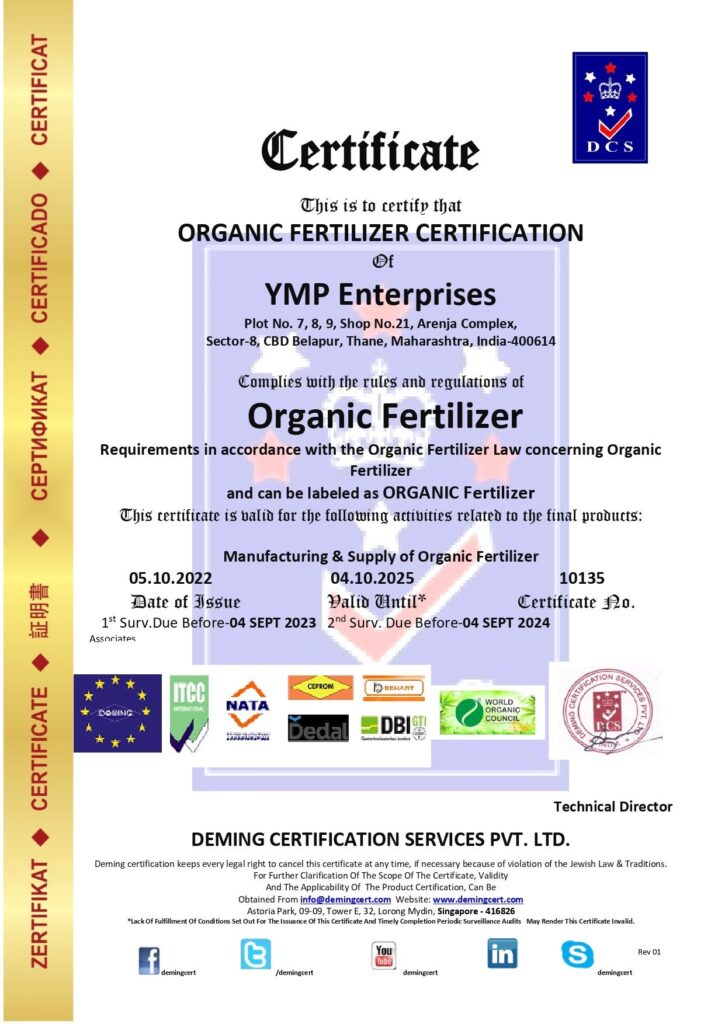
The company’s certification profile identifies Organic Fertilizer Certification as its scope of work and refers to requirements under the applicable Organic Fertilizer Law. This focus highlights the importance of conformity, product documentation, and correct labelling. The certificate was issued in 2022, with a stated validity date in 2025. Such certification-related milestones can form an important part of a company’s development story because they draw attention to the relationship between product claims, documented requirements, and customer confidence.
The decision to pursue certification can be understood as a commitment to making business processes more structured. Certification requirements often encourage organizations to examine their product descriptions, supplier information, inspection arrangements, storage practices, records, and customer communications. The exact obligations depend on the certification scheme and applicable law. Nevertheless, a disciplined approach to compliance can help a business identify weaknesses before they create larger commercial or regulatory problems.
For an enterprise working with organic fertilizers, quality begins before the product reaches the customer. Raw materials need to be suitable for their intended use. Suppliers need to be evaluated, and relevant documents need to be maintained. Storage conditions should protect product integrity, while packaging and labels should communicate accurate information. When these activities are managed systematically, the company is better positioned to reduce avoidable errors and respond to customer questions.
The broader agricultural market also creates opportunities for businesses that understand sustainability as a practical responsibility rather than simply a promotional phrase. Soil health, nutrient recycling, organic waste management, and responsible fertilizer use are interconnected issues. Organic fertilizers may contribute to soil improvement when appropriately produced and applied, but results depend on the material, soil conditions, crop requirements, and application methods. Honest communication about these factors helps customers make informed decisions.
YMP Enterprises can use its certification-related experience as a starting point for strengthening its business identity. This does not require making exaggerated promises about crop yields or environmental benefits. Instead, it involves developing reliable processes, providing accurate product information, listening to customers, and responding professionally to concerns. These habits can distinguish a responsible supplier in a competitive market.
The role of the promoter is important in this journey. Leadership establishes priorities, allocates resources, encourages employees or business partners to follow agreed procedures, and decides how the enterprise will respond to new opportunities. Although the supplied information does not identify the promoter by name or provide a personal career history, the company’s development can be explored through the leadership decisions that commonly support quality-focused businesses.
A clear vision can connect commercial success with customer satisfaction and regulatory responsibility. By focusing on dependable products, transparent documentation, responsible marketing, and continuous improvement, YMP Enterprises can develop a stronger foundation for future opportunities in the organic fertilizer sector.
The beginning of a growth journey is therefore not defined only by sales or the size of a business. It is also defined by the principles that guide daily decisions. For YMP Enterprises, organic fertilizer certification provides a useful theme through which to examine quality, trust, responsibility, and the possibilities for sustainable business development.
#YMPEnterprises
Chapter 2 – Understanding Organic Fertilizer Certification and Its Importance
The organic fertilizer sector operates at the intersection of agriculture, environmental responsibility, product quality, and regulatory compliance. For a business such as YMP Enterprises, understanding these areas is important because customers do not purchase agricultural inputs merely on the basis of price. They also want to know what a product contains, how it should be used, whether it is suitable for their requirements, and whether the supplier can provide reliable documentation. Organic fertilizer certification can support a more organized approach to answering these questions.
The certification information supplied for YMP Enterprises identifies a certificate issued in 2022 and a stated validity date in 2025. Its stated purpose relates to requirements under the Organic Fertilizer Law concerning organic fertilizer and whether the product can be labelled as organic fertilizer. This description places emphasis on conformity with the applicable requirements and the relationship between product characteristics and permitted claims. The precise legal obligations, assessment procedures, and authorized labelling rights depend on the relevant jurisdiction and certification scheme.
For businesses operating in this field, certification should be understood as a process that requires evidence. A company needs to establish which requirements apply to its product, what information must be collected, which tests or inspections may be necessary, and what documentation must be maintained. Depending on the product and the relevant scheme, these requirements may involve ingredient specifications, manufacturing or processing controls, contaminant limits, nutrient information, traceability, packaging, and labelling.
The value of a certification process lies partly in the discipline it can encourage. A company that systematically documents its activities is better placed to identify inconsistencies, investigate complaints, and respond to questions from customers or authorities. When records are incomplete, even a good product can become difficult to verify. By contrast, accurate and accessible documentation helps explain how a product was evaluated and which requirements it was assessed against.
For YMP Enterprises, certification can therefore be considered an opportunity to develop a more evidence-based approach to business operations. Instead of relying entirely on verbal assurances, the company can organize its relevant documents, product information, supplier records, and customer communications. These measures can support confidence among buyers who need to understand the nature of the products they purchase.
Organic fertilizer certification also needs to be distinguished from other forms of certification. A product certificate does not automatically establish that every activity of a business has been certified under ISO 9001 or another management-system standard. Similarly, certification for a particular product or regulatory requirement does not necessarily mean that the organization is authorized to make every possible environmental or agricultural claim. Each certificate has a defined scope, criteria, issuing body, and validity status.
This distinction is especially important when a company promotes its products online. Customers may interpret phrases such as “certified organic,” “safe for all crops,” or “environmentally friendly” as broad guarantees. Responsible communication requires that each claim be supported by appropriate evidence and remain within the certificate’s scope. Where a product has specific limitations or application instructions, those details should be communicated clearly.
A well-managed certification process can also encourage better coordination with suppliers. The company may need to establish what information suppliers must provide, how incoming materials are checked, and what happens when a delivery fails to meet specifications. Supplier approval, incoming inspection, and documented acceptance criteria can reduce uncertainty and make it easier to identify the source of a problem.
The same principles apply to storage and distribution. Fertilizer products may be affected by moisture, contamination, unsuitable packaging, improper handling, or excessive storage periods. The risks vary according to the material and product formulation. Appropriate storage conditions and stock-control procedures can help preserve product quality and reduce avoidable losses.
Customer service is another area where certification-related discipline can create value. If a farmer or distributor asks about composition, usage, packaging, or certification status, the business should be able to provide a consistent answer. When a complaint arises, the company should record the concern, investigate relevant batches or deliveries, and communicate the findings responsibly. A systematic process makes customer support less dependent on memory or individual employees.
Certification can also help a business prepare for commercial discussions. Some buyers may request certificates, test reports, specifications, or supplier declarations before considering a product. Having accurate documents readily available can make these discussions more efficient. However, certification alone does not guarantee contracts, higher prices, or increased market share. Commercial outcomes still depend on demand, product performance, pricing, service, and competition.
For YMP Enterprises, the central lesson is that certification should not be treated merely as a document displayed on a website or in an office. Its broader value comes from understanding the applicable requirements and translating them into practical controls. That means maintaining evidence, checking claims, training relevant personnel, and reviewing processes when requirements change.
The 2022–2025 dates also make current verification essential. Before presenting the certificate as active, the company should confirm whether it was renewed, replaced, or otherwise extended by the appropriate issuing authority. If it has not been renewed, the historical certificate may be described accurately as a certificate issued in 2022 with validity stated through 2025, without suggesting that it remains current.
Through these measures, certification can become part of a responsible business culture. For YMP Enterprises, the objective is not simply to claim that a product has been certified. It is to demonstrate a clear understanding of what the certification covers, what evidence supports the claim, and how the company intends to maintain quality and compliance over time.
#OrganicFertilizer
Chapter 3 – Building a Quality-Oriented Business Culture
A business grows more sustainably when quality becomes part of everyday work rather than a task performed only before an inspection. In the organic fertilizer sector, quality can influence product reliability, customer satisfaction, supplier relationships, distribution efficiency, and the reputation of a business. For YMP Enterprises, developing a quality-oriented culture offers a practical way to connect certification-related responsibilities with long-term commercial objectives.
Quality begins with clearly defined expectations. A business should know what constitutes an acceptable product, which documents must accompany it, how materials are identified, and which checks must be completed before delivery. Without defined expectations, employees and suppliers may use different assumptions when handling the same product. This can result in inconsistent packaging, incomplete records, incorrect labels, or delays in responding to customer requirements.
The company can address these risks by developing written procedures appropriate to its size and activities. These procedures need not be unnecessarily complicated. A small enterprise may begin with straightforward checklists for receiving materials, verifying supplier documents, inspecting packaging, recording stock movements, and releasing orders. As operations expand, the procedures can be reviewed and improved.
A quality culture also requires clear responsibilities. Someone should be accountable for maintaining product documents, checking labels, monitoring certificate validity, and responding to customer complaints. When responsibilities are not assigned, important tasks can be overlooked because each person assumes someone else will complete them. A simple responsibility matrix can help clarify who performs, checks, and approves each activity.
For the promoter or business leadership, the challenge is to balance commercial priorities with quality requirements. An urgent order may create pressure to dispatch products quickly, but speed should not replace necessary checks. A supplier may offer a lower price, but the business must consider whether the material meets the required specifications. A customer may request a promotional claim, but that claim should not be used unless it is adequately supported.
These decisions reveal the practical meaning of quality leadership. Management demonstrates its priorities through daily actions, resource allocation, and the way it responds to problems. If employees see that accurate records and responsible product handling are consistently valued, they are more likely to treat these activities as essential business responsibilities.
Employee awareness is another important element. Anyone involved in sales, purchasing, storage, documentation, or dispatch should understand the requirements relevant to their role. Sales personnel should know which product claims are permitted. Purchasing personnel should understand supplier documentation requirements. Staff handling inventory should know how products are identified and stored. Individuals responsible for certification records should understand how to check dates, scope, and issuing authority information.
Training can be practical and proportionate. Short sessions, written instructions, demonstrations, and periodic reviews may be sufficient for many routine tasks. The company can record the training provided and check whether employees understand the procedures. If repeated errors occur, management should investigate whether the cause is inadequate training, unclear instructions, poor equipment, excessive workload, or another process weakness.
A quality-oriented culture also encourages people to report problems early. If an employee notices damaged packaging, missing documents, a suspicious supplier declaration, or a discrepancy between a label and a product specification, the concern should be recorded and investigated. Staff should not feel compelled to conceal mistakes simply to avoid criticism. Early reporting can prevent a small issue from becoming a larger customer or compliance problem.
Documentation provides the evidence needed to understand what happened. Records of incoming materials, inspections, storage conditions where relevant, sales, deliveries, and complaints can help a business trace a problem to its source. The exact records needed depend on the product and applicable requirements, but the underlying principle is consistent: important decisions should be supported by reliable information.
The company can also use simple performance indicators to evaluate its quality processes. Examples include the percentage of orders dispatched on time, the number of customer complaints, the rate of packaging errors, the proportion of supplier documents received on time, and the time required to resolve a complaint. These indicators should be selected according to the company’s actual operations rather than adopted merely to produce impressive reports.
For instance, if a company notices an increase in complaints about damaged packaging, it can examine handling practices, packaging specifications, transport arrangements, and storage conditions. If dispatch delays increase, it can review stock availability, order planning, and document approval times. The purpose of measurement is to identify causes and improve performance, not simply to count failures.
The principles associated with ISO 9001 can provide a useful reference for organizations seeking to strengthen customer focus, process control, leadership, and continual improvement. However, the supplied information does not establish that YMP Enterprises held an ISO 9001 certificate. Its stated certification concerns organic fertilizer. Any reference to ISO 9001 in this story should therefore be understood as a possible management approach, not as a claim about the company’s certification status.
Ultimately, a quality-oriented business culture is built through repeated decisions. Clear procedures, responsible leadership, competent personnel, reliable records, and honest communication reinforce one another. For YMP Enterprises, these practices can help turn certification-related requirements into practical improvements that support customer confidence and prepare the enterprise for future business opportunities.
#OrganicFertilizerCertification
Chapter 4 – Product Quality, Supplier Management, and Customer Confidence
Product quality is one of the most important factors influencing the reputation of an organic fertilizer business. Customers expect the products they purchase to match their descriptions, arrive in suitable condition, and include enough information to support correct use. For YMP Enterprises, an effective approach to product quality can strengthen its business position by connecting supplier selection, product verification, storage, packaging, and customer service.
The quality of an organic fertilizer begins with its raw materials and processing methods. Depending on the product, the materials may include composted plant residues, animal-derived organic matter, or other permitted organic ingredients. Their characteristics can vary according to their source, treatment, moisture content, nutrient composition, and degree of decomposition. Consequently, a responsible supplier needs to understand the characteristics that matter for the product being offered.
Supplier management is an important starting point. Before accepting materials or purchasing finished products for distribution, the business can establish criteria for evaluating suppliers. These criteria may include product specifications, relevant test reports, traceability information, regulatory documentation, delivery reliability, and the supplier’s ability to respond to quality concerns. The requirements should reflect the actual product and applicable law.
A documented supplier evaluation process can reduce the risk of inconsistent materials entering the supply chain. For example, if a delivery arrives without required documents or differs from the agreed specification, the company should have a clear procedure for holding the material until the discrepancy is resolved. Accepting uncertain material simply to avoid a delay may create more serious problems later.
Product verification is equally important. Depending on applicable requirements, this may involve checking documents, inspecting packaging, verifying batch identification, reviewing laboratory results, or arranging appropriate testing. The company should not assume that every organic fertilizer requires the same testing regime. Instead, it should identify the specific legal and technical requirements applicable to each product.
Packaging and labelling are also central to product quality. Labels should accurately identify the product and include the information required by the applicable rules. Where relevant, this may include the product’s composition, net quantity, batch or lot number, manufacturer or supplier information, application guidance, storage instructions, and other mandatory declarations. Certification marks or claims should only be used where their use is authorized and the certificate supports the claim.
A clear label helps customers understand what they are buying. It also reduces the possibility of confusion between different product types. Organic fertilizer products can differ significantly in nutrient content and intended application. A product designed for one purpose should not be marketed as suitable for every crop or soil condition without supporting evidence.
Storage and transportation must protect the product after it has passed the required checks. Moisture, damaged packaging, contamination, inappropriate stacking, or unsuitable storage conditions may affect some products. The company can establish stock rotation, inspect stored goods, separate damaged products, and maintain clean storage areas. The appropriate controls will depend on the product’s characteristics.
Batch identification and traceability can provide further protection. If a customer reports a problem, the company should be able to identify the relevant delivery and, where applicable, trace it to the supplier or production batch. A traceability record may help determine whether the problem is isolated or affects other customers. It can also support a more informed decision about corrective action.
Customer confidence grows when a business communicates clearly and responds consistently. A customer who asks for product specifications should receive accurate information rather than vague promises. If a product’s characteristics are uncertain, the company should investigate before responding. If an error is confirmed, a timely explanation and appropriate corrective action can preserve trust more effectively than avoiding the issue.
Customer complaints should be treated as useful information. The company can record the nature of each complaint, the product concerned, the date, the investigation findings, and the action taken. Repeated complaints may reveal a larger problem with a supplier, packaging method, storage arrangement, or sales communication. Addressing the underlying cause is more effective than dealing with every complaint as an isolated incident.
YMP Enterprises can use these quality practices to build a reputation based on reliability rather than exaggerated claims. Certification-related documentation can support this objective when it is current, relevant, and accurately presented. However, certification cannot replace day-to-day product control. A certificate is only one part of a wider system of responsible business practices.
Over time, the combination of dependable products, accurate labelling, appropriate storage, traceable deliveries, and responsive service can help create stronger customer relationships. Such relationships may support repeat purchases and recommendations, although actual growth will depend on market conditions and the company’s performance.
The central lesson is that customer confidence must be earned through consistent conduct. For YMP Enterprises, product quality and supplier management can serve as practical foundations for a more resilient business, helping the enterprise respond to customer expectations while maintaining appropriate regulatory discipline.
#OrganicAgriculture
Chapter 5 – Marketing, Branding, and the Development of Market Opportunities
Marketing is essential for helping customers discover a business, understand its products, and decide whether those products meet their needs. In the organic fertilizer sector, effective marketing requires more than attractive packaging or persuasive slogans. It depends on accurate information, appropriate product claims, reliable service, and a clear understanding of the customers being served. YMP Enterprises can use these principles to develop a more professional market presence.
The first step in building a market strategy is identifying potential customer groups. Depending on the products the company actually supplies, these groups may include agricultural input dealers, farmers, nurseries, horticultural businesses, landscaping providers, agricultural distributors, and institutional buyers. Each group has different purchasing priorities. Farmers may focus on suitability for their crops and soil, while distributors may place greater emphasis on consistent supply, packaging, margins, and documentation.
Understanding these differences helps a business communicate more effectively. Rather than using one general message for every customer, YMP Enterprises can develop product information that answers the practical questions relevant to each group. Such information should explain the product’s characteristics, intended use, application guidance, storage requirements, and available supporting documentation.
A professional brand is built through consistency. The company name, contact details, product descriptions, invoices, quotations, labels, and website information should present a coherent business identity. Customers should not have to guess whether different documents refer to the same product or whether a certificate applies to the product being promoted.
Certification can form part of the company’s marketing communication, but it must be handled carefully. The supplied certificate information identifies a 2022 issue date and a stated validity date in 2025. Before using it in current promotional materials, the company should verify its present status with the relevant issuing body. If the certificate has expired and has not been renewed, marketing should not suggest that it is currently valid.
Similarly, the company should avoid claiming that certification guarantees superior crop yields, eliminates all environmental impacts, or makes every application risk-free. Organic fertilizer performance depends on several factors, including product composition, soil conditions, crop requirements, weather, and application methods. Credible marketing acknowledges these realities and encourages customers to follow suitable guidance.
Digital marketing can help a business reach potential customers beyond its immediate commercial area. A website can provide product descriptions, technical documents, contact details, frequently asked questions, and information about the company’s quality commitments. Search-engine optimization can help interested customers discover relevant pages, while informative articles can answer common questions about organic fertilizers and responsible nutrient management.
The most useful online content is specific and informative. For example, an article could explain the difference between organic fertilizer and other soil amendments, discuss the importance of correct storage, or describe the information customers should look for on a fertilizer label. Such material can build awareness without relying on unsupported product claims.
Social media may also help the company communicate with distributors, agricultural businesses, and prospective customers. Educational posts, product information, demonstrations where appropriate, and responses to customer questions can improve visibility. The company should ensure that photographs, testimonials, performance claims, and certification references are genuine and used with appropriate permission.
Offline marketing remains relevant as well. Business meetings, distributor relationships, agricultural exhibitions, industry events, and direct customer discussions may help the company understand market needs. Personal communication allows customers to ask detailed questions and gives the business an opportunity to explain its products and documentation clearly.
A useful marketing strategy should include a method for evaluating results. YMP Enterprises could track enquiries received, quotations issued, conversion rates, repeat purchases, customer feedback, and the cost of acquiring new customers. These indicators can help management identify which activities generate meaningful business opportunities.
For example, if a particular educational article generates enquiries from agricultural retailers, the company can investigate whether those enquiries lead to suitable commercial relationships. If an advertising campaign attracts many visitors but few qualified enquiries, the business may need to revise its audience, message, or landing page.
Market expansion should be planned carefully. Entering a new geographical area may require different distribution arrangements, additional working capital, revised logistics, or compliance checks. Before making substantial commitments, the company should evaluate demand, competition, expected costs, customer payment practices, and the ability to provide reliable service.
Pricing is another important consideration. A business must understand its purchase costs, transportation expenses, packaging costs, overheads, and expected margins. Offering the lowest price may attract attention but can become unsustainable if it leaves insufficient resources for quality control and customer support. Transparent quotations and clear commercial terms can help prevent disputes.
For YMP Enterprises, the most sustainable marketing opportunity lies in connecting professional communication with dependable business practices. A clear brand, informative product descriptions, accurate certification claims, suitable distribution, and consistent customer service can reinforce one another.
Growth cannot be guaranteed through marketing alone. Nevertheless, when marketing is based on genuine product information and supported by reliable operations, it can help a business build awareness, develop commercial relationships, and identify opportunities for future expansion.
#SoilHealth
Chapter 6 – Leadership, Financial Discipline, and Operational Development
Business growth depends not only on market demand but also on the quality of management decisions. A company may attract new customers and receive more enquiries, yet still experience difficulties if its costs are poorly controlled, inventory is unreliable, or customer payments arrive later than expected. For YMP Enterprises, leadership and financial discipline are important themes in understanding how an organic fertilizer business can develop responsibly.
The promoter or business leadership establishes the direction of the enterprise. This includes decisions about the products to offer, suppliers to work with, customers to serve, resources to invest, and standards to maintain. Since the promoter’s name and personal history have not been provided, this chapter focuses on the leadership practices that can support the company’s development without attributing unverified achievements to a particular individual.
A clear business plan can provide a starting point. It should identify the company’s current activities, intended customer groups, available resources, principal risks, and development priorities. Rather than relying on ambitious sales targets alone, the plan should connect growth objectives with the company’s ability to supply suitable products and maintain appropriate controls.
Financial planning is especially important in trading and distribution businesses. Money may be committed to purchasing inventory before customers pay their invoices. Transportation, packaging, storage, staff, administration, and marketing can create additional expenses. If these costs are not monitored, higher sales may increase pressure on working capital rather than improve profitability.
A basic financial management system should record sales, purchases, expenses, outstanding receivables, payables, inventory values, and cash movements. Management can review these records regularly to understand the business’s financial position. Where necessary, a qualified accountant can assist with financial reporting, tax obligations, and compliance.
Budgeting helps the company plan for both expected and unexpected costs. A budget may cover purchasing, logistics, marketing, staffing, testing, documentation, and equipment. Actual expenditure can then be compared with the budget. Significant differences should be investigated so that management can determine whether the original assumptions were incorrect or spending needs to be adjusted.
Inventory management also influences profitability. Excess inventory may tie up funds and create storage challenges, while insufficient stock may cause missed orders and dissatisfied customers. The appropriate balance depends on demand patterns, supplier lead times, product shelf life where relevant, and storage capacity. Maintaining reliable stock records can help the company make better purchasing decisions.
Customer credit requires careful attention. Offering credit may help attract commercial buyers, but overdue payments can restrict the company’s ability to pay suppliers or finance new orders. Written payment terms, appropriate customer assessments, invoice tracking, and timely follow-up can reduce avoidable financial pressure.
Supplier negotiations are another area where management can create value. The lowest purchase price is not always the best commercial option. Reliability, product consistency, delivery times, documentation, packaging, and the handling of complaints should also be considered. A supplier that offers dependable service may help the business reduce hidden costs caused by delays or quality problems.
Operational planning should be connected to demand. Before expanding storage, hiring additional personnel, or entering a new market, the company should evaluate whether the expected benefits justify the costs. Small, measured improvements may be more appropriate than large investments based on uncertain demand.
Leadership must also allocate time and resources to compliance. Certificate renewal checks, product documentation, label reviews, and regulatory monitoring can be overlooked when management focuses exclusively on sales. Establishing a calendar of compliance-related activities helps ensure that these responsibilities receive attention.
Risk management supports this approach. Potential risks may include supplier disruption, changes in applicable rules, product complaints, transport damage, cash-flow shortages, inaccurate promotional claims, and the loss of important customers. Management can assess the likelihood and potential consequences of each risk and decide what controls are appropriate.
Business continuity planning is useful as well. If a supplier becomes unavailable or a delivery is delayed, the company should understand which alternatives are acceptable and how customers will be informed. Alternative suppliers must still meet the relevant requirements; continuity should not become a reason to bypass quality checks.
Performance reviews can bring these activities together. Management can examine financial indicators, customer feedback, supplier performance, stock discrepancies, delivery reliability, and outstanding corrective actions. These reviews should lead to practical decisions, such as changing a purchasing process or improving customer communication.
For YMP Enterprises, leadership development means combining commercial ambition with disciplined execution. Financial records, careful purchasing, appropriate inventory, risk assessment, and compliance monitoring can create a stronger operational foundation.
The long-term objective is not growth at any cost. It is the development of a business that can serve customers reliably, meet its obligations, respond to change, and make informed decisions about future opportunities.
#SustainableAgriculture
Chapter 7 – Customer Relationships, Distribution, and Long-Term Business Development
Customer relationships are among the most valuable resources a business can develop. Products may be available from several suppliers, and customers may compare prices before placing an order. However, dependable service, accurate information, professional communication, and consistent follow-up can influence whether a customer chooses to work with the same supplier again. For YMP Enterprises, strong customer relationships can provide a foundation for sustainable development in the organic fertilizer market.
The first requirement is understanding what customers actually need. A farmer, agricultural retailer, nursery operator, and bulk distributor may all purchase organic fertilizers, but their expectations can differ. A farmer may need clear application guidance and information about product suitability. A retailer may want manageable packaging, reliable replenishment, and product literature. A distributor may focus on supply capacity, commercial terms, documentation, and delivery schedules.
Listening to customers helps a company avoid assumptions. Sales discussions can be used to understand the products customers require, the quantities they purchase, the problems they encounter, and the information they need before making a decision. These discussions can be recorded and reviewed to identify common requirements.
YMP Enterprises can develop a structured approach to customer communication. Enquiries should receive timely responses, quotations should contain clear terms, and delivery commitments should reflect actual availability. If a delay occurs, the customer should be informed as early as reasonably possible. Honest communication can help preserve a relationship even when circumstances prevent the company from meeting its original schedule.
Customer education is particularly important for organic fertilizer products. Customers need to understand that different fertilizers have different compositions and intended uses. Organic origin alone does not mean that every product has identical nutrient content or will produce the same results in every field. Soil characteristics, crop requirements, weather, application rates, and farming practices influence outcomes.
Providing accurate product information can therefore help customers make better decisions. Where appropriate, the company can supply product specifications, instructions, relevant test reports, and storage guidance. Recommendations involving crop performance should be supported by suitable technical evidence, and customers should be encouraged to consult qualified agricultural professionals when necessary.
Distribution arrangements influence the customer experience as well. A reliable distribution process connects purchasing, inventory management, order preparation, transportation, and delivery confirmation. If these activities are poorly coordinated, the company may experience missed delivery dates, damaged packaging, incorrect quantities, or unnecessary transportation costs.
A documented order process can help prevent such problems. Orders should be checked against available stock, product identification should be verified, and required documents should be prepared before dispatch. Delivery records can confirm what was supplied and help resolve later disagreements.
The company may also explore distribution partnerships where commercially appropriate. Agricultural retailers or regional distributors could help make products accessible to customers in locations that are difficult to serve directly. Such arrangements require clear expectations regarding product storage, handling, promotional claims, payment terms, and responsibility for customer complaints.
Before appointing a distributor, management should consider the partner’s market knowledge, financial reliability, distribution capacity, and ability to communicate accurate product information. Written agreements can clarify responsibilities and reduce misunderstandings.
Customer retention deserves the same attention as new customer acquisition. A business can maintain a simple record of enquiries, quotations, orders, feedback, and follow-up activities. This information can help the company understand purchasing patterns and identify customers who may need updated product information or assistance with future orders.
However, customer information should be handled responsibly. Contact details and commercial records should be collected and used for legitimate business purposes, protected from unauthorized access, and managed in accordance with applicable privacy requirements.
Complaints provide another opportunity to strengthen relationships. If a customer reports a problem, the company should acknowledge the concern, gather relevant information, investigate the product or delivery involved, and explain the next steps. If the issue results from a company error, suitable corrective action should follow. If the available evidence does not establish the cause, the company should communicate that uncertainty honestly.
A customer complaint should not automatically be interpreted as evidence that a product is defective. Investigation may reveal a packaging issue, a misunderstanding about application, transport damage, a documentation discrepancy, or another cause. The objective is to identify the facts and take appropriate action.
Customer satisfaction can be assessed through short feedback requests, repeat-order patterns, complaint records, and discussions with distributors. These methods can reveal recurring problems that may otherwise remain unnoticed.
The company should also maintain realistic expectations about expansion. Entering new markets may require more inventory, additional distribution partners, different documentation, and stronger customer support. Growth should proceed at a pace consistent with the company’s resources and compliance responsibilities.
For YMP Enterprises, the long-term value of customer relationships comes from reliability rather than promises alone. When the business understands customer needs, provides accurate information, delivers as agreed, and responds constructively to problems, it creates conditions that can support repeat business.
Although these practices do not guarantee commercial success, they can help establish a professional reputation. Over time, a customer-focused distribution model may enable the company to identify new opportunities, improve service, and develop stronger relationships throughout the organic fertilizer supply chain.
#FertilizerQuality
Chapter 8 – Environmental Responsibility and the Future of Organic Agriculture
Environmental responsibility is an increasingly important consideration in discussions about agriculture, soil management, and fertilizer use. Organic fertilizers are often associated with nutrient recycling and the use of organic materials, but their benefits depend on how they are produced, evaluated, transported, stored, and applied. For YMP Enterprises, understanding these relationships can support responsible product communication and a clearer long-term business strategy.
Healthy soil is a valuable agricultural resource. It supports plant growth, stores and moves water, provides habitats for soil organisms, and participates in important nutrient cycles. Repeated nutrient removal through crop harvesting must be managed through appropriate nutrient replacement and soil management practices. Fertilizers are one part of this wider system.
Organic fertilizers can contribute organic matter and nutrients to soil, depending on their composition. Some products release nutrients gradually, while others have different release characteristics. The quantity of available nutrients varies between materials and products. Consequently, farmers should not assume that all organic fertilizers provide the same benefits or can replace every other nutrient source under all circumstances.
Responsible application begins with understanding the crop’s needs and the condition of the soil. Soil testing, suitable agronomic advice, and accurate product information can help determine appropriate application rates. Excessive application can cause nutrient losses and environmental problems, while inadequate application may fail to meet crop requirements.
Water quality is another important consideration. Nutrients can move from agricultural land into waterways through runoff or leaching. The risk depends on factors such as the material used, application rate, rainfall, irrigation, soil characteristics, and the timing of application. Good agricultural practices can help reduce these risks.
Organic origin should not be confused with an automatic guarantee of safety. Materials may require appropriate processing, maturity checks, contaminant controls, and compliance with relevant legal requirements. Depending on the material and its intended use, concerns may include pathogens, heavy metals, physical contaminants, or other undesirable substances. Suitable verification helps establish whether a product meets the requirements applicable to it.
A responsible fertilizer business should therefore communicate carefully about environmental benefits. It should not claim that a product has zero environmental impact unless such a claim can be substantiated under an appropriate assessment. Nor should it guarantee higher yields without reliable evidence relevant to the product and conditions of use.
YMP Enterprises can support environmental responsibility through its own business practices. Depending on its actual activities, these may include reducing packaging waste, maintaining orderly storage, avoiding preventable product losses, improving transport planning, and communicating appropriate handling instructions. If the company manufactures or processes products, additional controls may be needed for waste management, emissions, water use, and workplace safety.
If the company primarily distributes finished products, it can still influence the supply chain through supplier selection and customer education. Purchasing from suppliers who provide reliable documentation and meet applicable requirements can help reduce uncertainty. Accurate storage and transport practices can protect products and prevent avoidable disposal.
The principles of resource efficiency can also be applied to business administration. Electronic records, carefully planned deliveries, accurate stock management, and consolidated shipments where practical may reduce waste and improve efficiency. Any environmental benefit should be described proportionately rather than overstated.
The future of organic agriculture will also be influenced by changing customer expectations, agricultural technology, scientific research, and regulatory developments. Farmers may increasingly seek better information about nutrient composition, soil suitability, traceability, and the environmental implications of agricultural inputs. Businesses that can provide clear, evidence-based information may be better positioned to respond.
Digital tools can support this transition. Product databases, electronic batch records, inventory systems, and online documentation can make relevant information easier to maintain and retrieve. The appropriate level of technology depends on the company’s size, budget, and operational complexity.
Partnerships with agricultural experts may also help a business improve its technical understanding. Where appropriate, discussions with qualified agronomists, laboratories, research organizations, or agricultural institutions can provide useful insight into product requirements and customer needs. Such partnerships should be genuine and should not be presented as formal endorsements unless authorization exists.
Regulatory awareness is equally important. Requirements concerning organic fertilizers, product composition, labelling, environmental claims, and distribution may change over time. The company should identify the rules that apply to its products and markets and establish a process for monitoring relevant changes.
The historical certificate information supplied for YMP Enterprises provides a useful reminder that compliance status needs regular attention. A certificate issued in 2022 with a stated validity date in 2025 should not be represented as currently active without verification. Maintaining accurate records is part of environmental and commercial responsibility because customers need to know what has actually been established.
Ultimately, sustainability is not a single label or marketing statement. It involves informed decisions throughout the product lifecycle. For YMP Enterprises, a responsible approach to organic fertilizer can combine product conformity, accurate information, careful resource use, and a willingness to improve.
By treating environmental responsibility as an ongoing business practice, the company can build a more credible relationship with customers and prepare for a market in which product quality and transparent claims remain essential.
#AgriculturalBusiness
Chapter 9 – Challenges, Continuous Improvement, and Business Resilience
Every business faces challenges as markets change and customer expectations develop. Competition, supplier interruptions, price fluctuations, regulatory changes, transport problems, and delayed payments can affect performance. For an enterprise involved in organic fertilizers, product documentation and customer confidence add further responsibilities. YMP Enterprises can approach these challenges by developing a structured method for identifying risks, learning from problems, and improving its operations.
One potential challenge is competition. Customers may compare several suppliers offering products that appear similar. A company that competes only on price can find it difficult to maintain adequate margins while meeting its quality and service commitments. Differentiation may instead come from reliable documentation, suitable packaging, clear communication, dependable deliveries, and responsive customer support.
Another challenge is variation in supply. Organic materials may differ in their characteristics, and finished products may depend on the consistency of upstream suppliers. Changes in raw materials, processing methods, or packaging can create uncertainty if the company does not receive appropriate information. Supplier controls and product verification can help identify these issues before products reach customers.
Regulatory compliance requires continued attention as well. A business must understand which requirements apply to its products, labels, and commercial activities. A procedure that was suitable in the past may need revision when rules change or a product’s composition changes. Regular reviews can help management identify such developments.
Certification management should be treated as a specific responsibility. The company should maintain a register of relevant certificates, their scope, issuing bodies, issue dates, validity dates, and renewal requirements. The responsible person should verify any renewal or status change before using the certificate in current promotional material.
For YMP Enterprises, the supplied certificate record indicates an issue date in 2022 and a stated validity date in 2025. This date should be treated as historical information unless the issuing body confirms an extension, renewal, or replacement. Accurate status verification is a practical example of risk management because an outdated claim could damage customer confidence or create compliance concerns.
Financial pressures can also become more serious when sales grow quickly. A company may need to purchase inventory before receiving payment from customers. If too much capital is tied up in stock or overdue receivables, it may struggle to meet routine obligations. Cash-flow forecasts, credit controls, inventory reviews, and timely invoicing can help management monitor these risks.
Operational risks should be examined systematically. Damaged packaging, incorrect labels, incomplete records, stock discrepancies, and missed deliveries may arise from different causes. Simply telling employees to be more careful may not solve the underlying problem. Management should investigate whether procedures, training, equipment, workload, or supplier performance need to change.
A practical improvement process begins by defining the problem clearly. The company then gathers relevant evidence, identifies possible causes, selects corrective actions, and checks whether those actions have worked. For example, if incorrect labels are repeatedly discovered before dispatch, management could examine label approval, document version control, and order preparation procedures.
Corrective action should address the cause rather than merely the immediate error. Replacing a damaged package may resolve one customer’s complaint, but a recurring packaging failure may require changes to storage, handling, transport, or packaging specifications.
The company can prioritize improvements according to their importance. Issues involving legal compliance, product conformity, customer safety, or misleading claims may require immediate attention. Less critical administrative improvements can be scheduled according to available resources.
Business resilience also depends on preparation for unexpected events. If a major supplier cannot deliver, the company should have a process for evaluating alternatives. If transport is disrupted, it should understand which customers are affected and how to communicate revised schedules. If important records become unavailable, secure backups may help preserve essential information.
Employees and business partners can contribute to resilience by sharing observations. Staff who handle orders every day may notice recurring inefficiencies that management cannot easily see. Encouraging practical suggestions can help identify improvements that require little investment.
The company should also recognize the limits of its own expertise. Technical questions about fertilizer composition, agricultural suitability, or laboratory results may require qualified professionals. Seeking appropriate advice is preferable to making unsupported statements merely to satisfy a customer quickly.
Continuous improvement should be measured through meaningful indicators. These may include complaint frequency, delivery performance, document errors, supplier reliability, inventory accuracy, and the completion of corrective actions. The company should choose indicators that reflect its real activities and review them consistently.
Improvement does not require every process to be changed at once. A business can begin with a small number of important priorities, test practical solutions, and expand successful changes. This approach helps avoid unnecessary complexity while maintaining attention to results.
For YMP Enterprises, resilience means being prepared to respond to problems without abandoning quality or compliance. Strong documentation, careful financial management, reliable suppliers, trained personnel, and honest customer communication can help the business manage uncertainty.
A successful enterprise is not one that never encounters difficulties. It is one that recognizes problems, learns from evidence, corrects weaknesses, and adapts responsibly. By making continuous improvement part of its management approach, YMP Enterprises can create a stronger foundation for future development.
#QualityAssurance
Chapter 10 – The Road Ahead: Growth, Innovation, and a Sustainable Business Future
The future of YMP Enterprises depends on how effectively it connects customer expectations, product quality, regulatory compliance, and business development. The organic fertilizer sector offers opportunities for enterprises that understand agricultural needs and can provide dependable products with accurate documentation. However, these opportunities must be evaluated carefully. Sustainable growth requires planning, consistent performance, responsible marketing, and the ability to respond to changing market conditions.
For YMP Enterprises, the certification-related milestone recorded in 2022 provides an opportunity to reflect on the importance of conformity and product credibility. The supplied certificate concerned organic fertilizer requirements and the eligibility to label a product as organic fertilizer under the applicable requirements. Its stated validity date was 2025. Looking ahead, the company should establish its current certification status and ensure that all future claims are supported by appropriate and up-to-date evidence.
Renewal or reassessment, where applicable, should be approached as part of an ongoing compliance process rather than a last-minute administrative task. The company can maintain a calendar for certificate reviews, document updates, regulatory checks, and other relevant obligations. Assigning clear responsibility for these activities can reduce the likelihood of missed deadlines or outdated information appearing in promotional materials.
An important future priority is the development of a strong product-information system. Customers increasingly expect clear answers about the products they purchase. A well-organized system can help the business maintain specifications, supplier documents, batch information where applicable, product labels, relevant test reports, and instructions for use. Keeping these records organized can also make customer service more efficient.
Digital transformation can support this objective. Even a relatively small enterprise can benefit from a structured electronic filing system, an inventory spreadsheet, a customer enquiry register, and reminders for important compliance dates. As the business grows, it may consider more advanced inventory or customer-management software. Technology should be selected according to genuine operational needs rather than purchased simply because it is available.
Another potential opportunity is to develop more informative digital content. Customers researching organic fertilizers may have questions about product characteristics, nutrient availability, application methods, storage, and differences between various soil amendments. Educational material can help the company establish a professional online presence while encouraging customers to make informed decisions.
All published content should distinguish general agricultural information from claims about a particular product. If the company states that a product meets a technical requirement, the statement should be supported by the relevant documentation. If it publishes a customer testimonial or performance result, the information should be genuine and presented with suitable context.
Market development should follow a similar evidence-based approach. Before entering a new region or increasing distribution, management should assess demand, competition, logistics, customer payment practices, regulatory requirements, and the company’s capacity to provide reliable service. A limited pilot with a suitable distribution partner may help evaluate a new opportunity before a larger investment is made.
Partnerships could also support future development. Depending on the company’s business model, suitable relationships may include agricultural retailers, distributors, laboratories, technical consultants, or organizations involved in agricultural education. These relationships can provide access to expertise and help the company understand customer requirements. Any claims about endorsements, partnerships, or technical validation should accurately reflect the actual relationship.
Product development and portfolio expansion require particular care. Adding new organic fertilizer products may create commercial opportunities, but each product should be evaluated against its own technical, regulatory, storage, and labelling requirements. The company should not assume that documentation for one product automatically applies to another. A controlled process for reviewing new products can help avoid preventable errors.
Customer service will remain an important part of the business’s future. The company can establish clear channels for enquiries, provide timely quotations, communicate delivery schedules, and maintain a consistent process for handling complaints. These practices can help customers understand what to expect and give the business useful feedback about its performance.
The future will also require financial discipline. Growth should be supported by realistic sales forecasts, adequate working capital, appropriate inventory levels, and a clear understanding of costs. The company should assess whether additional investments are likely to create sufficient value and avoid taking on commitments that exceed its financial capacity.
Environmental responsibility can remain an important business principle. Where appropriate, YMP Enterprises can focus on reducing avoidable waste, improving storage practices, maintaining product integrity, and supporting the responsible use of organic fertilizers. Environmental claims should be specific, proportionate, and evidence-based. Such an approach can help the company communicate its values without overstating the benefits of its products.
Leadership will play a central role in bringing these priorities together. A clear management direction can help employees understand why accurate records, suitable product handling, regulatory compliance, and customer satisfaction matter. Regular reviews can identify what is working, what needs attention, and where investment may be justified.
The company’s growth story should ultimately be judged by evidence rather than promotional language. Useful indicators may include customer retention, delivery reliability, complaint resolution, inventory accuracy, supplier performance, and financial sustainability. Improvements in these areas can demonstrate practical progress more meaningfully than unsupported claims about expansion or market leadership.
The broader lesson from YMP Enterprises’ organic fertilizer certification journey is that a certificate and a business strategy serve different but related purposes. Certification provides evidence concerning defined requirements within its scope. A business strategy determines how the organization serves customers, manages resources, addresses risks, and develops its market presence. Neither replaces the need for reliable daily operations.
YMP Enterprises can build on the principles highlighted throughout this story: customer focus, transparent communication, responsible product handling, accurate documentation, financial discipline, and continual improvement. By combining these principles with appropriate technical knowledge and careful market planning, the enterprise can work toward a stronger and more resilient business model.
The road ahead is not defined by a single certificate, a particular year, or one commercial milestone. It is defined by the willingness to maintain standards, learn from experience, and respond to customer needs with professionalism. For a business associated with organic fertilizers, these qualities can help connect commercial development with responsible agricultural practices.
In conclusion, YMP Enterprises’ certification-related history provides a useful starting point for discussing the relationship between product conformity and business development. The next stage should focus on verifying current compliance status, maintaining credible product information, strengthening operational controls, and pursuing realistic commercial opportunities. With these priorities in place, the company can work toward earning customer confidence and establishing a sustainable position in the organic fertilizer market.
#GreenAgriculture
#EcoFriendlyFarming #OrganicSoilCare #AgriculturalInnovation #ResponsibleFertilizerUse #SustainableBusinessGrowth
Take the Next Step Today
Don’t wait to enhance your business’s quality and efficiency. Partner with Hot Aaj News and experience the transformation that comes with expert consultancy and training. Contact us today to learn more about how we can help you achieve your business goals. Reach out via phone at +91-9322728183, visit our website at hotaaj.com, or email us at info@hotaaj.com Let us be your guide on the journey to excellence and innovation.