










Table of Contents
Chapter 1 – The Foundation of Workplace Excellence at Jamalpur Locomotive Workshop
The Eastern Railway Locomotive Workshop at Jamalpur, located in the Munger district of Bihar, represents a railway engineering environment in which technical skill, equipment reliability, maintenance discipline, and coordinated teamwork are essential. Railway workshops perform specialized activities involving the manufacture, repair, inspection, and overhaul of rolling stock, machinery, assemblies, and supporting equipment. Every activity requires an organized workplace where employees can work safely, identify the right components, use appropriate tools, and follow established procedures.
The Five-S Workplace Management System provides a practical framework for improving these everyday working conditions. Its importance becomes particularly clear in a large workshop containing several specialized sections, including the Wheel Shop, CTRB Section, Traction Machine Shop, Tool and Template Shop, Diesel POH Shop, MCTR Shop, CASNUB Bogie Shop, Wagon Component Shops, Crane Organization, and Diesel Component Shop. (https://en.wikipedia.org/wiki/5S_(methodology))
Each section has different technical responsibilities. Some work with heavy wheelsets and bogies, while others handle traction equipment, bearings, diesel locomotive components, air-brake assemblies, precision tools, and lifting equipment. Although their processes differ, they share a common requirement: the right material, tool, document, and equipment must be available at the right place and time.
The workplace organization principles associated with Five-S help create this foundation. Instead of allowing tools, materials, and unused components to accumulate without clear control, employees can classify items according to their purpose and frequency of use. Frequently used tools can be placed within convenient reach, while specialized equipment can be stored in identified locations. Unserviceable items can be segregated for inspection or disposal according to authorized procedures.
This approach is especially useful in railway workshops because components may look similar while having different technical requirements. Proper identification, segregation, and traceability help reduce the possibility of selecting the wrong part or mixing components from different jobs.
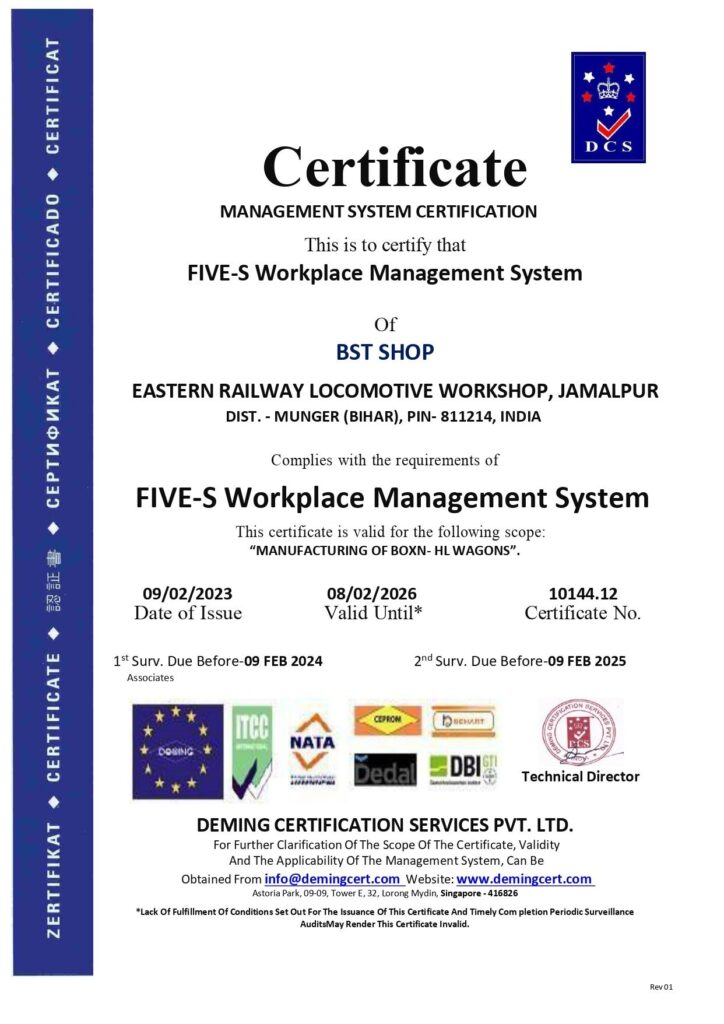
The year 2023 marks the stated issue year of the Five-S Workplace Management System Certificate for the client described in this case study. The stated validity extends to 2026. Within this period, the certification can serve as a framework for encouraging consistent workplace practices, reviewing housekeeping arrangements, improving visual management, and strengthening employee participation.
Certification, however, does not automatically guarantee improved productivity or safety. Its real value depends on how effectively the principles are implemented, monitored, and maintained during daily operations.
For the workshop, the first step in building a stronger Five-S culture would be to establish a clear picture of existing working conditions. A workplace assessment can examine tool storage, material movement, equipment accessibility, floor cleanliness, scrap segregation, identification boards, maintenance records, and the condition of workstations. The purpose is not to criticize employees but to identify obstacles that make their work unnecessarily difficult.
For example, a technician preparing a wheelset for overhaul should not have to search through several storage areas for commonly required tools. A worker inspecting a bearing should be able to distinguish accepted, rejected, and awaiting-inspection components. Similarly, a team repairing railway equipment should have access to the correct drawings, instructions, and inspection records.
These improvements begin with small, practical decisions. Marking storage spaces, identifying racks, arranging tools according to use, and removing unnecessary obstructions may appear simple. However, when applied consistently across multiple departments, such measures can make work more systematic and easier to supervise.
Another important foundation is employee involvement. The people who perform a task every day often understand its practical difficulties better than anyone else. Their suggestions can help determine where tools should be kept, how components should be identified, and which arrangements create unnecessary movement.
Supervisors can encourage this participation through short workplace discussions, inspection routines, and improvement suggestions. When employees understand why an arrangement is being introduced, they are more likely to maintain it.
The Five-S system also supports a shared sense of responsibility. Cleanliness, organization, and discipline should not be considered the responsibility of housekeeping staff alone. Every employee can contribute by returning tools after use, keeping materials in designated locations, reporting damaged equipment, and maintaining the cleanliness of the assigned workstation.
Over time, these habits can help create a more dependable working environment. The purpose is not simply to make the workshop look attractive. It is to establish conditions that support reliable engineering work, effective inspection, controlled material handling, and better use of available resources.
The growth journey associated with Five-S at Jamalpur can therefore begin with a straightforward principle: an organized workplace supports organized work. By connecting workplace discipline with the technical responsibilities of each shop, the system can help establish a strong foundation for quality, efficiency, safety awareness, and continuous improvement.
#FiveSWorkplaceManagement
Chapter 2 – The Five-S Certification Journey and the Role of Leadership
A workplace management system becomes effective when its principles are understood by leadership, supervisors, technicians, maintenance personnel, inspectors, and supporting employees. At a railway workshop with numerous specialized operations, leadership has an important role in translating the Five-S philosophy into practical working arrangements.
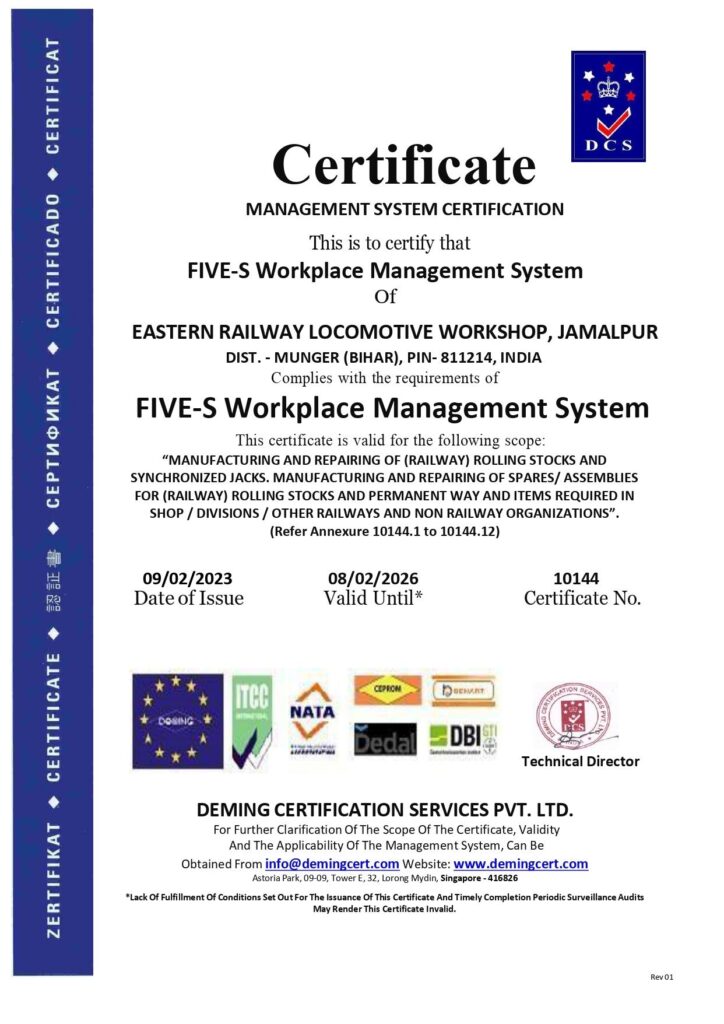
The Five-S Workplace Management System Certificate, issued in 2023 according to the supplied details, provides the central theme for examining this journey. Rather than treating certification as a final achievement, the organization can use it as a reference point for developing a consistent workplace management culture.
The first responsibility of leadership is to establish clear expectations. Employees need to understand what an organized workplace means in their particular department. The requirements of a Wheel Shop may differ from those of a Tool and Template Shop, but the underlying principles should remain consistent.
In the Wheel Shop, the emphasis may include designated component areas, clear movement routes, appropriate storage arrangements, and identification of materials awaiting inspection. In the Tool and Template Shop, attention may focus on the identification, preservation, and accessibility of tools, templates, and measuring instruments. In the Diesel POH Shop, an organized layout may help separate components at different stages of locomotive overhaul.
These examples demonstrate why a single generic housekeeping instruction may not be sufficient. The workshop can establish common Five-S principles while allowing each department to define practical controls suited to its operations.
Leadership can begin by assigning responsibilities for individual areas. A designated supervisor or team may coordinate workplace inspections, while employees remain responsible for maintaining their own workstations. This arrangement helps prevent the mistaken belief that Five-S is a separate activity performed only before an inspection or external assessment.
The next step is to define standards that employees can understand easily. Written instructions are useful, but visual controls can make expectations clearer. Labels, floor markings, equipment identification boards, storage outlines, and status indicators can help employees recognize where items belong and whether an area is in its expected condition.
Visual controls should be designed carefully. Markings must not obstruct railway movements, create trip hazards, interfere with emergency access, or conflict with applicable engineering and safety requirements. Their placement and meaning should be approved through the workshop’s established procedures.
Leadership also needs to ensure that necessary resources are available. A department cannot reasonably maintain an effective storage system if there is insufficient space, damaged shelving, inadequate identification, or no defined arrangement for obsolete materials. Five-S implementation should therefore include the correction of underlying problems wherever feasible.
The system can also encourage managers to review how work areas are used. Unnecessary storage, poorly positioned tools, and unclear component flows may contribute to wasted movement. Examining these conditions helps identify opportunities to improve the layout without assuming that every difficulty can be solved through housekeeping alone.
Another important responsibility is communication. Employees should receive clear explanations of the purpose of Five-S and how the system relates to their actual duties. Training can cover the five principles, local workstation standards, safe material handling, segregation of components, visual identification, and reporting of abnormal conditions.
Training should be practical rather than limited to classroom explanations. A supervisor might demonstrate how to arrange a workstation, identify a component awaiting inspection, or complete a workplace checklist. Employees can then apply the method in their own work areas.
Leadership should also establish a fair approach to evaluating performance. The purpose of inspections is to identify opportunities for improvement, not merely to find faults. When a problem is discovered, the review should consider whether the cause is inadequate training, insufficient storage, unclear responsibility, poor equipment condition, or failure to follow an established procedure.
This approach encourages employees to report difficulties openly. If workers fear blame for raising concerns, problems may remain hidden until they interfere with work. A supportive improvement culture makes it easier to identify and address such issues.
The certification journey also provides an opportunity to establish a review cycle. Departments can assess their workplaces regularly, record observations, assign corrective actions, and verify whether those actions have been completed. Repeated problems should be examined to determine whether a permanent change is needed.
Leadership can review trends such as unresolved housekeeping findings, misplaced tools, overdue corrective actions, and repeated storage difficulties. These indicators help reveal whether the system is becoming part of daily work or remaining a paper-based exercise.
For the Five-S system to contribute to organizational growth, managers must connect it with wider operational objectives. Better organization can support the availability of tools, improve access to work instructions, reduce avoidable searching, and make abnormal conditions easier to notice. These benefits can strengthen existing quality and maintenance practices.
The most important leadership lesson is that workplace excellence cannot be achieved through instructions alone. It requires visible commitment, practical resources, consistent follow-up, and respect for employees’ experience.
At Jamalpur, the Five-S certification framework can therefore be understood as an opportunity to strengthen cooperation between management and workshop teams. By creating clear standards and supporting employees in maintaining them, leadership can help turn workplace organization into a lasting operational habit.
#EasternRailway
Chapter 3 – Improving the Wheel Shop and CTRB Section Through Workplace Organization
The Wheel Shop and CTRB Section are central examples of how workplace organization principles can support specialized railway maintenance activities. Wheelsets and bearing assemblies require appropriate handling, clear identification, controlled storage, and systematic inspection. The precise technical procedures must always follow the applicable railway instructions, approved drawings, maintenance standards, and authorized inspection requirements.
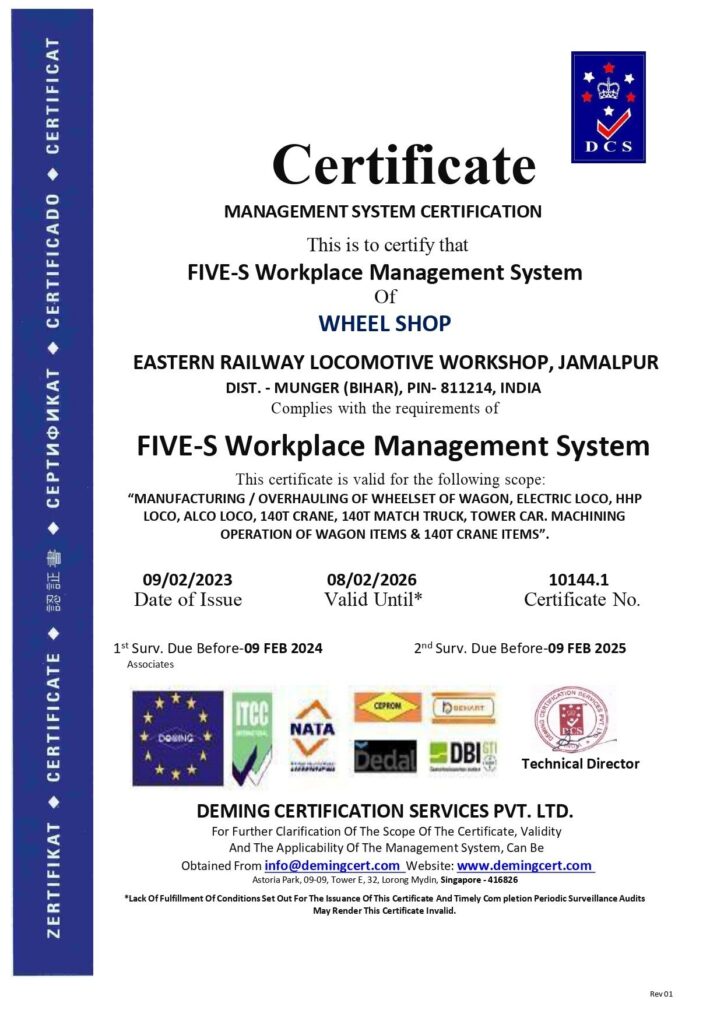
The Wheel Shop’s stated scope includes the manufacturing and overhauling of wheelsets associated with wagons, electric locomotives, high-horsepower diesel locomotives, ALCO locomotives, 140-ton cranes, matching trucks, and tower cars. The work also includes machining operations for wagon and crane items.
These activities involve different types of components and operations. Without an organized workplace, employees may face difficulties locating the required material, distinguishing work stages, and maintaining clear movement routes. Five-S provides a structured way to examine and improve these conditions.
The first principle, Sort, encourages teams to identify which items are needed for current work and which are obsolete, damaged, surplus, or awaiting a decision. In a wheel-handling environment, unnecessary objects should not be allowed to occupy designated working or movement areas. Components that require technical evaluation should be segregated according to authorized procedures rather than casually discarded or returned to general storage.
Set in Order focuses on giving materials and tools defined locations. Clearly identified storage areas can help distinguish incoming components, items awaiting inspection, work in progress, accepted components, and rejected material. The actual status categories should reflect the workshop’s approved process and quality controls.
Such arrangements are valuable because the physical appearance of a component alone may not reveal its inspection status. Identification tags, job records, and approved tracking methods can help employees understand what work has been completed and what remains outstanding.
Shine emphasizes cleanliness and the early identification of abnormal conditions. A clean working area can make oil leakage, loose objects, damaged storage equipment, and other visible irregularities easier to notice. Cleaning should be carried out safely, with appropriate precautions for machinery, electrical equipment, heavy components, and any hazardous substances present.
The fourth principle, Standardize, helps make good arrangements repeatable. The workshop can document where commonly used tools belong, how components should be identified, and how the work area should be left at the end of a shift. Standardization reduces dependence on individual memory and makes it easier for employees working different shifts to follow the same arrangements.
Sustain focuses on maintaining these practices. Supervisors can conduct routine inspections, discuss repeated problems, and ensure that corrective actions are completed. Employees can contribute by reporting missing labels, damaged storage fixtures, or difficulties with the existing layout.
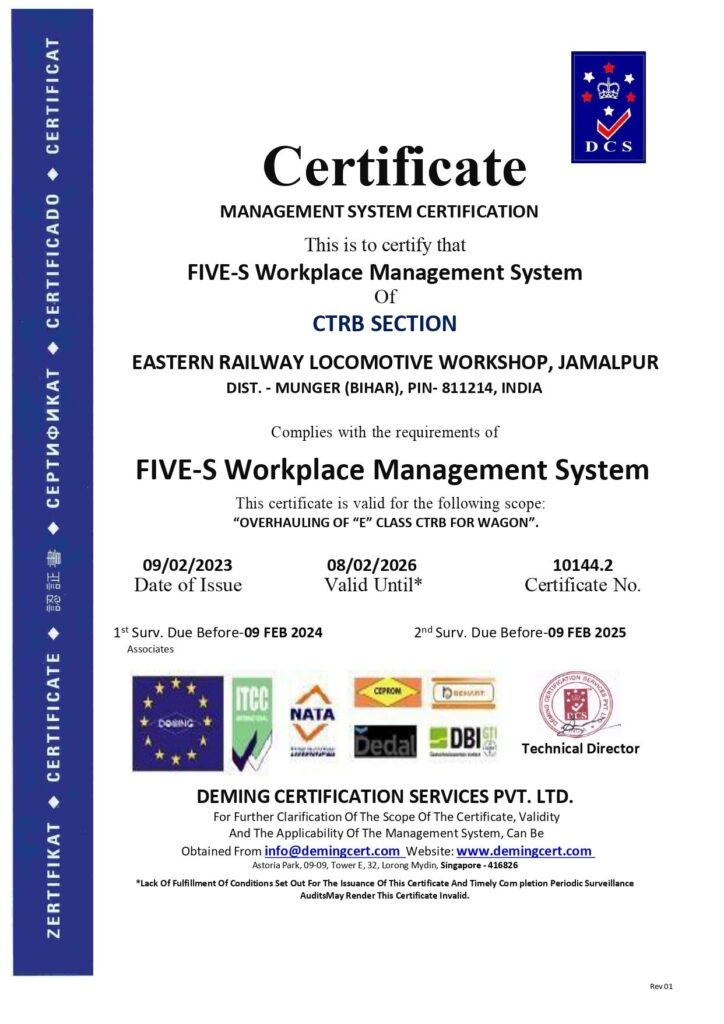
The CTRB Section has the stated responsibility of overhauling “E” class CTRBs for wagons. Its workplace arrangements can be examined through the same Five-S principles, adapted to the particular requirements of bearing overhaul.
For example, the section can establish designated areas for incoming assemblies, dismantled parts, components awaiting inspection, approved parts, and completed assemblies, subject to the actual authorized workflow. Clear segregation can reduce the risk of mixing parts or confusing different work stages.
Tool organization is equally important. Tools and measuring instruments should have designated storage locations, and their suitability for use should be managed under the applicable maintenance and calibration controls. A missing or damaged tool should be reported through the established system rather than replaced with an unapproved alternative.
The use of visual management can further improve clarity. Labels and work-status indicators can help employees identify the next action required for a component. These controls should supplement, not replace, technical inspection records and formal release procedures.
Five-S also encourages teams to examine unnecessary movement. If employees repeatedly walk across a shop to collect commonly used items, the layout may deserve review. Moving suitable tools closer to their point of use, while respecting safety and engineering requirements, can reduce avoidable travel.
However, not every item should be placed close to the workstation. Heavy components, restricted materials, precision instruments, and equipment requiring special environmental conditions may need specific storage arrangements. Practical improvement must always take account of technical requirements.
Employee knowledge is essential to achieving these improvements. Technicians can explain which tools are needed most frequently, where delays occur, and which storage arrangements create confusion. Their participation can help develop solutions that work in real operating conditions.
The workshop can also use simple measures to evaluate whether changes are useful. Examples include the frequency of missing-tool incidents, the number of unresolved housekeeping findings, the time required to locate commonly used equipment, and the completion rate for corrective actions. Any numerical targets should be established from actual baseline information rather than assumed results.
For management, the lesson is that workplace organization can support the technical discipline already required in wheelset and bearing work. It does not replace engineering competence or inspection, but it can make the working environment more orderly and the approved process easier to follow.
The potential growth outcome is a more consistent approach to handling materials, maintaining work areas, and supporting employees. Through the Five-S framework, the Wheel Shop and CTRB Section can contribute to a broader workshop culture in which organized working conditions are recognized as an essential part of quality-focused railway engineering.
#JamalpurLocomotiveWorkshop
Chapter 4 – Traction Machine Shop: Building Discipline in Electrical and Mechanical Work
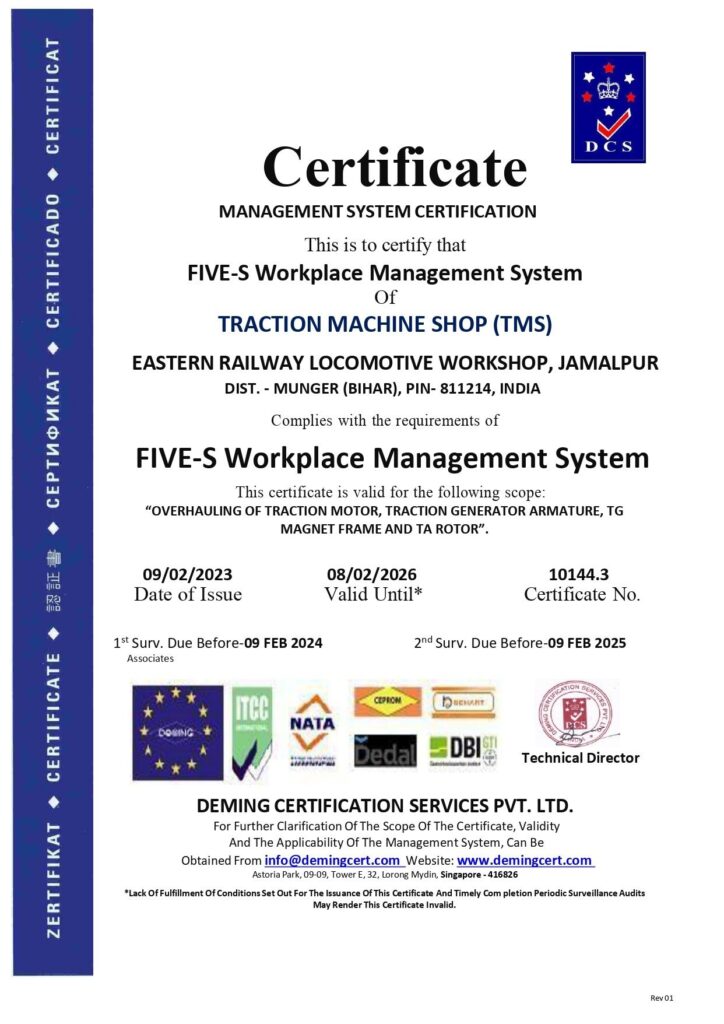
The Traction Machine Shop (TMS) performs specialized work involving traction motors, traction generator armatures, traction generator magnet frames, and traction alternator rotors, according to the supplied scope. These components are associated with railway traction systems and require careful handling, appropriate tools, technical knowledge, and controlled maintenance procedures.
Because the work involves complex equipment, workplace organization can make an important contribution to operational discipline. Employees need to identify components correctly, access the appropriate tools, maintain clean workstations, and follow the authorized sequence of dismantling, inspection, repair, assembly, and testing.
The first Five-S principle, Sort, encourages employees to separate essential tools and components from unnecessary materials. In a specialized machine shop, unused items can obstruct access, consume valuable storage space, or create confusion about which materials belong to a particular job. Removing unnecessary items through authorized procedures helps establish a clearer working environment.
Sorting must also consider the condition and status of components. Items awaiting inspection should not be mixed casually with accepted parts. Components requiring repair, technical evaluation, or further testing should remain identifiable through the workshop’s approved identification and traceability arrangements.
Set in Order focuses on ensuring that tools and materials have designated locations. Frequently used tools can be arranged for convenient access, while specialized instruments and equipment can be stored according to their handling and protection requirements. Drawings, work instructions, and job documents should also be accessible to authorized personnel.
This organization helps reduce unnecessary searching. When a technician needs a particular tool or instrument, a defined storage arrangement makes it easier to identify its location and determine whether it has been returned after use.
The Shine principle encourages cleanliness and inspection of the working environment. Electrical and mechanical equipment may have surfaces, connections, housings, and other features that require appropriate cleaning during maintenance. Cleaning methods must be suitable for the equipment and must follow approved safety and technical instructions.
Workplace cleaning should never substitute for technical inspection. Instead, it can help employees notice visible damage, leakage, loose objects, or other abnormalities that need reporting. Any electrical isolation, equipment handling, or maintenance activity must follow the relevant authorized procedures.
Standardization can help the TMS maintain consistent arrangements across shifts. Tool-location charts, workstation checklists, component identification practices, and documented cleaning responsibilities can make expectations easier to understand. When employees follow the same standards, handovers between teams can become clearer.
Sustainability depends on regular attention. Supervisors can review workstation conditions, discuss recurring problems, and ensure that necessary corrective actions are completed. Employees should be encouraged to report difficulties when an arrangement does not support the actual workflow.
Five-S can also support the control of measuring instruments. Instruments should be identified, protected, and managed in accordance with the applicable calibration and verification requirements. Instruments that are damaged, overdue for required calibration, or otherwise unsuitable should be handled according to the established control process.
Another opportunity lies in improving the flow of components. A workshop can examine whether materials move logically between dismantling, inspection, repair, assembly, and testing. Unnecessary backtracking or unclear temporary storage can make work harder to coordinate. Any proposed layout changes must preserve safe lifting arrangements, equipment access, and designated movement routes.
Employee training remains important. A practical demonstration can show technicians how to maintain an organized workstation, identify component status, return tools, and report abnormalities. Regular discussions can reinforce the idea that Five-S is not a separate housekeeping task but part of responsible technical work.
The section can monitor practical indicators, including tool availability, completion of workstation inspections, unresolved housekeeping findings, and the timely closure of corrective actions. Where reliable baseline data are available, management can assess whether changes are producing measurable benefits.
The broader lesson from the Traction Machine Shop is that complex engineering work benefits from a well-organized environment. Five-S cannot guarantee the performance of a traction component, but it can help create conditions in which approved maintenance procedures are easier to follow.
By connecting workplace discipline with technical requirements, the TMS can contribute to a consistent culture of careful handling, clear identification, equipment care, and continuous improvement throughout the Jamalpur workshop.
#WorkplaceOrganization
Chapter 5 – Tool and Template Shop: Precision, Calibration, and Resource Management
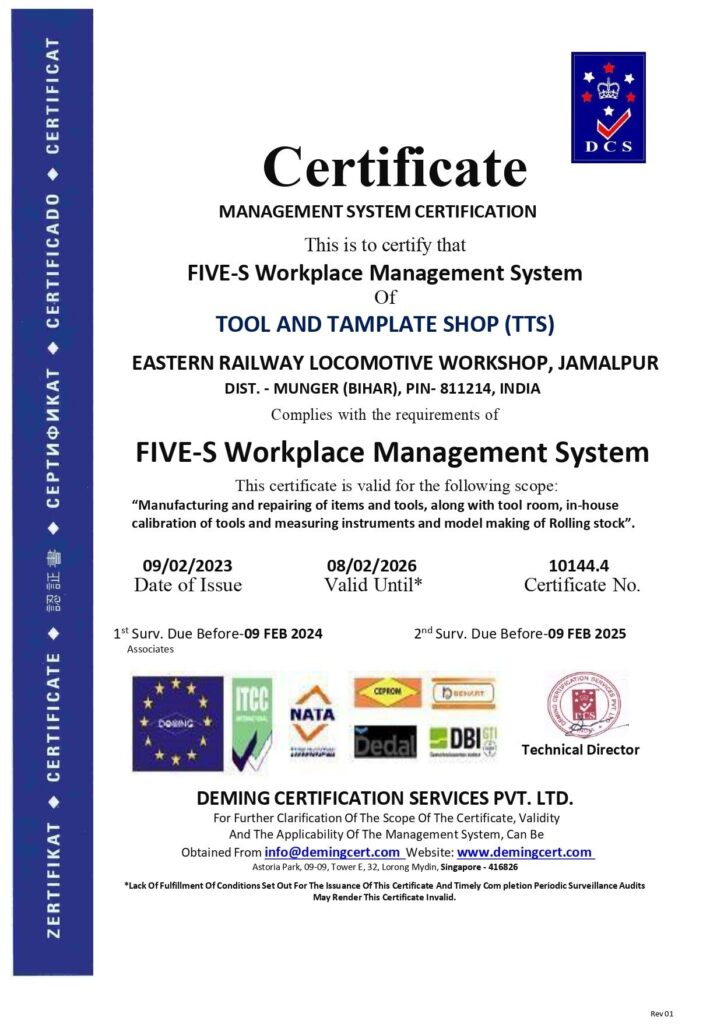
The Tool and Template Shop (TTS) has a distinctive role in the workshop’s operating system. Its supplied scope includes manufacturing and repairing items and tools, maintaining a tool room, conducting in-house calibration of tools and measuring instruments, and model making for rolling stock.
These activities support other workshop sections by helping provide the tools, templates, and measuring resources required for manufacturing and repair. Consequently, organization in the TTS can have an influence beyond its own boundaries. When tools are correctly identified, appropriately maintained, and available when required, other sections can plan their work more effectively.
The Five-S principle of Sort is particularly useful in a tool room. Tools may accumulate over time because of changing requirements, new designs, damaged equipment, or obsolete applications. A systematic review can identify items that are currently needed, those requiring repair, and those that must be evaluated for retirement or disposal.
The review must be controlled. Tools and instruments should not be discarded merely because they are not used frequently. Some specialized equipment may be necessary for particular repairs or uncommon railway components. Decisions should be based on authorized requirements and technical judgment.
Set in Order establishes a clear storage arrangement. Tools can be organized according to type, size, application, identification number, or another suitable classification. Templates and models should be stored in ways that protect their condition and preserve their identification.
Where appropriate, tool boards, labelled drawers, racks, and storage outlines can help employees identify missing items. Such arrangements also make it easier to return tools to their designated locations after use.
A controlled tool-issue and return process can strengthen accountability. Records may identify the tool, the responsible user, the date of issue, and its return status, according to local procedures. The purpose is to support availability and traceability without creating unnecessary administrative work.
The Shine principle emphasizes the cleanliness and condition of the tool room. Clean surfaces and orderly storage can help employees notice rust, damage, contamination, or deterioration. Tools should be cleaned using suitable methods that do not compromise their accuracy or protective finishes.
The management of measuring instruments deserves particular attention. Calibration and verification activities should follow the applicable procedures and technical requirements. Instruments must be identifiable, and their calibration status should be clear to authorized users.
An instrument that is damaged or unsuitable for use should not remain in circulation as though it were acceptable. The established process should determine whether it needs repair, recalibration, verification, restriction, or removal from service. Records should be maintained as required to demonstrate the instrument’s status.
Five-S supports these controls by making storage and identification clearer. However, visual labels alone do not establish measurement accuracy. Technical competence, appropriate calibration methods, traceable records where required, and authorized acceptance remain essential.
Standardization can establish common practices for tool storage, issue and return, cleaning, inspection, and handling. It can also help employees understand how to identify a tool that is unavailable, damaged, or awaiting technical review.
The workshop can further examine whether commonly required tools are positioned logically in relation to the sections that use them. A well-planned distribution arrangement may reduce avoidable movement and help employees obtain tools without disrupting other operations.
The TTS can support continuous improvement by gathering feedback from other shops. If several departments report difficulty locating a particular tool, the issue may reflect an unclear identification system, insufficient stock, poor storage, or an inefficient issue process. Investigating the underlying cause is more useful than repeatedly correcting the same immediate problem.
Training can explain how to select tools, maintain identification, report damage, and respect calibration requirements. Employees should also understand that using an unsuitable measuring instrument can compromise confidence in inspection results.
Potential performance indicators include the percentage of tools returned to designated locations, the number of overdue calibration actions, the frequency of missing-tool reports, and the timely completion of required inspections. These indicators should be measured consistently and interpreted in context.
From an organizational perspective, the TTS can become a strong example of how workplace management supports quality control. A well-organized tool room does not replace precision engineering, but it helps make suitable tools more accessible and their status easier to understand.
Through consistent Five-S practices, the Tool and Template Shop can strengthen its contribution to the entire workshop. Its work demonstrates that even a small improvement in tool identification, storage, or calibration control may help remove an obstacle faced by another department.
#RailwayEngineering
Chapter 6 – Diesel POH Shop and MCTR Shop: Improving Maintenance Readiness
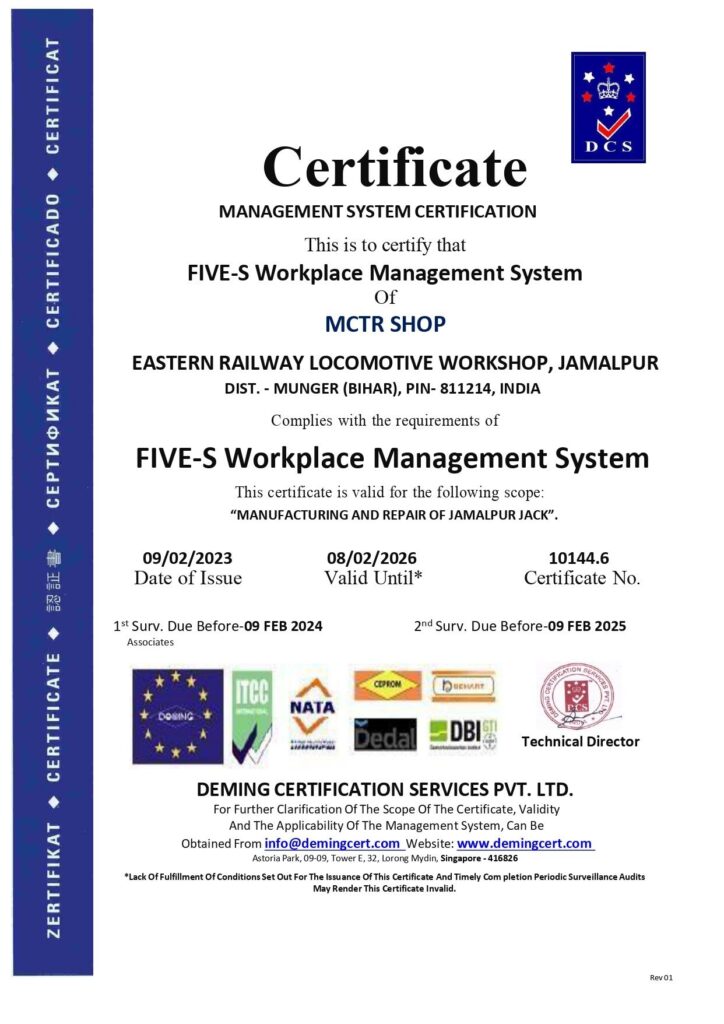
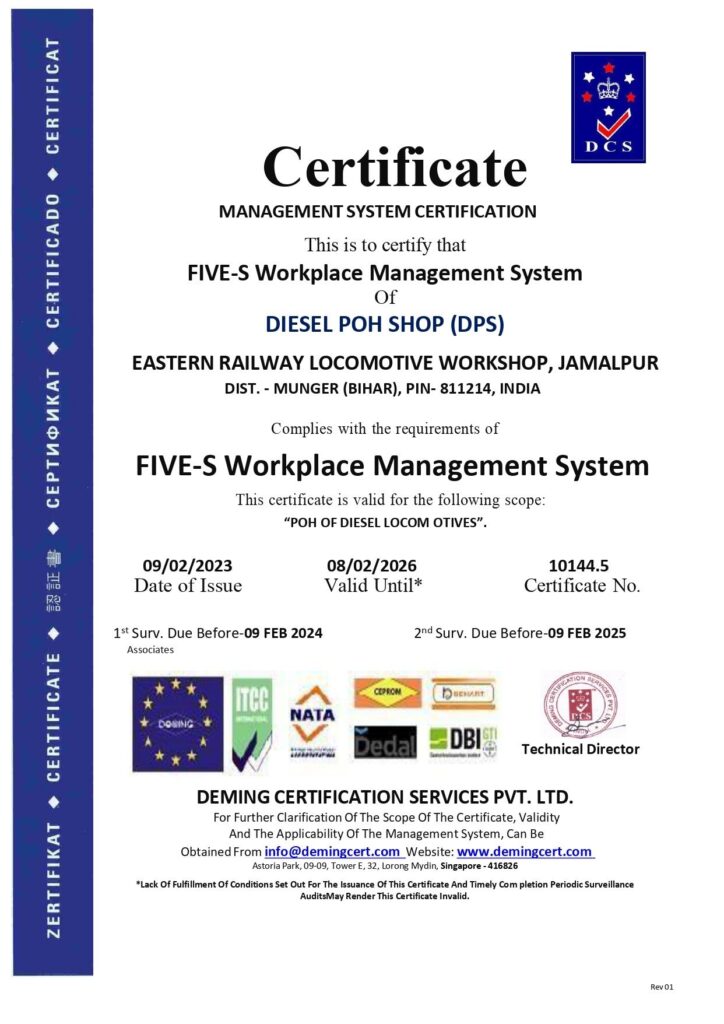
The Diesel Periodical Overhauling (POH) Shop has the stated responsibility of performing periodical overhauling of diesel locomotives. The MCTR Shop’s supplied scope includes the manufacturing and repair of Jamalpur jacks. These activities involve different types of equipment, yet both depend on organized workplaces, controlled tools, reliable identification, and appropriate maintenance practices.
Diesel locomotive overhauling can involve numerous components, tools, work instructions, inspection stages, and supporting materials. A clear workplace arrangement can help employees distinguish incoming items, components undergoing work, materials awaiting inspection, and completed work awaiting authorized release.
The first Five-S principle, Sort, helps identify materials that are necessary for current maintenance activities. Unused objects and obsolete materials can occupy space needed for components and equipment. Their segregation and disposition should follow approved procedures, particularly where items may require technical evaluation or formal records.
Set in Order can improve the visibility of work stages. Designated storage locations, component identification, and clear workstation arrangements can help employees recognize where materials belong. Where job-based segregation is appropriate, components can be associated with the relevant maintenance task through the workshop’s approved identification system.
This reduces confusion and supports orderly handovers between employees. A team starting a new shift should be able to understand the status of the work area and identify materials that require attention.
Cleanliness is equally important. The Shine principle encourages employees to maintain appropriate housekeeping and observe visible abnormalities. Oil, grease, loose materials, and other contaminants should be managed according to the relevant safety and environmental procedures. Cleaning must not expose employees to avoidable risks or interfere with machinery and equipment.
Standardization helps ensure that maintenance workstations are returned to an expected condition after each task. Checklists can identify the tools that should be present, the materials that need segregation, and the housekeeping activities required before a shift ends.
The system can also support the management of maintenance documents. Current work instructions, applicable technical drawings, and inspection records should be accessible to authorized personnel. Obsolete documents should be controlled so they are not mistakenly used in place of current approved information.
In the MCTR Shop, Jamalpur jacks are associated with lifting and supporting applications. Such equipment requires careful attention to its condition, identification, inspection, and authorized maintenance requirements. Five-S can support these activities by ensuring that tools and components have designated storage locations and that the workplace remains orderly.
The system should not be interpreted as permission to improvise lifting arrangements or bypass formal inspection. Jack maintenance, testing, load limits, and service acceptance must follow the applicable technical and safety requirements. Equipment whose condition or status is uncertain should be managed through the approved control process.
Five-S can also help employees identify damaged storage arrangements, obstructed access, or materials that interfere with movement. These observations should be reported and addressed through the appropriate maintenance and safety channels.
Both shops can benefit from practical employee involvement. Workers can identify repeated difficulties, such as time spent locating a tool, confusion about component status, or inadequate space for work in progress. Supervisors can evaluate these concerns and coordinate feasible improvements.
A workplace review can examine how materials enter each section, where they are stored, how they move between work stages, and how completed work is handed over. The objective is to reduce unnecessary handling and clarify responsibilities without compromising approved maintenance procedures.
Useful indicators may include the number of overdue housekeeping actions, the completion rate of scheduled workplace inspections, the frequency of missing tools, and the number of repeated findings. Maintenance-related indicators should be assessed separately according to their approved definitions.
Training is essential for sustaining these improvements. Employees should understand how to maintain their areas, report unsafe conditions, identify materials correctly, and follow the relevant technical instructions.
For the Diesel POH Shop, an organized workplace can support the coordination of complex maintenance tasks. For the MCTR Shop, it can help maintain clear arrangements for tools, components, and equipment associated with jack manufacture and repair.
The wider organizational benefit is improved readiness. When employees can identify resources, understand work status, and maintain orderly workstations, avoidable obstacles may be reduced. Five-S thus provides a practical link between housekeeping, maintenance coordination, equipment care, and the consistent performance of railway workshop duties.
#ContinuousImprovement
Chapter 7 – CASNUB Bogie Shop and Wagon Component Shops: Strengthening Quality and Traceability
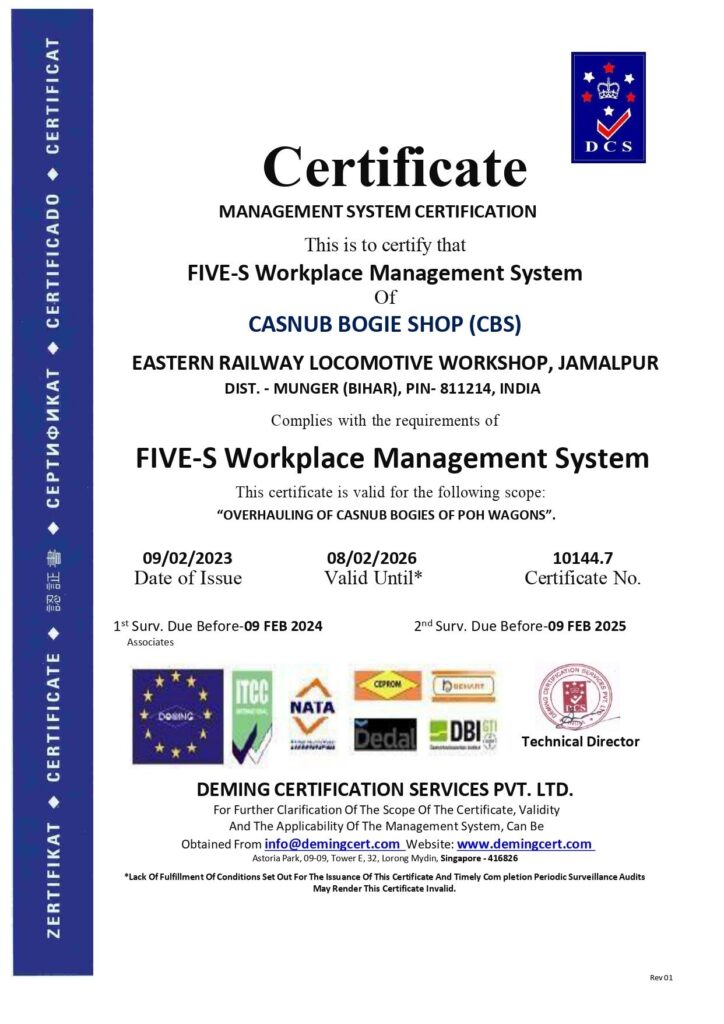
The CASNUB Bogie Shop (CBS), Wagon Component Shop-I (WCS-I), and Wagon Component Shop-II (WCS-II) perform specialized activities associated with wagon overhaul and component maintenance. Their supplied scopes include CASNUB bogie overhauling, work on centre buffer couplers and draft gear, and the stripping, fitting, overhauling, and testing of air-brake components.
These operations illustrate how Five-S can support consistent workplace organization across several departments while respecting the different technical requirements of each shop.
The CASNUB Bogie Shop is responsible for overhauling CASNUB bogies of periodical-overhaul wagons. Bogie maintenance involves numerous components and requires careful identification, inspection, handling, and assembly according to approved instructions.
A structured storage system can help employees distinguish components awaiting inspection from those approved for subsequent work. Designated locations can be used for work in progress, subject to the shop’s authorized process. Clear identification helps employees understand component status without relying solely on memory or verbal communication.
Sorting is the first step. Unnecessary objects should be removed from active work areas through appropriate procedures, while components requiring evaluation should remain identifiable. Items that appear similar should not be mixed without confirming their identity and status.
Set in Order helps create logical arrangements for tools, components, and supporting materials. The layout should provide suitable access for employees and equipment while preserving approved movement routes and safe handling requirements.
Shine emphasizes cleanliness and the observation of abnormal conditions. Employees can check workstations and storage areas for loose objects, contamination, damaged racks, or other problems requiring attention. Cleaning and inspection should follow the applicable safety instructions.
Standardization establishes common expectations for workstation condition, identification, storage, and shift handover. The workshop can develop suitable checklists and visual controls that make these expectations easy to understand.
Sustain ensures that improvements continue after their introduction. Regular reviews can identify repeated housekeeping issues, unclear storage arrangements, or difficulties that employees experience during normal work.
WCS-I has the stated scope of stripping, fitting, overhauling, and inspecting centre buffer couplers, draft gear, yokes, knuckles, and associated components for periodical and non-periodical wagon overhaul.
Because these activities involve several component types and work stages, identification and segregation are especially important. An organized workplace can help prevent confusion between components awaiting inspection and those that have completed the required checks.
Tools used during dismantling and fitting should have designated locations and be maintained according to applicable requirements. Employees should be able to identify tools that are missing, damaged, or unsuitable for use and report them through the established process.
Work records should remain connected with the authorized maintenance process. Five-S can improve the visibility of documents and components, but it cannot replace required inspection records, technical acceptance, or component traceability controls.
WCS-II covers air-brake component overhauling, stripping, fitting, and SWTR testing according to the supplied scope. These activities require orderly workstations and clear identification of components at different stages.
A practical workplace arrangement can establish separate, clearly identified areas for incoming components, dismantled items, parts awaiting inspection, and completed assemblies. The actual arrangement must be aligned with the authorized process and should not create a substitute for formal inspection or testing.
The Five-S system can also support cleanliness in work areas where components are prepared, assembled, and tested. Appropriate housekeeping may make it easier to identify visible leakage, damage, contamination, or abnormal conditions that need attention. Any technical conclusion must still be established through the prescribed inspection and test methods.
Standardization can help employees maintain the same arrangements across shifts. Labels, tool-location outlines, work-status boards, and checklists can reduce ambiguity when responsibility passes from one team to another.
The three shops can also exchange useful improvement practices. For example, a storage-labeling method developed in one department may be suitable for another, provided it is adapted to the second department’s technical and safety requirements.
Cross-functional discussions can identify common challenges, including insufficient storage space, unclear component status, repeated searching, and delays in completing corrective actions. Management can prioritize issues according to operational significance and available resources.
Performance indicators may include repeated identification errors, missing-tool reports, completion of housekeeping inspections, and the number of corrective actions closed within agreed timelines. These indicators should be supported by actual records and interpreted alongside technical quality information.
Employee participation remains essential. Technicians and inspectors often have direct experience of the difficulties created by poor storage or unclear identification. Their suggestions can help improve the system without adding unnecessary complexity.
The broader lesson is that workplace organization and quality control reinforce each other. A clean, clearly arranged work area helps employees follow established processes, while formal inspection and traceability procedures establish the technical acceptability of the work.
Through consistent Five-S implementation, the CASNUB Bogie Shop and both Wagon Component Shops can contribute to a shared culture of organized maintenance, careful component handling, and continuous improvement throughout the Jamalpur workshop.
#QualityManagementSystem
Chapter 8 – Crane Organization: Managing Heavy Equipment and Complex Workflows
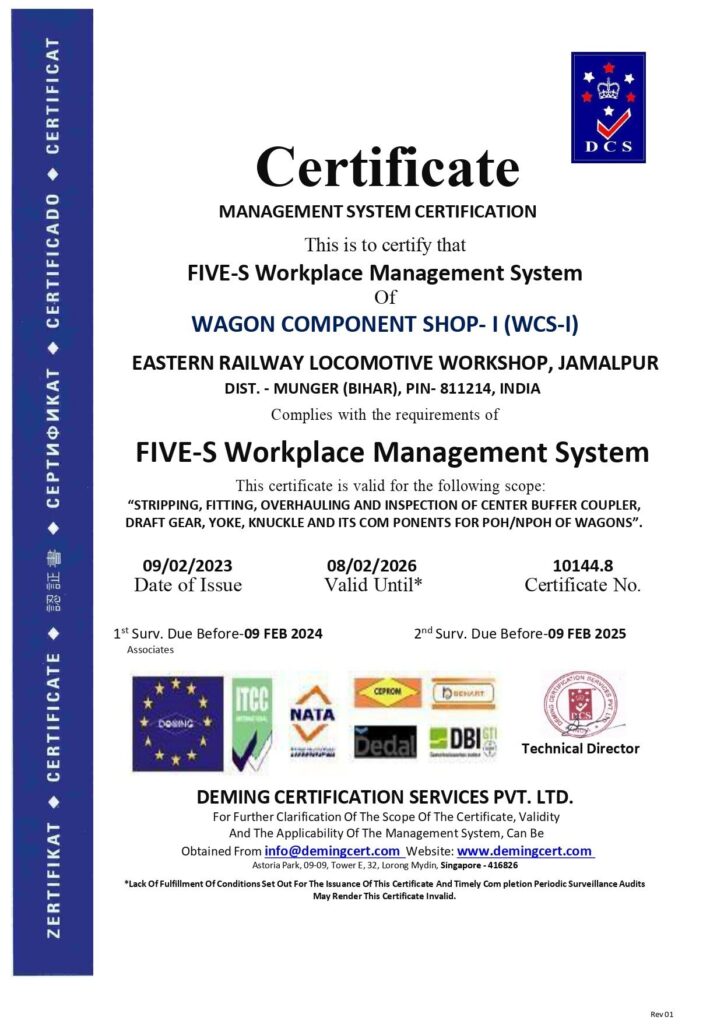
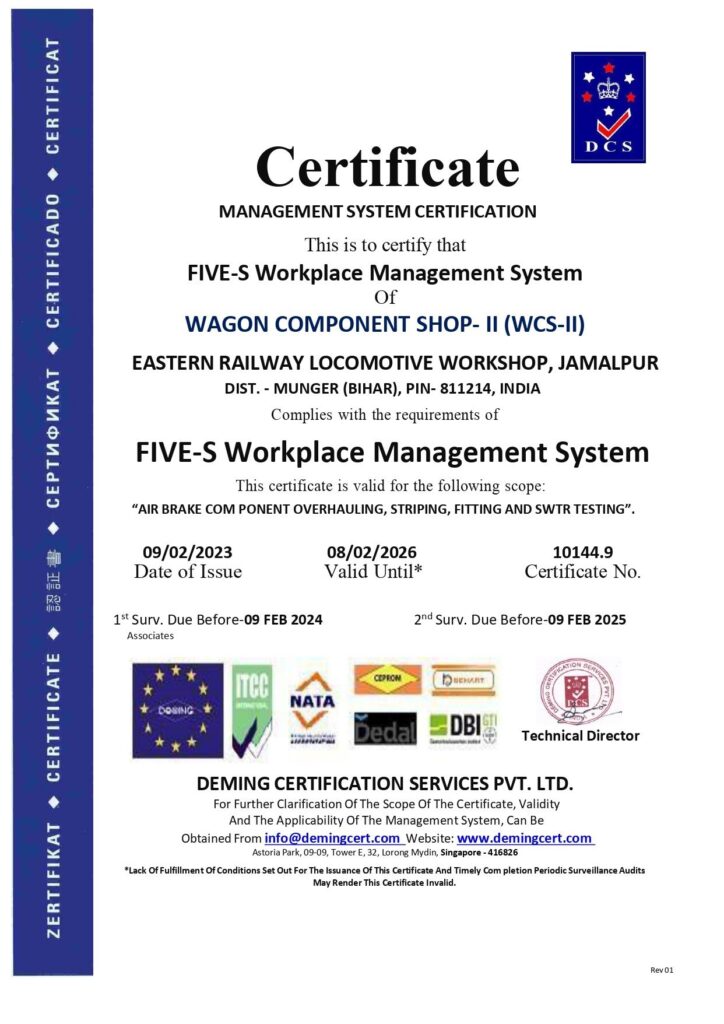
The Crane Organization has a specialized role within the workshop’s supplied certification scope. Its activities include manufacturing and overhauling 140-ton cranes, overhauling and converting 20-ton diesel-hydraulic cranes, and working on four-wheeler tower cars.
These activities involve heavy equipment, large assemblies, specialized tools, and coordinated technical work. Workplace organization is therefore important not only for convenience but also for supporting safe access, clear identification, and disciplined maintenance arrangements.
Five-S provides a structured method for improving the organization of the work environment. However, the system does not replace crane-specific engineering controls, lifting plans, equipment inspections, authorized testing, or statutory requirements.
The Sort principle encourages the department to review materials, tools, and equipment stored in active work areas. Items not required for the current task can be relocated to approved storage areas, while obsolete or damaged materials can be evaluated through authorized procedures.
This helps preserve working space around large components. In heavy-equipment environments, unnecessary objects can interfere with movement and make it more difficult to access tools or inspect the surrounding area. Any storage change must preserve approved clearance, access, and load-handling requirements.
Set in Order focuses on establishing designated locations for tools, parts, lifting accessories, documents, and other resources. Identification boards and storage labels can help employees recognize where items belong and whether they have been returned after use.
The location of equipment must be planned carefully. Heavy components should be stored only in suitable areas under approved arrangements, and lifting accessories must be managed according to the applicable inspection and serviceability requirements. Visual order cannot compensate for an unsuitable storage surface or an unauthorized lifting method.
The Shine principle emphasizes cleanliness and awareness of visible abnormalities. Keeping the work area clean may make oil leakage, damaged storage equipment, loose materials, or other irregularities easier to notice. Cleaning around machinery must be performed only under the relevant safe-work procedures.
Standardization can establish consistent expectations for workstation setup, tool storage, material identification, cleaning, and shift handover. Checklists can help employees verify that the work area is in the required condition before and after a task.
For equipment undergoing overhaul, clear identification of work status is especially valuable. Materials awaiting inspection should not be confused with accepted components, and work should not progress beyond an authorized stage merely because the area appears organized.
Sustain focuses on maintaining the standards. Supervisors can conduct routine reviews, discuss recurring problems, and ensure that corrective actions are completed. Where the same problem repeatedly occurs, the team should examine the underlying cause rather than relying on temporary rearrangements.
The Crane Organization can also review material movement. Large assemblies often require careful coordination of work areas, handling equipment, and supporting resources. A process review may reveal avoidable movement, poorly placed tools, or storage arrangements that complicate the approved workflow.
Any proposed improvement must be evaluated by the responsible technical personnel. The objective is to make work more orderly without changing an approved engineering arrangement or creating a new risk.
Documentation is another important consideration. Current drawings, inspection records, maintenance instructions, and equipment histories should be available to authorized employees. Five-S can support document organization, but formal document-control arrangements remain necessary to prevent the use of outdated information.
The same principles apply to diesel-hydraulic cranes and tower cars, although their components, maintenance requirements, and work sequences may differ. Each equipment category should have arrangements suited to its actual technical needs.
Training should cover practical housekeeping, safe storage, equipment identification, abnormal-condition reporting, and the importance of following approved lifting and maintenance procedures. Employees should understand that a tidy workplace is only one part of a safe and technically controlled operation.
The department can monitor indicators such as completion of workplace inspections, overdue corrective actions, missing-tool incidents, and repeated housekeeping findings. Any safety or maintenance performance measures should be based on verified records and their approved definitions.
Employee participation can improve the quality of workplace arrangements. People who work with large assemblies can often identify access problems and repeated handling difficulties. Their observations can help supervisors prioritize feasible improvements.
The growth opportunity for the Crane Organization lies in creating a more predictable working environment. Clearly identified materials, organized tools, controlled documentation, and regular workplace reviews can help support coordinated maintenance and manufacturing activities.
Five-S does not independently establish crane reliability or lifting safety. Its contribution is to support the organized conditions in which qualified employees can apply the appropriate engineering, inspection, and maintenance controls consistently.
#RailwayMaintenance
Chapter 9 – Building a Common Five-S Culture Across All Twelve Sections
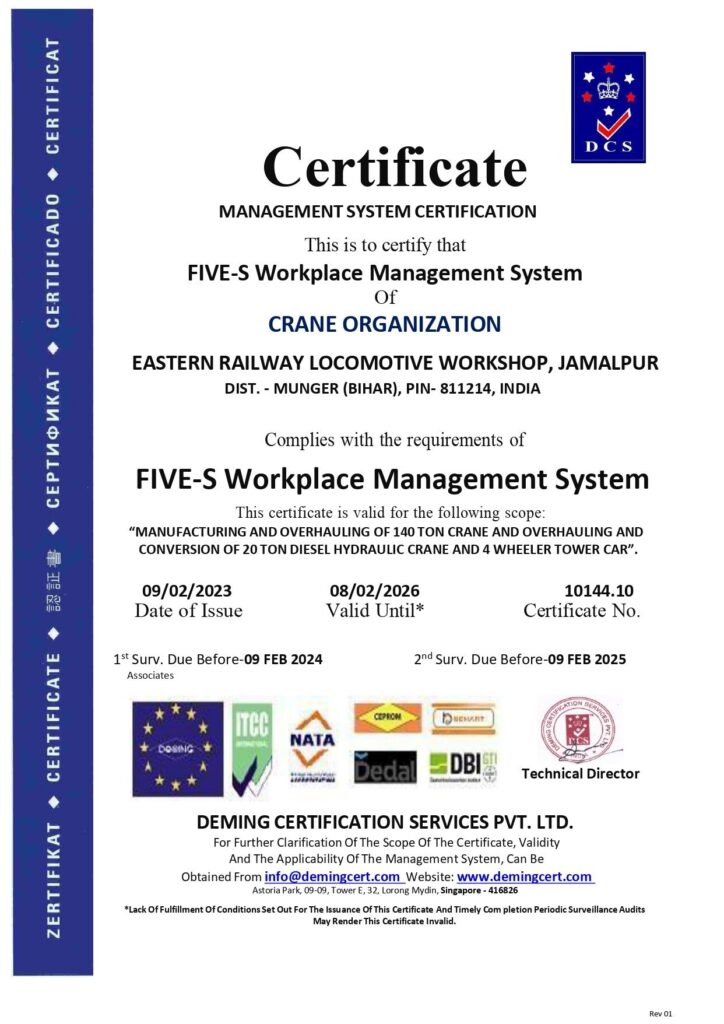
A multi-section railway workshop cannot achieve lasting workplace excellence through isolated departmental efforts alone. The Wheel Shop, CTRB Section, Traction Machine Shop, Tool and Template Shop, Diesel POH Shop, MCTR Shop, CASNUB Bogie Shop, Wagon Component Shops, Crane Organization, and Diesel Component Shop each have distinct responsibilities, yet their activities are connected through tools, materials, maintenance requirements, and shared operational objectives.
The Five-S Workplace Management System provides a common framework that can connect these departments through consistent principles.
The first requirement is to establish a shared understanding of the five principles. Employees should know that Sort means identifying and controlling unnecessary items, Set in Order means giving resources designated locations, Shine means maintaining cleanliness and observing abnormalities, Standardize means making good practices repeatable, and Sustain means maintaining the system over time.
The specific implementation can differ by department. A tool room may need detailed identification and calibration-status arrangements, while a crane workshop requires carefully planned storage and access. A bearing-overhaul section may need clearly defined component-status categories, while a locomotive overhaul area may require a structured arrangement for work in progress.
The goal is therefore not to impose identical physical layouts on every shop. It is to apply consistent management principles while respecting the technical characteristics of each activity.
A common assessment method can help management understand the condition of different areas. The assessment may examine unnecessary materials, storage arrangements, cleanliness, visual identification, standard work practices, and evidence that previous improvements have been maintained.
The criteria should be understandable and applied consistently. If different supervisors interpret the same requirement in completely different ways, the results will be difficult to compare. Training assessors and documenting expectations can improve consistency.
The next step is to assign responsibility. Each section can identify the employees responsible for coordinating local Five-S activities, while individual workers remain responsible for their workstations. Supervisors can review findings and ensure that issues requiring additional resources are referred to the appropriate authority.
A central coordination mechanism may help identify problems that affect more than one department. For example, a tool-storage issue might originate in one section but create difficulties for another. Similarly, an unclear method for identifying shared equipment may require a workshop-wide solution.
Regular meetings can review outstanding findings, repeated problems, employee suggestions, and completed improvements. The purpose should be practical problem-solving rather than producing reports that do not lead to action.
Training can also be coordinated across the workshop. New employees should learn the local Five-S arrangements as part of their introduction to the workplace. Existing employees can receive refresher training when procedures change or recurring issues indicate that additional instruction is needed.
Visual management can support communication. Properly designed boards can display area responsibilities, workplace standards, inspection schedules, and the status of improvement actions. Information should be current, easy to understand, and relevant to the people using the area.
Management can encourage employees to submit improvement suggestions. Some changes may be simple, such as adjusting the position of a commonly used tool. Others may require additional storage, revised material-flow arrangements, or engineering review.
Suggestions should be evaluated fairly. An improvement should be accepted when it is feasible, useful, and consistent with applicable safety and technical requirements. Employees should receive feedback so they understand whether a suggestion will be implemented, modified, or deferred.
Measurement can help the workshop understand progress. Suitable indicators include:
- Completion of scheduled Five-S inspections.
- Number of repeated workplace findings.
- Timeliness of corrective-action closure.
- Frequency of missing or misplaced tools.
- Completion of required training.
- Employee suggestions evaluated and implemented.
- Observed compliance with approved storage and identification standards.
These indicators should not be used to make unsupported claims about productivity or quality. Their value depends on accurate data, consistent definitions, and regular review.
A good Five-S culture also requires a distinction between appearance and effectiveness. A workplace may look clean on the day of an assessment yet fail to maintain its standards during routine operations. Sustained performance must therefore be evaluated over time.
Management should also recognize that some problems cannot be solved through employee discipline alone. Insufficient storage space, inadequate infrastructure, damaged equipment, and conflicting workflow requirements may require investment or technical changes. Five-S assessments can help make these needs visible.
The certification’s stated 2023–2026 period offers a useful framework for discussing continued improvement. However, the existence of a certificate does not establish that every department has achieved a particular result. Actual progress must be supported by documented assessments, corrective actions, and reliable performance information.
The central opportunity is to build a shared identity around organized work. Employees should see workplace management as part of their professional responsibilities rather than an additional task performed only for an assessment.
By encouraging common principles, local ownership, cooperation between sections, and evidence-based reviews, the workshop can create a foundation for more consistent working practices across its twelve listed operational areas.
#IndustrialHousekeeping
Chapter 10 – Sustaining Improvement and Creating a Long-Term Growth Vision
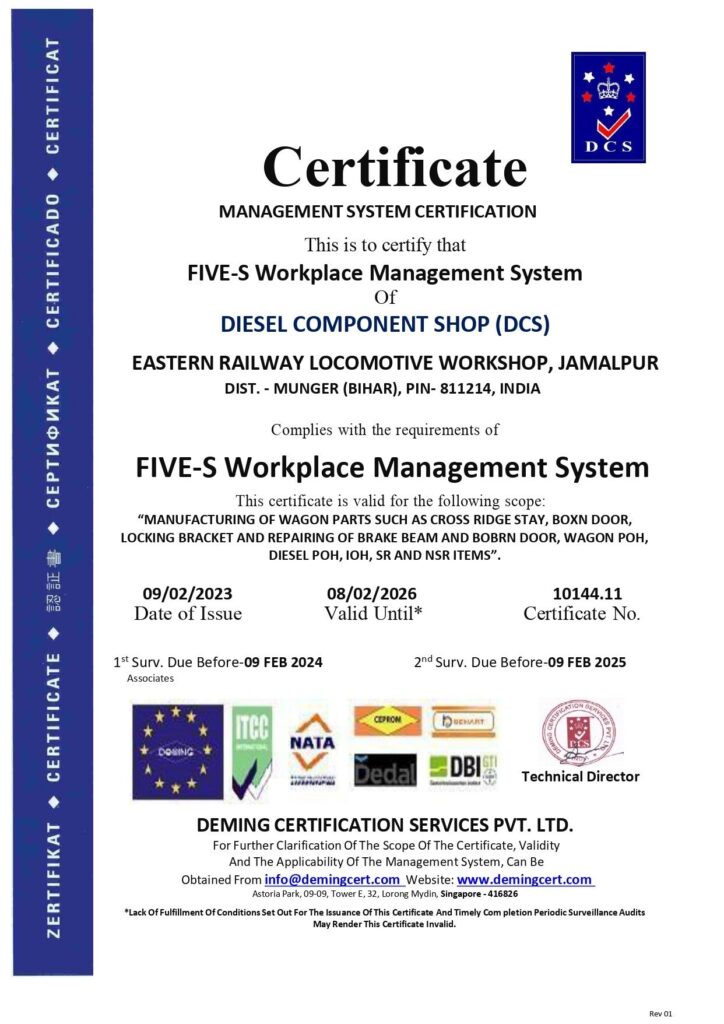
The long-term value of a Five-S Workplace Management System lies in its ability to become part of everyday working life. Certification can recognize a management framework, but sustained improvement depends on what employees and managers continue to do after the initial implementation.
For the Eastern Railway Locomotive Workshop at Jamalpur, the stated Five-S certificate issue year of 2023 and validity year of 2026 provide the timeframe for this case study. The next stage of development should be approached as a continuing management responsibility, supported by actual assessments and the organization’s applicable certification arrangements.
A sustainable system begins with regular workplace reviews. These reviews should examine whether tools remain in designated locations, materials are correctly identified, unnecessary items are controlled, and work areas meet established housekeeping standards.
The purpose is to detect problems before they become recurring obstacles. When an inspection identifies an issue, the responsible team should record it, determine its cause, assign corrective action, and verify completion.
Corrective action should address the underlying problem wherever possible. If tools repeatedly go missing, for example, the cause might be an unclear return process or inadequate storage rather than simple employee carelessness. If components are repeatedly mixed, the identification method or physical segregation arrangements may need improvement.
This problem-solving approach helps prevent the same issue from returning after a temporary correction.
Another important element is employee development. Five-S practices become more sustainable when workers understand not only what to do but why it matters. Training should connect workplace organization with technical work, safe material handling, equipment care, and the ability to recognize abnormal conditions.
Supervisors can reinforce these principles through practical demonstrations and regular communication. Recognition can be given to teams that identify useful improvements, maintain their standards, and help other departments solve common problems.
Recognition should encourage genuine improvement rather than competition over appearance. Employees should not feel pressured to conceal defects or delay reporting a problem simply to achieve a favorable assessment result.
The workshop can also establish a structured improvement programme. Each section may identify a small number of realistic priorities, assess the current situation, implement suitable changes, and review the results. This approach allows progress to be evaluated without overwhelming employees with too many simultaneous initiatives.
For example, a department might focus on tool identification, another on component segregation, and another on the organization of work instructions. After reviewing the results, the workshop can decide whether the method should be continued, modified, or shared with other sections.
Performance information should be reliable. Management can compare inspection results over time, review corrective-action completion, and examine whether recurring findings are decreasing. Where baseline measurements are unavailable, the first step should be to establish them rather than inventing improvement percentages.
The system should also remain connected to other management processes. Five-S can support quality management, maintenance planning, document control, safety awareness, and resource management, but it does not replace the technical or regulatory requirements of these functions.
The same principle applies to the workshop’s manufacturing and repair activities. An organized environment can support work on wheelsets, traction equipment, railway jacks, bogies, air-brake components, wagon parts, diesel locomotives, cranes, and associated assemblies. Technical acceptance must nevertheless depend on the relevant engineering instructions, inspections, tests, and authorized release procedures.
Infrastructure and resource planning will also influence sustainability. Suitable storage, clear identification, maintained facilities, and appropriate workplace equipment may require investment. Management should prioritize improvements according to operational needs, risks, and available resources.
The workshop can use employee feedback to understand whether the system is practical. If a standard is difficult to maintain during normal operations, the appropriate response may be to review the arrangement, provide additional resources, or revise the procedure through the authorized process.
The status of the certification itself should also be managed carefully. Since the supplied validity year is 2026, any statement about continued certification after that period should be based on current documentary evidence from the applicable certification arrangements. The original dates alone do not establish renewal or present certification status.
Looking ahead, the growth vision for Five-S at Jamalpur can be expressed through several priorities: consistent workplace standards, clear responsibility, better visibility of work status, effective employee training, reliable corrective-action follow-up, and continuous evaluation of results.
These priorities can help the organization build an environment where employees spend less effort dealing with avoidable disorder and more effort performing their assigned technical responsibilities. The actual benefits should be evaluated through operational evidence rather than assumed in advance.
Ultimately, Five-S is not simply about arranging tools or cleaning floors. It is about developing a disciplined approach to work in which employees understand their responsibilities, resources are managed systematically, problems are reported openly, and improvements are maintained.
The experience of the twelve listed sections illustrates the breadth of opportunities available to a large railway engineering workshop. Although their operations differ, they can all benefit from clear identification, appropriate storage, standardized practices, and a commitment to continuous improvement.
The central message of this case study is that certification provides a framework, employees bring it to life, and consistent management sustains its value.
By continuing to develop these principles, the Eastern Railway Locomotive Workshop at Jamalpur can use the Five-S Workplace Management System as a practical foundation for workplace discipline, operational coordination, and a long-term culture of quality-focused railway engineering.
#OperationalExcellence
#LeanWorkplace #RailwayWorkshopManagement #EquipmentMaintenance #WorkplaceSafetyAwareness #ProductivityImprovement
Take the Next Step Today
Don’t wait to enhance your business’s quality and efficiency. Partner with Hot Aaj News and experience the transformation that comes with expert consultancy and training. Contact us today to learn more about how we can help you achieve your business goals. Reach out via phone at +91-9322728183, visit our website at hotaaj.com, or email us at info@hotaaj.com Let us be your guide on the journey to excellence and innovation.