









Table of Contents
Chapter 1 – Introduction to Coaching Complex Wadi Bunder and Its Important Role in Railway Operations
The Indian railway network is one of the largest railway systems in the world. It connects cities, towns, industrial areas, villages and important commercial centres. Millions of passengers depend on railway services every day for transportation, education, employment, business and personal travel. Behind every successful railway journey, there is a large system of planning, engineering, inspection, maintenance and operational coordination. Railway coaches must remain suitable for service through regular checking, maintenance, repairing and overhauling. These activities are essential for passenger comfort, operational reliability and the long-term performance of railway assets.
Coaching Complex Wadi Bunder, operating under Mumbai Division of Central Railway, Mumbai, Maharashtra, is associated with an important area of railway coach maintenance. Located in Mumbai – 400010, the complex forms part of the larger railway maintenance environment in which technical personnel, supervisors, engineering teams and supporting staff contribute to the upkeep of railway coaches. Its main activities include overhauling, repairing, checking and maintenance of coaches. Each of these activities requires technical knowledge, careful planning, proper tools, trained personnel and a systematic approach to quality. (https://en.wikipedia.org/wiki/Mumbai)
Railway coaches are complex assets containing several interconnected components and systems. Their maintenance is not limited to correcting visible defects. It involves checking the condition of components, identifying abnormalities, examining equipment, attending to repair requirements, maintaining records and ensuring that the prescribed technical procedures are followed. A small maintenance issue, if not identified and corrected at the appropriate time, may create a larger operational problem. Therefore, preventive maintenance and systematic inspection are important elements of railway engineering.
The work carried out at a coaching maintenance facility requires coordination between different departments and job functions. Mechanical personnel, electrical teams, technical inspectors, supervisors, stores staff and administrative employees may all contribute to the overall maintenance process, depending on the applicable organizational structure. Each team has a specific responsibility, but the final result depends on the combined performance of all concerned personnel.
For such an environment, quality cannot depend only on the personal experience of individual employees. It must become a consistent organizational practice. Work instructions, inspection methods, responsibility allocation, record maintenance, equipment management and corrective actions should support the same objective. This is where a Quality Management System becomes valuable.
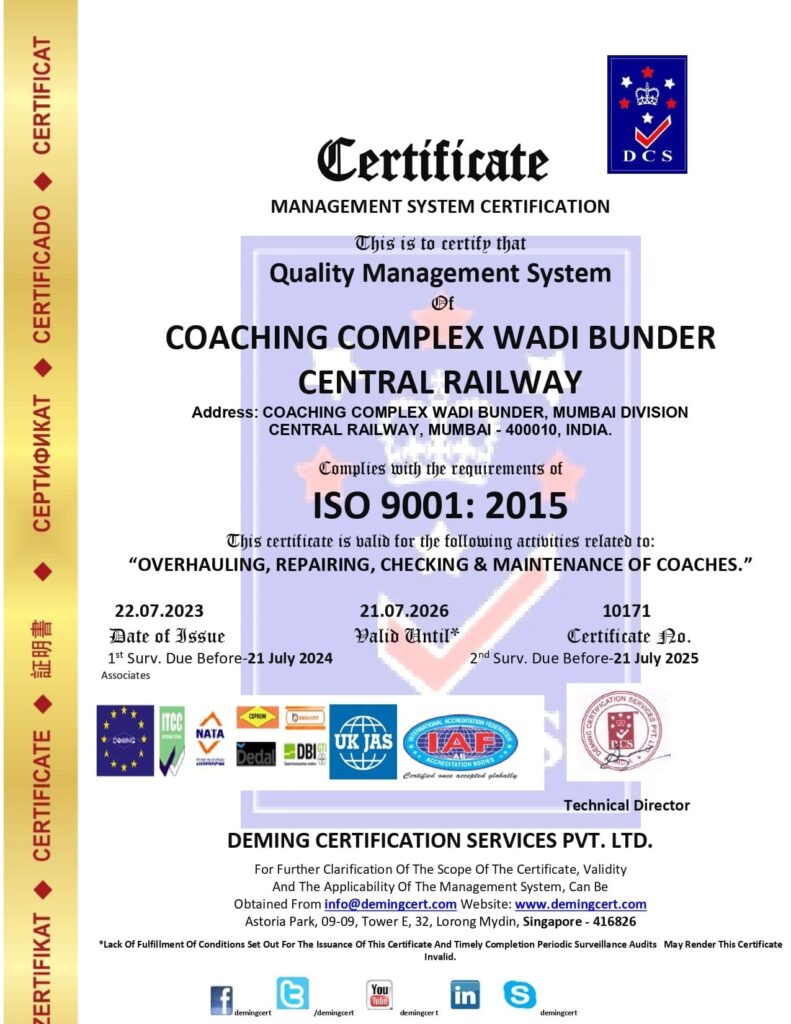
The introduction and certification of ISO 9001:2015 provided Coaching Complex Wadi Bunder with an internationally recognized framework for organizing quality-related processes. The standard emphasizes customer focus, leadership, process management, risk-based thinking, performance evaluation and continual improvement. In the railway maintenance environment, these principles can support better planning, consistent execution, documented procedures and systematic monitoring of maintenance activities.
Alongside quality, environmental responsibility is equally important. Railway maintenance activities can involve the use of lubricants, oils, paints, cleaning materials, electrical equipment, metals, packaging and other resources. They may also generate waste materials, used components, wastewater, noise and other environmental aspects requiring proper management. A responsible maintenance facility must consider how its activities affect the surrounding environment and how unnecessary waste can be reduced.
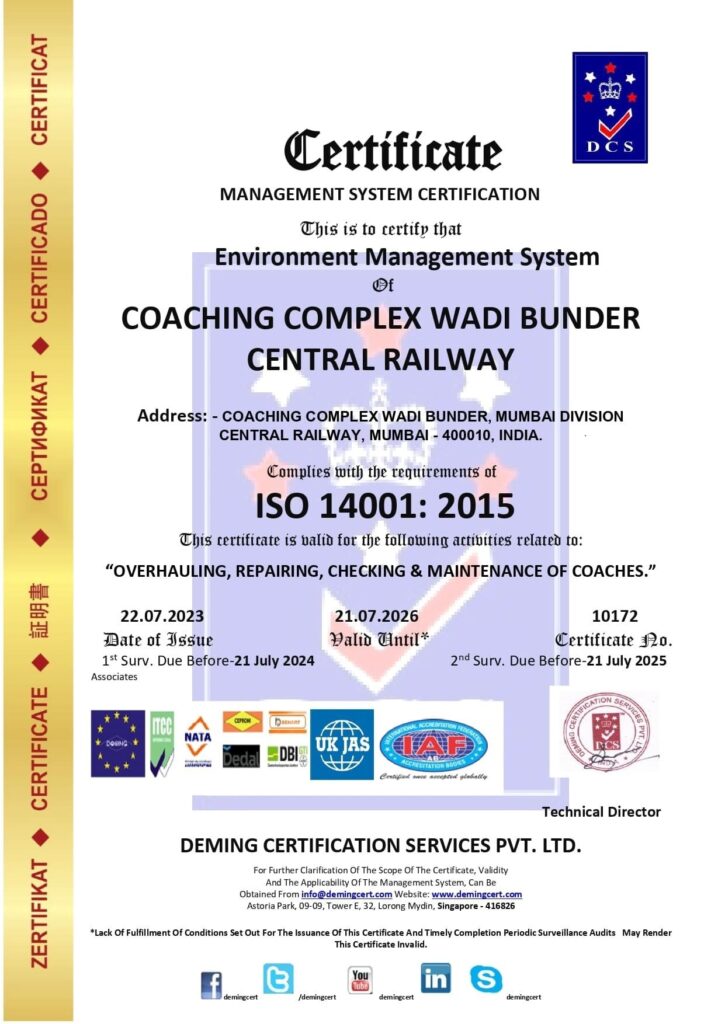
The ISO 14001:2015 Environmental Management System provides a structured framework for identifying environmental aspects, evaluating environmental impacts, meeting applicable obligations, establishing environmental objectives and improving environmental performance. Its implementation complements the quality management approach by ensuring that operational efficiency and environmental responsibility are considered together.
The certification of Coaching Complex Wadi Bunder against ISO 9001:2015 and ISO 14001:2015 in 2023 represents an important milestone in its management-system development. The certification scope covers the Quality Management System and Environmental Management System associated with overhauling, repairing, checking and maintenance of coaches. The certificates carry a stated validity period up to 2026.
The significance of these certifications extends beyond displaying certificates. Their real value lies in the management practices that support them. A properly implemented system encourages employees to understand their responsibilities, follow established procedures, maintain evidence of work and identify opportunities for improvement.
For a railway maintenance facility, the ultimate objective is to support dependable maintenance operations. Better work planning, careful inspection, effective communication and appropriate environmental controls can strengthen the maintenance process. They can also help management identify weaknesses before they become major operational challenges.
Coaching Complex Wadi Bunder’s institutional growth story is therefore a story of systematic improvement. It reflects the importance of combining engineering experience with documented processes, employee participation, quality awareness and environmental management.
The journey toward operational excellence is continuous. Railway technology changes, maintenance requirements evolve and environmental expectations increase. A management system provides a stable foundation through which an organization can respond to these changes in a planned and responsible manner.
The ISO 9001:2015 and ISO 14001:2015 certifications provide Coaching Complex Wadi Bunder with a framework for strengthening its management practices, supporting maintenance consistency and encouraging a culture of quality and environmental responsibility.
#CoachingComplexWadiBunder
Chapter 2 – The Importance of Quality Management in Railway Coach Maintenance
Quality management is one of the most important requirements in railway engineering. Railway coaches operate under demanding conditions. They experience repeated movement, vibration, changing weather conditions, passenger usage and continuous operational requirements. Their components must be inspected and maintained according to applicable technical instructions and railway procedures.
The maintenance of coaches requires a disciplined approach because every activity contributes to the overall condition of the vehicle. Overhauling, repairing, checking and maintenance are interconnected processes. If one activity is performed without proper coordination, it may affect the quality of subsequent work.
For example, an inspection activity identifies the condition of a component. Based on the findings, a repair or replacement decision may be required. The work must then be completed using appropriate methods, tools and approved materials. After completion, the relevant inspection or verification must be conducted. Documentation provides evidence that the required activity has been carried out.
This sequence demonstrates why quality management must be integrated into everyday work rather than treated as an additional administrative responsibility.
ISO 9001:2015 offers a process-based approach that helps organizations establish, operate, monitor and improve their quality management systems. It encourages organizations to understand their operational context, identify interested parties, determine risks and opportunities, establish objectives and evaluate performance.
For Coaching Complex Wadi Bunder, the application of these principles can support a more organized approach to maintenance activities. The first requirement is to understand the processes involved in coach maintenance. Each process should have a defined purpose, responsible personnel, required resources and suitable performance-monitoring methods.
Work planning is an important part of this process. Maintenance activities need to be organized according to operational requirements, available resources, technical priorities and applicable schedules. Proper planning helps reduce confusion and supports the efficient use of manpower and equipment.
Inspection is another essential component. A systematic inspection process helps identify defects, deterioration, abnormal conditions and maintenance requirements. Inspection results should be recorded in an appropriate format so that supervisors and responsible technical personnel can review the findings.
The management of nonconformities is equally important. A nonconformity may arise when an activity does not meet an applicable requirement, an inspection identifies an unacceptable condition or a documented procedure is not followed. Such situations should be evaluated and addressed through suitable corrective action.
Corrective action is different from simply correcting an immediate problem. It also involves identifying the underlying reason for the problem and taking appropriate steps to prevent recurrence. This approach helps an organization learn from experience and improve its processes.
Documentation supports consistency. Maintenance instructions, inspection formats, records, equipment information and relevant technical documents should be controlled appropriately. Employees must have access to the information necessary for their assigned work. Outdated or uncontrolled instructions can create confusion and increase the possibility of inconsistent practices.
Another important element is competence. Railway maintenance requires personnel with suitable technical knowledge, practical experience and an understanding of applicable procedures. Training and competency development help employees perform their responsibilities more effectively.
ISO 9001:2015 also emphasizes leadership and employee participation. Management has an important role in establishing quality objectives, providing resources and reviewing performance. Supervisors translate these objectives into practical instructions and monitor implementation. Employees contribute through their technical work, observations and suggestions.
Internal audits help determine whether the management system is functioning as intended. They provide an opportunity to examine whether documented processes are being followed, whether records are maintained and whether improvement actions are effective.
Management review brings together information about system performance. This may include audit findings, nonconformities, corrective actions, achievement of objectives, resource requirements and opportunities for improvement.
The value of a quality management system is visible when its procedures become part of normal working habits. Employees begin to understand why records are important, why inspection requirements must be followed and why deviations should be reported rather than ignored.
For Coaching Complex Wadi Bunder, quality management can contribute to better coordination, more consistent maintenance practices and improved organizational accountability. It also provides a common framework for different teams to work toward shared operational objectives.
The certification milestone achieved in 2023 can therefore be understood as recognition of the management-system framework established for the defined certification scope. Its long-term value depends on maintaining the system, reviewing its effectiveness and continuing to improve it.
Quality management is not a one-time project. It is a continuous commitment to doing work correctly, checking results, learning from problems and strengthening performance.
#CentralRailway
Chapter 3 – ISO 9001:2015 Certification and the Development of a Process-Based Working Culture
Before an organization can improve its performance systematically, it must understand how its work is performed. In a railway coaching maintenance environment, numerous activities take place in a coordinated sequence. These may include receiving maintenance requirements, preparing work schedules, arranging manpower, checking equipment, conducting inspections, carrying out repairs, verifying completed work and maintaining relevant records.
Each activity contributes to the final maintenance outcome. However, the efficiency of the overall system depends on how effectively these activities are connected.
ISO 9001:2015 promotes a process-based approach. This means that an organization identifies its important processes, understands their interactions and manages them as parts of one integrated system.
For Coaching Complex Wadi Bunder, this approach is particularly relevant because coach maintenance involves several technical and supporting functions. A process-based working culture can help personnel understand where their responsibilities begin, how their work connects with other teams and what results are expected from each activity.
The first step in developing such a culture is process identification. The organization needs to understand the activities covered by its certification scope and determine how these activities are controlled. Processes should be supported by suitable procedures, work instructions, inspection requirements and records, as applicable.
The second step is responsibility allocation. Every activity should have an appropriate level of responsibility and supervision. When employees understand their roles, communication becomes easier and accountability improves. Clear responsibilities also reduce unnecessary duplication of work.
The third step is resource planning. Maintenance operations require suitable tools, equipment, technical information, spare parts and competent personnel. Availability of these resources should be considered during planning. Resource-related difficulties should be communicated to the responsible management personnel.
The fourth step is operational control. Work should be performed according to applicable instructions and technical requirements. Personnel should understand the acceptance criteria relevant to their tasks and should know how to report an abnormal condition.
Inspection and verification are important parts of operational control. Work should not be considered complete merely because a repair activity has been performed. Appropriate verification is necessary to establish whether the required result has been achieved.
Another important principle of ISO 9001:2015 is risk-based thinking. Instead of waiting for problems to occur, organizations should consider what could go wrong and determine suitable preventive measures.
In coach maintenance, possible risks may relate to equipment failure, incorrect documentation, inadequate inspection, unavailability of resources, insufficient competence or communication gaps. The organization can evaluate such risks according to their significance and establish suitable controls.
Risk-based thinking also supports better decision-making. When supervisors understand the possible consequences of an activity, they can give appropriate attention to critical tasks and ensure that required controls are applied.
The standard also encourages the use of measurable quality objectives. These objectives should be relevant to the organization and should support its overall operational direction. Possible areas include timely completion of planned maintenance activities, reduction of repeat defects, improvement in inspection effectiveness, training completion and closure of corrective actions.
The measurement of performance makes improvement more practical. Instead of relying entirely on general opinions, management can review available information and identify areas requiring attention.
A process-based system also supports communication. When different teams follow established procedures, the transfer of information becomes more structured. Inspection findings, maintenance requirements and outstanding issues can be communicated through suitable records and reporting channels.
Document control is another essential element. Technical instructions, forms and procedures should be reviewed and maintained appropriately. Changes should be communicated to relevant employees so that work is performed using current information.
The process approach does not remove the importance of practical experience. Experienced technicians remain valuable because they understand the behaviour of equipment and can identify unusual conditions. The management system provides a framework within which that experience can be applied consistently and shared with other employees.
The development of this working culture can also support knowledge retention. When important activities are documented, an organization becomes less dependent on the memory of individual employees. New personnel can receive structured guidance, and existing employees can refer to established instructions.
Certification against ISO 9001:2015 in 2023 represents a significant step in formalizing the quality management framework for Coaching Complex Wadi Bunder. However, the achievement of lasting benefits requires consistent implementation.
The process-based culture must be supported through regular training, supervision, internal audits and management review. Employees should be encouraged to report problems, suggest improvements and participate in quality-related activities.
Over time, these practices can help build an organization in which quality is understood as everyone’s responsibility. From maintenance planning to final verification, every employee has a role in supporting reliable operations.
#ISO9001
Chapter 4 – ISO 14001:2015 Certification and Environmental Responsibility
Environmental management has become an important part of responsible industrial and infrastructure operations. Railway maintenance facilities must consider not only the quality of their work but also the environmental effects associated with their activities.
Overhauling, repairing, checking and maintaining railway coaches can involve different materials, equipment and maintenance resources. Depending on the activity, environmental aspects may include the use of lubricating oils, greases, cleaning agents, paints, metals, electrical components, packaging and other consumables.
Some activities may generate used oil, discarded parts, metal scrap, contaminated materials, wastewater or general waste. There may also be energy consumption, water consumption, noise and emissions associated with certain maintenance operations.
These aspects require proper identification and control. Environmental responsibility means understanding how everyday work affects the surrounding environment and taking practical steps to prevent pollution and reduce unnecessary resource consumption.
ISO 14001:2015 provides an internationally recognized framework for establishing an Environmental Management System. It helps organizations identify environmental aspects and impacts, determine applicable compliance obligations, establish environmental objectives and monitor environmental performance.
For Coaching Complex Wadi Bunder, the environmental management framework complements the quality management system. Both standards encourage systematic planning, defined responsibilities, monitoring and continual improvement.
The first important step in environmental management is identifying environmental aspects. An environmental aspect is an element of an organization’s activities, products or services that can interact with the environment.
For example, the use of lubricants during maintenance is an environmental aspect. The possibility of soil or water contamination from improper handling may be an associated environmental impact.
Similarly, electricity consumption is an environmental aspect that may contribute to indirect environmental impacts. The generation of metal scrap is another aspect, and its appropriate segregation and disposal or recycling can help improve resource management.
The organization should evaluate which aspects are significant and establish appropriate controls according to applicable requirements.
Waste management is an important area. Different types of waste should be identified and handled according to their characteristics and applicable legal and organizational requirements. Used oils, chemical containers, metal scrap, electrical waste and general waste should not be treated as identical materials.
Appropriate segregation, labelled storage, controlled handling and transfer to authorized channels, wherever required, can support better waste management.
Water management is also important. Cleaning and maintenance activities may require water. Responsible use, prevention of unnecessary wastage and suitable wastewater management practices can help reduce environmental impacts.
Energy management contributes to environmental performance as well. Maintenance facilities use electricity for lighting, tools, equipment and other operational requirements. Proper equipment use, switching off unnecessary loads and regular monitoring can support energy efficiency.
Chemical management requires attention because certain cleaning agents, lubricants, paints and other substances may create environmental risks if handled improperly. Relevant safety information, storage requirements and handling instructions should be made available to concerned personnel.
Environmental awareness among employees is essential. A management system can establish procedures, but successful implementation depends on people following them. Workers should understand waste segregation, spill prevention, safe storage and the importance of reporting environmental incidents.
Emergency preparedness is another important element of ISO 14001:2015. Organizations should identify possible environmental emergency situations and establish appropriate response arrangements. Depending on the risks, these may include oil spills, chemical leakage, fire-related environmental impacts or accidental releases.
Environmental performance should be monitored through suitable indicators. Possible indicators include electricity consumption, water consumption, waste generation, waste segregation, environmental incident reporting and closure of environmental corrective actions.
The organization should also evaluate its compliance obligations. Applicable environmental laws, rules, permits and railway requirements must be identified and reviewed by responsible personnel. Compliance evaluation should be conducted at suitable intervals.
Internal audits help determine whether environmental controls are being implemented. Management reviews provide an opportunity to evaluate environmental performance and identify resource or improvement requirements.
ISO 14001:2015 certification in 2023 provides Coaching Complex Wadi Bunder with a framework for integrating environmental responsibility into its maintenance activities. Its value is not limited to environmental documentation. It lies in the everyday practices that help prevent pollution, reduce waste and encourage responsible resource utilization.
A cleaner and better-organized maintenance environment can also support employee awareness and operational discipline. Environmental management and quality management are therefore complementary elements of responsible railway maintenance.
#ISO14001
Chapter 5 – Employee Competence, Training and Teamwork in Maintenance Operations
People are the most important resource in any maintenance organization. Equipment, procedures and technology are valuable, but their effectiveness depends on the competence and commitment of the people using them.
Railway coach maintenance requires different technical skills. Employees may be involved in mechanical inspection, electrical checking, component repair, equipment handling, documentation, material management and supervisory activities. Each responsibility requires appropriate knowledge and practical understanding.
A quality management system recognizes that competence is essential for achieving consistent results. ISO 9001:2015 requires organizations to determine the necessary competence of persons performing work under their control, ensure that they are competent and retain appropriate documented information as evidence.
For Coaching Complex Wadi Bunder, competency development can be approached through structured training, experience sharing, practical demonstrations and regular performance monitoring.
Training should be connected with actual job responsibilities. Employees involved in inspection should understand the relevant inspection requirements. Personnel performing repair work should understand applicable technical instructions and acceptance criteria. Supervisors should be familiar with work planning, documentation, quality control and reporting responsibilities.
Environmental awareness should also be included in training. Employees should understand how to segregate waste, handle materials responsibly, prevent spills and report environmental concerns.
Training is not limited to classroom sessions. Practical learning is particularly important in railway maintenance. Demonstrations, supervised work, equipment familiarization and discussions about actual maintenance situations can improve understanding.
Experienced personnel have an important role in knowledge sharing. Their practical knowledge can help younger employees understand equipment behaviour, common defects and effective maintenance practices.
A structured approach to knowledge sharing can help reduce dependence on individual experience. Important lessons, work methods and technical information can be documented and made available to relevant employees.
Communication is equally important. Maintenance activities require coordination between different teams. A delay in communicating inspection findings or a change in work requirements may affect subsequent activities.
Regular briefings and suitable reporting arrangements can help employees understand priorities and outstanding work. Communication should be clear, timely and supported by appropriate records where required.
Teamwork also improves problem-solving. When employees from different functions discuss a recurring maintenance issue, they can examine the problem from different perspectives. Technical personnel may identify the immediate cause, while supervisors may identify planning or resource-related factors.
This combined approach supports more effective corrective action.
Employee participation is an important principle of a successful management system. Workers should be encouraged to identify problems, report unsafe or environmentally harmful conditions and suggest practical improvements.
A positive reporting culture is especially important. Employees should feel that reporting a problem is a responsible action rather than something to be avoided. Early reporting helps management address issues before they become more serious.
Supervisors also contribute by providing guidance and ensuring that procedures are followed. They help connect management objectives with actual workplace practices.
Leadership commitment is another essential factor. Management must provide suitable resources, establish clear objectives and demonstrate that quality and environmental responsibility are important organizational priorities.
Training effectiveness should be evaluated. Attendance alone does not always demonstrate competence. Practical observation, assessment, feedback and review of work results can provide a better understanding of whether training has achieved its intended purpose.
The organization can also consider cross-functional learning wherever appropriate. Understanding how different departments interact helps employees appreciate the importance of coordination and complete documentation.
Employee morale and workplace discipline are influenced by the working environment. Proper organization of tools, materials, work areas and responsibilities can support efficiency and reduce unnecessary confusion.
The ISO certifications provide Coaching Complex Wadi Bunder with a common framework for strengthening employee awareness and competence. They encourage management to consider people-related requirements as part of overall system performance.
In the long term, the development of a skilled and quality-conscious workforce can support reliable maintenance operations, better communication and stronger organizational knowledge.
The real success of certification is achieved when employees understand the system and use it naturally in their daily responsibilities.
#QualityManagementSystem
Chapter 6 – Improving Maintenance Planning, Inspection and Operational Efficiency
Maintenance planning is an essential activity in railway operations. Railway coaches must be maintained according to applicable schedules, technical requirements and operational priorities. Unplanned work, incomplete inspections or inadequate coordination can create difficulties for maintenance teams.
A systematic maintenance approach helps the organization prepare for activities in advance, allocate resources and monitor progress.
Coaching Complex Wadi Bunder’s core activities include overhauling, repairing, checking and maintenance of coaches. Each activity requires suitable planning and coordination.
Overhauling involves systematic examination and attention to the relevant components and systems according to applicable technical requirements. Repairing involves addressing identified defects or damaged components. Checking includes inspection and verification activities. Routine maintenance supports the continuing condition of equipment and components.
These activities should be managed through appropriate technical instructions and railway procedures.
Planning begins with understanding the maintenance requirements. Work priorities may depend on the condition of the coach, prescribed schedules, inspection findings, operational requirements and availability of resources.
The next step is resource allocation. Personnel, tools, equipment, materials and technical information must be considered before work begins. A lack of necessary resources may delay activities or create additional coordination requirements.
The maintenance process should include suitable inspection and verification stages. Inspection helps identify the condition of equipment, while verification helps determine whether the required maintenance work has been completed satisfactorily.
Documentation supports this process. Maintenance records provide information about work performed, inspection observations, materials used where applicable and relevant verification results.
These records can also support future planning. When maintenance history is available, responsible personnel may be better positioned to understand recurring issues and identify areas requiring additional attention.
Preventive maintenance is an important concept in railway engineering. Its purpose is to reduce the likelihood of unexpected failures through planned inspection, servicing and replacement activities according to applicable requirements.
The management system also supports the review of repeat defects. If similar problems occur repeatedly, the organization can examine whether the underlying cause relates to component condition, work methods, equipment, materials, inspection frequency or another factor.
Corrective action should address the actual cause rather than only the immediate symptom.
Equipment management is another important area. Tools and measuring equipment should be suitable for their intended use. Where monitoring and measuring resources require calibration or verification, they should be controlled according to applicable requirements.
Workplace organization can support maintenance efficiency. Proper identification and arrangement of tools, materials and components can reduce unnecessary searching and improve the use of available space.
Stores and material management also influence maintenance operations. Components and consumables should be handled and stored appropriately. The identification and traceability requirements applicable to specific items should be followed.
Operational performance can be reviewed through suitable indicators. Examples include planned maintenance completion, inspection findings, repeat defects, nonconformity closure, equipment availability and training completion.
The purpose of measurement is not simply to produce reports. It is to help management understand whether processes are achieving their intended results.
Internal audits provide an additional opportunity to examine how work is performed. They can identify gaps between documented procedures and actual practices.
Management review can bring together information from maintenance performance, audit findings, corrective actions and resource requirements. This allows management to consider whether existing controls remain suitable and whether changes are needed.
The application of ISO 9001:2015 can therefore support a more structured approach to maintenance planning and operational control.
The integration of ISO 14001:2015 adds another important dimension. Planning should also consider environmental requirements, such as material handling, waste segregation, energy use and pollution prevention.
By combining quality and environmental considerations, the organization can approach maintenance activities more responsibly.
For Coaching Complex Wadi Bunder, the long-term opportunity lies in developing an improvement-oriented maintenance environment where planning, inspection, repair, verification and documentation work together.
A disciplined maintenance process can support better coordination, more consistent results and effective use of available resources.
#EnvironmentalManagementSystem
Chapter 7 – Customer Focus, Reliability and the Importance of Stakeholder Confidence
Railway services are built around the needs of passengers, operational departments and the wider transportation system. Although a coaching maintenance facility may not interact directly with every passenger, its work contributes to the overall reliability and condition of railway coaches.
Passenger expectations include safe, comfortable and dependable transportation. These expectations depend on several interconnected railway functions, including rolling stock maintenance.
For this reason, the quality of maintenance work is an important part of the larger railway service experience.
ISO 9001:2015 places strong emphasis on understanding customer requirements and enhancing customer satisfaction. In an institutional railway environment, relevant interested parties and their requirements should be understood according to the organization’s context and assigned responsibilities.
These interested parties may include railway management, operational departments, maintenance personnel, passengers as beneficiaries of railway services, regulatory authorities, suppliers and other relevant stakeholders.
Each stakeholder may have different expectations.
Operational teams require maintenance coordination and information that supports service planning. Technical personnel require suitable instructions, equipment and materials. Management requires reliable performance information. Passengers ultimately benefit from properly maintained coaches and dependable railway services.
Understanding these expectations helps an organization establish relevant quality objectives.
For a maintenance facility, customer focus can be reflected in consistent execution of maintenance requirements, appropriate communication, timely reporting of defects and effective closure of identified issues.
Reliability is another important consideration. A maintenance organization contributes to reliability through inspection, repair, verification and preventive maintenance activities. However, reliability should be understood as the outcome of several connected technical and operational controls rather than a result of certification alone.
The maintenance history of equipment can support decision-making. Records of previous inspections and repairs may help technical personnel identify recurring patterns and consider appropriate preventive measures.
Communication is particularly important when work involves multiple departments. Relevant information should be transferred accurately and on time. Unclear instructions or incomplete records can create avoidable difficulties.
Stakeholder confidence also depends on transparency. Documented procedures and records provide evidence of how activities are controlled. Internal audits and management reviews help demonstrate that the organization evaluates its own performance.
ISO 14001:2015 extends stakeholder confidence to environmental responsibility. Environmental performance is increasingly important for public infrastructure organizations. Responsible handling of waste, pollution prevention and efficient resource utilization demonstrate an organized approach to environmental management.
Environmental awareness can also contribute to the reputation of an institution. A facility that considers environmental impacts as part of its routine activities demonstrates a broader understanding of its responsibilities.
Suppliers and service providers may also influence maintenance quality. Materials, components and external services should be controlled according to relevant procurement and technical requirements. Where supplier performance is important to maintenance outcomes, suitable evaluation and monitoring arrangements may be used.
A strong management system also supports accountability. Employees understand their assigned responsibilities, supervisors monitor activities and management reviews overall performance.
The certification milestone achieved in 2023 can support confidence in the defined management systems because it provides an internationally recognized reference framework. However, stakeholder confidence must continue to be earned through actual performance and effective implementation.
A certificate does not replace technical competence, railway safety requirements or applicable statutory obligations. Instead, the management system complements these requirements by strengthening organizational control and continual improvement.
For Coaching Complex Wadi Bunder, the opportunity is to build confidence through disciplined work practices, transparent documentation, effective communication and responsible environmental management.
The wider railway network benefits when its maintenance facilities consistently focus on quality, reliability and accountability.
#RailwayCoachMaintenance
Chapter 8 – Environmental Sustainability, Resource Conservation and Cleaner Maintenance Practices
Environmental sustainability is an important responsibility for modern infrastructure organizations. Railway transportation plays a significant role in public mobility, and railway maintenance facilities contribute to the long-term management of railway assets.
However, maintenance activities must also be conducted with proper attention to resource utilization, waste management and pollution prevention.
Coaching Complex Wadi Bunder’s Environmental Management System, based on ISO 14001:2015, provides a framework for addressing these considerations within its defined scope.
The first step towards environmental sustainability is awareness. Employees must understand that environmental performance is influenced by everyday decisions. The way materials are handled, waste is segregated, equipment is operated and resources are consumed can affect the overall environmental impact of a facility.
Waste management is one of the most visible areas of environmental control. Maintenance work can generate metal scrap, used components, packaging, general waste and other materials. Appropriate identification and segregation help ensure that these materials are handled through suitable channels.
Reusable materials should be identified wherever technically appropriate. Components that cannot be reused should be managed according to applicable requirements. Materials requiring special handling must be controlled to prevent environmental contamination.
Used oil and lubricants require particular care. They should be collected, stored and transferred according to applicable rules and authorized disposal arrangements. Uncontrolled discharge can create serious environmental concerns.
Chemical storage is another important area. Cleaning materials, paints and other chemicals should be identified and stored appropriately. Relevant safety and environmental information should be available to concerned personnel.
Spill prevention and emergency response arrangements can reduce the consequences of accidental releases. Employees should know the appropriate reporting and response procedures for environmental incidents.
Water conservation is equally important. Maintenance and cleaning activities should use water responsibly. Unnecessary consumption should be avoided, and wastewater should be managed according to applicable requirements.
Energy conservation provides another opportunity. Lighting, electrical equipment and maintenance tools should be operated efficiently. Equipment should be switched off when not required, where appropriate. Regular review of energy consumption can help identify opportunities for improvement.
Air quality and noise management may also be relevant depending on the nature of maintenance activities. Suitable controls should be considered wherever significant environmental aspects are identified.
Environmental objectives should be practical and measurable. An organization may consider objectives related to waste segregation, reduction of avoidable resource consumption, employee awareness, environmental incident prevention and compliance evaluation.
The achievement of environmental objectives should be monitored through appropriate records and performance indicators.
Environmental audits help determine whether established controls are being followed. They can also identify opportunities to improve material storage, housekeeping, waste management and employee awareness.
Environmental management is not limited to the maintenance facility itself. It may also involve communication with contractors, suppliers and other service providers wherever their activities influence significant environmental aspects within the organization’s control or influence.
Employee participation is important for creating a sustainable workplace. Workers who understand the environmental consequences of their activities are more likely to identify unnecessary wastage and report problems.
A clean and organized workplace can support both environmental and operational objectives. Proper material identification, suitable storage and responsible waste handling may improve workplace discipline while reducing environmental risks.
The integration of ISO 9001:2015 and ISO 14001:2015 provides an opportunity to consider quality and environmental performance together.
For example, effective maintenance planning can reduce unnecessary material consumption. Proper inspection can help identify defects before they become more serious. Better material handling can reduce damage and wastage. Controlled documentation can improve accountability.
These practices demonstrate that quality and environmental management are not separate responsibilities. They can reinforce each other.
For Coaching Complex Wadi Bunder, environmental certification represents a commitment to systematic environmental management within the defined scope. Its ongoing effectiveness depends on employee participation, regular monitoring, compliance evaluation and continual improvement.
The long-term goal is to create a maintenance environment where responsible resource use and pollution prevention are considered normal parts of daily work.
#RailwayOverhauling
Chapter 9 – Continual Improvement, Performance Evaluation and Institutional Development
No organization can achieve lasting excellence without continually reviewing and improving its performance. Railway technology, operational expectations, maintenance requirements and environmental responsibilities continue to evolve.
A maintenance facility must therefore remain prepared to identify new challenges and improve its working methods.
ISO 9001:2015 and ISO 14001:2015 both emphasize continual improvement. This principle encourages organizations to examine their performance, identify weaknesses, take corrective action and strengthen their management systems.
For Coaching Complex Wadi Bunder, continual improvement can be approached through a structured cycle of planning, implementation, checking and action.
The planning stage involves identifying objectives, understanding risks and determining the resources and controls required to achieve intended results.
The implementation stage involves carrying out maintenance activities, following procedures, providing training and applying operational and environmental controls.
The checking stage involves monitoring performance, conducting inspections, evaluating compliance and carrying out internal audits.
The action stage involves addressing identified problems, implementing corrective actions and improving the system based on the available evidence.
This cycle helps convert improvement from a general idea into a practical management activity.
Performance evaluation should use suitable information. Quality-related information may include inspection results, maintenance records, nonconformities, corrective actions and achievement of objectives.
Environmental performance information may include waste management records, resource consumption, environmental incidents, compliance evaluation and environmental objective achievement.
The purpose of collecting this information is to understand trends and identify areas requiring attention.
For example, if a particular maintenance issue occurs repeatedly, management can examine its causes and determine whether changes are required in inspection methods, technical procedures, employee competence or resource planning.
Similarly, if waste segregation is not being followed consistently, the organization can review employee awareness, waste identification arrangements and supervision.
Corrective action is more effective when it addresses the underlying cause. A temporary correction may resolve an immediate problem, but long-term improvement requires preventing its recurrence.
Internal audits play a valuable role in this process. They provide an independent and systematic examination of whether the management system meets applicable requirements and is effectively implemented.
Audit findings should be evaluated carefully. Where nonconformities are identified, suitable corrective actions should be planned, implemented and reviewed for effectiveness.
Management review provides leadership with an overall picture of system performance. It should consider audit results, stakeholder feedback where relevant, achievement of objectives, nonconformities, corrective actions, risks, opportunities and resource requirements.
Management review also provides an opportunity to consider changes in the internal and external context of the organization.
Employee suggestions can contribute to improvement. Technical staff often understand practical workplace challenges and may identify simple changes that improve efficiency or reduce waste.
An organization should create appropriate channels through which employees can communicate such suggestions.
Knowledge management is another area of institutional development. Maintenance knowledge should be retained through relevant records, instructions, training material and experience-sharing activities.
This becomes particularly important when employees change roles, retire or transfer to other locations. Documented knowledge supports continuity and reduces dependence on individual memory.
Technology can also support future development. Digital records, electronic inspection formats, maintenance tracking and data analysis may improve information availability where suitable systems are adopted and authorized.
However, technology should be introduced with attention to practical requirements, information security, employee training and organizational procedures.
Certification is not the end of improvement. The ISO 9001:2015 and ISO 14001:2015 certificates issued in 2023, with validity stated up to 2026, should be supported by ongoing system maintenance, surveillance activities where applicable and effective management review.
The real institutional benefit comes from using the management systems to improve everyday work.
For Coaching Complex Wadi Bunder, continual improvement offers a pathway towards stronger operational discipline, more effective environmental controls, better documentation and improved employee participation.
The journey is ongoing. Each inspection, audit, corrective action and improvement suggestion can contribute to a more effective maintenance system.
#RailwayEngineering
Chapter 10 – The Future Vision of Coaching Complex Wadi Bunder: Quality, Sustainability and Operational Excellence
The future of railway transportation depends on reliable infrastructure, well-maintained rolling stock, competent employees and responsible management. As passenger expectations and operational requirements continue to evolve, railway maintenance facilities must strengthen their ability to deliver consistent and dependable services.
Coaching Complex Wadi Bunder, Central Railway, Mumbai, has an important role within the railway maintenance environment through its activities involving overhauling, repairing, checking and maintenance of coaches.
Its ISO 9001:2015 and ISO 14001:2015 certifications, achieved in 2023 and stated as valid up to 2026, provide a foundation for systematic quality and environmental management.
The future development of the facility can be guided by several important priorities.
The first priority is strengthening the Quality Management System. Procedures should remain relevant, responsibilities should be clear and maintenance activities should be performed according to applicable technical requirements.
The second priority is improving inspection and maintenance discipline. Inspection findings should be recorded accurately, defects should be addressed through appropriate processes and completed work should receive the required verification.
The third priority is developing employee competence. Training should remain connected with changing technical requirements, equipment, working methods and management-system responsibilities.
The fourth priority is strengthening environmental performance. Waste segregation, appropriate handling of used oils and chemicals, pollution prevention and responsible resource utilization should remain important elements of the maintenance environment.
The fifth priority is improving documentation and information management. Accurate records support traceability, accountability and informed decision-making. Where suitable and authorized, digital systems may improve the accessibility and analysis of maintenance information.
The sixth priority is strengthening risk-based thinking. Management should regularly consider operational, quality and environmental risks and establish suitable controls.
The seventh priority is encouraging employee participation. Every employee should understand that quality and environmental responsibility are shared organizational commitments.
The eighth priority is improving performance monitoring. Suitable indicators can help management evaluate maintenance processes, identify recurring issues and determine whether improvement objectives are being achieved.
The ninth priority is maintaining stakeholder confidence through transparency, consistent work practices and effective communication.
The tenth priority is ensuring that certification remains an active management commitment rather than a document maintained only for formal purposes.
The integration of quality and environmental management provides a balanced approach to institutional development. Quality management supports process consistency and the achievement of requirements. Environmental management encourages responsible resource utilization and pollution prevention.
Together, these systems can support a more disciplined, accountable and improvement-oriented workplace.
The growth of a railway maintenance facility should not be measured only through the number of activities completed. It should also be understood through the quality of work, effectiveness of inspections, competence of employees, reliability of records and ability to learn from experience.
The role of leadership is essential in this journey. Management must ensure that appropriate resources are available, responsibilities are understood and performance is reviewed regularly.
Supervisors must translate management expectations into practical workplace controls. Employees must follow applicable procedures and report problems. Supporting personnel must help maintain the records and resources required for effective operations.
This collective effort creates a strong institutional culture.
Coaching Complex Wadi Bunder’s development under ISO 9001:2015 and ISO 14001:2015 can therefore be viewed as a commitment to improving maintenance management through structured processes, technical discipline and environmental awareness.
Its contribution is connected to a larger objective: supporting the Indian railway system through responsible maintenance of railway coaches.
The journey towards operational excellence will continue beyond the certification period. Future performance will depend on the effectiveness of the management systems, the commitment of personnel and the ability to adapt to changing requirements.
The certifications provide a framework, but employees and management bring that framework to life through their daily actions.
A successful quality culture is created when every task is performed with attention to requirements. A successful environmental culture is created when every employee understands the importance of preventing pollution and reducing waste.
The combination of these values can help Coaching Complex Wadi Bunder strengthen its institutional capabilities and support the broader objectives of Central Railway.
Conclusion
Coaching Complex Wadi Bunder, Central Railway, Mumbai, represents an important part of the railway maintenance environment. Its work involving overhauling, repairing, checking and maintenance of coaches requires technical competence, careful inspection, effective coordination and responsible resource management.
The achievement of ISO 9001:2015 Quality Management System and ISO 14001:2015 Environmental Management System certification in 2023 marks an important milestone in the development of its management-system framework.
By maintaining these systems, strengthening employee competence, improving operational controls and encouraging continual improvement, the organization can continue working towards higher standards of quality and environmental responsibility.
The central message of this growth story is simple: Quality in every maintenance activity, responsibility in every environmental decision and improvement in every working process.
Through these principles, Coaching Complex Wadi Bunder can continue contributing to dependable railway maintenance and the long-term development of India’s railway infrastructure.
#ContinualImprovement
#MumbaiDivision #IndianRailways #SustainableRailwayMaintenance #RailwayQualityAssurance #OperationalExcellence
Take the Next Step Today
Don’t wait to enhance your business’s quality and efficiency. Partner with Hot Aaj News and experience the transformation that comes with expert consultancy and training. Contact us today to learn more about how we can help you achieve your business goals. Reach out via phone at +91-9322728183, visit our website at hotaaj.com, or email us at info@hotaaj.com Let us be your guide on the journey to excellence and innovation.