










Table of Contents
Chapter 1 – The Beginning of Sinha Electrochemical Plant: Building a Foundation in Surface Engineering
The growth of an industrial enterprise is not simply measured by the size of its factory, the number of machines it operates or the quantity of products it processes. True industrial growth is reflected in its ability to understand customer requirements, deliver consistent quality, develop technical capabilities and establish long-term confidence in the marketplace. Sinha Electrochemical Plant, located at C-48, 2nd Phase Industrial Area, Adityapur, Saraikela-Kharsawan, Jharkhand – 832109, represents an industrial business operating in the specialised field of electrochemical surface treatment and metal finishing services. (https://www.indiamart.com/sinha-electrochemical-plant/aboutus.html?srsltid=AYCX9vKpWMxsZi8oRkw8MeN0Pqyn1l7yS6C2cfjt2TR4U7hnytDdQx–)
Surface treatment plays an important role in modern manufacturing. Metal components are frequently exposed to moisture, chemicals, friction, changing temperatures and demanding working environments. Without suitable protection, their surfaces may experience corrosion, oxidation, wear and deterioration. These problems can affect the appearance, performance, reliability and service life of manufactured components. Electroplating and related surface engineering processes help manufacturers improve the functional characteristics of metal products and meet the requirements of different industrial applications.
Sinha Electrochemical Plant deals in electroplating services for Zinc, Zinc Alloy and other specialised surface treatment processes, including Electroless Nickel Plating and Aluminium Anodizing. These services are important for manufacturers who require corrosion protection, surface durability, functional performance and consistent finishing. Each treatment process has its own technical requirements, and maintaining quality throughout the process requires knowledge, discipline, process control and an understanding of customer specifications.
The company’s industrial identity is connected with the wider manufacturing environment of Adityapur, an important industrial area in Jharkhand. The region provides an environment in which engineering, fabrication, component manufacturing and supporting industrial services contribute to the manufacturing economy. In such an environment, surface treatment providers can play an important supporting role by helping manufacturers improve the quality and reliability of their components.
For an electroplating business, the customer’s expectations extend beyond receiving a plated component. Customers generally expect the treatment to meet agreed specifications, maintain consistency between batches, provide suitable corrosion resistance, achieve the required coating characteristics and arrive within the agreed delivery schedule. These expectations make quality management an essential part of business development.
The electroplating industry also involves several interconnected activities. These may include incoming material inspection, component identification, cleaning, pretreatment, chemical processing, rinsing, drying, final inspection, handling, packaging and dispatch. Every stage has an influence on the final product. A problem during pretreatment may affect coating adhesion. Inadequate process control may create variation in coating thickness. Incorrect handling may damage the finished surface. Inconsistent inspection practices may allow nonconforming products to reach customers.
Recognising the importance of these requirements provides the foundation for a stronger quality-oriented organisation. The development of a systematic management approach enables the company to move beyond depending exclusively on individual experience and towards documented processes, defined responsibilities and measurable performance.
Quality is particularly important in automotive-related manufacturing. Automotive components are expected to perform reliably throughout their intended service life. A surface coating that fails to meet its specified requirements may affect corrosion protection, assembly performance, appearance or component functionality. Therefore, automotive customers generally expect their suppliers and service providers to maintain a disciplined approach towards quality assurance.
For Sinha Electrochemical Plant, participation in this industrial environment creates an opportunity to strengthen its technical identity and establish a more structured business approach. Its different plating services provide a foundation for serving customers with varied surface engineering requirements. Zinc plating and Zinc Alloy plating can support corrosion protection requirements, while Electroless Nickel Plating can provide specialised coating characteristics. Aluminium Anodizing offers another surface treatment option for suitable aluminium components.
Each of these processes requires appropriate technical knowledge and process discipline. A successful surface treatment operation must understand the material being processed, the required finish, the customer’s technical specification and the inspection criteria applicable to the job.
The company’s quality journey can therefore be understood as a transition towards a more organised, process-based industrial operation. Instead of treating quality inspection as an activity performed only after production, a comprehensive quality management approach considers quality at every stage of the operation.
This philosophy becomes especially significant when an organisation works towards automotive quality requirements. The IATF 16949:2016 standard provides a framework for establishing an automotive quality management system, emphasising process effectiveness, customer-specific requirements, risk-based thinking, defect prevention and continual improvement.
The certification journey represents an important step in the professional development of Sinha Electrochemical Plant. It demonstrates the organisation’s commitment to aligning its management system with recognised automotive quality management requirements within its certified scope.
The story of Sinha Electrochemical Plant is therefore a story of industrial capability, technical discipline and the pursuit of customer confidence. Its future development depends on combining its surface treatment expertise with systematic quality practices, employee involvement and responsible manufacturing.
A strong foundation in quality provides the organisation with an opportunity to build stronger customer relationships, improve its operational consistency and participate more confidently in demanding manufacturing supply chains.
#SinhaElectrochemicalPlant
Chapter 2 – Understanding Surface Treatment and Its Importance in the Automotive Industry
The automotive industry is built upon thousands of individual components that must work together with precision and reliability. From structural assemblies and fasteners to brackets, fittings, housings and specialised metal parts, every component contributes to the overall performance of a vehicle. Although some components may appear relatively small, their quality can have a significant influence on durability, corrosion protection, assembly and long-term customer satisfaction.
Surface treatment is an important supporting activity in this manufacturing environment. Metals used in industrial and automotive applications often require protection against environmental exposure and operational conditions. Surface engineering processes improve the characteristics of these materials and help them meet their intended application requirements.
Sinha Electrochemical Plant operates in this specialised field through its Zinc, Zinc Alloy, Electroless Nickel Plating and Aluminium Anodizing services. These processes address different technical requirements and provide customers with surface treatment solutions for suitable metal components.
Zinc electroplating is widely associated with corrosion protection for steel components. The deposited zinc coating can provide sacrificial protection under appropriate conditions. Its effectiveness depends on coating characteristics, component geometry, process parameters, post-treatment and the environment in which the component will operate. Customers may specify coating thickness, appearance, passivation, corrosion performance and other acceptance criteria depending on the application.
Zinc Alloy plating is another important surface treatment category. Depending on the selected alloy system and process, it can provide different performance characteristics compared with conventional zinc plating. Automotive applications may require particular attention to coating composition, thickness, corrosion performance and compatibility with subsequent treatments.
Electroless Nickel Plating uses an autocatalytic chemical deposition process rather than an externally applied electrical current. This process can provide relatively uniform deposits on suitably prepared surfaces, including complex geometries. The resulting coating characteristics depend on the bath formulation, phosphorus content, process conditions, substrate preparation and customer specification. It may be selected where particular requirements for corrosion resistance, wear behaviour or surface characteristics exist.
Aluminium Anodizing is a different type of surface treatment. Instead of depositing a metallic coating, the process develops a controlled oxide layer on an aluminium surface through an electrochemical process. The resulting layer can improve surface protection and provide other specified characteristics depending on the anodizing process and application.
Although these processes differ technically, they share one important requirement: consistency. A customer expects each processed batch to meet the agreed technical specification. Consistency cannot be achieved through final inspection alone. It requires controlled inputs, suitable equipment, trained employees, defined process parameters and effective monitoring.
For example, the quality of a plated component can be influenced by the condition of the incoming material. Surface contamination, oil, rust, scale or unsuitable pretreatment can affect coating adhesion and appearance. Proper cleaning and activation procedures are therefore important before the main treatment begins.
The chemical process itself must also be appropriately controlled. Bath condition, chemical concentration, temperature, treatment time and other relevant parameters may influence the coating result. Their acceptable ranges should be determined through validated process requirements, applicable specifications and technical knowledge.
Rinsing, drying and post-treatment operations also require attention. Inadequate rinsing may leave residues, while unsuitable drying or handling may affect the final surface. Packaging and transportation can introduce additional risks if components are not protected against damage or contamination.
In automotive manufacturing, these issues are important because customers may have specific requirements regarding product characteristics, traceability, process documentation and inspection evidence. A surface treatment supplier must understand the applicable requirements before accepting and processing a customer order.
The implementation of an automotive quality management system encourages organisations to establish clear controls over these activities. It provides a systematic method for identifying process risks, defining responsibilities, monitoring performance and addressing problems.
For Sinha Electrochemical Plant, this approach is relevant because its service portfolio covers multiple surface treatment technologies. Each process may require different control plans, inspection methods and acceptance criteria. A common quality management framework can help establish consistency while allowing process-specific technical controls.
Customer communication is another important element. Before processing components, the organisation should establish a clear understanding of the customer’s drawings, specifications, purchase order requirements, approved samples and inspection expectations. Any ambiguity should be resolved before production begins.
A technically capable surface treatment provider must also recognise that not every coating is suitable for every application. Material compatibility, dimensional tolerances, coating requirements and environmental conditions must be considered. Appropriate technical review helps prevent misunderstandings and reduces the possibility of nonconforming work.
The automotive industry’s emphasis on defect prevention creates an opportunity for service providers to strengthen their professional standards. By developing systematic procedures and improving technical controls, Sinha Electrochemical Plant can support customers who require reliable surface treatment services.
Ultimately, surface treatment is not merely a finishing operation. It is an important manufacturing process that contributes to the quality, durability and performance of industrial and automotive components. Treating it with the same seriousness as other critical manufacturing activities creates a strong foundation for long-term industrial development.
#IATF16949
Chapter 3 – The Quality Management Journey: From ISO 9001 Principles to Automotive Excellence
The development of a reliable industrial organisation requires more than technical machinery and production capacity. It requires a management philosophy that makes quality an essential responsibility throughout the organisation. ISO 9001 provides a widely recognised foundation for quality management, encouraging organisations to understand customer needs, establish controlled processes, evaluate performance and continually improve their operations.
For an organisation involved in electroplating and specialised surface treatment, the principles of quality management are particularly relevant. Every customer order involves technical requirements that must be understood, reviewed, processed and verified. A systematic quality management approach helps ensure that these activities are performed consistently.
The transition from general quality management principles towards automotive quality management requirements represents an important stage of organisational development. Automotive customers often expect additional controls relating to risk prevention, process capability, traceability, supplier management, product conformity and continual improvement.
IATF 16949:2016 builds upon the foundation of ISO 9001:2015 and establishes additional automotive-specific requirements. It is intended for organisations within the automotive supply chain that fall within its applicable scope and certification rules. Its emphasis is on preventing defects, reducing variation and waste, and strengthening customer satisfaction.
For Sinha Electrochemical Plant, the adoption of an automotive-oriented quality management system provides a structured approach to managing its surface treatment activities.
The first important step in such a journey is understanding the organisation’s processes. An organisation must identify how customer requirements enter the business, how production planning is performed, how components are processed, how quality is verified and how finished products are delivered.
A process-based approach helps establish the relationship between different activities. For example, customer order review provides information to production planning. Production planning establishes the requirements for processing. Process controls guide the operation. Inspection verifies conformity. Dispatch ensures that approved products are delivered according to agreed requirements.
Each activity has inputs, outputs, responsibilities and performance expectations. Understanding these connections helps reduce confusion and improve coordination.
Documented information is another important element. Procedures, work instructions, inspection records, chemical control records, equipment maintenance documents and training records can provide evidence that defined activities are being performed. However, documentation should support actual operations rather than become an administrative exercise.
Employees must understand the purpose of the procedures they follow. An instruction for pretreatment, for example, should communicate the required sequence and relevant control conditions in a manner that operators can understand and apply. Records should be accurate, identifiable and maintained according to established requirements.
Leadership also plays a central role in quality development. Management must establish quality objectives, provide resources, assign responsibilities and review the performance of the management system. Quality cannot be treated as the responsibility of a single inspection employee or department. It must become an organisational commitment.
Risk-based thinking is especially valuable in surface treatment operations. Risks may arise from incorrect chemical concentration, equipment malfunction, contamination, inadequate employee training, unsuitable material handling, unclear customer specifications or unexpected changes in process conditions.
Identifying such risks before they create defects allows the organisation to establish preventive controls. These may include monitoring schedules, equipment checks, process verification, employee competency requirements and escalation procedures.
The automotive quality framework also places emphasis on customer-specific requirements. Different customers may establish different requirements for documentation, inspection frequency, packaging, traceability and process approval. These requirements should be reviewed and incorporated into relevant operating controls where applicable.
Another important element is the use of performance data. Instead of relying only on general opinions about quality, organisations can monitor indicators such as rejection rates, rework, customer complaints, on-time delivery, process interruptions and corrective action effectiveness.
These measurements help management understand where improvement is required. They also provide a basis for reviewing whether corrective actions have produced the intended results.
Internal audits provide another mechanism for evaluating the system. Audits can identify whether documented processes are implemented effectively, whether records provide appropriate evidence and whether employees understand their responsibilities.
Management review brings together information about the performance of the quality management system. It provides an opportunity to assess customer feedback, process performance, audit findings, nonconformities, resource requirements and improvement opportunities.
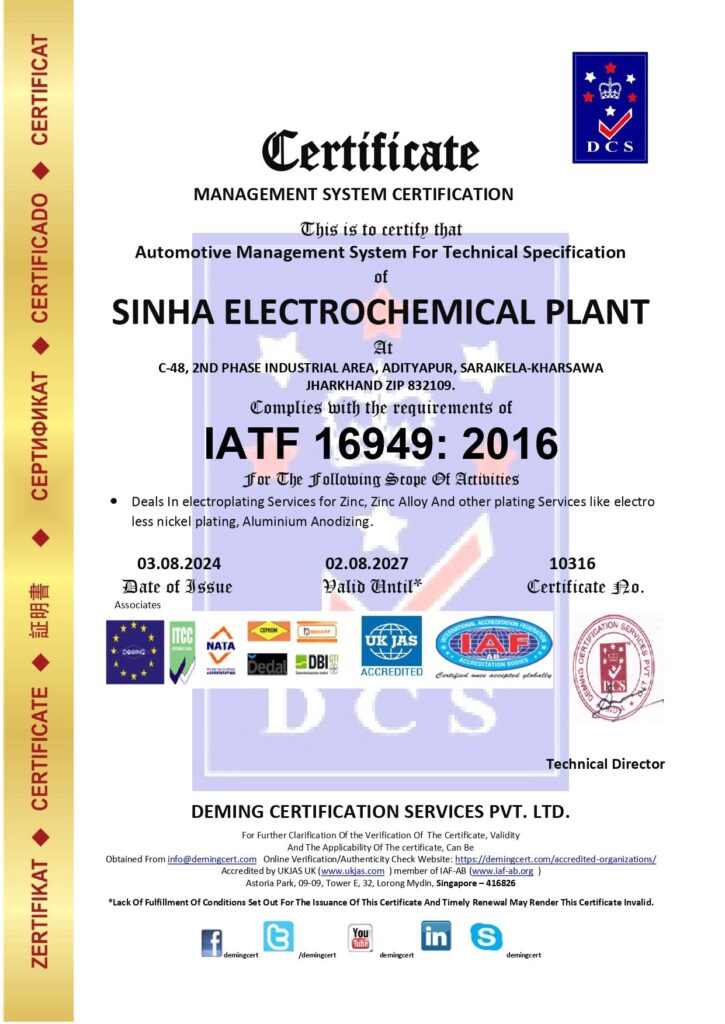
The IATF 16949:2016 certification achieved by Sinha Electrochemical Plant in 2024, with validity stated through 2027, represents an important milestone in its quality management journey. The certification is associated with the stated scope of Automotive Management System for Technical Specification.
It should be understood as recognition of the management system’s conformity within the certified scope, rather than a guarantee that every individual product is defect-free or that every customer automatically approves the organisation.
The real value of certification comes from consistent implementation. A certificate provides recognition, but the daily discipline of employees, supervisors and management determines whether the system continues to deliver meaningful results.
By integrating quality management principles with automotive-specific controls, Sinha Electrochemical Plant can strengthen its organisational capabilities and establish a more dependable foundation for future business development.
#IATF16949Certification
Chapter 4 – IATF 16949:2016 Certification: A Milestone in Professional Development
Certification is an important event in the development of an industrial organisation because it provides formal recognition that its management system has been assessed against a defined standard. However, certification should not be viewed as the final destination of quality improvement. It should be treated as a milestone that encourages an organisation to maintain discipline, evaluate its performance and continuously strengthen its operations.
For Sinha Electrochemical Plant, the IATF 16949:2016 certification issued in 2024 and stated as valid until 2027 represents a significant step in its professional quality journey.
The automotive industry has high expectations regarding product conformity, process consistency and customer satisfaction. Organisations serving automotive customers must understand the requirements applicable to their products and processes. A structured automotive quality management system helps create a framework for addressing these expectations.
IATF 16949:2016 is built around several important principles. These include customer focus, leadership, engagement of people, process management, risk-based thinking, evidence-based decision-making and continual improvement. It also includes additional automotive-specific requirements that strengthen controls across relevant organisational processes.
For an electrochemical surface treatment organisation, these principles can be translated into practical operating disciplines.
Customer focus begins with understanding what the customer actually requires. A purchase order may refer to a drawing, technical specification, coating standard or approved sample. The organisation must review the requirements carefully and ensure that its technical capability and available resources are suitable for the requested work.
Where a requirement is unclear, clarification should be obtained before processing. This reduces the possibility of misunderstandings and prevents avoidable quality problems.
Process management involves identifying the activities that influence product conformity. These may include material receipt, identification, cleaning, pretreatment, electroplating, rinsing, post-treatment, drying, inspection, packaging and delivery.
Each stage should have suitable controls. The organisation should determine which process parameters are important, how they will be monitored, who is responsible and what action is required when results fall outside the defined limits.
Risk management provides a method for considering what could go wrong before a problem occurs. For example, a change in chemical bath condition may influence coating quality. An equipment breakdown may affect processing consistency. Inadequate identification may create a risk of mixing different customer batches.
A risk-based approach encourages organisations to consider the likelihood and impact of such situations and establish proportionate controls.
Employee competence is another important requirement. Employees involved in chemical handling, process operation, inspection and quality verification must possess suitable knowledge and training for their responsibilities. Competence should be evaluated through appropriate methods rather than assumed simply because an employee has performed a task for a long time.
Training can cover process requirements, work instructions, safety precautions, inspection methods, nonconformity reporting and customer-specific requirements.
The certification journey also highlights the importance of internal audits. Internal audits help management determine whether the quality management system is operating as intended. They should evaluate both documented requirements and actual workplace practices.
An effective audit does not merely search for missing signatures or incomplete forms. It examines whether processes are controlled, whether employees understand the requirements and whether the available evidence demonstrates effective implementation.
Corrective action is equally important. When a nonconformity occurs, the organisation should identify the immediate issue, control affected material and investigate the underlying cause. Corrective action should address the reason for the problem rather than only correcting the visible defect.
For example, if a coating-related rejection occurs, the investigation may examine pretreatment, chemical bath conditions, material condition, process sequence, equipment performance and inspection practices. The objective is to identify the actual contributing causes and prevent recurrence.
The organisation must also evaluate whether corrective actions are effective. Closing an action without verifying the result may allow the same problem to return.
Management commitment supports all these activities. Leaders must ensure that employees have the necessary resources, equipment, training and authority to maintain quality. They must also review performance and encourage employees to report problems without unnecessary fear.
Certification can also improve the organisation’s professional presentation to prospective customers. Automotive manufacturers and suppliers frequently evaluate the management systems and technical capabilities of their supply-chain partners. A recognised automotive quality management certification may therefore support supplier evaluation and create opportunities for further discussions.
Nevertheless, business opportunities depend on additional factors such as customer approval, technical suitability, commercial terms, delivery capability and applicable purchasing requirements. Certification alone does not guarantee orders.
For Sinha Electrochemical Plant, the important achievement is the establishment and recognition of an automotive quality management framework within its certified scope. Its continued value will depend on maintaining the system, addressing audit findings, complying with applicable requirements and demonstrating continual improvement.
The 2024 certification milestone can therefore be viewed as the beginning of a stronger phase of organisational development. It provides a foundation for greater process discipline, improved customer confidence and a more systematic approach to industrial quality.
#AutomotiveQualityManagement
Chapter 5 – Operational Excellence: Improving Electroplating Processes and Product Consistency
Operational excellence is achieved when an organisation performs its activities in a controlled, efficient and reliable manner. In the surface treatment industry, operational excellence depends on the effective management of people, equipment, chemicals, materials, technical specifications and inspection activities.
Sinha Electrochemical Plant’s service portfolio includes Zinc Plating, Zinc Alloy Plating, Electroless Nickel Plating and Aluminium Anodizing. These processes have different technical characteristics, but they all require appropriate preparation, process control and verification.
A major element of operational excellence is understanding the relationship between process inputs and final product quality.
Incoming components should be identified and checked against the relevant order and customer requirements. Material identification is important because components may differ in substrate material, geometry, condition and intended application. Mixing customer batches or processing components under incorrect specifications can result in serious quality concerns.
Pretreatment is one of the most important stages in surface treatment. Components may require degreasing, cleaning, rinsing, pickling or other suitable preparation steps depending on their material and the specified process. The objective is to establish a surface condition suitable for the intended treatment.
Inadequate preparation may contribute to coating defects, poor adhesion, uneven deposits or surface contamination. Therefore, work instructions and process monitoring should clearly address the requirements applicable to each product category.
During Zinc and Zinc Alloy plating, the relevant process parameters should be controlled according to the established technical requirements. These may include bath composition, temperature, current density, treatment duration, agitation and other process-specific conditions.
The organisation should establish appropriate methods for monitoring and maintaining chemical baths. Chemical additions, analysis results, replenishment activities and bath maintenance should be controlled through suitable procedures and records.
Electroless Nickel Plating requires a different control approach because the deposition process is chemical and autocatalytic. Bath chemistry, temperature, pH, stabilisation and other applicable process conditions can influence deposition behaviour and coating characteristics.
Aluminium Anodizing also requires appropriate process control. The condition of the aluminium substrate, pretreatment, electrolyte condition, temperature, electrical parameters and sealing requirements may influence the final anodized layer.
The precise controls must be established according to the selected process, customer requirements and applicable technical specifications. A single general procedure cannot adequately replace process-specific instructions.
Inspection is another essential part of operational excellence. Depending on customer requirements, verification may include visual examination, coating thickness measurement, adhesion evaluation, corrosion testing, dimensional checks or other specified tests.
Inspection equipment must be suitable for its intended purpose. Measuring instruments should be identified, maintained and calibrated or verified according to applicable requirements. Employees performing inspections should understand the correct method and acceptance criteria.
Batch traceability is also valuable. The organisation should be able to identify processed batches and associate them with relevant customer orders, process records and inspection evidence. Effective traceability supports investigation when a complaint or nonconformity occurs.
Equipment maintenance helps protect process consistency. Pumps, rectifiers, heating systems, filtration arrangements, tanks, electrical connections and measuring instruments may influence the stability of operations. A planned maintenance programme helps identify deterioration and reduce unexpected breakdowns.
Workplace organisation contributes to productivity and quality. Clearly identified material areas, proper chemical storage, controlled movement of components and suitable separation of incoming, work-in-process and finished products can reduce handling errors.
The principles of 5S can support this effort through workplace organisation, cleanliness, standardisation and discipline. A well-organised workplace makes it easier for employees to identify materials, locate tools and follow defined procedures.
Waste reduction is another operational objective. Rework, rejection, unnecessary movement, excessive waiting, overprocessing and inefficient resource utilisation can increase operating costs. Monitoring these issues helps management identify opportunities for improvement.
Employee participation is important because operators often have practical knowledge of process behaviour and recurring difficulties. Encouraging employees to report abnormalities and suggest improvements can help identify problems before they become serious.
A systematic quality management approach also supports the evaluation of process performance. Relevant indicators may include batch rejection, rework, customer complaints, process downtime and delivery performance. Management can use this information to prioritise improvement projects.
Operational excellence is not achieved through a single major investment. It develops through consistent attention to small details and disciplined execution of established processes.
For Sinha Electrochemical Plant, strengthening operational controls across its different surface treatment activities can support reliable customer service and improve its ability to meet demanding technical requirements.
#ElectroplatingServices
Chapter 6 – Customer Satisfaction, Technical Reliability and Long-Term Business Relationships
Customer satisfaction is one of the most important factors influencing the long-term success of an industrial service organisation. Customers do not evaluate a supplier only by the price of a service. They also consider quality, delivery reliability, technical understanding, communication, responsiveness and the supplier’s ability to resolve problems.
In electroplating and surface treatment, customer satisfaction depends heavily on whether the finished component meets its agreed technical specification. A coating may look acceptable but still fail to satisfy a specified thickness, adhesion or corrosion performance requirement. Therefore, customer satisfaction must be supported by objective verification and appropriate process controls.
Sinha Electrochemical Plant’s range of Zinc Plating, Zinc Alloy Plating, Electroless Nickel Plating and Aluminium Anodizing services provides opportunities to support different customer requirements. However, each order must be reviewed carefully to establish the correct process and acceptance criteria.
Customer communication begins before production. The organisation should understand the customer’s technical drawing, purchase order, coating specification, material details, quantity, inspection requirements and delivery expectations.
A formal review process helps ensure that requirements are understood before the organisation accepts an order. It also provides an opportunity to identify any technical uncertainty or capability limitation.
Technical communication is particularly important when customers have specialised requirements. For example, a component may require a specific coating thickness, a particular appearance, controlled dimensional build-up or a defined corrosion test result. Such requirements should be understood and translated into appropriate production and inspection controls.
Customers may also require documents such as inspection reports, material identification records, certificates of conformity or process-related evidence. These requirements should be reviewed and incorporated into the order documentation where applicable.
Delivery performance is another major factor. A high-quality product delivered after the required date may still create difficulties for a customer. Delays can affect assembly schedules, inventory planning and production commitments.
Effective production planning helps coordinate available capacity, material requirements, process sequences and inspection activities. Clear communication is necessary when unexpected conditions may affect delivery.
Packaging and transportation also contribute to customer satisfaction. Finished components must be handled in a way that protects them from scratches, contamination, corrosion or other damage. Packaging requirements should be based on component characteristics and customer expectations.
Customer complaints should be treated as valuable information. A complaint may reveal an issue that was not detected through internal inspection or may identify a difference between the customer’s expectations and the organisation’s understanding of the requirement.
An effective complaint-handling process begins with acknowledgement and containment. Affected material should be identified, and appropriate action should be taken to prevent unintended use or delivery.
The next step is investigation. The organisation should review available records, process conditions, inspection evidence, employee observations and relevant technical requirements. Root-cause analysis can help determine why the issue occurred.
Corrective actions should address the identified causes. Depending on the situation, improvements may involve revised work instructions, additional process monitoring, equipment maintenance, employee training or changes to inspection controls.
The effectiveness of corrective action must be reviewed to establish whether the problem has been prevented from recurring.
Customer feedback should also be evaluated systematically. Positive feedback can identify strengths, while repeated complaints may reveal areas requiring management attention.
Customer satisfaction indicators can include complaint trends, delivery performance, rejection levels, repeat orders and customer feedback. These indicators should be interpreted carefully and used to support improvement decisions.
Building long-term customer relationships requires transparency. If an organisation identifies a technical difficulty or a potential delay, early communication is generally more constructive than waiting until the problem affects the customer’s operations.
The IATF 16949:2016 framework reinforces the importance of customer-specific requirements, risk management, process effectiveness and corrective action. Applying these principles can help Sinha Electrochemical Plant strengthen its approach to customer service.
The certification milestone may also support the organisation’s professional credibility during supplier evaluations. However, long-term trust is established through actual performance over time.
Customers are more likely to develop confidence when a supplier demonstrates consistent product conformity, accurate documentation, timely communication and a willingness to resolve problems responsibly.
For Sinha Electrochemical Plant, customer satisfaction should remain an ongoing organisational objective rather than a one-time achievement. Every order provides an opportunity to demonstrate technical understanding, process discipline and professional responsibility.
#ZincPlating
Chapter 7 – Employee Development, Workplace Safety and Environmental Responsibility
Industrial growth depends not only on technology and management systems but also on the people who perform daily operations. Employees influence product quality through their decisions, skills, attention and understanding of process requirements.
In an electrochemical plant, employee competence is particularly important because operations involve chemicals, electrical equipment, process tanks, measuring instruments and metal components. Employees must understand both the technical requirements of their jobs and the precautions necessary to perform them safely.
Sinha Electrochemical Plant’s quality management journey provides an opportunity to strengthen employee involvement and develop a more structured approach to competence management.
The first step is identifying the competence requirements for different positions. Production operators may require knowledge of process sequences, chemical handling, bath monitoring and equipment operation. Quality personnel may require competence in inspection methods, coating thickness measurement, documentation and nonconformity management.
Supervisors may need additional knowledge of production planning, process monitoring, employee coordination and corrective action. Management personnel must understand quality objectives, customer requirements, resource planning and management review responsibilities.
Training should be based on identified requirements. New employees should receive suitable induction and job-related training before independently performing tasks that may influence product quality or safety.
Existing employees should receive refresher training when procedures change, new equipment is introduced or performance reviews identify a need for additional competence.
Training effectiveness should also be evaluated. Attendance at a training session does not automatically establish competence. Practical demonstrations, observation, testing or other appropriate methods can help determine whether employees understand and can perform their responsibilities.
Employee awareness is equally important. Employees should understand how their activities contribute to product conformity and customer satisfaction. They should also know the consequences of ignoring process requirements or failing to report abnormalities.
Workplace safety is a major responsibility in electrochemical operations. Chemical handling may involve exposure risks, splashes, vapours and other hazards depending on the substances and processes used. Electrical equipment, wet working areas and manual material handling may introduce additional risks.
Appropriate safety measures should be established through hazard identification and risk assessment. These may include suitable personal protective equipment, safe chemical storage, ventilation, emergency arrangements, equipment safeguards, training and clearly communicated operating instructions.
Safety information should be available to employees who handle chemicals. Safety data sheets and relevant handling instructions should be maintained and communicated according to applicable requirements.
Emergency preparedness is also essential. Employees should understand the actions required in the event of chemical spills, exposure incidents, equipment failures or other foreseeable emergencies. Emergency equipment should be maintained and accessible.
Environmental responsibility is another important consideration for surface treatment organisations. Electroplating and anodizing processes can generate wastewater, chemical residues, sludge and other waste streams that require appropriate management.
The organisation should identify its applicable environmental obligations and establish controls for relevant activities. Wastewater treatment, chemical storage, waste segregation, authorised disposal and pollution prevention should be addressed according to applicable environmental laws and permissions.
Efficient chemical management can also support environmental performance. Proper process monitoring and chemical handling may help reduce unnecessary consumption and minimise avoidable waste.
Resource efficiency is another opportunity. Water and energy consumption should be monitored where relevant, and practical improvement measures may be identified through operational reviews.
The quality management system can support employee awareness and accountability by defining responsibilities and establishing communication methods. Regular discussions, workplace reviews and internal audits can help reinforce expected practices.
A positive workplace culture encourages employees to identify problems and suggest improvements. Employees who work directly with processes often notice small abnormalities that may not be immediately visible to management.
Management should therefore encourage open communication and take employee suggestions seriously. Recognising practical improvements can strengthen participation and develop a shared sense of responsibility.
For Sinha Electrochemical Plant, employee development is an important part of maintaining the value of its IATF 16949:2016 certification. A management system becomes effective when employees understand it and apply it consistently in their daily activities.
By strengthening competence, workplace safety and environmental responsibility, the organisation can create a more disciplined working environment and support sustainable industrial development.
#ZincAlloyPlating
Chapter 8 – Market Opportunities, Business Development and Competitive Strength
The industrial market is continuously evolving. Manufacturers seek suppliers who can provide technically suitable services, consistent quality, competitive commercial terms and dependable delivery. Surface treatment providers therefore have opportunities to strengthen their position by improving technical capabilities and developing professional relationships with customers.
Sinha Electrochemical Plant operates in a specialised service sector that supports the broader manufacturing industry. Its location in Adityapur, Jharkhand, places it within an industrial environment where engineering and manufacturing activities create demand for different supporting services.
The company’s portfolio includes Zinc Plating, Zinc Alloy Plating, Electroless Nickel Plating and Aluminium Anodizing. These services provide a basis for approaching customers whose components require suitable protective or functional surface treatments.
Business development should begin with understanding market requirements. Different industries may have different coating specifications, inspection expectations and approval processes. A company serving automotive-related customers must pay particular attention to customer-specific technical requirements.
Potential customer segments may include automotive component manufacturers, engineering companies, fabrication businesses, industrial equipment manufacturers and other organisations requiring surface treatment services. Actual business opportunities will depend on the organisation’s technical capability, applicable approvals and customer demand.
IATF 16949:2016 certification can support the company’s professional presentation during supplier evaluations. It demonstrates that the organisation has established a quality management system assessed against an internationally recognised automotive quality standard within its certified scope.
However, certification is only one element of supplier qualification. Customers may also examine process capability, available equipment, testing facilities, production capacity, delivery performance, financial suitability and previous experience.
A strong business development strategy should therefore connect quality management with practical technical evidence.
The organisation can prepare clear service information explaining its surface treatment processes, technical capabilities and applicable limitations. This information should be supported by accurate process descriptions and relevant inspection documentation.
Technical discussions with customers can help identify opportunities for improving existing services or understanding new requirements. Such discussions should be based on realistic technical capability rather than unsupported promises.
Customer visits and supplier assessments can also provide opportunities to demonstrate the organisation’s management practices. A clean, organised and controlled workplace can help communicate professionalism.
The company may strengthen its competitiveness through continual improvement in process consistency, reduced rejection, better production planning and more reliable delivery. These improvements can help reduce unnecessary operating costs while supporting customer satisfaction.
Another opportunity lies in developing the competence of employees and supervisors. Skilled employees are essential for controlling specialised processes and responding to technical challenges. Investment in training can therefore support both quality and business growth.
Digital record management may also provide benefits. Properly maintained digital records can improve access to inspection information, process history, training records and customer order details. Such systems can support traceability and reduce administrative difficulties when appropriately implemented.
The organisation may also consider developing performance dashboards for important indicators such as customer complaints, rejection, rework, delivery performance, equipment downtime and corrective action status. These indicators can help management make decisions based on actual performance information.
Supplier management is another area of importance. Chemicals, process consumables, equipment services and other purchased inputs may influence the final quality of surface-treated components. Evaluating suppliers and monitoring purchased material conformity can help reduce incoming risks.
Commercial development should remain aligned with operational capability. Accepting more orders without considering available capacity may increase delivery delays and quality risks. Growth planning should therefore evaluate resources, process capability and customer requirements before committing to additional work.
A balanced strategy focuses on sustainable growth rather than volume alone. A smaller number of well-managed customer relationships can sometimes create a stronger business foundation than accepting orders that exceed the organisation’s technical or operational capabilities.
For Sinha Electrochemical Plant, IATF 16949:2016 certification can become a useful part of its business identity. Combined with reliable surface treatment services, transparent communication and continuous improvement, it may support stronger supplier relationships and future market opportunities.
The long-term objective should be to establish a reputation based on technical reliability, responsible service and consistent customer satisfaction.
#ElectrolessNickelPlating
Chapter 9 – Continual Improvement, Risk Management and the Future of Quality
Industrial quality is not a fixed condition. Customer requirements change, production technologies develop, materials evolve and manufacturing expectations become more demanding. An organisation that wants to remain competitive must continually evaluate its performance and improve its processes.
The philosophy of continual improvement is central to the IATF 16949:2016 quality management framework. It encourages organisations to identify opportunities, analyse performance and take action to improve customer satisfaction and process effectiveness.
For Sinha Electrochemical Plant, continual improvement is especially important because electroplating and surface treatment processes depend on multiple technical variables. Small changes in material condition, chemical bath characteristics, equipment performance or employee practices may influence the final outcome.
The organisation should therefore develop a systematic approach to monitoring its processes.
One important method is the analysis of nonconformities. When a defect or deviation is identified, the immediate concern is to control the affected material and prevent unintended delivery. However, effective quality management goes further by investigating why the problem occurred.
Root-cause analysis can involve examining process records, inspection results, chemical conditions, equipment status and employee observations. Tools such as the 5 Whys and cause-and-effect analysis may help structure the investigation.
Corrective action should address the underlying cause and be proportionate to the significance of the issue. The organisation should also verify whether the action has been effective.
Process performance data provides another source of improvement information. Rejection trends, rework levels, customer complaints, delivery delays and equipment downtime can reveal recurring weaknesses.
Management can use these findings to prioritise improvement projects. For example, repeated defects associated with a particular process stage may justify a review of work instructions, process monitoring or employee training.
Risk management should be integrated into operational planning. Risks may arise from chemical supply interruptions, equipment breakdowns, incorrect process settings, unexpected changes in customer requirements or inadequate employee availability.
The organisation should assess relevant risks and establish appropriate controls. Contingency arrangements may be necessary for important resources and activities.
Change management is another important element. When a process, material, chemical, equipment arrangement or operating instruction changes, the organisation should evaluate the possible impact on product conformity and customer requirements before implementing the change.
This is particularly important in automotive-related work, where customers may require approval or notification before certain changes are introduced.
Internal audits should continue to evaluate the effectiveness of the quality management system. Audit planning should consider process importance, risk, previous findings and changes within the organisation.
Management review should provide a broader evaluation of performance. It should consider customer satisfaction, process results, audit findings, nonconformities, corrective actions, resource requirements and improvement opportunities.
Technology can support future development. Better monitoring equipment, improved measurement methods and suitable digital record systems may increase process visibility. However, technology should be selected according to actual operational needs and technical suitability.
The organisation may also consider strengthening its approach to process validation and measurement. Where customer requirements demand specialised testing, suitable testing arrangements and competent personnel are important.
Customer collaboration can provide additional improvement opportunities. Feedback about coating performance, assembly difficulties or field conditions may help the organisation understand how its services perform in actual applications.
Sustainability should also remain part of future planning. Responsible chemical management, wastewater treatment, waste reduction and efficient resource use can support environmental performance and long-term operational stability.
The 2024 IATF 16949:2016 certification milestone provides Sinha Electrochemical Plant with a recognised framework for maintaining and developing these practices. The stated validity through 2027 makes continued conformity, surveillance arrangements and ongoing system maintenance particularly important.
The organisation should not treat the certificate as a substitute for technical performance. Instead, it should use the management system to improve the way work is planned, performed, inspected and reviewed.
Continual improvement is ultimately a shared responsibility. Management establishes direction and provides resources, supervisors coordinate implementation, quality personnel evaluate conformity and operators maintain discipline during daily operations.
When these responsibilities work together, the organisation can develop a culture in which problems are identified early, decisions are based on evidence and improvement becomes a regular part of industrial activity.
For Sinha Electrochemical Plant, this approach provides an opportunity to build a stronger future through disciplined process management, technical learning and responsible business development.
#AluminiumAnodizing
Chapter 10 – A Vision for Sustainable Industrial Growth: Sinha Electrochemical Plant’s Journey Beyond Certification
The story of an industrial organisation is shaped by its ability to respond to changing requirements while maintaining its core commitment to quality. For Sinha Electrochemical Plant, the journey towards IATF 16949:2016 certification represents an important stage in the development of a more structured and professionally managed surface treatment operation.
Located at C-48, 2nd Phase Industrial Area, Adityapur, Saraikela-Kharsawan, Jharkhand – 832109, the organisation operates in an industrial sector that supports the wider manufacturing economy through specialised electrochemical treatment services.
Its business activities include Zinc Plating, Zinc Alloy Plating, Electroless Nickel Plating and Aluminium Anodizing. These services address different requirements relating to surface protection, coating characteristics and component performance.
The automotive manufacturing environment provides a demanding context for such activities. Automotive components must meet defined specifications, and their surface treatment can influence corrosion protection, durability, appearance and functional suitability.
The IATF 16949:2016 certification issued in 2024 and stated as valid until 2027 represents an important quality management milestone for the organisation within its certified scope of Automotive Management System for Technical Specification.
This milestone can be understood as part of a wider commitment to process discipline, customer focus, risk management and continual improvement.
However, the real success of an automotive quality management system is demonstrated through its ongoing implementation. The certificate is an important recognition, but the daily application of procedures and controls gives the system practical value.
Looking towards the future, Sinha Electrochemical Plant can continue strengthening its capabilities through several areas of development.
The first is technical consistency. Each surface treatment process should be supported by suitable operating instructions, process monitoring, inspection methods and competent personnel. Maintaining stable process conditions can help reduce variation and support customer confidence.
The second is customer-oriented planning. Understanding technical requirements before accepting an order helps the organisation identify capability needs and establish suitable controls. Clear communication can prevent misunderstandings and support stronger business relationships.
The third is employee development. Training and competence improvement should remain continuous activities. As technologies and customer requirements change, employees must receive the knowledge necessary to perform their responsibilities effectively.
The fourth is operational efficiency. Better planning, equipment maintenance, workplace organisation and process monitoring can help reduce avoidable waste and improve productivity. These improvements should be evaluated using actual operating information.
The fifth is responsible environmental management. Electrochemical operations require appropriate attention to chemical storage, wastewater management, waste disposal and pollution prevention. Compliance with applicable environmental requirements should remain an important part of the organisation’s operating philosophy.
The sixth is business development. Certification can support supplier evaluations and professional credibility, while technical capability and actual performance remain essential for securing and retaining customers. The organisation can explore suitable opportunities in automotive and other industrial sectors according to its resources and approvals.
The seventh is digital development. Suitable digital systems may improve documentation, traceability, production planning and management reporting. Any such implementation should be practical, secure and appropriate to the size and requirements of the organisation.
The eighth is continual improvement. Management should regularly review performance indicators, customer feedback, audit findings and operational risks. Improvement actions should be implemented systematically and evaluated for effectiveness.
The organisation can also strengthen its reputation by maintaining transparency in customer communication. Clear technical information, accurate inspection records and responsible complaint handling demonstrate professionalism.
An important lesson from the quality journey is that quality cannot be created by inspection alone. It must be built into the process from the beginning. Every employee, from management to the production floor, contributes to the final result.
Similarly, customer satisfaction cannot be achieved through promises alone. It is developed through consistent service, dependable delivery, technical understanding and the willingness to correct problems.
The automotive quality management framework provides Sinha Electrochemical Plant with a structured method for maintaining these commitments. By connecting technical expertise with management discipline, the organisation can continue improving its ability to serve demanding industrial customers.
The next phase of development should focus on strengthening what has been established, identifying realistic opportunities and maintaining the effectiveness of the certified management system.
The organisation’s growth should be measured not only by business expansion but also by improvements in quality, employee competence, customer relationships, process reliability and environmental responsibility.
Sinha Electrochemical Plant’s journey illustrates the importance of quality management in specialised industrial services. Its work in Zinc and Zinc Alloy Plating, Electroless Nickel Plating and Aluminium Anodizing places it within an important supporting segment of the manufacturing ecosystem.
The 2024 IATF 16949:2016 certification milestone provides a platform for continued organisational development. Its future value will be determined by the consistency with which the organisation applies its management system, responds to customer expectations and improves its processes.
With a sustained commitment to technical discipline, customer satisfaction and continual improvement, Sinha Electrochemical Plant can work towards a stronger industrial identity and more sustainable business development.
Quality is not simply a certificate displayed on a wall. It is a commitment demonstrated through every process, every inspection, every customer interaction and every improvement made.
#QualityManagementSystem
#SurfaceEngineering #AutomotiveComponentQuality #IndustrialExcellence #AdityapurIndustrialArea #ContinualImprovement
Take the Next Step Today
Don’t wait to enhance your business’s quality and efficiency. Partner with Hot Aaj News and experience the transformation that comes with expert consultancy and training. Contact us today to learn more about how we can help you achieve your business goals. Reach out via phone at +91-9322728183, visit our website at hotaaj.com, or email us at info@hotaaj.com Let us be your guide on the journey to excellence and innovation.