








Table of Contents
Chapter 1 – The Foundation of Railway Engineering Excellence and the Importance of Quality
Railways represent one of the most important foundations of modern transportation. Every day, millions of passengers and enormous quantities of goods depend on railway networks for safe, reliable and economical transportation. Behind every successful railway journey is a large network of engineering facilities, maintenance teams, workshops, technicians, inspectors and skilled workers. Among these essential facilities, Carriage Repair Workshop, situated at N.M. Joshi Marg, Lower Parel, Mumbai – 400013, Maharashtra, India, represents the important role played by railway repair and engineering activities in maintaining rolling-stock performance. (https://en.wikipedia.org/wiki/Carriage_Repair_Workshop,_Lower_Parel,_Mumbai)
Railway coaches and their associated components are continuously exposed to demanding operating conditions. They experience vibration, changing temperatures, repeated loading, environmental exposure, mechanical stress and long operating hours. Over time, these conditions can affect the condition and performance of different structural and mechanical components. Regular inspection, planned maintenance, timely repair and technically controlled restoration are therefore necessary to maintain the reliability of railway rolling stock.
Carriage Repair Workshop is associated with repairs to railway rolling stock, including ICF and LHB coaches, as well as activities involving railway vehicles and components for railway vehicles. Such work requires a combination of engineering knowledge, practical experience, trained manpower, suitable machinery, inspection arrangements and effective quality control.
One of the most important activities in railway component repair and manufacturing is welding. Welding is widely used to join metallic materials, restore damaged components, repair structural sections and support the manufacture or modification of engineering assemblies. However, welding is not simply a matter of joining two metal pieces together. It is a special process in which the quality of the final result depends on several interconnected factors.
These factors include the type and condition of base material, welding process, joint preparation, welding consumables, welder competence, welding parameters, environmental conditions, inspection requirements and the quality of supporting documentation. A weakness in any of these areas may affect the integrity of the completed welded joint.
In railway engineering, the importance of controlled welding becomes even greater because components may perform important structural or operational functions. Welding quality must therefore be managed through a systematic approach rather than depending exclusively on individual experience.
This is where ISO 3834-2:2021 becomes particularly relevant.
ISO 3834-2:2021 establishes comprehensive quality requirements for fusion welding of metallic materials. It provides a structured framework for controlling welding activities, ensuring that appropriate technical procedures, qualified personnel, inspection arrangements and production controls are established and maintained.
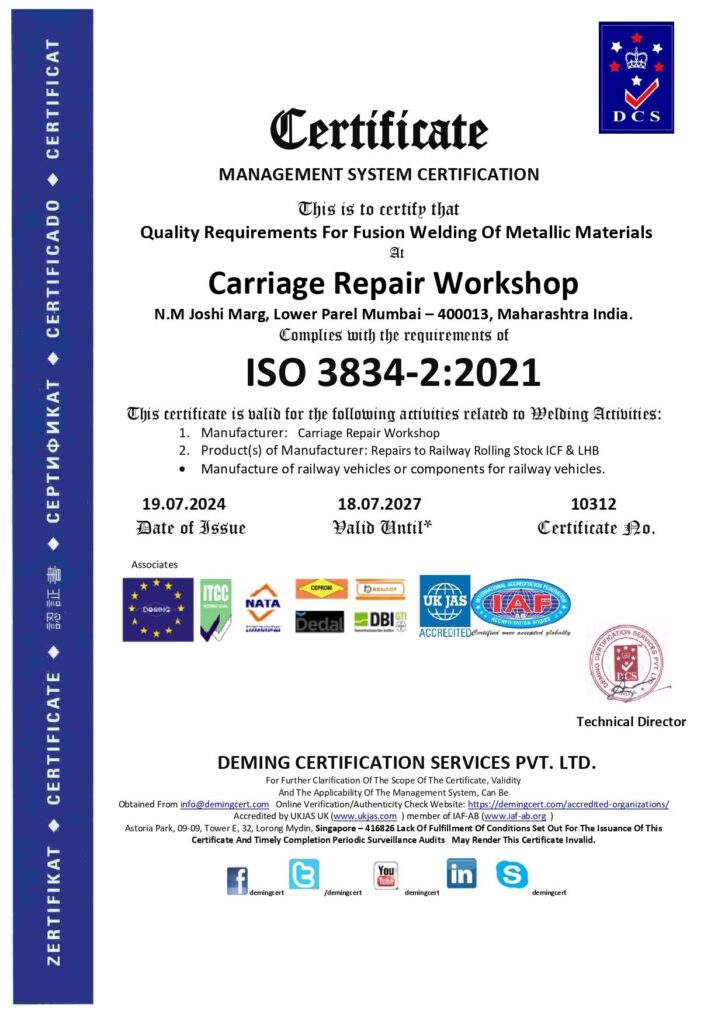
For Carriage Repair Workshop, certification to ISO 3834-2:2021, issued in 2024 and valid through 2027 as per the supplied certification information, represents an important step towards demonstrating a systematic approach to welding quality management.
The certification is especially relevant to the workshop’s stated scope of quality requirements for fusion welding of metallic materials. It connects technical welding activities with a broader management system that supports consistency, traceability, inspection and continual improvement.
The development of a quality-oriented workshop does not happen through documentation alone. It requires a working culture in which employees understand why procedures matter, supervisors recognize their responsibilities, inspectors maintain objectivity and management provides the necessary resources.
A successful welding quality system begins with understanding the work being performed. Each repair assignment must be examined to determine the nature of the component, its material, the extent of damage, the required repair method and the applicable technical requirements. The workshop must then determine which welding processes and controls are appropriate for the particular activity.
This approach helps reduce unnecessary variation between jobs. It also encourages employees to follow approved instructions rather than depending on assumptions or informal working practices.
Another important foundation is the recognition that quality belongs to everyone. Welders contribute through their workmanship, supervisors through planning and monitoring, quality personnel through verification, stores personnel through material identification and management through resource allocation and review.
When these responsibilities are coordinated, the workshop becomes better positioned to deliver consistent engineering results.
Railway maintenance also requires an appreciation of service continuity. Delays in repair work can affect the availability of rolling stock and place additional pressure on maintenance schedules. A systematic welding quality process can help prevent avoidable rework, improve the organization of inspection activities and support more predictable completion of repair assignments.
The objective is not simply to complete work quickly. The objective is to complete it correctly, safely and in accordance with applicable requirements.
Carriage Repair Workshop’s association with ISO 3834-2:2021 provides a framework for strengthening this objective. It supports the recognition of welding as a controlled special process requiring competent personnel, documented procedures, suitable equipment and appropriate inspection.
The workshop’s future development can therefore be understood through three interconnected priorities: engineering reliability, welding quality and organizational discipline.
Engineering reliability ensures that repaired components are suitable for their intended application. Welding quality establishes confidence in the integrity of welded joints. Organizational discipline ensures that the required controls are consistently applied.
Together, these priorities create a strong foundation for professional growth.
The certification journey also provides an opportunity to strengthen communication between departments. Repair teams, engineering personnel, quality inspectors and material stores can work more effectively when information is accurate, responsibilities are clear and technical requirements are communicated before work begins.
In this way, the value of certification extends beyond an official document. It encourages a practical quality culture that connects people, processes and engineering results.
For an organization involved in railway rolling-stock repair, such a culture is essential. The workshop’s contribution is not measured only by the number of components repaired but also by the reliability, consistency and technical confidence associated with the work.
The foundation of railway engineering excellence is therefore built on the principle that every component matters, every welding operation requires control and every employee contributes to the overall quality of the railway system.
#CarriageRepairWorkshop
Chapter 2 – Understanding ISO 3834-2:2021 and Building a Systematic Welding Quality Framework
The development of a dependable welding quality system requires more than skilled welders and modern equipment. It requires a clearly defined framework that establishes how welding work is planned, performed, monitored, inspected and documented. ISO 3834-2:2021 provides this framework through comprehensive quality requirements for fusion welding of metallic materials.
For Carriage Repair Workshop, the implementation of this international standard provides an opportunity to organize welding-related activities in a more systematic and technically controlled manner. This is particularly important because the workshop’s stated activities involve repairs to ICF and LHB railway rolling stock and the manufacture of railway vehicles or their components.
ISO 3834-2 focuses on the quality requirements associated with welding. It recognizes that welding is a special process because the final quality of a welded joint cannot always be completely verified through inspection of the finished product alone. Appropriate controls must therefore be established before, during and after welding.
The first major element is contract and technical requirement review. Before accepting or beginning a welding assignment, the organization needs to understand the applicable technical specifications, drawings, acceptance criteria, material requirements and inspection obligations. Any uncertainty should be clarified before work proceeds.
For railway repair operations, this review is particularly valuable. Different components may have different material grades, dimensions, structural responsibilities and repair limitations. The welding requirements must be appropriate to the specific component and its intended service.
The second important element is technical review and planning. The workshop needs to determine which welding processes are suitable, what equipment is required, which personnel are competent and what inspection activities must be performed. This planning establishes a connection between engineering requirements and actual workshop operations.
Welding procedures are another essential part of the framework. Welding Procedure Specifications (WPS) describe the necessary welding parameters and conditions for performing a particular welding operation. Where applicable, these procedures are supported by appropriate procedure qualification records. They help ensure that welding work is carried out under controlled conditions.
Personnel competence is equally important. Welders must possess qualifications appropriate to the processes, materials, positions and work requirements assigned to them. Welding coordination personnel must also have the necessary technical knowledge and authority to manage the relevant activities.
Material identification and traceability provide another important layer of quality assurance. Base materials and welding consumables should be controlled so that their identification, suitability and storage conditions can be established. This reduces the possibility of using unsuitable materials or consumables in important repair work.
Equipment control also deserves attention. Welding machines, measuring instruments and inspection equipment must be suitable for their intended purpose and maintained in satisfactory condition. Where measurement or monitoring equipment requires calibration or verification, appropriate arrangements should be established.
Inspection and testing must be planned according to the applicable requirements. Depending on the component and repair specification, this may involve visual inspection, dimensional checks and suitable non-destructive testing methods. The objective is to establish whether the completed work meets the defined acceptance criteria.
Documentation is not merely an administrative responsibility. It provides evidence that the welding operation was performed under the intended conditions. Records can include material identification, welding procedure references, welder qualifications, inspection results, equipment information and nonconformity records.
For Carriage Repair Workshop, a systematic approach to these elements can support better coordination between repair teams, engineering personnel and quality inspectors.
The standard also encourages organizations to establish controls for nonconforming work. When a defect or deviation is identified, the organization should record the issue, evaluate its significance, determine the appropriate corrective action and verify the result. This helps prevent repeated problems.
Continual improvement completes the framework. Inspection findings, internal reviews, customer feedback and performance information can be examined to identify opportunities for improving welding operations.
The importance of ISO 3834-2:2021 lies in the way it connects individual welding activities into one coordinated quality system. It creates a structured relationship between planning, competence, materials, equipment, production and inspection.
For a railway repair workshop, this relationship is essential. Each department contributes to the final quality of the component. When all departments work according to clearly defined responsibilities and documented arrangements, the organization can strengthen its ability to deliver consistent and technically controlled results.
The certification issued in 2024 and valid through 2027, according to the supplied details, provides a foundation for demonstrating this commitment. Its long-term value will depend on maintaining the system through regular monitoring, competent personnel, effective implementation and continual improvement.
#ISO3834
Chapter 3 – Strengthening Welding Operations for ICF and LHB Railway Rolling Stock
Railway rolling stock consists of numerous interconnected components that must work together under demanding operational conditions. Passenger coaches are exposed to continuous movement, vibration, environmental influences and repeated mechanical loading. Their maintenance therefore requires careful engineering assessment and technically appropriate repair practices.
Carriage Repair Workshop’s stated involvement in repairs to ICF and LHB railway rolling stock makes welding quality an important consideration in its operational activities.
ICF and LHB coaches represent different generations and designs of railway passenger rolling stock. Their construction, component arrangements, materials and maintenance requirements may differ. Consequently, repair activities must be based on the applicable drawings, specifications, engineering instructions and authorized maintenance requirements.
A workshop cannot apply one general welding method to every component. Each repair must begin with an assessment of the component’s condition and the nature of the defect. Cracks, damaged joints, corrosion-related deterioration, deformation and worn sections may require different technical evaluations and repair decisions.
The first stage is inspection. The damaged component must be examined to understand the extent and location of the defect. Visual examination, dimensional measurement and appropriate non-destructive testing may be necessary depending on the component and applicable instructions.
The next stage is engineering evaluation. Not every damaged component should automatically be repaired through welding. Some components may require replacement, while others may be repairable only through an approved method. The decision must consider the component’s function, material properties, structural significance and relevant railway requirements.
Once a repair method is approved, the welding operation must be planned. This includes selecting the applicable welding procedure, identifying suitable consumables, confirming personnel qualifications and establishing inspection requirements.
Joint preparation is an important factor. The surfaces and edges must be prepared according to the approved procedure and technical requirements. Incorrect preparation can affect penetration, fusion and the final quality of the welded joint.
During welding, the relevant parameters must remain within the qualified procedure limits. These may include current, voltage, travel speed, heat input and other variables depending on the welding process. Environmental conditions and component positioning must also be considered where relevant.
The welder’s competence plays a major role. Even an appropriate welding procedure cannot produce dependable results if the person performing the operation is not qualified or lacks the required practical ability.
Supervisors and welding coordination personnel have an important responsibility in ensuring that the approved method is followed. They must communicate technical instructions, monitor production conditions and address deviations when they arise.
After welding, the completed work must undergo the specified inspection. Visual examination can identify surface imperfections and visible irregularities. Dimensional verification helps establish whether the component conforms to the required geometry. Where necessary, non-destructive testing can provide additional information about internal or surface discontinuities.
The acceptance of the repaired component must follow the applicable engineering criteria. A repair should not be accepted merely because it appears satisfactory to the operator. Appropriate inspection evidence and authorization are necessary.
For railway rolling stock, this systematic approach supports reliability and maintenance discipline. It also helps reduce the possibility of repeated defects caused by uncontrolled repair methods.
Another benefit is improved coordination between departments. Engineering personnel can establish the repair requirements, welding teams can execute the approved procedure, and quality inspectors can verify the results. Documentation then provides a record connecting the original defect with the completed repair.
ISO 3834-2:2021 supports the establishment of these controls. It encourages organizations to manage welding as a coordinated technical activity instead of treating it as an isolated workshop operation.
For Carriage Repair Workshop, the opportunity is to strengthen consistency across different repair assignments while recognizing that ICF and LHB components may require different technical approaches.
The long-term objective is to develop a repair environment in which every welding operation is supported by appropriate planning, qualified personnel, suitable equipment and documented inspection.
Such discipline can contribute to better repair reliability, improved use of workshop resources and greater confidence in the quality of completed railway components.
Ultimately, the quality of railway rolling stock maintenance depends on the ability to combine practical engineering experience with systematic technical controls. ISO 3834-2:2021 provides an important foundation for achieving that balance.
#ISO38342021
Chapter 4 – Skilled Workforce, Welding Competence and Employee Development
People are among the most valuable resources of any engineering workshop. Machines, materials and technical procedures are important, but their effective use depends on the knowledge, experience and responsibility of the workforce.
For Carriage Repair Workshop, employee competence is particularly significant because railway rolling-stock repair requires coordinated engineering activities. Welding personnel, supervisors, technicians, inspectors, maintenance employees and supporting departments all contribute to the final result.
ISO 3834-2:2021 recognizes the importance of competent personnel in achieving satisfactory welding quality. It encourages organizations to identify the necessary qualifications and responsibilities for people involved in welding operations.
A qualified welder must be competent for the work assigned. Qualifications should be relevant to the applicable welding process, material group, welding position and other essential variables. The organization should ensure that qualifications remain appropriate and valid according to the applicable requirements.
However, professional development should not end with obtaining a qualification. Welding technology and engineering requirements continue to develop. Employees need opportunities to refresh their knowledge, understand updated procedures and improve their practical abilities.
Training can cover several areas. These include welding processes, joint preparation, consumable handling, welding parameters, defect recognition, safety requirements and documentation practices.
Employees should also understand the importance of following approved Welding Procedure Specifications. A procedure is not simply a technical document kept in the quality department. It is an operational instruction that guides the actual welding activity.
Supervisors have an equally important role. They must understand production requirements, verify that appropriate resources are available and ensure that assigned employees are competent for their tasks. They should also recognize when a job requires additional engineering evaluation or technical clarification.
Welding coordination personnel provide another important link between management and the workshop floor. Their responsibilities may include reviewing technical requirements, selecting appropriate welding procedures, coordinating qualification activities, monitoring welding production and supporting the resolution of technical issues.
Quality inspectors also require appropriate competence. They must understand the inspection methods applicable to the work, recognize relevant imperfections and make decisions using established acceptance criteria.
Employee development should extend beyond technical skills. Communication, teamwork, problem-solving, recordkeeping and professional responsibility are important for effective workshop performance.
For example, a welder who identifies an unexpected material condition should know how to report it rather than independently changing the approved repair method. A supervisor should understand the importance of stopping or holding work when a significant deviation is identified. An inspector should record findings accurately and communicate nonconformities clearly.
These behaviours create a culture of responsibility.
Another important aspect is knowledge sharing. Experienced employees often possess valuable practical knowledge developed through years of engineering work. Organizations can strengthen their capabilities by encouraging experienced personnel to guide younger employees and share lessons from previous assignments.
Mentoring can help new employees understand workshop practices, equipment handling, technical documentation and the importance of workmanship.
Training effectiveness should also be evaluated. Attendance alone does not prove competence. Practical demonstrations, qualification assessments, work observations and review of performance can help determine whether training has produced the intended results.
Carriage Repair Workshop can use this approach to strengthen the connection between individual skills and organizational quality objectives.
Employee participation is equally valuable. Workers who perform welding and inspection activities often understand operational difficulties that may not be visible during management reviews. Their suggestions can identify opportunities to improve material handling, equipment arrangement, workflow and defect prevention.
A supportive working environment encourages employees to report problems without unnecessary fear. This is essential because early identification of a problem is usually more effective than dealing with its consequences after the work has been completed.
The implementation of ISO 3834-2:2021 can therefore encourage a shift from experience-dependent working methods towards a combination of professional experience and documented competence.
The ultimate goal is not simply to maintain a list of qualified employees. It is to develop a workforce that understands the technical requirements of its responsibilities and applies them consistently.
When employees receive suitable training, clear instructions and appropriate support, they become active contributors to quality improvement.
For Carriage Repair Workshop, investing in people can strengthen operational discipline, improve coordination and support the long-term reliability of railway repair activities.
#RailwayEngineering
Chapter 5 – Material Traceability, Welding Equipment and Production Control
The quality of a welded component depends not only on the skill of the welder but also on the suitability of the materials, consumables and equipment used during production. Even a technically competent welding operation can produce unsatisfactory results if materials are incorrectly identified, consumables are unsuitable or equipment is not properly maintained.
For Carriage Repair Workshop, material management and equipment control are important elements of the quality framework associated with ISO 3834-2:2021.
Railway rolling-stock repair involves working with metallic materials that may have different compositions, thicknesses, mechanical properties and service requirements. The correct identification of materials is therefore essential before welding begins.
Material traceability helps establish a connection between the material used in a repair and its relevant identification or supporting documentation. Depending on the applicable requirements, this may include material certificates, heat numbers, batch references, purchase documentation and inspection records.
The objective is to ensure that the material selected for a particular application is suitable for the approved engineering requirements.
Material identification becomes particularly important when similar-looking materials have different technical properties. Using an unsuitable material can affect the performance and reliability of a repaired component.
The workshop should therefore establish appropriate procedures for receiving, inspecting, identifying, storing and issuing materials. Material handling personnel should understand the importance of maintaining identification throughout the process.
Welding consumables require similar attention. Electrodes, filler wires, shielding gases and other consumables must be selected according to the applicable welding procedure. Their storage and handling conditions should be controlled to maintain suitability for use.
Moisture exposure, contamination and unsuitable storage conditions can affect certain consumables. Appropriate storage facilities, handling instructions and issue records can reduce these risks.
Another important element is the control of welding equipment.
Welding machines must be suitable for the intended welding process and application. Their condition should be monitored through planned maintenance and appropriate verification. Damaged cables, faulty connections, unstable power output and poorly maintained accessories can affect production quality and workplace safety.
The organization should also identify the measuring and monitoring equipment required for quality control. Instruments used for dimensional verification, electrical measurements and inspection should be maintained in suitable condition.
Where calibration or verification is required, records should be available to demonstrate the equipment’s status. If an instrument is found to be outside its acceptable limits, the organization should evaluate whether previously completed measurements may have been affected.
Production planning connects materials and equipment with the actual welding assignment. Before beginning work, the responsible personnel should confirm that the necessary drawings, procedures, consumables, qualified welders and inspection arrangements are available.
A planned workflow reduces interruptions and unnecessary movement within the workshop.
Production records can provide valuable information about how a particular repair was performed. Depending on the applicable requirements, these records may include the component identification, material details, welding procedure reference, welder identification, consumable information, inspection findings and final acceptance status.
Such information becomes particularly useful when a component requires future examination or when an earlier repair needs to be reviewed.
Equipment maintenance also contributes to productivity. Planned maintenance can reduce unexpected breakdowns and support better utilization of available workshop resources. It allows potential equipment problems to be identified before they seriously affect production.
Another benefit of systematic material and equipment management is reduced wastage. Proper identification and controlled issue of materials can prevent avoidable consumption. Better equipment condition can reduce interruptions and the need for repeated work.
For Carriage Repair Workshop, the integration of material control, equipment maintenance and welding production planning can support a more reliable operational environment.
ISO 3834-2:2021 provides the quality framework within which these activities can be managed. It emphasizes that welding quality must be supported by suitable resources and documented controls.
A workshop that understands its material requirements, controls consumables and maintains its equipment is better positioned to achieve consistent results.
The long-term objective is to ensure that every welding operation begins with suitable materials, appropriate equipment and clear technical instructions.
This approach strengthens traceability, supports effective inspection and creates a dependable foundation for railway engineering quality.
#RailwayWorkshop
Chapter 6 – Inspection, Testing, Defect Prevention and Corrective Action
Inspection and testing are essential parts of railway engineering quality management. They help establish whether repaired and manufactured components conform to the applicable technical requirements. For welding operations, inspection is particularly important because the quality of a welded joint can be influenced by several variables throughout the production process.
Carriage Repair Workshop’s implementation of ISO 3834-2:2021 provides a structured basis for planning and controlling welding inspection activities.
A successful inspection system begins before welding starts. The organization must understand the applicable acceptance criteria and determine which inspection methods are necessary for the component and the particular welding assignment.
The first stage may involve inspection of incoming materials and consumables. Their identification, condition and suitability should be checked against the applicable requirements.
Before welding, inspectors or responsible personnel may examine joint preparation, alignment, cleanliness, dimensions and fit-up. Proper preparation is important because problems at this stage can create difficulties during welding and affect the finished joint.
During welding, production monitoring helps confirm that the approved procedure is being followed. Depending on the work, this may include checking relevant parameters, consumable handling, preheating requirements, interpass conditions and other essential variables.
After welding, the completed joint must be inspected according to the applicable technical instructions.
Visual testing is one of the most widely used inspection methods. It can help identify surface imperfections such as cracks, visible porosity, undercut, overlap, excessive reinforcement and irregular weld profiles.
Dimensional inspection helps verify whether the repaired component maintains the required dimensions and geometry.
Where required, non-destructive testing can provide additional information about weld quality. Methods may include ultrasonic testing, radiographic testing, magnetic particle testing and liquid penetrant testing, depending on material characteristics, component geometry and applicable requirements.
These methods must be performed by appropriately qualified personnel using suitable procedures and equipment.
The selection of inspection methods should be based on the engineering requirements rather than applied uniformly to every component.
One important objective of inspection is defect prevention. Detecting a problem after welding is valuable, but preventing it from occurring in the first place is generally more efficient.
For example, appropriate joint preparation can help reduce certain welding imperfections. Correct consumable storage can minimize problems associated with moisture. Proper welding procedure control can reduce the risk of unsuitable welding parameters.
Training and supervision also contribute to defect prevention because employees become better able to recognize conditions that may affect quality.
When a nonconformity is identified, the organization must establish a systematic response. The issue should be recorded and evaluated to determine its nature, extent and potential impact.
The next step is to determine the appropriate disposition. Depending on the circumstances, the component may require repair, rework, further inspection, replacement or another authorized decision.
Corrective action should address the underlying cause rather than merely correcting the visible defect.
For example, if repeated welding defects are associated with inconsistent joint preparation, the organization should review preparation instructions, training, supervision and production controls.
If equipment problems are contributing to irregular welding conditions, maintenance and verification arrangements should be examined.
The effectiveness of corrective action should be evaluated to determine whether the issue has been adequately addressed.
Records are important throughout this process. Inspection reports, nonconformity records, corrective-action reports and final acceptance documents help establish a clear history of the work performed.
Trend analysis can also reveal recurring problems. If similar defects occur repeatedly in particular operations, materials or work areas, management can investigate the underlying reasons.
This allows the organization to move from reactive inspection towards preventive quality management.
For railway rolling-stock repair, reliable inspection contributes to confidence in maintenance activities. It also supports better communication between engineering, production and quality departments.
ISO 3834-2:2021 encourages a systematic relationship between welding procedures, production monitoring and inspection.
For Carriage Repair Workshop, the long-term benefit is the development of a quality culture in which defects are identified early, investigated properly and prevented wherever possible.
The objective is not to achieve inspection records alone. It is to establish confidence that every completed welding operation has been evaluated against the applicable requirements and that identified problems are managed responsibly.
#RailwayRollingStock
Chapter 7 – Operational Efficiency, Productivity and the Growth of Engineering Capabilities
An engineering workshop must balance several important objectives. It must maintain technical quality, use resources efficiently, complete repair assignments within planned schedules and ensure that its workforce operates safely.
For Carriage Repair Workshop, the implementation of ISO 3834-2:2021 provides an opportunity to strengthen operational efficiency by organizing welding-related activities through defined processes and responsibilities.
Railway rolling-stock repair often involves multiple stages. A component may require initial examination, technical assessment, repair planning, material arrangement, welding, inspection and final acceptance. These stages must be coordinated to avoid unnecessary delays.
A poorly organized process can create problems such as waiting for materials, unclear instructions, repeated inspections, equipment unavailability and avoidable rework.
A structured welding quality system can help address these challenges.
The first improvement opportunity is better planning. When technical requirements are reviewed before work begins, the organization can identify the necessary resources and establish a suitable sequence of activities.
Production planning can consider the availability of qualified welders, welding equipment, consumables, inspection personnel and supporting facilities.
This reduces the possibility of beginning a job without having all the necessary arrangements in place.
The second opportunity is standardization. Approved welding procedures and documented work instructions help reduce unnecessary variation between similar assignments.
Standardization does not mean ignoring the technical differences between components. Instead, it ensures that comparable operations are performed using appropriately controlled methods.
The third opportunity is improved communication.
Engineering personnel must communicate technical requirements clearly to supervisors and production teams. Quality inspectors must communicate findings promptly. Stores personnel must understand material identification and issue requirements.
When communication is effective, employees spend less time resolving avoidable misunderstandings.
Another important factor is first-time quality. Work that meets requirements during the initial operation generally requires fewer corrective activities than work that must be repeatedly repaired or inspected.
Improving first-time quality can reduce material consumption, labour effort and equipment utilization associated with rework.
A workshop can monitor indicators such as welding nonconformities, repair frequency, rework hours, inspection rejection trends and equipment downtime. These indicators can help management identify where improvement is needed.
However, productivity should never be improved by compromising technical requirements. Railway components must be repaired according to the applicable engineering specifications and acceptance criteria.
Operational efficiency must therefore be understood as the ability to complete work correctly using available resources in a planned and responsible manner.
Another development opportunity is better use of digital information. Electronic records can help organize welding procedures, welder qualifications, material information, equipment maintenance schedules and inspection reports.
A well-designed recordkeeping system can make it easier to retrieve information when required and support management reviews.
Digital systems can also improve the monitoring of recurring issues. For example, management may examine whether particular welding operations generate repeated nonconformities or whether equipment downtime affects specific work areas.
These findings can guide practical improvement projects.
The workshop can also benefit from periodic process reviews. Employees who perform the work can identify unnecessary movements, delays and difficulties. Their feedback can be used to improve workplace arrangements and workflow.
The development of engineering capabilities also depends on learning from new technologies and updated requirements. Technical training, professional knowledge sharing and suitable equipment modernization can support long-term development.
ISO 3834-2:2021 contributes by establishing a quality-oriented framework in which these improvements can be planned and evaluated.
The certification issued in 2024 provides an important reference point for maintaining welding quality controls through the stated validity period ending in 2027.
For Carriage Repair Workshop, the broader opportunity is to connect quality performance with operational performance.
Better planning supports timely work. Competent personnel support dependable workmanship. Suitable equipment supports production consistency. Effective inspection supports acceptance. Corrective action supports continual improvement.
These elements work together to strengthen workshop performance.
The result is an organization better positioned to manage its engineering responsibilities while making effective use of its people, materials, machinery and technical knowledge.
Operational growth is therefore not simply an increase in the quantity of work completed. It is the development of a more organized, capable and dependable engineering environment.
#ICFCoaches
Chapter 8 – Railway Safety, Reliability, Customer Confidence and Organizational Reputation
Safety and reliability are fundamental expectations in railway transportation. Passengers, railway employees and other stakeholders depend on the railway system to operate through carefully managed engineering, maintenance and inspection activities.
The condition of railway rolling stock is an important part of this responsibility. Coaches must remain suitable for their intended operational use, and repair activities must be performed according to applicable technical and maintenance requirements.
Carriage Repair Workshop’s involvement in repairs to ICF and LHB rolling stock places welding quality within a wider framework of railway engineering reliability.
Welding can contribute to the restoration and manufacture of metallic components, but it must be performed under appropriate technical controls. A welded joint should be evaluated according to its intended function, applicable specifications and required acceptance criteria.
ISO 3834-2:2021 supports this objective by providing comprehensive requirements for controlling fusion welding activities.
One important contribution of the standard is the development of preventive thinking. Instead of depending only on final inspection, the organization is encouraged to establish controls throughout the welding process.
These controls include technical review, appropriate procedures, competent personnel, material identification, equipment maintenance and planned inspection.
Such an approach can help reduce the possibility of defects arising from uncontrolled production conditions.
However, it is important to recognize that ISO 3834-2 certification is not a guarantee that every welded component is defect-free or that every railway vehicle is automatically approved for service. Component acceptance, maintenance authorization and operational safety remain dependent on the applicable railway rules, engineering specifications and inspection requirements.
The certification provides a structured framework for managing welding quality within its defined scope.
This distinction is important because railway safety depends on multiple interconnected systems. Structural integrity, mechanical performance, electrical systems, braking arrangements, maintenance procedures and operational inspections all contribute to the overall safety of railway vehicles.
Welding quality is one important part of this broader responsibility.
Another major benefit of a systematic quality framework is improved confidence among stakeholders.
When an organization can demonstrate that welding activities are controlled through documented procedures, competent personnel and inspection records, it provides a stronger basis for technical confidence.
Engineering departments can refer to documented requirements when planning repair work. Inspectors can use defined criteria during verification. Management can review performance through records and internal evaluations.
Documentation also supports accountability. When responsibilities are clearly assigned, it becomes easier to establish who performed an activity, which procedure was followed and what inspection was completed.
For a railway repair organization, this information can be particularly useful when reviewing earlier work or investigating a technical issue.
The certification may also strengthen professional recognition. ISO 3834 is an internationally recognized series of standards associated with welding quality requirements. Demonstrating conformity to the comprehensive quality requirements of ISO 3834-2:2021 can help communicate an organization’s commitment to structured welding management.
Nevertheless, reputation must be supported by consistent performance. A certificate alone cannot establish long-term confidence. The organization must maintain its controls, demonstrate competent implementation and respond effectively when problems arise.
Customer and stakeholder confidence also depends on communication. Technical requirements should be understood before work begins, and inspection findings should be communicated accurately.
Where concerns are identified, they should be addressed through transparent investigation and appropriate corrective action.
Another aspect of reputation is professional responsibility. Employees should understand that their work contributes to the reliability of a larger transportation system.
This understanding can improve attention to detail and encourage responsible reporting of defects or unusual conditions.
Carriage Repair Workshop can further strengthen its quality culture through awareness programmes, technical discussions, process reviews and knowledge-sharing activities.
Lessons learned from repair assignments can help improve future work. Repeated defects can be examined to identify common causes. Successful improvements can be standardized and shared across relevant departments.
The organization’s reputation can also benefit from effective coordination with engineering suppliers and service providers. Material requirements, technical documentation and inspection expectations should be clearly communicated to all relevant parties.
The long-term objective is to establish a working environment where quality is not viewed as the responsibility of one department alone.
Every person involved in the repair process contributes to the reliability of the finished component.
ISO 3834-2:2021 provides an important structure for this responsibility. Through consistent implementation, the workshop can support a stronger relationship between engineering discipline, welding quality and stakeholder confidence.
In railway engineering, trust is earned through dependable work, accurate records and responsible technical decisions. These principles provide the foundation for lasting organizational reputation.
#LHBCoaches
Chapter 9 – Continual Improvement, Management Responsibility and Sustainable Development
Certification should never be considered the final destination of an organization’s quality journey. Its greatest value comes from the ability to maintain and improve the system over time.
For Carriage Repair Workshop, ISO 3834-2:2021 provides a framework that can support continual improvement in welding operations, employee competence, material management, equipment control and inspection activities.
Management responsibility is central to this process.
Senior management must ensure that appropriate resources are available to maintain the welding quality system. These resources may include qualified personnel, suitable welding equipment, inspection facilities, training arrangements and effective documentation systems.
Management must also establish clear responsibilities. Employees should understand who is authorized to approve technical requirements, coordinate welding operations, monitor production, inspect completed work and address nonconformities.
Without clear responsibilities, even well-written procedures may not be implemented consistently.
Management review provides an opportunity to evaluate the performance of the system. Relevant information can include inspection results, welding defects, corrective actions, equipment performance, training requirements and feedback from relevant stakeholders.
The purpose of a management review is not simply to examine documents. It is to identify whether the existing arrangements remain effective and whether changes are necessary.
Internal audits can provide another valuable source of information. They help determine whether documented arrangements are being implemented and whether the organization is meeting the applicable requirements within its certification scope.
Audit findings should be evaluated objectively. When an issue is identified, the organization should determine whether it represents an isolated problem or a wider weakness in the system.
Corrective action should then address the underlying cause.
For example, repeated deviations from welding procedures may indicate that instructions are unclear, employees require additional training or supervision arrangements need improvement.
Similarly, recurring inspection failures may suggest the need to review joint preparation, consumable management or welding parameters.
The objective is to transform inspection information into practical improvements.
Risk-based thinking is also useful. Management can identify activities where a failure or process deviation could have a significant effect on product conformity or operational reliability. Appropriate controls can then be prioritized.
This does not mean that every operation requires the same level of control. The nature of the component, technical requirements and consequences of failure should guide the level of attention.
Another important area is supplier and external-provider management. Materials, consumables, equipment services and inspection services can influence welding quality. The organization should establish suitable controls for externally supplied products and services according to their importance and applicable requirements.
Sustainable development is also becoming increasingly important in engineering operations.
A well-organized workshop can contribute to responsible resource utilization through improved material planning, reduced avoidable rework, better consumable storage and planned equipment maintenance.
Reducing unnecessary repair cycles can help save labour, electricity, materials and workshop resources.
Waste management and appropriate handling of industrial materials should also be considered in accordance with applicable environmental and safety requirements.
Employee development supports sustainability as well. Maintaining technical knowledge within the organization reduces dependence on individual experience and helps transfer important skills between generations of workers.
Digital transformation can provide further opportunities. Electronic records, equipment-maintenance schedules, qualification databases and inspection tracking systems can improve the availability of information.
However, digital systems must be appropriately controlled to ensure that records remain accurate, accessible and protected from unauthorized changes.
The certification issued in 2024 and valid through 2027, as supplied, should be supported by ongoing monitoring and the applicable surveillance or reassessment arrangements. Maintaining certification requires continued conformity with relevant requirements, not merely possession of the original certificate.
Carriage Repair Workshop can use periodic performance reviews to establish improvement priorities for each year of the certification cycle.
These priorities may include improved welding procedure control, employee refresher training, better traceability, reduced recurring nonconformities and stronger inspection planning.
Progress should be evaluated using meaningful evidence rather than assumptions.
The long-term objective is to create a learning organization. Such an organization does not ignore mistakes or treat audits as formal exercises. It examines experience, identifies weaknesses and makes improvements that can be sustained.
ISO 3834-2:2021 offers a structured foundation for this approach.
Through committed leadership, employee participation and regular performance evaluation, the workshop can strengthen its quality system and support the continuing development of its railway engineering capabilities.
Continual improvement is ultimately the process of making each future operation more controlled, more efficient and more dependable than the previous one.
#WeldingQuality
Chapter 10 – Future Vision, Professional Recognition and the Road Ahead After ISO 3834-2:2021 Certification
The future of railway engineering will depend on the ability of maintenance and manufacturing organizations to combine technical expertise, modern technology, skilled employees and internationally recognized quality practices. As railway transportation continues to develop, the expectations placed on repair workshops will also evolve.
Carriage Repair Workshop, located at N.M. Joshi Marg, Lower Parel, Mumbai – 400013, Maharashtra, India, has an important role within the railway engineering environment through its association with repairs to ICF and LHB rolling stock and the manufacture of railway vehicles or components for railway vehicles.
Its ISO 3834-2:2021 certification, issued in 2024 and valid through 2027 according to the supplied details, represents an important professional milestone in the management of fusion welding quality.
The certification provides a framework for demonstrating that welding activities are supported by systematic quality requirements. Its significance lies in the establishment of controls covering technical review, welding procedures, personnel competence, material management, equipment, production and inspection.
However, the real strength of the certification will be demonstrated through its continued implementation.
The future development of the workshop can be considered through several important areas.
1. Strengthening technical capabilities
Railway engineering requires continuous attention to new materials, repair technologies, welding methods and technical specifications.
The workshop can support its future development by encouraging technical knowledge sharing, reviewing relevant engineering developments and ensuring that employees receive suitable training.
The objective should be to maintain a workforce capable of understanding changing requirements and applying appropriate technical controls.
2. Improving welding procedure management
Welding procedures should remain appropriate to the work being performed. Their review, qualification and implementation should follow the applicable requirements.
A systematic procedure-management arrangement can help ensure that employees use the correct instructions and that changes are properly evaluated and authorized.
This is particularly important when different rolling-stock components require different welding arrangements.
3. Developing a stronger inspection culture
Inspection should be integrated into the production process rather than treated only as a final activity.
Pre-welding checks, production monitoring and post-welding inspection can help identify problems at an appropriate stage.
The use of suitable non-destructive testing methods, where required, can provide additional confidence in weld quality.
4. Investing in workforce development
The long-term strength of an engineering workshop depends on its people.
Training, practical knowledge sharing, welder qualification and technical development can help maintain competence.
Experienced personnel can contribute by guiding younger employees and sharing lessons learned from earlier repair assignments.
5. Improving digital documentation
Digital recordkeeping can support faster retrieval of welding procedures, material information, qualification records, equipment-maintenance details and inspection reports.
An organized digital system can improve traceability and make management reviews more effective.
6. Encouraging preventive maintenance
Equipment reliability has a direct influence on production continuity.
Planned maintenance, suitable equipment verification and timely replacement of defective accessories can help reduce interruptions and support consistent welding operations.
7. Strengthening process performance
The organization can review indicators such as rework frequency, inspection results, equipment downtime and recurring nonconformities.
These indicators can help management identify improvement opportunities and evaluate the effectiveness of corrective actions.
8. Supporting responsible resource utilization
Reduced rework, effective material handling and better equipment utilization can support more sustainable workshop operations.
Efficient use of materials and energy also contributes to responsible industrial practices.
9. Building stakeholder confidence
Internationally recognized welding quality requirements can help communicate the organization’s commitment to technical discipline.
However, stakeholder confidence must be maintained through consistent implementation, reliable inspection and responsible management of engineering activities.
10. Maintaining certification and continual improvement
The certification cycle should be used as an opportunity to evaluate the system regularly.
Internal reviews, corrective actions, employee awareness and applicable certification surveillance activities should support continued conformity.
The future of Carriage Repair Workshop is closely connected with the broader development of railway engineering in India. As railway infrastructure and rolling-stock technologies develop, the importance of dependable repair and manufacturing capabilities will remain significant.
A strong welding quality system can contribute to this development by supporting consistent processes and improved technical accountability.
The workshop’s work also demonstrates the importance of coordination between different professional groups. Welders, engineers, inspectors, supervisors, maintenance personnel and management must work together to achieve the intended quality objectives.
No individual or department can independently guarantee the quality of an entire railway component. Quality is created through the combined performance of all relevant activities.
The ISO 3834-2:2021 certification therefore represents more than a formal recognition of welding quality requirements. It provides an opportunity to strengthen a culture of technical responsibility and systematic improvement.
It is also important to recognize that ISO 3834-2 certification and railway operational authorization serve different purposes. Certification demonstrates conformity with the applicable welding quality requirements within the defined scope. The acceptance of railway components for service continues to depend on the applicable railway engineering, inspection and authorization requirements.
The broader lesson from this certification journey is that engineering excellence is achieved through continuous commitment. A certificate establishes an important benchmark, but everyday implementation gives that benchmark practical meaning.
Carriage Repair Workshop can continue building on this foundation by maintaining qualified personnel, suitable welding procedures, reliable inspection arrangements and effective management controls.
The ultimate vision is to contribute to railway engineering through dependable workmanship, disciplined processes and responsible quality management.
Every repaired coach component represents an important engineering responsibility. Every controlled welding operation contributes to the overall quality objective. Every employee has an opportunity to improve the reliability of the work being performed.
With the support of ISO 3834-2:2021 and a continued commitment to professional development, Carriage Repair Workshop can strengthen its position as a quality-conscious railway repair and engineering organization.
#QualityManagement
Conclusion
The journey towards welding quality excellence is continuous. From understanding technical requirements and controlling materials to developing skilled personnel and improving inspection practices, every activity contributes to the final result.
The 2024 ISO 3834-2:2021 certification provides an important foundation for this journey, with the supplied validity period extending through 2027.
Its lasting value will be reflected in the consistency of welding operations, the competence of employees, the effectiveness of quality controls and the organization’s commitment to continual improvement.
Carriage Repair Workshop’s story represents the importance of combining engineering experience with internationally recognized welding quality requirements.
The guiding principle for its future development remains clear:
Quality in every welding operation, reliability in every repair and excellence in every engineering responsibility.
#RailwayMaintenanceExcellence #FusionWeldingStandards #CertifiedWeldingQuality #RailwayComponentManufacturing #EngineeringQualityAssurance
Take the Next Step Today
Don’t wait to enhance your business’s quality and efficiency. Partner with Hot Aaj News and experience the transformation that comes with expert consultancy and training. Contact us today to learn more about how we can help you achieve your business goals. Reach out via phone at +91-9322728183, visit our website at hotaaj.com, or email us at info@hotaaj.com Let us be your guide on the journey to excellence and innovation.