

Table of Contents
Chapter 1: The Beginning of a Vision — Building a Foundation for Quality
Aliya Corporation, located in Juhapura, Ahmedabad, Gujarat, represents a business working in the field of toilet cubicle partitions, urinal partitions and interior furniture. These products are important components of modern commercial buildings, offices, educational institutions, hospitals, shopping centres, hotels and other public facilities. Although partitions and interior furniture may appear to be ordinary building products, their quality can influence the appearance, usability, cleanliness, privacy, durability and overall experience of a building. For a company serving this market, long-term growth depends on understanding these requirements and developing a reliable approach to product quality, customer service and responsible business practices.
The journey of a company begins with a clear understanding of the needs it wants to fulfil. In the interior products industry, customers generally expect products that are practical, attractive, durable and suitable for their intended environment. A toilet cubicle partition must provide privacy and maintain its appearance under regular use. A urinal partition must be appropriately designed and installed to serve its purpose. Interior furniture must combine functionality, appropriate material selection and a professional finish. When these expectations are considered together, it becomes clear that success requires more than simply supplying a product. It requires a complete approach that considers design, material selection, manufacturing or fabrication arrangements, inspection, delivery and installation wherever applicable. (https://www.indiamart.com/aliyacorporation/profile.html?srsltid=AYCX9vJO-FO3sx0EkjehOP_V8Q9SUS24c9XuKyGjfUtmNos0yVHL8Ve6)
For Aliya Corporation, its presence in Ahmedabad provides a foundation for serving customers who need interior products for different types of facilities. Ahmedabad has a diverse commercial and industrial environment, creating opportunities for businesses involved in construction, renovation, workplace improvement and interior development. Customers undertaking these projects often need suppliers who understand measurements, product specifications, delivery schedules and coordination with contractors. A supplier that communicates clearly and manages these responsibilities carefully can develop lasting professional relationships.
The company’s product range, including models AC-101C, AC-102C and AC-103C, provides a defined basis for product identification and customer discussions. Model identification can help organise quotations, product specifications, order processing, inspection records and customer enquiries. When each model is supported by clear technical information, customers can compare options and understand which product is appropriate for a particular application. Consistent identification also helps reduce confusion between orders and makes it easier to maintain records throughout the product’s commercial life.
A growing business must also understand that customer trust is built gradually. A customer may initially select a supplier because of price, availability or a recommendation. However, repeat business usually depends on the complete experience. Were the specifications understood correctly? Was the product supplied as agreed? Was communication timely? Were installation concerns addressed? Did the supplier respond professionally when a problem arose? These practical questions shape a company’s reputation more strongly than advertising alone.
Quality management therefore becomes an important part of business development. Even when a business has a relatively small team, clear procedures can make daily work more organised. Employees can use documented order details, approved specifications, inspection checklists and delivery records to reduce avoidable mistakes. Suppliers can be evaluated according to material quality, consistency and reliability. Customer complaints can be recorded and reviewed rather than handled informally and forgotten. Such practices create a foundation that can support growth as the number and complexity of orders increase.
Environmental responsibility is another consideration for modern interior products. Customers are increasingly interested in the materials used in buildings, the indoor environment and the long-term impact of purchasing decisions. Products installed inside occupied spaces can contribute to the overall indoor environment, depending on their materials, coatings, adhesives and other components. Responsible businesses therefore benefit from understanding the environmental requirements relevant to their products and communicating verified information accurately.
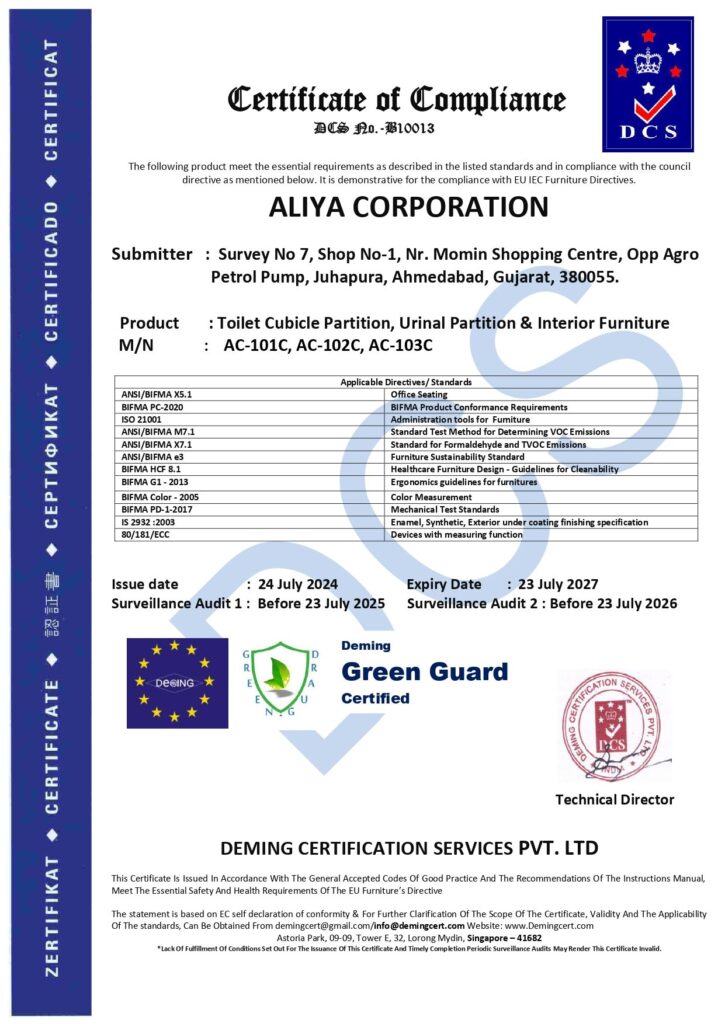
The Green Guard Certificate associated with Aliya Corporation, issued in 2024 and valid through 2027 according to the supplied details, provides an important theme for this growth story. The certificate can be presented as part of the company’s quality and environmental responsibility narrative, subject to the exact scope and claims authorised by the certificate. Its value is greatest when the company connects certification with actual product controls, supplier information, traceable records and responsible communication.
Certification alone does not automatically guarantee commercial success. Instead, it can support a structured approach to building credibility. Customers may seek evidence that a supplier takes product requirements seriously and can explain the basis of its claims. A company that maintains accessible records and communicates the limits of its certifications clearly is better positioned to establish professional confidence.
The first chapter of Aliya Corporation’s growth journey is therefore about establishing the right foundation. Product understanding, organised operations, customer focus, environmental awareness and accurate documentation are all important building blocks. By strengthening these areas, the company can prepare itself to respond to changing customer expectations and develop a more dependable position in the interior products market.
The central lesson is simple: sustainable business growth begins when a company treats quality not as a final inspection activity, but as a responsibility that starts with understanding the customer and continues through every stage of the order.
#AliyaCorporation
Chapter 2: Understanding Green Guard Certification and Its Role in Business Growth
For a company involved in toilet cubicle partitions, urinal partitions and interior furniture, environmental responsibility is closely connected with product selection, material control and customer confidence. Buildings are used by people every day, and the materials installed inside them can influence maintenance requirements, comfort and the overall indoor environment. As awareness of healthier buildings increases, customers may ask suppliers for more information about product composition, emissions, environmental characteristics and supporting documentation. This creates an opportunity for businesses such as Aliya Corporation to develop a stronger understanding of the relationship between product quality and environmental performance.
The Green Guard Certificate associated with Aliya Corporation is an important part of the company’s supplied business profile. According to the information provided, the certificate was issued in 2024 and is valid through 2027. The product categories include toilet cubicle partitions, urinal partitions and interior furniture, with model references AC-101C, AC-102C and AC-103C. These details provide a starting point for communicating the company’s certification status to customers. However, every public statement should remain consistent with the actual certificate, including its approved products, applicable criteria and authorised claims.
Green Guard certification is commonly associated with requirements concerning chemical emissions from products and their contribution to indoor air quality. The precise meaning of a particular certificate depends on the certification programme, the certified products and the applicable criteria. Consequently, a responsible supplier should retain the certificate and relevant supporting documents and ensure that marketing materials do not claim more than the certification demonstrates.
For Aliya Corporation, this distinction is particularly important because interior products can contain several materials and components. Depending on the product design, these may include boards, surface laminates, metal fittings, adhesives, sealants, coatings, fasteners and other accessories. The environmental characteristics of the complete product may depend on the materials and processes used together. Understanding this relationship helps the company ask better questions of suppliers and maintain more useful product records.
A practical first step is to develop a product documentation system. Each model should have an identifiable record containing its description, intended use, dimensions where applicable, material specifications, finish options and relevant supporting documents. If a model includes components obtained from external suppliers, the records should identify those components and their sources. This information helps staff respond to customer enquiries without relying entirely on memory or informal communication.
A second step is to establish a process for reviewing changes. If a supplier changes a board, adhesive, laminate or coating, the company should assess whether the change affects the product specification or the validity of any environmental claim. A component that appears visually similar may not have the same technical characteristics. Therefore, material substitutions should be evaluated rather than accepted automatically. Where certification conditions require approval or reassessment after a change, the applicable requirements must be followed.
These practices can also support purchasing decisions. Instead of selecting materials solely on the basis of their immediate price, the company can consider consistency, durability, documentation, delivery reliability and suitability for the intended application. A cheaper component may create additional costs if it produces more defects, requires replacement or causes installation delays. A balanced purchasing process considers the total effect on the order rather than only the initial purchase price.
Customer communication is equally important. When a client asks whether a product is certified, the sales team should be able to identify the relevant model and provide the appropriate evidence. Staff should avoid general statements that imply every product or every component has been independently assessed if the certificate covers only specified items. Clear communication protects the customer and the company’s reputation.
Certification can also encourage internal learning. Employees involved in procurement, sales, product preparation and customer service can receive guidance on what the certificate means, which products are covered and how supporting documents should be used. Such training helps prevent inconsistent messages and makes environmental responsibility part of everyday work.
The business benefits may extend beyond documentation. A more structured product information system can reduce repeated enquiries, improve quotation accuracy and help the company respond to projects with specific material requirements. Contractors and institutional buyers may appreciate suppliers who can organise technical information and provide it promptly. These capabilities can make commercial discussions more efficient, although actual sales growth will still depend on pricing, product performance, competition and customer demand.
Green Guard certification should therefore be viewed as one component of a wider business strategy. It can support a conversation about product responsibility, but it cannot replace suitable design, reliable installation, maintenance planning or honest customer service. The strongest approach is to connect certification with practical controls and continuous improvement.
For Aliya Corporation, the opportunity lies in making certification meaningful through daily business practices. When the company maintains accurate records, evaluates suppliers, controls material changes and explains product claims carefully, it can develop a more professional image. Over time, these practices may help create stronger customer relationships and improve the company’s readiness to participate in projects where documented product requirements are important.
The key lesson of this chapter is that certification delivers its greatest practical value when it becomes part of the company’s working system rather than remaining only a document used for promotion.
#GreenGuardCertification
Chapter 3: Product Quality, Design Consistency and Customer Satisfaction

Product quality is one of the most important factors influencing the long-term success of an interior products business. Customers purchasing toilet cubicle partitions, urinal partitions and interior furniture expect products that meet their specifications and suit the conditions in which they will be used. A product may look attractive in a catalogue, but its actual value depends on how well it performs after delivery and installation. For Aliya Corporation, strengthening product quality can therefore become a practical route towards improved customer satisfaction and repeat business.
Toilet cubicle partitions serve an essential function in public and commercial washrooms. They help create separate spaces, support privacy and contribute to the overall appearance of a facility. Their suitability depends on several factors, including the intended environment, material characteristics, dimensions, fittings and installation arrangements. Products used in busy public facilities may face frequent cleaning, moisture exposure and repeated contact. These conditions make appropriate material selection and correct installation particularly important.
Urinal partitions have their own functional requirements. Their dimensions, positioning, stability and finish must suit the layout of the washroom and the needs of the facility. Incorrect measurements can create installation problems or affect usability. Inadequate fittings may reduce stability, while unsuitable materials may deteriorate more quickly under the conditions of use. Clear product specifications and careful order review can help reduce these risks.
Interior furniture represents a broader category of products with different design and performance expectations. Depending on the application, customers may prioritise strength, appearance, storage capacity, ease of cleaning, efficient use of space or compatibility with existing interiors. An office, educational institution, commercial establishment and healthcare facility may each require a different combination of features. Understanding the customer’s actual needs before finalising an order helps the supplier avoid unnecessary changes and misunderstandings.
The model references AC-101C, AC-102C and AC-103C provide a useful basis for organising Aliya Corporation’s product information. A structured model catalogue could include descriptions, available dimensions, finish options, approved materials, relevant drawings and installation guidance. Where product configurations vary, the quotation and order documents should clearly identify the selected configuration. This approach reduces ambiguity and helps ensure that the delivered product matches the agreed requirements.
An effective quality process begins before the product is prepared. During the enquiry stage, employees should collect the information needed to understand the customer’s application. This may include the site location, number of units, dimensions, material preferences, expected delivery date and any project-specific requirements. When technical details are incomplete, the company should seek clarification instead of making assumptions that could lead to rework.
The next stage is order review. The company can compare the customer’s requirements with its available product specifications, supplier capabilities and delivery arrangements. Any differences should be resolved before the order proceeds. A written confirmation provides a common reference for the customer, sales team, procurement staff and installation personnel.
Incoming material inspection is another useful control. Materials can be checked against purchase specifications and supplier documentation. Depending on the item, the inspection may cover dimensions, finish, visible damage, quantity and identification. Records of rejected or nonconforming materials help the company monitor supplier performance and identify recurring problems.
During fabrication, preparation or assembly, appropriate checks can be used at important stages. These might include dimensional verification, surface inspection, confirmation of fitting positions and checks for visible defects. The precise inspection method should match the product and the company’s actual operations. It is not necessary to make every process complicated; the objective is to identify important problems early enough to prevent them from reaching the customer.
Before dispatch, a final review can confirm that the order is complete and matches the agreed specifications. Products should be protected against damage during handling and transportation. Accessories, fittings and relevant installation information should be included where required. Packaging and identification also deserve attention because a correctly prepared product can still arrive in poor condition if it is inadequately protected.
Customer feedback provides another opportunity for improvement. If a customer reports a dimensional error, surface defect, missing component or installation concern, the issue should be documented and reviewed. The immediate priority is to respond professionally and agree on a practical solution. The longer-term priority is to understand why the problem occurred and what can prevent its recurrence.
For example, repeated measurement errors may indicate that the site measurement process needs clearer responsibility or a standard checklist. Missing accessories may suggest that packing requires a separate verification step. Surface damage may point towards weaknesses in handling or transportation. Addressing the underlying cause is more effective than repeatedly correcting the same symptom.
Quality improvement can also reduce business costs. Rework, replacement materials, extra transportation and delayed installation all consume resources. Preventing these problems may improve operational efficiency and protect profit margins. However, the actual financial impact should be measured using the company’s own records rather than assumed.
For Aliya Corporation, a consistent approach to product quality can support the value of its certification-related communication. Customers are more likely to develop confidence when documentation is supported by dependable delivery and responsive service. Environmental responsibility and functional performance should be treated as complementary expectations.
The central message is that quality is created through many connected decisions. It begins with understanding the customer’s needs, continues through material selection and product preparation, and concludes with inspection, delivery and after-sales support. When these stages work together, Aliya Corporation can build a stronger foundation for customer satisfaction and sustainable commercial growth.
#ToiletCubiclePartitions
Chapter 4: Strengthening Customer Relationships and Expanding Market Opportunities
A company’s growth depends not only on what it sells but also on the relationships it develops with customers. In the interior products sector, buyers often seek suppliers who can understand project requirements, communicate clearly and deliver products according to agreed specifications. Aliya Corporation can use its experience in toilet cubicle partitions, urinal partitions and interior furniture to develop a customer-focused approach that supports long-term business opportunities.
The potential customer base for these products is diverse. Commercial offices require functional washroom facilities and suitable interior arrangements. Educational institutions need products that can withstand regular use and support practical maintenance. Hospitals and healthcare facilities may require careful attention to cleanliness, durability and the needs of different users. Hotels, restaurants and shopping centres often place importance on appearance as well as functionality. Industrial premises may need robust solutions appropriate for their working environments.
Each customer group has different priorities. A contractor working on a large commercial project may focus on technical specifications, coordination and delivery schedules. A smaller business renovating its premises may value straightforward advice, cost transparency and assistance with selecting appropriate products. An architect or interior designer may need product information that supports design decisions. Recognising these differences enables the company to tailor its communication without making unrealistic promises.
A useful starting point is to understand the customer’s application before recommending a model. Rather than discussing price alone, the sales team can ask about the type of building, expected usage, available space, preferred finish and installation requirements. The team can then explain the available options and identify any information that still needs confirmation. This approach helps the customer make a more informed decision and reduces the risk of selecting an unsuitable configuration.
Product information should be presented in a clear and professional format. Quotations can identify the model number, description, quantity, relevant specifications, price, delivery conditions and any exclusions. If installation is included, the responsibilities of the supplier and customer should be stated clearly. If site measurements are required, the timing and ownership of that activity should also be agreed. Such details prevent confusion when several contractors are involved in the same project.
Aliya Corporation can also develop a systematic follow-up process. After submitting a quotation, employees can contact the customer at an appropriate time to answer questions and understand whether any additional information is needed. Follow-up should be helpful rather than excessive. The aim is to maintain communication and make the purchasing process easier.
Customer relationships do not end when an order is delivered. A professional supplier should remain available to address reasonable questions about the supplied product and agreed services. If a concern arises, the response should be timely, respectful and based on the facts. Customers often judge a business not only by whether a problem occurs, but also by how the company responds.
A well-managed complaint can provide valuable information. If a product does not fit the site as expected, the company can review the measurement records, drawings and order confirmation. If a delivery is delayed, the team can examine supplier coordination and scheduling. If a customer is uncertain about a product’s environmental claims, the company can provide the relevant certificate information and explain its scope accurately. Each case can help improve future service.
Certification-related information may also be useful when communicating with professional buyers. Some projects have specific requirements concerning product documentation or indoor environmental considerations. Aliya Corporation can make the relevant documents available when appropriate, provided that the claims are supported by the certificate and any applicable restrictions are respected. This can help reduce uncertainty during supplier evaluation.
Digital communication offers another route to reaching potential customers. A clear website can introduce the company, describe its product categories and provide contact details. Separate pages for toilet cubicle partitions, urinal partitions and interior furniture can make it easier for visitors to find relevant information. Product photographs, model references and accurate descriptions can help customers understand the available range.
Search engine optimisation can improve the discoverability of this information. Useful content may address practical questions such as how to select a toilet cubicle partition, what to consider when planning commercial washrooms, how to maintain interior products or what information buyers should request from suppliers. Such content is most valuable when it genuinely helps customers rather than repeating keywords without useful detail.
The company’s location in Juhapura, Ahmedabad, can be included in its business information to help local customers understand where it operates. Any claims about delivery areas, installation coverage or project experience should reflect actual capabilities. It is better to describe a service area accurately than to promise coverage that the company cannot consistently provide.
Partnerships can provide additional opportunities. Interior designers, contractors, architects, builders and facility-management professionals may encounter projects that require partitions or furniture. Maintaining professional relationships with these groups can help the company understand upcoming needs and participate in relevant enquiries. Successful partnerships depend on reliability, transparent pricing and respect for agreed responsibilities.
Market expansion should nevertheless be approached carefully. New customer segments may require different technical capabilities, delivery arrangements or documentation. Before accepting a large or unfamiliar order, the company should evaluate whether it has the materials, resources and supplier support needed to fulfil the requirements. Growth that exceeds operational capacity can damage customer relationships and place pressure on cash flow.
A simple customer relationship record can support better follow-up. It may contain enquiry details, quotation history, customer preferences, order status, delivery information and feedback. Access should be managed appropriately, and personal or commercial information should be handled responsibly. Even a modest recordkeeping system can help prevent missed commitments and improve continuity when staff responsibilities change.
The long-term opportunity for Aliya Corporation is to become known as a supplier that listens carefully, explains products honestly and manages orders professionally. Strong customer relationships can lead to repeat enquiries, recommendations and more stable commercial connections. These outcomes cannot be guaranteed by certification alone, but they can be supported by a consistent customer-focused operating model.
The lesson of this chapter is that market growth is not simply about finding more customers. It is about serving the right customers well, understanding their needs and creating enough confidence for them to return when new requirements arise.
#UrinalPartitions
Chapter 5: Environmental Responsibility and the Future of Interior Products
Environmental responsibility has become an important consideration in the construction and interior products industries. Businesses, institutions and property owners increasingly consider how materials are selected, how products are maintained and how indoor spaces are managed. For Aliya Corporation, which supplies toilet cubicle partitions, urinal partitions and interior furniture, environmental awareness can become a practical part of product planning and customer service.
A responsible approach begins with understanding the materials used in each product. Depending on the design, interior products may contain boards, laminates, metal fittings, adhesives, coatings and other components. These materials can differ in durability, maintenance requirements and environmental characteristics. The company should therefore seek reliable information from suppliers and use suitable specifications when selecting components for its products.
Green Guard certification is relevant to this discussion because the programme is associated with chemical emissions and indoor air quality. However, environmental claims must be based on the precise certificate and its applicable requirements. A certificate should not be used to suggest that a product is completely harmless, entirely sustainable or environmentally superior in every respect unless appropriate evidence supports that particular statement.
For Aliya Corporation, maintaining a clear connection between certification records and product models is important. Models AC-101C, AC-102C and AC-103C should be identified in accordance with the actual scope of the certificate. If the company changes a material, supplier or product configuration, it should assess whether the change affects the relevant certification requirements. Where necessary, it should obtain updated evidence or approval before continuing to make a certification claim.
Material efficiency is another area in which a business can improve its environmental practices. Accurate measurements and careful planning can reduce unnecessary cutting and material waste. Better coordination between order confirmation, purchasing and product preparation can prevent avoidable errors. Materials that remain usable should be stored properly to protect them from damage. Waste should be segregated and handled according to applicable requirements.
These measures can also have operational benefits. Reduced waste may lower material costs, while better planning can improve productivity. Preventing damage helps avoid replacement purchases and additional transportation. Environmental responsibility and business efficiency are therefore not always competing objectives; in many situations, sensible process improvements support both.
Durability is equally important. A product that performs well over an appropriate service life may reduce the need for frequent replacement. For partitions and furniture, durability depends on the intended use, material properties, installation quality and maintenance conditions. Aliya Corporation should provide practical product guidance and avoid recommending configurations that are unsuitable for the environment in which they will be installed.
Maintenance information can help customers protect their investment. Depending on the product and material, guidance may cover appropriate cleaning methods, the use of compatible cleaning agents, inspection of fittings and prompt attention to damage. Instructions should be based on the manufacturer’s recommendations and the actual product specification rather than generic assumptions.
Supplier cooperation is central to these efforts. Suppliers can provide technical data, material identification, safety information and relevant environmental documentation. Establishing consistent documentation requirements can help the company compare materials more effectively and respond to customer enquiries. Suppliers should also be informed when documentation is incomplete or a material change has not been properly explained.
Employee awareness is another practical requirement. Staff involved in procurement, sales and product preparation should understand why material identification matters and how certification-related claims must be communicated. Employees should know where records are maintained and whom to contact when a customer requests information that they cannot verify independently.
The company can also use customer feedback to identify opportunities for improvement. Customers may report concerns about cleaning, durability, surface condition or the suitability of a particular configuration. These observations can guide future product recommendations and supplier discussions. Environmental responsibility should be treated as an ongoing process rather than a one-time marketing activity.
In the long term, businesses that understand their materials and communicate responsibly may be better prepared to respond to changing market expectations. Some customers may request specific environmental documentation during procurement, while others may simply value clear information and practical product guidance. Being prepared for both situations can improve the purchasing experience.
For Aliya Corporation, the Green Guard Certificate issued in 2024 and stated to be valid through 2027 provides a starting point for a broader discussion about responsible product selection. The next step is to support that message with accurate records, appropriate supplier controls and careful communication.
Environmental responsibility becomes meaningful when it can be seen in daily decisions. By considering material suitability, waste reduction, product durability and honest certification claims, Aliya Corporation can strengthen its business practices while contributing to more informed purchasing decisions.
#InteriorFurniture
Chapter 6: Operational Efficiency, Team Development and Professional Management
Every successful product business depends on the coordination of people, materials, information and time. Even when customer demand is strong, poor internal organisation can create delays, errors and unnecessary costs. For Aliya Corporation, improving operational efficiency can help connect its product quality objectives with reliable customer service and sustainable growth.
The order management process is a useful place to begin. Every order should have a clear record of the customer’s requirements, the selected model, agreed specifications, quantity, delivery arrangements and commercial terms. When information is recorded consistently, employees can refer to the same details rather than relying on informal conversations. This is especially important when multiple orders are being processed simultaneously.
A standard workflow can help staff understand their responsibilities. The process may begin with an enquiry, followed by requirement review, quotation, order confirmation, procurement, preparation, inspection, dispatch and customer follow-up. The precise sequence should reflect Aliya Corporation’s actual operations. If installation is provided, site coordination and completion checks can be included as additional stages.
Each stage should have a clear handover. For example, purchasing staff need accurate product specifications before placing an order with a supplier. Product preparation staff need confirmed dimensions and configuration details. Dispatch personnel need the correct quantity and delivery information. When responsibilities are unclear, mistakes can occur even when individual employees are working hard.
Simple checklists can reduce these risks. An order review checklist can confirm that the product model, dimensions and finish have been agreed. A material receipt checklist can record quantity and visible condition. A dispatch checklist can verify that the correct products and accessories are included. Such tools should be brief enough for employees to use consistently.
Planning is another essential part of operational efficiency. Supplier lead times, transport availability, site readiness and the customer’s requested delivery date all influence order scheduling. The company should avoid promising dates without considering these factors. When delays become likely, communicating early gives the customer more time to adjust project arrangements.
Inventory management can also support better performance. Keeping appropriate records of frequently used materials and components helps employees understand what is available and what needs to be ordered. Excessive inventory may tie up working capital, while insufficient inventory may delay orders. The objective is to balance availability with actual demand and supplier lead times.
A basic performance review can help identify recurring problems. Useful indicators may include on-time delivery, order accuracy, customer complaints, material rejection, rework and quotation response time. The company does not need a complicated reporting system at the beginning. It can start with a small number of meaningful measures and review them regularly.
Employee development is equally important. Workers who understand the product range, customer requirements and quality procedures can perform their tasks more confidently. Training may cover product identification, documentation, safe material handling, communication, inspection methods and the correct use of certification information.
Training should be practical. Employees can review common order errors, discuss examples of incomplete documentation and practise responding to typical customer questions. Supervisors can then observe whether the learning is being applied during daily work. Where mistakes continue, the company should determine whether further training, better instructions or changes to the process are needed.
A positive working environment encourages employees to report problems rather than conceal them. If staff members fear criticism whenever they identify an error, important information may remain hidden until it affects the customer. A professional culture should distinguish between honest mistakes, inadequate systems and deliberate disregard for agreed procedures.
Management commitment gives these activities direction. Leaders should make expectations clear, provide the resources needed to perform tasks correctly and review whether the procedures remain practical. They should also encourage employees to suggest improvements based on their daily experience.
Documentation is useful when it supports work rather than creating unnecessary administration. The best records are accurate, accessible and proportionate to the risk involved. Information that is no longer current should be updated, and employees should know which version of a specification or instruction is valid.
Operational efficiency also requires financial awareness. Material costs, transport, labour, rework and overheads all influence profitability. By reviewing costs against individual orders where practical, management can identify areas where better planning or supplier coordination may improve performance. Cost reduction should not compromise product suitability or agreed customer requirements.
For Aliya Corporation, professional management is the connection between its business ambitions and everyday results. Clear processes, trained employees, reliable records and meaningful performance reviews can make the organisation more dependable as its workload changes.
Growth becomes easier to manage when success does not depend entirely on the memory or personal effort of one individual. A well-organised business develops repeatable ways of working, enabling employees to coordinate their activities and customers to receive more consistent service.
#SustainableInteriors
Chapter 7: Digital Marketing, Brand Reputation and Competitive Positioning
In a competitive market, customers need to understand what a company offers, where it operates and why its products may be suitable for their requirements. Digital communication gives Aliya Corporation an opportunity to present its product range and certification information in a clear, accessible way. When supported by accurate information and reliable service, a professional digital presence can contribute to brand awareness and commercial development.
A useful website should make it easy for visitors to understand the business. The company introduction can describe its focus on toilet cubicle partitions, urinal partitions and interior furniture. Product pages can explain the purpose of each category and provide available specifications where confirmed. The contact page can display the company’s Ahmedabad address and appropriate business communication channels.
Product identification should remain consistent across the website, quotations and supporting documents. Model references AC-101C, AC-102C and AC-103C can help customers identify the products they want to discuss. Photographs should represent the actual products accurately, and descriptions should not include unsupported performance claims.
Certification information deserves particular care. The website can refer to the Green Guard Certificate according to the actual certificate details and authorised scope. The company should identify which products are covered and avoid implying that every item sold or every component used is certified unless the evidence supports that statement. The certificate’s issue and validity dates should also be reviewed before publication or renewal of marketing materials.
Search engine optimisation can help customers discover relevant product information. Rather than concentrating only on broad promotional phrases, the company can develop useful pages around customer questions. Topics might include choosing toilet cubicle partitions for commercial washrooms, planning partition layouts, comparing suitable materials, maintaining interior furniture and preparing product specifications for a project.
Such content should answer real questions. A helpful article explains relevant considerations and identifies when customers should seek professional advice. Repeating the same keywords many times without providing useful information is unlikely to create a strong user experience. Clear headings, meaningful descriptions, relevant images and logical internal links can make pages easier to navigate.
Local business information can support visibility among customers looking for suppliers in Ahmedabad and nearby areas. The company should ensure that its address, telephone details, operating information and business name are consistent wherever it maintains official profiles. It should only claim delivery or installation coverage in locations it can actually serve.
Social media can provide another way to communicate with potential customers. Posts may introduce products, explain maintenance considerations, show completed work with appropriate permission or share educational information about material selection. Images and project descriptions should be genuine. Customer names, photographs and project details should not be published without the necessary authorisation.
Digital communication can also support existing customers. A customer who receives a quotation may benefit from a product information sheet, a clear specification or a copy of relevant certification documentation. Making information easy to access reduces repeated enquiries and can help the customer coordinate with other project participants.
Online reputation develops through the relationship between promises and actual performance. Marketing may attract an enquiry, but customers form their lasting opinions through communication, product suitability, delivery and problem resolution. A company that responds professionally to concerns can demonstrate its commitment to service more effectively than one that relies only on promotional claims.
Customer reviews may provide useful feedback, but they should be handled honestly. The company should not manufacture testimonials or offer misleading representations of customer experience. Genuine feedback can highlight strengths and identify areas requiring improvement. Complaints should be addressed constructively rather than ignored.
Competitive positioning should also be based on real capabilities. Aliya Corporation may choose to emphasise product understanding, responsive communication, organised documentation or the availability of relevant certification evidence, provided these claims reflect its actual practices. It should not claim to be the largest, cheapest or most advanced supplier without reliable evidence.
A clear brand message can connect these elements. The company can present itself as a supplier focused on practical interior solutions, appropriate product information and responsible business conduct. This message becomes credible when customers experience the same qualities during actual transactions.
Digital performance should be reviewed using meaningful indicators. These might include relevant website enquiries, quotation requests, calls, product-page engagement and the proportion of enquiries that become orders. Website traffic alone does not establish business growth. The company should evaluate whether its digital activities attract the right customers and support profitable, sustainable work.
The long-term opportunity is to build a digital presence that informs rather than exaggerates. Accurate product descriptions, useful educational content and clear certification communication can help customers make decisions with greater confidence.
For Aliya Corporation, digital marketing is most effective when it reflects the real business. A professional online identity can open the door to new enquiries, but dependable service and product quality are what give customers reasons to return.
#IndoorAirQuality
Chapter 8: Challenges, Risk Management and Continuous Improvement
Every business faces challenges as it develops. Changing customer requirements, supplier delays, material price fluctuations, competition and unexpected project conditions can affect the performance of an interior products supplier. Aliya Corporation’s long-term development therefore depends not only on identifying opportunities but also on preparing for the difficulties that may arise during everyday operations.
One common challenge is variation in customer requirements. Two projects may both require toilet cubicle partitions but differ significantly in dimensions, layout, material preferences and installation conditions. A standard product may suit one location but require a different configuration for another. If these differences are not clarified before the order is confirmed, the company may face rework, delays or disagreements about the final product.
A practical risk-control measure is to review requirements before accepting the order. Drawings, measurements and written specifications should be checked for completeness. Unclear details should be confirmed with the customer or relevant project representative. Where site conditions may influence the final configuration, responsibilities for measurement and approval should be established in advance.
Supplier reliability is another important consideration. If a supplier delivers materials late or provides products that do not meet the agreed specifications, the company’s delivery commitments may be affected. Aliya Corporation can reduce this risk by maintaining clear purchasing requirements, reviewing supplier performance and identifying alternatives where appropriate. Alternative materials should not be introduced without assessing their suitability and any implications for product specifications or certification claims.
Price fluctuations can create additional pressure. A quotation prepared using one set of material prices may become less profitable if costs rise before procurement. The company can manage this risk through sensible quotation validity periods, timely purchasing decisions and clear commercial terms. It should also monitor costs to understand which products or orders are most exposed to price changes.
Cash-flow management is closely related to operational stability. A business may receive an order but still need funds to purchase materials, pay workers and arrange transport before receiving the final payment. Appropriate credit checks, agreed payment milestones and timely invoicing can help reduce financial uncertainty. Decisions should be based on actual customer relationships, contractual requirements and the company’s available resources.
Product quality risks require systematic attention. If repeated complaints occur, the company should examine the underlying causes rather than treating each complaint as an isolated event. For example, recurring fitting problems may indicate unclear specifications, while repeated surface damage may suggest inadequate handling or packaging. Corrective action should address the process responsible for the problem.
The same principle applies to certification-related risks. Environmental claims can create reputational and commercial problems if they are inaccurate or applied to products outside the certificate’s scope. Aliya Corporation should maintain the relevant documentation, verify product references and review public statements when the certification or its requirements change. Employees should know how to direct technical questions to the person responsible for the documentation.
Health and safety considerations are also important wherever materials are handled, products are assembled or installation activities are undertaken. Suitable working practices, appropriate equipment, safe storage and employee awareness can reduce the likelihood of injuries and damage. The controls required will depend on the company’s actual activities and applicable legal requirements.
Another risk comes from dependence on informal knowledge. If important specifications, supplier contacts or customer commitments are known only to one employee, the business may struggle when that person is unavailable. Keeping essential information in organised records improves continuity and reduces the likelihood of missed commitments.
Continuous improvement offers a structured response to these challenges. The company can review problems regularly, identify recurring patterns and decide which changes would provide the greatest benefit. Improvements might include revising an inspection checklist, clarifying a quotation template, changing a packaging method or introducing a supplier evaluation process.
The improvement process should be practical and measurable. Management can define the problem, investigate its cause, introduce a corrective measure and review the result. If the change does not work as expected, the company can adjust its approach. The aim is to learn from experience rather than simply produce additional paperwork.
Customer feedback should form part of this process. Complaints are useful, but positive feedback and repeat enquiries can also reveal what customers value. If customers consistently appreciate clear product information, the company can make that information easier to obtain. If customers experience difficulties coordinating deliveries, scheduling procedures may need improvement.
Risk management does not mean eliminating every uncertainty. That is rarely possible in a commercial environment. It means understanding the most important risks, deciding which controls are appropriate and responding promptly when conditions change.
For Aliya Corporation, a disciplined approach to risk can protect customer relationships and support responsible growth. The Green Guard Certificate can contribute to the company’s product documentation framework, while wider operational controls address the many other factors that influence business performance.
The lesson of this chapter is that strong businesses do not merely react to problems. They develop the ability to recognise patterns, correct weaknesses and improve the way work is performed.
#QualityManagement
Chapter 9: Business Expansion, Long-Term Planning and Promoter Development
Long-term business growth requires a balance between ambition and practical planning. A company may identify new markets and promising customer groups, but successful expansion depends on its ability to fulfil orders reliably, maintain financial stability and preserve product quality. For Aliya Corporation, the next stage of development can be approached through a structured plan that connects its existing product categories with realistic commercial opportunities.
The company’s current product range provides a starting point for evaluating potential markets. Toilet cubicle partitions and urinal partitions may be relevant to commercial washrooms, educational facilities, hospitality projects and other public or private buildings. Interior furniture may serve customers undertaking office development, renovation or facility improvement. The suitability of each opportunity will depend on the company’s actual product specifications, resources and service capabilities.
Rather than entering every market at once, management can assess opportunities according to customer demand, competition, expected order size, payment conditions and operational requirements. A market that appears attractive may also require substantial investment, specialised documentation or demanding delivery arrangements. Reviewing these factors before committing resources can prevent expansion from placing unnecessary pressure on the business.
Partnerships may provide a gradual route to broader market access. Relationships with contractors, architects, interior designers, builders and facility-management companies can introduce the business to relevant projects. To develop such relationships, the company should prepare clear product information and demonstrate that it can coordinate effectively with other project participants.
A professional quotation process can help distinguish the company in competitive situations. Customers should receive clear descriptions, appropriate specifications and transparent commercial terms. If an order includes several models, each item should be identified correctly. Delivery schedules and installation responsibilities should be stated wherever applicable. These details help customers compare offers on a consistent basis.
The company can also evaluate opportunities to improve its product catalogue. Better-organised model information can make it easier for customers to understand available options and for employees to prepare quotations. Any proposed product development should be based on actual demand, technical feasibility and the availability of reliable suppliers.
Certification-related information may be relevant to certain procurement discussions. Aliya Corporation can provide evidence associated with its Green Guard Certificate when the product and intended claim fall within the certificate’s actual scope. If a customer requests documentation beyond that scope, the company should explain the distinction and obtain the appropriate evidence rather than making unsupported commitments.
Financial planning is central to expansion. Before accepting larger orders, management should evaluate material requirements, supplier payment terms, transport costs, labour needs and expected customer payments. An order can generate substantial revenue while still creating cash-flow difficulties if expenses arise well before payment is received. Careful planning helps ensure that commercial growth remains manageable.
Promoter and management development also deserve attention. As a business becomes more complex, its leaders need to spend time not only on daily transactions but also on planning, supplier relationships, customer development and performance review. Delegating routine responsibilities can create more time for these priorities, provided employees have clear instructions and suitable authority.
Leadership is demonstrated through consistent decisions. When management insists on accurate quotations, fair treatment, realistic commitments and honest product claims, employees receive a clear message about the company’s standards. When these expectations are applied inconsistently, staff may become uncertain about which priorities matter most.
A business plan can establish direction without attempting to predict every future event. It may identify target customer groups, product priorities, marketing activities, operational improvements and financial objectives. Progress should be reviewed periodically so that the plan can be adjusted when customer demand or market conditions change.
Useful targets might include improving quotation response time, reducing order errors, increasing the proportion of repeat customers or maintaining better supplier documentation. Financial targets should be based on the company’s actual records and realistic forecasts. No target should encourage employees to compromise product suitability or make misleading claims merely to increase sales.
The company should also consider succession and continuity. Important supplier relationships, product knowledge and customer records should be documented so that the business can continue operating when responsibilities change. A more resilient organisation is less dependent on any one person’s memory or availability.
Expansion may eventually involve additional employees, broader distribution or new service arrangements. Such changes should be introduced only when demand and resources justify them. Growing too quickly can increase complexity before the necessary management systems are ready. Gradual, well-supported development may provide a stronger foundation.
For Aliya Corporation, the goal should be to develop a business that can grow without losing the qualities customers value. Product knowledge, dependable communication, appropriate documentation and responsible decision-making can all contribute to this objective.
The Green Guard Certificate, with the supplied issue year of 2024 and stated validity through 2027, can remain part of the company’s documented product story while management focuses on the wider foundations of commercial success. Long-term growth will ultimately depend on how effectively the company combines customer demand, product suitability, financial discipline and operational capability.
The lesson of this chapter is that expansion should be treated as a managed process rather than simply an increase in the number of orders. The strongest growth is growth that the organisation can support consistently.
#AhmedabadBusiness
Chapter 10: The Road Ahead — Building a Lasting Reputation Through Quality and Responsibility
The future of Aliya Corporation will depend on its ability to connect product quality, customer service, environmental responsibility and sound business management. Its product categories— toilet cubicle partitions, urinal partitions and interior furniture—serve practical needs in buildings where functionality, appearance and appropriate material selection matter. By continuing to improve the way these products are specified, supplied and supported, the company can work towards a stronger and more dependable market position.
The company’s Green Guard Certificate, identified in the supplied information as issued in 2024 and valid through 2027, forms an important part of this narrative. It provides a basis for discussing certification and product responsibility, subject to the exact certificate scope and applicable requirements. Its long-term value will be strengthened by accurate documentation, suitable supplier controls and transparent communication.
A certificate should not be viewed as the end of an improvement journey. It is more useful when supported by ongoing attention to product specifications, material changes and customer requirements. The company should ensure that its employees understand the relevant claims and that customers receive information appropriate to the products they are considering.
Product consistency will remain an important priority. The model references AC-101C, AC-102C and AC-103C should be supported by clear product identification and suitable technical information. Correct order review, material inspection, product checks and dispatch verification can help reduce avoidable mistakes. When problems arise, the company should investigate their causes and use the findings to improve future performance.
Customer satisfaction should remain at the centre of the company’s approach. Customers want to know that their requirements have been understood and that agreed commitments will be respected. Timely communication, transparent pricing and professional complaint handling help build this confidence. Repeat business is more likely to develop when the overall purchasing experience is dependable, although commercial outcomes will naturally depend on market conditions and customer needs.
Environmental awareness can also become a continuing area of development. The company can work with suppliers to obtain relevant material information, reduce avoidable waste and improve product documentation. It can guide customers on appropriate product care and maintenance where reliable instructions are available. These actions are practical ways to connect environmental responsibility with everyday operations.
Digital communication will remain useful for explaining the company’s products and capabilities. A clear website, organised product pages and accurate certification information can help potential customers understand what Aliya Corporation offers. Educational articles can answer common questions and support more informed purchasing decisions. Marketing should remain grounded in verified information and should not replace evidence with exaggerated claims.
Operational improvement is equally important. A business that records orders properly, manages suppliers carefully and reviews performance can identify weaknesses before they become recurring problems. Employees should receive practical training and be encouraged to suggest improvements. Management should review whether procedures are effective and revise them when business requirements change.
Financial discipline will help the company manage future opportunities. Larger orders may create attractive possibilities, but they can also require additional working capital, supplier coordination and delivery capacity. Reviewing these factors before making commitments can protect the business from unnecessary strain. Growth should be based on realistic demand and the resources required to serve customers properly.
The company can also strengthen its reputation by maintaining professional relationships throughout the supply chain. Contractors, designers, suppliers and customers all contribute to the success of an interior project. Clear communication and respect for agreed responsibilities make coordination easier and help reduce misunderstandings.
The next stage of development does not require every improvement to be introduced at once. Aliya Corporation can begin with a small number of priorities: keep certification records accurate, improve model-level product documentation, standardise order review, strengthen supplier evaluation and review customer feedback regularly. Progress in these areas can provide a foundation for further improvements.
Management can measure progress through indicators such as order accuracy, delivery performance, complaint resolution and repeat enquiries. The figures should be reviewed honestly, with attention to the reasons behind changes. A rise in sales may be encouraging, but it should be considered alongside profitability, service quality and the company’s ability to fulfil its commitments.
A lasting reputation is built through repeated actions. Customers remember whether the product matched the specification, whether the supplier communicated clearly and whether problems were handled fairly. Employees remember whether management supported responsible working practices. Suppliers respond to whether requirements and commitments are communicated consistently. Over time, these experiences shape the identity of a business.
Aliya Corporation’s growth story can therefore be understood as a continuing effort to combine practical products with professional management and responsible communication. Its location in Juhapura, Ahmedabad, provides its business identity, while its product range defines the market needs it seeks to serve. Its certification information provides an additional point of reference for customers who require relevant product documentation.
No certificate can guarantee commercial success, and no single process can eliminate every business risk. However, a company that continually improves its systems, respects its customers and communicates honestly can develop a more resilient foundation for future opportunities.
The broader lesson from this ten-chapter story is that quality is not only about the product delivered. It also concerns the information provided, the commitments made, the materials selected, the people involved and the way a company responds when circumstances change.
For Aliya Corporation, the road ahead is an opportunity to make these principles part of its everyday work. By keeping its claims accurate, strengthening its operations and focusing on customer needs, the company can continue working towards sustainable development and a reputation based on trust, responsibility and consistent service.
#EnvironmentallyResponsibleProducts
#GreenBuildingSolutions #ResponsibleMaterialSelection #CommercialWashroomDesign #CertifiedInteriorProducts #SustainableBusinessGrowth
Take the Next Step Today
Don’t wait to enhance your business’s quality and efficiency. Partner with Hot Aaj News and experience the transformation that comes with expert consultancy and training. Contact us today to learn more about how we can help you achieve your business goals. Reach out via phone at +91-9322728183, visit our website at hotaaj.com, or email us at info@hotaaj.com Let us be your guide on the journey to excellence and innovation.