

Table of Contents
Chapter 1 — The Beginning of a Technology-Driven Vision
Chrisel Technolab Private Limited represents the kind of technology-focused enterprise that can contribute to the changing landscape of software development, IT services and robotic technologies. Based at Vakhare Wadi, Post-Papdy, Vasai West, Maharashtra, the company operates in a field where innovation, reliability, information security and customer satisfaction are increasingly important. In a business environment shaped by digital transformation, organisations need technology partners that can understand complex requirements, develop practical solutions and provide dependable services. This creates opportunities for companies that combine technical knowledge with disciplined business processes.
The development of a technology company begins with a clear understanding of the problems it wants to solve. Software applications, digital platforms and robotic technologies are created to improve the way people and organisations work. They can help reduce repetitive activities, organise information, support decision-making and improve the efficiency of business operations. However, technical innovation alone is not enough. A successful technology service provider must also understand customer expectations, manage projects responsibly, protect information and deliver consistent results. (https://www.chrisel.net/)
For Chrisel Technolab Private Limited, research and development in software and robotic technologies provides a foundation for exploring new possibilities. Research encourages the study of emerging technologies, while development converts ideas into applications, systems, prototypes and practical solutions. These activities require a combination of creativity, technical competence, planning, testing and continuous improvement. A structured management approach can help connect these activities with the wider objectives of the business.
The technology industry is also characterised by rapidly changing customer requirements. A solution that satisfies a customer’s needs today may require updates, maintenance or improvements tomorrow. Software applications can experience performance issues, integration challenges and compatibility problems. Robotic systems may require careful evaluation of their operating conditions, programming logic and interaction with other equipment. Customers therefore value service providers that can respond to concerns, investigate problems and communicate clearly throughout the service lifecycle.
This is where systematic IT service management becomes important. Rather than depending entirely on individual experience or informal working arrangements, an organisation can define processes for service planning, delivery, monitoring, incident management and improvement. These processes provide a common framework for employees and management. They also make it easier to identify responsibilities, maintain records and learn from previous experiences.
The adoption of ISO/IEC 20000-1:2018 is relevant to this objective. The international standard specifies requirements for an IT service management system. It provides a structured approach to managing services so that they can meet agreed requirements and support customer needs. For a company involved in technology research and development, this framework can help connect technical activities with service quality, accountability and operational consistency.
Privacy management is equally significant. Software development frequently involves the collection, storage, transmission or processing of information. Depending on the project, that information may include personal data, customer records, employee details or information handled on behalf of other organisations. Responsible management of such information is essential for maintaining trust. Privacy cannot be treated merely as a final technical feature; it should be considered during project planning, system design, development, testing and service delivery.
ISO/IEC 27701:2019 provides a framework for establishing, implementing, maintaining and continually improving a privacy information management system. It extends privacy management practices in connection with information security management and helps organisations define how personal information should be handled. Its relevance to a software and robotics technology provider lies in the need to understand data responsibilities, control access, document processes and address privacy risks.
The company’s supplied certification profile identifies both ISO/IEC 20000-1:2018 and ISO/IEC 27701:2019, with an issue date of 2022 and a validity date of 2025. Together, these certifications represent two important management themes: dependable IT services and responsible privacy management. Their value is strongest when the principles behind them are incorporated into everyday operations rather than treated as documentation maintained only for assessment purposes.
Certification can also encourage a company to examine its internal practices. Management may review how customer requirements are recorded, how service issues are resolved, how development work is approved, how access to information is controlled and how improvement opportunities are identified. These questions help establish a stronger foundation for growth. They encourage employees to understand not only what they are doing, but also why a particular process exists and how it contributes to customer satisfaction.
For a growing technology enterprise, this discipline can support a more professional business identity. Customers increasingly evaluate service providers through their technical capabilities, communication practices, reliability and approach to risk. A clearly defined management system can help a company explain its working methods and demonstrate its commitment to structured operations, provided that its actual practices support those claims.
The story of Chrisel Technolab Private Limited can therefore be understood as a journey in which technical innovation and management discipline work together. Research and development provide opportunities to create new solutions, while IT service management and privacy management offer structures for delivering those solutions responsibly.
The broader lesson is that sustainable technology growth requires more than producing innovative products. It requires the ability to understand customers, manage complexity, protect information, learn from experience and improve consistently. By aligning its software and robotic technology activities with recognised management-system principles, Chrisel Technolab Private Limited can build a foundation for professional development, customer confidence and future opportunities in an increasingly digital economy.
#ChriselTechnolab
Chapter 2 — Understanding ISO/IEC 20000-1:2018 and the Importance of IT Service Management

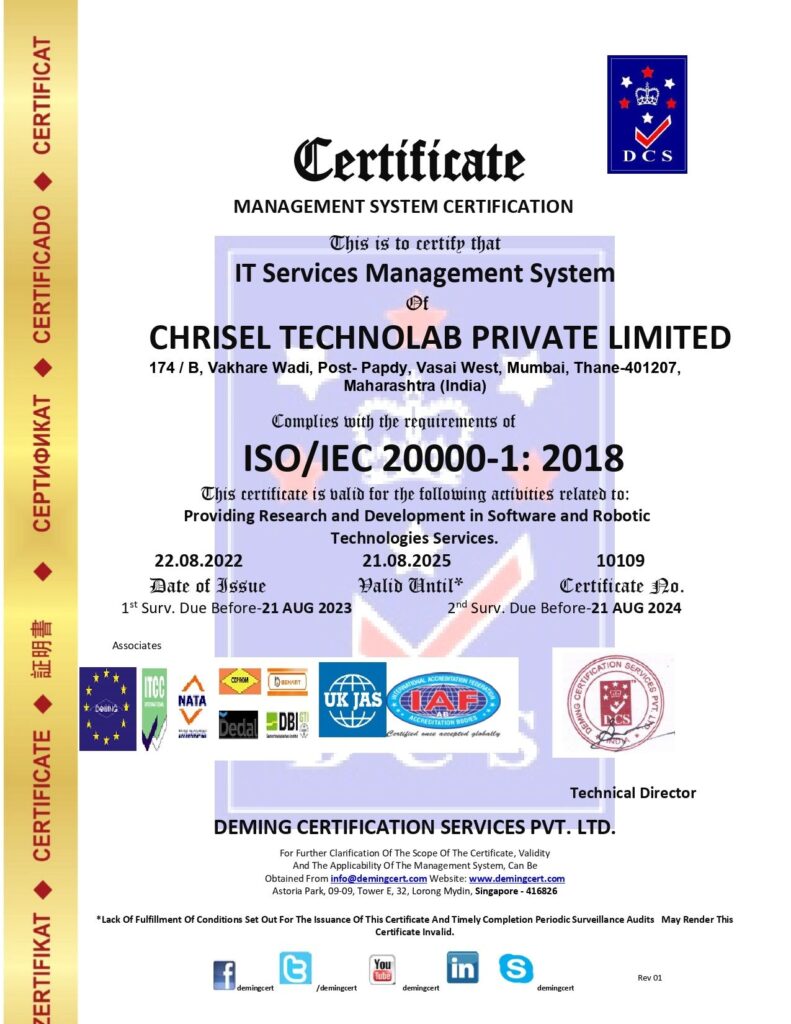
The growth of a technology business depends on its ability to provide services that are reliable, consistent and aligned with customer expectations. In software and robotic technology research, even a small service failure can affect a larger project. Delays in resolving a technical issue, unclear responsibilities, inadequate testing or poor communication can interrupt business operations and reduce customer confidence. A structured IT service management system helps an organisation address these challenges through planned activities, defined responsibilities and continual evaluation.
ISO/IEC 20000-1:2018 is an internationally recognised standard that specifies requirements for an IT service management system, commonly known as an SMS. Its central purpose is to help organisations establish, implement, maintain and continually improve a system for managing services. It is relevant to organisations that provide IT services directly, manage services for customers or depend on technology services to support their operations.
For Chrisel Technolab Private Limited, this framework is particularly relevant because the company’s stated activities include research and development in software and robotic technologies. Such activities can involve multiple stages, including understanding requirements, designing solutions, developing software, testing functionality, deploying applications and supporting customers after delivery. Each stage creates service-management responsibilities that benefit from clear procedures.
The first important area is service planning. Before starting a project, the organisation needs to understand the customer’s objectives, expected deliverables, timelines, technical environment and support requirements. These details can be documented through project briefs, service specifications, agreements and acceptance criteria. Clear documentation helps reduce misunderstandings and establishes a reference point for measuring whether the delivered service meets expectations.
The second area is service delivery. Once requirements are understood, the team needs a reliable method for assigning work, tracking progress, managing dependencies and reviewing results. Standardised processes can help employees follow consistent practices without restricting technical creativity. A developer may still explore different programming methods, but the project should have clear rules for approvals, version control, testing, release management and documentation.
Incident management is another important element. An incident may involve an application malfunction, a service interruption, an access problem or an unexpected technical error. A defined process helps the team record the issue, assess its impact, assign responsibility, investigate the cause and communicate progress. Once the issue is resolved, the organisation can review whether additional action is required to prevent recurrence.
For example, imagine that a customer reports that a software application is not processing a particular type of request. An informal response might involve making an immediate correction without documenting the underlying problem. A structured response would record the incident, identify affected functions, establish priorities, investigate the technical cause, test the correction and communicate the resolution. If the problem could occur again, the team might introduce an additional validation check or update the relevant development procedure.
This approach is valuable because it turns individual problem-solving experiences into organisational knowledge. Over time, incident records can reveal recurring weaknesses, frequently affected components and areas where preventive action is needed. Management can use this information to prioritise improvements and allocate resources more effectively.
Change management also matters in software and robotic technology projects. Changes may affect application functionality, system configuration, databases, interfaces or supporting infrastructure. Without suitable controls, an improvement intended to solve one problem may introduce another. A controlled change process considers the reason for the change, potential risks, testing requirements, approval, implementation and rollback arrangements where appropriate.
Service continuity and availability are equally important. Customers may rely on technology systems for essential operations. The service provider should understand which services are most important, what interruptions could mean for customers and what recovery arrangements are appropriate. Depending on the service, this may involve backups, documented recovery procedures, alternative operating arrangements and periodic testing.
ISO/IEC 20000-1:2018 also supports the use of performance evaluation. An organisation can define meaningful indicators for response times, resolution times, service availability, recurring incidents, customer feedback and delivery against agreed commitments. The purpose is not simply to collect figures. Measurements should help management understand performance, identify trends and decide which improvements will make the greatest difference.
For Chrisel Technolab Private Limited, these practices can help connect technical expertise with a more predictable service experience. Customers may benefit from clearer communication, better-defined responsibilities and a more systematic approach to resolving problems. Employees may benefit from consistent procedures, accessible documentation and improved coordination across projects.
However, the standard does not automatically guarantee that every service will be successful or that no incidents will occur. Its effectiveness depends on implementation, leadership, employee participation, suitable resources and regular review. Documentation must reflect actual work, and procedures must be updated when business needs change.
Certification should therefore be viewed as part of a broader management journey. The real objective is to build processes that help the organisation provide dependable services, respond to changing requirements and improve its performance over time.
When applied consistently, IT service management can support operational stability while allowing software and robotics teams to continue experimenting, learning and innovating. This balance between structured delivery and technical creativity is an important foundation for long-term growth.
#ISO200001
Chapter 3 — ISO/IEC 27701:2019 and the Responsibility of Protecting Privacy
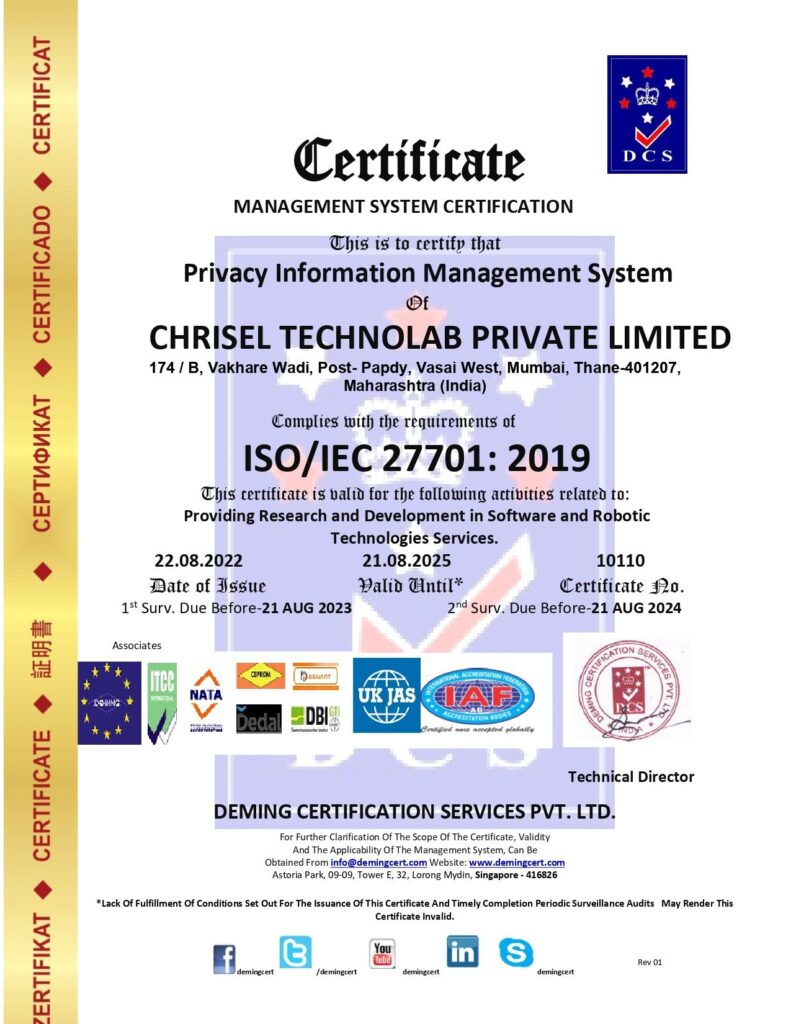
Digital technology creates opportunities for faster communication, improved automation and more effective information management. At the same time, it increases the responsibility of organisations that collect, access, store or process personal information. Privacy has become an important consideration for software developers, technology service providers and businesses that depend on digital platforms.
Chrisel Technolab Private Limited identifies Privacy Information Management System implementation within its supplied certification scope. This is significant because software and robotic technology projects may involve different categories of information, depending on the application and the customer’s requirements. A system may process user profiles, employee records, customer contact details, access logs or other information that can be connected to identifiable individuals.
ISO/IEC 27701:2019 provides requirements and guidance for a privacy information management system. It was designed as an extension to the information security management framework established by ISO/IEC 27001 and ISO/IEC 27002. The 2019 edition helps organisations establish responsibilities and controls for privacy-related information processing. Its implementation must be understood in the context of the applicable management-system arrangements and legal obligations.
Privacy management begins with understanding what information an organisation handles. A business cannot adequately manage privacy risks if it does not know what personal information is collected, why it is collected, where it is stored, who can access it and when it should be deleted. A structured information inventory can help identify these details and make responsibilities clearer.
For a software development project, this assessment may begin during requirements gathering. The team should determine whether personal information is necessary for the application to function. If it is necessary, the team should establish the intended purposes, relevant access permissions, retention requirements and appropriate security measures. If the information is unnecessary, avoiding its collection may reduce risk and simplify the design.
Privacy by design is an important principle in this context. Instead of treating privacy as a final checklist, developers consider it throughout the development lifecycle. During design, they can minimise unnecessary data collection. During implementation, they can apply appropriate access controls. During testing, they can avoid exposing real personal information unnecessarily. Before deployment, they can review privacy notices, configuration settings and data-handling procedures as applicable.
Consider a hypothetical robotic monitoring application that receives information from users and connected devices. The technical team might need to distinguish between operational data required for performance analysis and personal information that could identify an individual. Proper classification can help ensure that access to sensitive records is restricted and that information is used only for appropriate purposes.
Access management is another essential control. Not every employee or contractor needs access to every dataset. Role-based permissions, individual accounts, strong authentication and periodic access reviews can help limit unnecessary exposure. When a team member changes roles or leaves a project, access rights should be reviewed and adjusted promptly.
Data retention also requires careful attention. Keeping information indefinitely can create unnecessary risk, increase storage costs and complicate compliance. Organisations should establish retention periods based on legitimate business requirements, contractual commitments and applicable laws. Secure deletion or anonymisation should be considered when information is no longer required, subject to relevant preservation obligations.
Privacy incidents need an organised response. An incident may involve information being sent to the wrong recipient, unauthorised access, accidental disclosure or loss of a device containing sensitive data. A documented procedure can establish how incidents are reported, assessed, investigated and escalated. It can also help the organisation determine whether notifications to customers, authorities or affected individuals are required under applicable law.
Customer and supplier relationships introduce additional responsibilities. A technology company may act as a processor of personal information on behalf of a customer, while in other circumstances it may determine the purposes and means of processing and act as a controller. The applicable role depends on the actual arrangement, not merely on the wording used in a contract. Responsibilities should therefore be established clearly before a project begins.
Training is essential because privacy risks do not arise only from technology failures. Employees may accidentally disclose information through email, mishandle credentials or share files with an unauthorised person. Practical awareness programmes can explain how information should be classified, stored, transmitted and reported when something goes wrong.
Privacy management also supports customer confidence. Customers are more likely to trust a technology partner when the organisation can explain its approach to information handling, access control, risk assessment and incident response. Certification may help demonstrate that a formal framework exists, although it does not replace due diligence or guarantee that no privacy incident will occur.
For Chrisel Technolab Private Limited, the value of ISO/IEC 27701:2019 lies in integrating privacy responsibilities into technology development and service delivery. Its principles can help employees consider privacy risks before they become operational problems. They can also encourage more consistent documentation and clearer accountability.
Ultimately, privacy is both a management responsibility and a professional obligation. Protecting information requires appropriate technology, sound processes, informed employees and continued attention to changing risks. When privacy management becomes part of everyday decision-making, it can strengthen relationships with customers and support responsible participation in the digital economy.
#ISO27701
Chapter 4 — Bringing Software Research and Development into a Structured Environment
Research and development is an important driver of innovation. It allows a technology organisation to explore new concepts, test technical possibilities and transform promising ideas into useful solutions. In software and robotic technologies, research may involve algorithms, application architecture, automation methods, device integration, user interfaces, data processing or system performance.
For Chrisel Technolab Private Limited, research and development is the stated core business activity. This creates a natural connection between technical experimentation and structured management. Innovative work requires freedom to explore alternatives, but it also needs a reliable method for evaluating ideas, managing risks and documenting outcomes.
The research process often begins with a problem statement. A customer may need to automate a repetitive task, improve the reliability of a digital workflow or create a new software capability. The research team should translate that broad requirement into clear objectives. These objectives can then guide feasibility analysis, resource planning and technical evaluation.
A feasibility study can help determine whether a proposed solution is practical. The team may consider technical complexity, expected cost, available skills, infrastructure requirements, compatibility, performance and possible security implications. Early analysis does not eliminate uncertainty, but it helps the organisation identify important questions before committing substantial resources.
The next stage may involve developing a prototype. A prototype provides an opportunity to test assumptions and gather feedback before a full solution is built. It can help demonstrate whether a proposed workflow is understandable, whether a software component performs adequately or whether a robotic process can complete the intended task under specified conditions.
Testing should be planned according to the nature and risk of the project. Software testing may include unit tests, integration tests, functional testing, performance evaluation and user acceptance testing. Robotic technology development may additionally require checks relating to sensor behaviour, control logic, communication interfaces, environmental conditions and safe operation. The precise test programme should reflect the actual system rather than a generic checklist.
Documentation plays a vital role in this process. Research notes, requirements, design decisions, test results, defect reports and version histories help the team understand why a particular solution was selected. They also make it easier for another engineer to review the work, reproduce a result or continue development if the original contributor becomes unavailable.
A structured approach can reduce dependence on individual memory. In an informal environment, important technical knowledge may remain in personal notebooks or private conversations. This can create difficulties when a project expands or employees change responsibilities. A managed knowledge repository can make approved information easier to locate and maintain.
Version control is particularly important in software development. It allows teams to track modifications, compare versions, review contributions and restore earlier code when necessary. Changes can be reviewed before they are incorporated into the main development branch. Release procedures can then help ensure that tested versions are deployed to the intended environments.
The relationship between research and service management is also important. An innovative solution must eventually become a usable service or product. The organisation therefore needs a clear transition from development to operational support. This transition may include installation instructions, user documentation, support arrangements, known limitations, maintenance plans and training.
ISO/IEC 20000-1:2018 can provide relevant management-system processes for the services that result from development. It does not prescribe a particular software development methodology, nor does it certify the technical quality of every individual application. Instead, it helps establish requirements for managing the services covered by the system.
Privacy considerations must also be integrated into research activities. Development teams should determine whether test data contains personal information and whether a less sensitive dataset could achieve the same purpose. Where personal information is necessary, access should be controlled and the data should be handled according to applicable requirements. Privacy risks should be considered when selecting architectures and external services.
Robotic technology projects may create additional challenges because software interacts with physical equipment. Testing should account for the relevant operating environment, failure modes and potential consequences of unexpected behaviour. Where a robotic system can affect human safety or critical operations, qualified technical assessment and appropriate safety engineering are essential. A general management-system certificate is not a substitute for product-specific safety evaluation.
Management can support research by defining priorities while allowing engineers to investigate alternatives. Regular technical reviews can examine progress, unresolved issues, resource needs and lessons learned. Projects that prove unfeasible can still create valuable knowledge when their findings are documented and shared appropriately.
A disciplined research environment can also improve collaboration between technical and non-technical employees. Business teams can clarify customer needs, developers can explain technical constraints, and service personnel can identify support challenges. This shared understanding reduces the risk of producing technically interesting solutions that do not solve the customer’s actual problem.
For Chrisel Technolab Private Limited, integrating structured management into research and development can support repeatability, accountability and knowledge preservation. The objective is not to restrict creativity with unnecessary paperwork. It is to establish enough structure to make innovation more reliable, traceable and useful.
When research, testing, documentation and service delivery are connected effectively, an organisation is better positioned to turn technical ideas into solutions that customers can understand, adopt and maintain.
#ITServiceManagement
Chapter 5 — Improving Customer Satisfaction Through Reliable IT Services
Customer satisfaction is one of the most important foundations of long-term business growth. In the technology sector, customers do not evaluate a service provider only by the software delivered or the technical features demonstrated. They also consider whether the provider understands their requirements, meets agreed timelines, responds to problems and communicates clearly throughout the relationship.
For Chrisel Technolab Private Limited, a business engaged in software and robotic technology research and development, customer satisfaction can be strengthened through a consistent approach to service planning, delivery and support. The principles of ISO/IEC 20000-1:2018 provide a useful framework for organising these activities and making service responsibilities clearer.
The customer relationship generally begins with understanding the problem. A customer may request a software application, a technical upgrade, an automation solution or support for an existing system. Before work begins, the service provider should clarify the expected results, operational environment, required features, budget constraints, acceptance criteria and support arrangements. Written confirmation can reduce confusion and establish a common understanding.
Requirements should be reviewed when changes arise. Technology projects often evolve as customers discover additional needs or encounter new operational challenges. A disciplined change process allows the organisation to evaluate the effect of a requested modification on cost, schedule, performance and risk. This helps both parties make informed decisions rather than relying on assumptions.
Communication is another essential element. Customers should know whom to contact, how to report an issue and when they can expect an update. A service desk or clearly defined support channel can provide a consistent point of contact. Even when an issue cannot be resolved immediately, timely communication can help the customer understand the situation and plan accordingly.
Service-level agreements can make expectations more precise. Depending on the engagement, these may specify service hours, response targets, escalation arrangements, availability expectations and responsibilities for maintenance. The commitments should be realistic and appropriate to the service. Promising performance that the organisation cannot consistently deliver may create dissatisfaction rather than confidence.
Incident management can also improve the customer experience. When a problem occurs, the organisation should assess its impact and urgency, assign appropriate resources and communicate progress. A high-impact interruption may require faster escalation than a minor inconvenience affecting a single user. Documented prioritisation rules help teams make these decisions consistently.
Problem management adds another layer of improvement. Resolving an immediate incident restores service, but investigating its underlying cause may prevent the same issue from happening again. For example, repeated application failures might indicate inadequate input validation, a capacity limitation or a configuration problem. Corrective action should address the actual cause where it can be identified, rather than repeatedly treating the symptoms.
Customer feedback provides additional evidence. Feedback may be collected through service reviews, surveys, project meetings, support records or acceptance discussions. The organisation should examine the feedback for patterns rather than reacting only to isolated comments. Repeated concerns about response times, documentation or usability can reveal opportunities for improvement.
Performance indicators can make service reviews more objective. Potential indicators include the proportion of incidents resolved within agreed targets, the number of recurring incidents, customer satisfaction scores, service availability and completion of agreed deliverables. Measures should be selected carefully so that they reflect genuine service performance and do not encourage employees to prioritise numerical targets over customer needs.
For software and robotic technology services, usability is also important. A technically sophisticated system may still disappoint users if its workflow is confusing or its instructions are incomplete. User acceptance testing, demonstrations, training and clear documentation can help customers understand how to operate a solution effectively.
Knowledge management can improve support efficiency. When recurring problems and their solutions are recorded in an accessible knowledge base, employees may be able to resolve similar issues more quickly. Customers can also benefit from user guides, troubleshooting instructions and frequently asked questions where appropriate.
Trust is strengthened when a company communicates honestly about limitations. If a requested feature requires additional research, the provider should explain the technical considerations and agree on a realistic plan. Transparent communication is more sustainable than making unsupported promises about delivery dates or performance.
Privacy management also contributes to customer satisfaction. Customers may share confidential information or allow access to systems containing personal data. Appropriate privacy procedures, access controls and clear contractual responsibilities can help protect this information and support confidence in the relationship.
Certification alone does not guarantee customer satisfaction. Its contribution depends on whether the organisation uses its management system to understand customer needs, monitor performance and implement meaningful improvements. A certificate is most valuable when supported by evidence of actual operational practices.
For Chrisel Technolab Private Limited, a customer-centred service model can help establish a professional reputation based on responsiveness, transparency and dependable delivery. Positive customer experiences may support repeat business, referrals and stronger commercial relationships, although these outcomes depend on the quality of service actually experienced.
In the long term, customer satisfaction should be treated as an ongoing responsibility rather than a final project milestone. Every enquiry, delivery, support request and review creates an opportunity to understand expectations more clearly. By using structured IT service management to improve these interactions, the company can strengthen its service culture and create conditions that support sustainable growth.
#PrivacyInformationManagement
Chapter 6 — Privacy, Information Security and Responsible Technology Development
Technology businesses operate in an environment where information is both an important asset and a source of responsibility. Software systems may process customer records, business documents, user accounts, technical specifications and other confidential material. The consequences of inadequate information handling can include service disruption, contractual disputes, financial losses and damage to professional relationships.
For Chrisel Technolab Private Limited, the combination of IT service management and privacy information management provides a relevant foundation for considering these risks. ISO/IEC 20000-1:2018 focuses on the management of IT services, while ISO/IEC 27701:2019 provides a framework for managing privacy-related responsibilities. Together, they can help an organisation connect service reliability with responsible information processing.
Information security and privacy are related but distinct concepts. Information security generally concerns protecting information against unauthorised access, disclosure, modification or destruction and ensuring its confidentiality, integrity and availability. Privacy focuses on the appropriate processing of personal information and the rights and expectations associated with it. An organisation may protect information from unauthorised access while still using it for an inappropriate purpose. Effective management must consider both dimensions.
A useful starting point is information classification. Information can be categorised according to its sensitivity and business importance. Public information may require fewer restrictions than confidential customer information or sensitive personal records. Classification should be supported by clear handling instructions so that employees understand how information may be stored, shared and transmitted.
Access control is another fundamental measure. Employees should receive access appropriate to their responsibilities. Accounts should be individually assigned where practical, permissions should be reviewed periodically, and access should be removed when no longer needed. Privileged accounts require particular care because they can provide extensive control over systems and data.
Authentication controls can further reduce risk. Strong passwords, multifactor authentication where appropriate and secure credential-management practices can help protect accounts. Employees should not share credentials casually or store them in unsecured locations. Technical controls should be supported by awareness training and clear procedures for reporting suspected compromise.
Software development requires special attention because security weaknesses can be introduced during design, coding, testing or deployment. Secure development practices may include code review, dependency management, vulnerability testing, controlled configuration changes and timely security updates. The specific controls should reflect the type of application, its operating environment and the consequences of failure.
Robotic technologies may introduce additional considerations. Connected devices can exchange information with software platforms, networks and external services. Teams should understand which components communicate with each other, what information is transmitted and whether connections are adequately protected. System design should consider the effects of unauthorised access, incorrect commands and loss of communication where relevant.
Third-party relationships also matter. A software project may rely on cloud services, external developers, hosting providers or specialist technology suppliers. These relationships can introduce risks beyond the organisation’s direct control. Supplier evaluation, contractual requirements, access restrictions and periodic reviews can help clarify responsibilities. Where personal information is involved, agreements should address the relevant privacy and processing obligations.
Incident response should be planned before an incident occurs. The organisation can establish procedures for reporting suspected data exposure, compromised accounts, malware, lost devices and other relevant events. Responsibilities should be clear, evidence should be preserved where appropriate, and the response should be proportionate to the potential impact.
Privacy incidents may require additional assessment. Depending on the circumstances and applicable law, the organisation may need to notify customers, regulators or affected individuals within specified periods. This requires accurate records, an understanding of contractual responsibilities and an escalation process that enables timely decisions. Certification itself does not determine whether a particular notification is legally required.
Business continuity is another important consideration. Technology services can be affected by equipment failure, cyber incidents, power interruptions, software defects or supplier outages. Organisations should identify critical services, assess potential disruption and establish suitable recovery arrangements. Backups, recovery procedures and periodic exercises can help determine whether those arrangements work as intended.
Employee awareness remains essential. Technical safeguards may be undermined by accidental disclosure, social engineering or careless handling of confidential information. Training should therefore explain practical responsibilities, including recognising suspicious communications, using approved tools and reporting incidents promptly.
Management review can help ensure that controls remain suitable as the business evolves. New software products, different customer requirements, changes in suppliers and emerging threats may require adjustments. Risk assessments should be revisited when significant changes occur, rather than being treated as documents completed only once.
For Chrisel Technolab Private Limited, these practices can support a responsible approach to software and robotics development. They can help the company demonstrate that privacy and information security are considered in project planning and service delivery, provided that the practices are actually implemented and maintained.
The wider business value lies in confidence. Customers need to know that their information will be handled responsibly and that the service provider understands its obligations. Strong privacy and security practices can support that confidence while helping the organisation manage operational and reputational risks.
Ultimately, responsible technology development requires a balance between innovation, convenience and protection. By making privacy and security part of everyday technical and management decisions, the company can support more trustworthy services and a stronger foundation for long-term professional growth.
#SoftwareResearchAndDevelopment
Chapter 7 — Building an Effective Workforce and a Culture of Continuous Improvement
A management system becomes effective through people. Policies and procedures may define the expected way of working, but employees are responsible for applying them in real situations. In a technology organisation, the quality of collaboration between developers, researchers, service personnel, project managers and management can influence both technical outcomes and customer experience.
Chrisel Technolab Private Limited can use the principles of structured IT service management and privacy management to support a workplace culture in which responsibilities are clear, knowledge is shared and improvement is encouraged. This is particularly important in software and robotic technologies, where employees must continually develop their skills to keep pace with changing tools and requirements.
The first step is defining roles and responsibilities. Employees should understand what they are expected to deliver, which decisions they can make independently and when approval or escalation is required. For example, developers may be responsible for testing their code, while release approval may belong to an authorised project lead. Access to customer information may be restricted according to defined roles.
Clear responsibilities reduce uncertainty and make collaboration easier. They also help management identify gaps in accountability when a process does not work as intended. However, role definitions should not create unnecessary barriers. Teams need practical ways to share information and coordinate work across different functions.
Competence development is equally important. Software developers may need training in programming languages, architecture, testing and secure coding. Service personnel may need knowledge of incident management, customer communication and service documentation. Employees handling personal information should understand privacy responsibilities and the procedures relevant to their work.
Training should be linked to actual job requirements. General awareness sessions can introduce management-system principles, while role-specific training can address practical tasks. New employees may receive induction training before accessing customer systems or sensitive information. Existing employees may require refresher sessions when procedures change or new risks emerge.
Competence should also be evaluated. Attendance at a training session does not necessarily demonstrate that an employee can perform a task correctly. Practical exercises, supervised work, assessment results and review of completed tasks can provide additional evidence. Where gaps are identified, the organisation can arrange coaching or further training.
Knowledge sharing is particularly valuable in research and development. Technical teams often solve complex problems through experimentation. If the lessons remain with one individual, the organisation may have difficulty repeating the result or supporting the solution later. Documenting significant decisions, test outcomes and known limitations helps preserve institutional knowledge.
Internal communication supports this process. Regular project reviews can help employees discuss progress, risks, dependencies and customer feedback. Lessons-learned meetings can identify what worked well and what should change in future projects. These discussions should focus on understanding and improving processes rather than assigning blame without investigation.
A culture of continuous improvement encourages employees to report weaknesses. If people fear criticism for raising a concern, problems may remain hidden until they affect a customer. Management can encourage early reporting by responding constructively, investigating the facts and explaining the corrective actions taken.
Corrective action should address causes rather than appearances. Suppose a project repeatedly experiences incomplete technical documentation. The problem may not be a lack of employee effort; the template might be confusing, responsibilities may be unclear or the project schedule may not allocate sufficient time. Investigating these possibilities can lead to a more effective solution than simply instructing employees to work harder.
Internal audits can provide an additional mechanism for improvement. An audit can assess whether relevant procedures are followed, records are maintained and the management system meets its defined requirements. Findings should be documented and followed through to resolution. Audits are most useful when they identify practical opportunities to improve performance and control risks.
Management reviews can bring together information from audits, customer feedback, service performance, incidents, risks and improvement actions. This allows leaders to consider whether the system remains suitable and whether additional resources or changes are necessary.
Employee participation should also extend to innovation. Engineers and service personnel often identify opportunities to simplify a workflow, improve testing or make documentation easier to use. A formal process for submitting and evaluating suggestions can help management identify useful improvements without accepting every proposal automatically.
Performance measures should be balanced. Counting the number of incidents closed, for example, may encourage rapid closure without ensuring that the issue has been properly resolved. Measures should consider quality, customer impact, recurrence and compliance with agreed procedures. Quantitative information should be supplemented by professional judgement and feedback.
Well-defined processes can also support employee development. Consistent onboarding, mentoring and documented procedures help new team members understand how work is organised. This can reduce dependence on informal explanations and improve continuity as responsibilities change.
For Chrisel Technolab Private Limited, the combination of technical competence, clear responsibilities and continuous improvement can help create a more resilient operating environment. Employees gain a clearer understanding of how their work contributes to service quality and responsible information handling.
A strong organisational culture does not emerge from certification alone. It develops through daily leadership, practical training, fair communication and consistent follow-through. When employees are encouraged to learn, raise concerns and improve processes, the management system becomes a useful part of the working environment rather than an administrative burden.
Over time, these practices can support more consistent project delivery, stronger knowledge retention and better coordination. Such capabilities are valuable foundations for a technology company seeking to expand its services while maintaining responsible management.
#RoboticTechnologies
Chapter 8 — Business Development, Market Credibility and Sustainable Growth
Business growth requires more than technical capability. A technology company must also communicate its strengths, understand its target markets, develop commercial relationships and deliver on the commitments it makes. In a competitive environment, customers compare providers on expertise, reliability, cost, support and their ability to understand business requirements.
For Chrisel Technolab Private Limited, its stated focus on software and robotic technology research and development offers opportunities to serve organisations looking for digital solutions and technology-related services. Structured IT service management and privacy management can support the company’s business-development efforts by helping it explain how services are planned, managed and improved.
ISO certification can contribute to market credibility when its scope is relevant to a prospective customer’s requirements. Some organisations prefer or require suppliers to demonstrate that appropriate management systems are in place. Certification may therefore help a service provider participate in certain procurement processes or respond to customer due-diligence questions.
However, certification should not be presented as a guarantee of commercial success. It does not automatically produce new customers, increase revenue or establish technical superiority over every competitor. Its business value depends on customer needs, the relevance of the certified scope, the organisation’s actual performance and its ability to demonstrate practical competence.
Clear communication is essential when discussing certification. The company should accurately identify the standards, their editions, the certified scope and the status of the certificates. It should not imply that a management-system certificate proves that every software application or robotic device is independently certified for safety or performance. Management-system certification and product certification serve different purposes.
The supplied profile identifies ISO/IEC 20000-1:2018 and ISO/IEC 27701:2019, with an issue date of 2022 and a validity date of 2025. Because that stated validity date has passed, any present-day marketing or tender submission should verify the current certification status with the relevant certification body and supporting records. Historical certification details can be retained in a case study, but they should not be represented as evidence of current validity without verification.
Business development can begin with identifying customer problems that match the company’s capabilities. Potential needs may include software development, workflow improvement, technical research, application maintenance or support for automation-related projects. The organisation should evaluate each opportunity carefully to ensure that it has the necessary skills, capacity and resources.
A well-defined proposal can explain the customer’s problem, the proposed approach, expected deliverables, project phases, assumptions, exclusions and acceptance criteria. Where appropriate, it should also address maintenance, technical support, data handling and change requests. This level of clarity can help prevent disagreements later.
Project planning supports commercial reliability. Unrealistic schedules or incomplete cost estimates can create pressure on employees and reduce service quality. A structured estimation process considers complexity, dependencies, testing requirements, resource availability and possible uncertainties. When new information changes the scope, the organisation can discuss the implications with the customer before proceeding.
Customer references and case studies can also support business development, provided that they are accurate and authorised. A useful case study describes the challenge, the approach taken and the measurable results achieved. Where actual measurements are unavailable, the company should explain the work performed without inventing financial gains, customer testimonials or percentage improvements.
Partnerships may offer additional opportunities. Technology companies can collaborate with specialist developers, hardware suppliers, research institutions or service providers where their capabilities complement one another. Such relationships should have clear responsibilities, appropriate confidentiality provisions and defined arrangements for intellectual property and customer information.
Market positioning should remain realistic. A company does not need to claim expertise in every emerging technology. It can build credibility by identifying the areas in which it has demonstrable skills and developing deeper capabilities in those fields. A focused service portfolio can make it easier for customers to understand the company’s strengths.
Digital marketing can communicate those capabilities through an informative website, professional profiles, technical articles and clearly described services. Content should explain the problems the company can address, the methods it uses and the support it provides. Claims about experience, clients, projects and certification should be supported by evidence.
Service quality remains central to sustainable business development. A new customer may be attracted by a proposal or professional presentation, but repeat business depends heavily on the actual experience. Timely responses, transparent communication, dependable delivery and responsible information handling can contribute to stronger commercial relationships.
Management can review business-development performance using indicators such as qualified enquiries, proposal conversion rates, project profitability, customer retention and customer feedback. These measures should be interpreted in context. A large number of enquiries is not necessarily beneficial if they do not match the company’s capabilities or commercial objectives.
For Chrisel Technolab Private Limited, structured management can support the credibility of its market offering while providing a foundation for more consistent delivery. The company can use its management-system experience to explain its commitment to service processes and privacy responsibilities, while relying on technical evidence to demonstrate the quality of individual solutions.
Sustainable growth comes from aligning promises with delivery. Certification may open a conversation, but technical competence, customer value and trustworthy conduct help maintain the relationship. When these elements reinforce one another, the organisation can build a more resilient platform for future business opportunities.
#InformationSecurity
Chapter 9 — Operational Efficiency, Risk Management and Long-Term Resilience
Operational efficiency is important for every technology organisation because resources are limited and customer requirements continue to evolve. Employees must balance project deadlines, research activities, service requests, maintenance responsibilities and ongoing learning. Without a structured operating model, work may become fragmented, important tasks may be overlooked and recurring problems may consume valuable time.
For Chrisel Technolab Private Limited, the principles associated with ISO/IEC 20000-1:2018 and ISO/IEC 27701:2019 can support a systematic approach to managing operational responsibilities. Their value lies in helping the organisation identify risks, clarify processes, preserve information and improve the way services are delivered.
A useful starting point is process mapping. Management can identify the principal activities involved in receiving a customer request, evaluating requirements, approving a project, carrying out development, testing the solution, deploying it and providing ongoing support. Mapping these activities helps clarify handovers and reveal unnecessary duplication.
Process mapping can also expose points where information is frequently lost. For example, customer requirements may be recorded during a meeting but not transferred to the technical specification. A formal review step can help ensure that important decisions are documented before development begins. Similar controls can be introduced for release approvals, customer acceptance and support handovers.
Standardisation can reduce avoidable variation. When different employees perform the same task in completely different ways, results may depend heavily on individual experience. Suitable procedures and templates help establish a consistent minimum approach while allowing flexibility where the work requires it.
Automation can further improve efficiency. Repetitive activities such as build testing, deployment checks, report generation or routine monitoring may be candidates for automation. Before introducing an automated process, the organisation should assess its reliability, security implications and failure-handling arrangements. Automating a poorly designed process may simply make its weaknesses occur faster.
Performance measurement can help identify bottlenecks. Potential measures include the time taken to complete a service request, the number of defects discovered during testing, the frequency of repeated incidents and the percentage of work delivered according to agreed plans. The purpose is to understand how processes behave and where changes could provide meaningful benefits.
Risk management provides a complementary perspective. A risk is an uncertain event or condition that could affect the organisation’s objectives. In a technology business, risks may relate to technical failure, project delays, employee availability, information exposure, supplier dependency, equipment problems or changes in customer requirements.
A risk register can record the identified risk, its potential impact, the likelihood of occurrence, existing controls, the responsible owner and planned actions. The organisation should prioritise risks according to their significance rather than treating every issue equally. A potential exposure of sensitive customer information may require different attention from a minor documentation inconsistency.
Risk assessments should be updated when circumstances change. A new application, a major supplier change, a different type of personal information or a new customer environment may introduce risks that were not previously considered. Regular reviews help ensure that controls remain appropriate.
Business continuity planning is also relevant. The organisation should consider how essential services would be affected by a disruption and what recovery arrangements are practical. Depending on the nature of the business, these arrangements may include secure backups, alternative equipment, documented recovery steps, contact lists and defined responsibilities during an incident.
Testing recovery procedures is important because a documented plan may not work as expected. A controlled exercise can reveal missing information, unclear responsibilities or technical dependencies. Lessons from the exercise can then be used to improve the plan.
Supplier management supports resilience as well. If a critical service depends on an external hosting provider, software vendor or specialist contractor, the organisation should understand the implications of that dependency. Appropriate supplier evaluation, contractual clarity and contingency planning can reduce the likelihood that a third-party problem will become an unmanaged operational crisis.
Privacy risk should be integrated into these activities. Data retention, access permissions, external sharing and incident response can affect both operational continuity and privacy compliance. Information inventories and documented responsibilities can help management understand where important information is held and how it should be protected.
Financial efficiency may improve when processes become more predictable, but specific savings should be measured rather than assumed. Fewer recurring incidents, clearer project requirements and reduced rework may create opportunities to use resources more effectively. The actual effect will depend on the initial conditions, implementation costs and the quality of the improvements.
Management reviews can bring these different perspectives together. Leaders can consider service performance, customer feedback, risks, audit results, resource requirements and progress against improvement actions. Decisions should lead to practical responsibilities and follow-up rather than remaining only as meeting records.
For Chrisel Technolab Private Limited, the broader opportunity is to create an operating environment that supports innovation without neglecting control. Reliable processes can free employees to focus more effectively on solving technical problems, while risk management helps protect customers and the business from avoidable disruption.
Long-term resilience is not the absence of difficulties. It is the ability to recognise problems, respond appropriately, recover from disruption and learn from experience. By building these capabilities into everyday operations, the company can strengthen its foundation for responsible and sustainable development.
#QualityManagement
Chapter 10 — Future Opportunities and the Continuing Journey of Improvement
The technology sector continues to evolve as organisations explore artificial intelligence, advanced automation, connected devices, intelligent software and new methods of managing information. These developments create opportunities for research and development companies, but they also introduce new technical, operational and privacy challenges.
For Chrisel Technolab Private Limited, the combination of software and robotic technology research and development with structured service and privacy management provides a useful basis for considering future opportunities. The long-term objective should be to develop solutions that are technically appropriate, professionally managed and responsive to customer needs.
One opportunity is the continued improvement of software services. Organisations increasingly depend on digital applications to manage workflows, organise information and communicate with customers. Technology providers can explore ways to improve usability, interoperability, maintainability and performance. Each proposed solution should begin with a clear understanding of the problem and a realistic assessment of its feasibility.
Automation and robotics may offer further opportunities where repetitive or carefully defined tasks can be supported by machines and software. Successful implementation requires more than demonstrating that a device or algorithm can perform a task under controlled conditions. The solution must also be evaluated in its intended environment, including reliability, maintenance requirements, user interaction and the consequences of failure.
Artificial intelligence may also influence software development and automation. AI-enabled systems can support classification, prediction, language processing and decision assistance. However, their use introduces questions about accuracy, explainability, bias, data quality, privacy and human oversight. Organisations should evaluate whether an AI-based approach is appropriate for the intended purpose and establish controls proportionate to the associated risks.
Privacy management will remain important as digital systems process increasing volumes of information. Companies should consider data minimisation, transparent processing, appropriate access restrictions and retention controls when designing new services. They should also review whether the use of external platforms or AI services introduces additional data-sharing obligations.
The management system itself should evolve with the business. Procedures created for a small project may not be sufficient for a larger portfolio of services. As the organisation grows, it may need more formal resource planning, stronger supplier oversight, improved monitoring and clearer escalation arrangements. Changes should be introduced thoughtfully so that additional controls improve the work rather than create unnecessary complexity.
Customer expectations may change as well. Some customers will prioritise speed and flexibility, while others may place greater emphasis on documented controls, contractual commitments or privacy safeguards. A service provider should understand these differences and agree on appropriate requirements before work begins.
Continual improvement offers a practical way to respond. The organisation can use customer feedback, service records, internal audits, risk assessments and employee suggestions to identify areas for change. Improvements can then be planned, implemented and evaluated to determine whether they achieved the intended outcome.
For example, if service records show that a particular category of incident repeatedly takes too long to resolve, management can investigate whether the cause is insufficient documentation, a lack of specialist knowledge or a technical design weakness. The corrective action should address the identified cause, and later measurements should determine whether performance improved.
Certification status also requires ongoing attention. The supplied company profile lists ISO/IEC 20000-1:2018 and ISO/IEC 27701:2019 certificates issued in 2022 with a validity date of 2025. Since that date has passed, the current status should be verified before the certificates are described as valid today. Any renewal, recertification or transition to a newer applicable standard should be supported by the relevant certification records and requirements.
The company should also distinguish between maintaining a management system and demonstrating the quality of a particular product. A management-system certificate provides evidence about a defined system within its certified scope. It does not, by itself, establish that every developed application, robotic device or customer project meets all technical, safety or regulatory requirements. Product-specific evaluation remains necessary wherever applicable.
A forward-looking development plan can establish priorities for the next stage of growth. These priorities might include strengthening technical skills, improving project documentation, expanding appropriate research capabilities, enhancing privacy controls or refining customer support. The selected priorities should reflect actual customer demand, available resources and the company’s business objectives.
Employees should be involved in this process. Their daily experience can reveal where a procedure is helpful, where a workflow creates unnecessary delays and which technical capabilities require further development. Encouraging constructive feedback helps ensure that improvement decisions are connected to operational reality.
The company can also benefit from professional partnerships, technical learning and collaboration with relevant institutions or suppliers. Such relationships may provide access to specialised expertise and new ideas, provided that responsibilities, intellectual property, confidentiality and data-handling arrangements are appropriately managed.
The wider lesson from the company’s certification profile is that technology and management should develop together. Research creates new possibilities, IT service management supports organised delivery, and privacy management helps address responsibilities associated with personal information. Each element contributes to a more complete approach to technology services.
For Chrisel Technolab Private Limited, future success will depend on how effectively these principles are translated into practical outcomes. Customer needs must guide priorities, technical work must be supported by suitable testing, and management decisions must be informed by evidence. Certification can provide a framework, but daily performance gives that framework its real value.
The continuing journey of improvement is therefore not defined by a single certificate or a particular year. It is defined by the willingness to learn, adapt, protect information, improve service delivery and develop technology responsibly. By maintaining this focus, the company can work towards a stronger professional reputation and pursue future opportunities in software and robotic technologies.
#TechnologyInnovation
#DigitalTransformation #SecureSoftwareDevelopment #PrivacyByDesign #RoboticsAndAutomation #ContinualImprovement
Take the Next Step Today
Don’t wait to enhance your business’s quality and efficiency. Partner with Hot Aaj News and experience the transformation that comes with expert consultancy and training. Contact us today to learn more about how we can help you achieve your business goals. Reach out via phone at +91-9322728183, visit our website at hotaaj.com, or email us at info@hotaaj.com Let us be your guide on the journey to excellence and innovation.