









Table of Contents
Chapter 1 – The Foundation of Diesel Loco Shed and Its Role in Railway Operations
Diesel Loco Shed, New Katni Junction, situated in Katni, Madhya Pradesh, is part of the important railway operating and maintenance environment of West Central Railway. Railway maintenance facilities play a significant role in supporting dependable train operations, maintaining locomotive availability, and ensuring that essential equipment remains suitable for service. Their work extends beyond repairing mechanical or electrical components. It also involves planning, technical inspection, inventory control, coordination between departments, workplace safety, and the effective use of resources.
The railway network depends on the availability of reliable locomotives. Every locomotive requires regular inspection, preventive maintenance, fault identification, repair, testing, and appropriate documentation. These activities help maintenance teams identify defects before they become more serious operational problems. The quality of maintenance influences equipment reliability, the continuity of railway services, and the efficient use of public infrastructure.
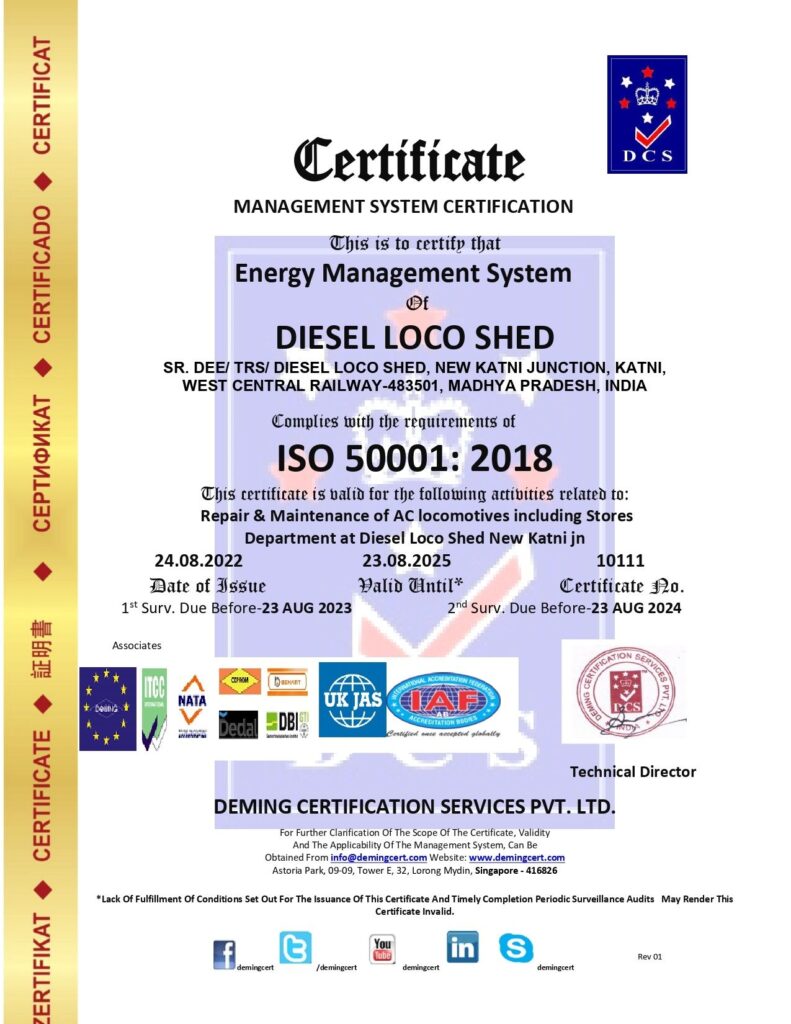
At Diesel Loco Shed, the stated scope covers the repair and maintenance of AC locomotives, including the Stores Department. This scope brings together technical maintenance and material management. Both functions are important because locomotive maintenance depends on suitable tools, spare parts, electrical equipment, consumables, and trained personnel. When the maintenance and stores functions work together effectively, the organization is better positioned to plan work, reduce avoidable delays, and use its available resources responsibly. (https://en.wikipedia.org/wiki/Diesel_Loco_Shed,_Ernakulam)
The railway maintenance environment also presents an important energy management challenge. Workshops and locomotive sheds may use electricity for lighting, ventilation, office equipment, testing arrangements, machinery, pumps, battery charging, and other maintenance-related activities, depending on their actual infrastructure. Energy may represent a significant operating resource, and its efficient use requires systematic planning rather than occasional efforts to switch off unnecessary equipment.
Energy management is especially relevant in an organization where maintenance activities must continue to meet technical and operational requirements. The objective is not simply to reduce electricity consumption at any cost. Instead, it is to use energy efficiently while maintaining the quality, reliability, and safety of maintenance work.
This approach became particularly relevant to the Diesel Loco Shed growth narrative through its ISO 50001:2018 Energy Management System certification, with the issue year supplied as 2022. ISO 50001:2018 provides an internationally recognized framework for establishing, implementing, maintaining, and continually improving an energy management system. It encourages organizations to understand their energy use, establish objectives, monitor performance, and make informed decisions based on reliable information.
For Diesel Loco Shed, an energy management system can provide a structured way to examine how energy supports maintenance activities and how unnecessary consumption might be avoided. The framework can also encourage coordination between maintenance personnel, electrical and technical staff, administration, and stores personnel.
A certification initiative is most valuable when it becomes part of daily working practices. Employees need to understand how their activities influence energy consumption, managers need access to meaningful performance information, and corrective actions need to be followed through. Written procedures alone cannot create lasting improvement unless they are supported by actual implementation.
The Stores Department is an important part of this picture. Appropriate inventory planning can help avoid emergency procurement, unnecessary movement of materials, and prolonged equipment downtime. Better control of energy-related spare parts and maintenance supplies may also support the reliability of equipment used in the facility. Although stores management and energy consumption are different subjects, they can contribute to the same objective of efficient resource utilization.
The location at New Katni Junction places the shed within a railway environment where dependable maintenance and effective coordination are essential. Its institutional responsibilities require attention to technical requirements, operational discipline, safety, and the responsible use of available resources.
The growth of a public-sector railway maintenance facility should not be measured only through revenue or commercial expansion. It can also be evaluated through improved processes, better maintenance planning, stronger accountability, effective use of materials, reduced avoidable waste, and the ability to sustain performance over time.
In this context, ISO 50001:2018 represents an opportunity to connect energy efficiency with the wider objectives of railway maintenance. The certification framework can encourage the organization to understand its energy baseline, establish measurable objectives, review equipment performance, and involve employees in practical improvements.
The most important foundation for long-term progress is a shared understanding that energy is a valuable operational resource. When technical staff, supervisors, stores personnel, and management work toward this common objective, energy management can become a normal part of maintenance planning rather than an additional administrative task.
The story of Diesel Loco Shed’s energy management journey is therefore a story about strengthening operational discipline, encouraging responsible resource use, and supporting the long-term reliability of railway maintenance through a systematic management approach.
#DieselLocoShed
Chapter 2 – Understanding ISO 50001:2018 and the Beginning of a Systematic Energy Management Approach
Energy management is an important part of modern industrial and infrastructure operations. Every organization uses energy to perform its activities, but the amount of energy consumed and the efficiency with which it is used can vary significantly. A structured management system helps an organization understand these differences and develop a practical approach to improvement.
For Diesel Loco Shed, New Katni Junction, ISO 50001:2018 provides a framework for managing energy systematically within the stated scope of locomotive repair and maintenance, including the Stores Department. The standard focuses on establishing an Energy Management System, commonly known as EnMS, that enables an organization to improve its energy performance through planned action, measurement, review, and continual improvement.
Unlike an informal energy-saving campaign, an energy management system connects organizational objectives with responsibilities, operating procedures, monitoring arrangements, and management decisions. It helps ensure that energy efficiency remains an ongoing concern rather than a temporary activity undertaken only when consumption increases.
The standard follows the Plan-Do-Check-Act approach. This familiar management cycle provides a practical structure for understanding energy requirements, implementing improvements, checking results, and making adjustments where necessary.
The planning stage involves identifying the activities that consume energy, understanding the factors that influence consumption, establishing a suitable energy baseline, and identifying opportunities for improvement. At a locomotive maintenance facility, the relevant areas would depend on the actual equipment and infrastructure available. Potential areas of examination may include lighting, ventilation, electrical machinery, pumps, battery charging arrangements, testing equipment, offices, and other energy-consuming systems.
The first step is to understand the existing situation. Management needs reliable information about energy bills, meter readings, equipment ratings, operating schedules, and maintenance practices. Without such information, it becomes difficult to determine whether consumption is reasonable or whether a particular activity offers a genuine opportunity for improvement.
For example, electricity consumption may increase because of longer operating hours, additional maintenance activity, seasonal conditions, or the introduction of new equipment. A simple comparison of monthly bills may not explain the reason for the change. A more useful analysis considers the operational factors that influence consumption.
This is where an energy review becomes valuable. It can help identify significant energy uses and establish priorities for action. Instead of treating every piece of equipment equally, the organization can focus its attention on areas where energy consumption, operational importance, or improvement potential justifies closer monitoring.
The implementation stage converts plans into working practices. Depending on the facility’s needs, this may involve improving lighting controls, establishing shutdown procedures, reviewing equipment operating schedules, maintaining motors and pumps, correcting avoidable compressed-air or electrical losses where relevant, and improving employee awareness.
However, any proposed change must be evaluated carefully. Railway maintenance is a technical activity, and energy efficiency cannot be pursued in a way that compromises safety, maintenance quality, or equipment reliability. Equipment needed for essential inspections, testing, or emergency readiness must remain available according to approved procedures.
The checking stage focuses on monitoring and evaluation. Relevant measurements can help management understand whether actions are delivering the intended result. Energy consumption may be reviewed alongside operating hours, workload, equipment usage, and other suitable variables. This helps prevent misleading conclusions based on figures that do not reflect actual operating conditions.
The final stage involves corrective action and continual improvement. When monitoring identifies an unexpected increase in consumption or a failure to achieve an objective, the organization can investigate the cause, implement suitable corrections, and evaluate whether the problem has been resolved.
For Diesel Loco Shed, this cycle offers a practical way to connect energy performance with daily maintenance operations. Supervisors can review relevant observations, maintenance teams can identify equipment-related issues, and management can prioritize improvement actions according to their operational importance.
ISO 50001:2018 also emphasizes leadership and accountability. Senior management support is essential because energy management often requires coordination across departments. Maintenance teams may understand equipment behavior, administrative staff may manage utility records, and stores personnel may support the availability of components needed for repairs. Each department can contribute useful information.
The Stores Department can support the system by maintaining suitable records of energy-related equipment and spare parts, where relevant. It can help establish clear processes for identifying materials, managing stock, and supporting planned maintenance. Such arrangements may reduce delays caused by unavailable components and help maintenance teams avoid unnecessary emergency interventions.
Employee awareness is equally important. A procedure is effective only when employees understand why it exists and how to follow it. Staff members can be encouraged to report abnormal equipment behavior, identify unnecessary energy use, and follow authorized operating and shutdown instructions.
The certification framework can also strengthen documentation. Records of energy reviews, objectives, measurements, maintenance activities, corrective actions, and management reviews provide a basis for informed decisions. Documentation should remain practical and relevant to actual work rather than becoming an unnecessary paperwork burden.
A further benefit of a structured system is continuity. Employees may change roles, equipment may be upgraded, and operating conditions may vary. Documented processes help preserve organizational knowledge and ensure that important responsibilities are not dependent on individual memory alone.
The ISO 50001:2018 certification recorded for 2022 can therefore be understood as a milestone in the development of a formal energy management approach. Certification provides evidence of conformity within the assessed scope at the time of certification, but it does not by itself establish a particular percentage of energy savings or guarantee future performance.
The long-term value comes from implementation. When the organization regularly reviews energy information, assigns responsibilities, trains employees, evaluates improvement opportunities, and follows through on corrective actions, the system can support better resource management.
For Diesel Loco Shed, the essential lesson is that energy efficiency is not a single project with a fixed completion date. It is a continuing management responsibility. ISO 50001:2018 provides a framework through which that responsibility can be organized, measured, and improved while maintaining the essential requirements of railway locomotive maintenance.
#ISO50001
Chapter 3 – Improving Locomotive Maintenance Through Energy Awareness and Operational Discipline
Locomotive maintenance is a coordinated technical process that depends on trained employees, appropriate equipment, suitable spare parts, accurate records, and effective work planning. Every maintenance activity must be completed according to applicable technical instructions and safety requirements. Energy management can support this work by encouraging the efficient use of supporting equipment and improving awareness of how daily operational decisions influence resource consumption.
At Diesel Loco Shed, New Katni Junction, the stated scope includes the repair and maintenance of AC locomotives. This activity requires a disciplined approach to inspection, fault identification, component replacement, testing, and documentation. Energy efficiency should be considered within this established framework rather than as a separate objective that competes with maintenance quality.
The first opportunity is to understand how energy supports different stages of maintenance. Equipment may need electricity during inspections, repairs, diagnostic activities, component testing, lighting, ventilation, and workshop operations. The exact energy profile depends on the facility’s equipment and working arrangements, so a proper review should be based on actual operational records.
A systematic review can help identify equipment that operates for extended periods, systems that consume energy when not required, and processes where operating schedules could be better coordinated. It can also identify cases where equipment performance has deteriorated because of poor maintenance or inappropriate operating conditions.
Consider the example of workshop lighting. Employees require adequate illumination to inspect components, identify defects, read technical information, and complete repairs safely. Energy management does not mean reducing lighting below acceptable levels. Instead, it may involve checking whether lights are suitable for the task, ensuring that controls work properly, and avoiding unnecessary illumination in unoccupied areas where permitted by the facility’s procedures.
Ventilation presents a similar consideration. Appropriate ventilation can support employee comfort and workplace conditions. A useful energy review would examine whether systems operate according to actual requirements and whether maintenance can improve their efficiency. Any changes must respect applicable safety, environmental, and workplace requirements.
Electrical motors and pumps, where installed, may also deserve attention. Their performance can be influenced by maintenance condition, operating load, alignment, controls, and the suitability of the equipment for its application. Routine inspection can help identify abnormal noise, vibration, overheating, or other signs that require technical attention.
These examples illustrate an important principle: maintenance and energy management can reinforce one another. Equipment that is properly maintained may operate more efficiently, while energy monitoring may help reveal unusual operating patterns that deserve investigation.
A structured energy management system can encourage the organization to connect maintenance schedules with energy performance observations. When a machine repeatedly consumes more energy than expected, the appropriate response is not necessarily to reduce its operating time. The team should first determine whether the change reflects workload, equipment condition, a measurement issue, or another operational factor.
Accurate diagnosis helps prevent inappropriate corrective actions. In a railway environment, equipment must remain suitable for its intended purpose, and maintenance activities must meet relevant technical specifications. An energy-saving measure should never be accepted solely because it reduces consumption if it creates an unacceptable maintenance or safety risk.
Work planning is another important area. When maintenance tasks are scheduled effectively, teams may be able to coordinate the use of tools, equipment, and supporting systems. Better coordination can reduce unnecessary equipment idling and improve the use of available resources. These benefits depend on actual operating conditions and should be evaluated through observation and measurement.
The role of supervisors is particularly important. They help ensure that maintenance instructions are followed, work is assigned appropriately, and equipment is used according to authorized procedures. Supervisors can also communicate energy-related expectations during routine briefings and encourage employees to report unusual conditions.
Employees working directly with machinery often notice small problems before they become major concerns. A fan that runs continuously, a pump that behaves unusually, or a lighting circuit that remains energized unnecessarily may provide an opportunity for investigation. A reporting process allows such observations to reach the appropriate person and ensures that action can be tracked.
Training should explain not only what employees need to do but also why their actions matter. When workers understand the relationship between equipment condition, operating practices, energy consumption, and maintenance quality, they are better equipped to contribute to improvement.
A useful training programme can include awareness of significant energy uses, approved operating procedures, equipment shutdown requirements, reporting responsibilities, and the importance of maintaining safe working conditions. Training records can help management identify whether employees have received the information relevant to their responsibilities.
Energy performance should also be considered when equipment is purchased, replaced, or substantially modified. Where applicable, specifications can address energy efficiency alongside reliability, safety, maintainability, technical suitability, and lifecycle cost. The cheapest equipment to purchase is not always the least expensive to operate over its useful life.
For example, equipment selection may involve considering purchase price, expected energy consumption, maintenance requirements, availability of spare parts, and suitability for the working environment. A structured evaluation supports decisions based on total operational value rather than the initial price alone.
The Stores Department can contribute by supporting the availability of suitable replacement parts and maintaining clear inventory information. When essential parts are readily identifiable and available through appropriate processes, maintenance teams can plan work more effectively. This may reduce avoidable delays and help ensure that equipment is returned to service in a timely manner.
However, inventory decisions must remain aligned with operational needs. Holding too much stock can create storage and resource challenges, while holding too little can delay important repairs. A balanced approach considers consumption patterns, criticality, lead times, and approved inventory policies.
Another important aspect is the use of records. Maintenance work orders, equipment histories, energy observations, and corrective-action records can help identify recurring problems. When the same issue appears repeatedly, management can investigate whether a deeper technical or procedural improvement is needed.
Over time, these practices can encourage a culture in which employees see energy management as part of professional maintenance. Instead of focusing exclusively on immediate task completion, teams can consider whether work is being performed safely, correctly, and with appropriate use of resources.
For Diesel Loco Shed, the potential operational benefit of ISO 50001:2018 lies in this integration. Energy awareness becomes more meaningful when it is linked to equipment reliability, preventive maintenance, work planning, and employee responsibility.
A mature energy management approach does not ask maintenance teams to compromise the quality of their work. It gives them an additional perspective through which to evaluate equipment performance, identify avoidable waste, and support dependable railway operations.
#ISO500012018
Chapter 4 – The Stores Department: Inventory Control, Resource Planning and Energy Management
The Stores Department is a vital support function within a locomotive maintenance facility. Maintenance teams depend on the timely availability of appropriate components, tools, consumables, and other approved materials. If a required item is unavailable, a repair may be delayed even when trained personnel and technical facilities are ready to perform the work.
At Diesel Loco Shed, New Katni Junction, the stated certification scope specifically includes the Stores Department. Its inclusion recognizes that an energy management system can involve supporting functions as well as activities performed directly on locomotives. Effective energy management benefits from coordination between the people who operate equipment, those who maintain it, and those who support the supply of necessary materials.
Inventory management and energy performance are connected in several practical ways. The relationship is not always direct, and stock control should not be described as an automatic source of energy savings. Nevertheless, better planning can support efficient maintenance, reduce unnecessary movement, and help equipment remain in serviceable condition.
The first requirement is accurate inventory information. Records should identify materials clearly and reflect actual stock levels, subject to the organization’s approved procedures. Proper identification helps prevent confusion between similar components and supports the correct selection of parts for maintenance work.
Where applicable, materials may be classified according to their type, criticality, usage, storage requirements, and expected replenishment time. Such classification helps the Stores Department prioritize attention and coordinate with maintenance planners.
Critical components may require special consideration because their unavailability can delay important maintenance activities. Other items may be used frequently and therefore require routine replenishment. Understanding these differences helps the organization maintain a suitable balance between availability and efficient use of storage space.
Energy management can benefit from a similar approach to equipment information. Records of major energy-consuming equipment, relevant specifications, maintenance requirements, and available replacement components may help teams plan improvements more effectively. When equipment requires repair, the availability of suitable parts can influence how quickly the issue is resolved.
Storage conditions are another consideration. Depending on the materials involved, some items may require protection from moisture, dust, temperature variation, or other environmental conditions. Appropriate storage practices help preserve material quality and reduce the risk of damage or premature replacement.
The use of lighting, ventilation, and other supporting systems in storage areas may also be relevant to an energy review. Management can assess whether such systems are appropriate for the work performed and whether their operating arrangements can be improved without compromising safety, material preservation, or access requirements.
A well-organized store can make materials easier to locate and reduce unnecessary searching. Clear labels, appropriate shelving, defined storage locations, and reliable records may help employees complete their tasks efficiently. Where material movement is involved, sensible layout and handling arrangements can reduce unnecessary travel within the facility.
These improvements should be implemented according to the store’s actual conditions. Heavy materials, electrical components, sensitive items, and safety-related equipment may require different handling and storage methods. Efficiency must not override established requirements for safe handling and traceability.
Procurement planning is also important. Emergency purchasing can create administrative pressure, additional transportation requirements, and disruption to maintenance schedules. Better forecasting may help reduce avoidable emergencies, although unexpected failures and urgent operational needs cannot always be eliminated.
For energy-related equipment, the Stores Department may help ensure that approved replacement components are available when needed. For example, the repair of a lighting system, motor, pump, or other electrical installation may depend on obtaining a suitable component. The precise requirements will vary according to the facility’s infrastructure.
The quality of purchased materials matters as well. Components must be appropriate for their intended applications and meet the required technical specifications. An unsuitable component may fail prematurely, require repeated replacement, or create an equipment reliability concern. Procurement decisions should therefore consider quality, compatibility, safety, availability, and lifecycle implications.
Where energy efficiency is relevant to purchasing decisions, the organization can evaluate equipment using suitable technical information. Expected energy consumption, operating conditions, maintenance requirements, and useful life may all be relevant. Such decisions should be supported by reliable information rather than unsupported claims about future savings.
Coordination between Stores and maintenance personnel is essential. Maintenance teams can provide forecasts of planned work and identify critical requirements, while stores personnel can communicate stock availability, procurement lead times, and potential shortages. Regular coordination helps both functions plan their activities more effectively.
The same principle applies to corrective actions identified through energy monitoring. If an equipment issue requires a replacement component, the responsible team should document the problem, identify the appropriate remedy, and confirm that the action has been completed. Stores records may support the traceability of the component used.
Digital inventory systems, where available and suitable, may improve the speed and accuracy of information retrieval. However, technology alone cannot guarantee effective control. The usefulness of any system depends on accurate data entry, appropriate access, staff training, and regular review.
Performance indicators can help the Stores Department understand whether its processes are meeting operational requirements. Relevant measures may include inventory accuracy, material availability, delays caused by stock shortages, and the timely completion of required records. These measures should be selected according to the organization’s needs and should not create unnecessary administrative work.
Management can also review whether obsolete or damaged materials are being identified and handled through approved procedures. Unusable stock can occupy valuable space and create confusion if records are not maintained properly. Responsible disposal or other authorized action should follow applicable organizational requirements.
For Diesel Loco Shed, including the Stores Department within the energy management scope creates an opportunity to align material support with maintenance priorities. It encourages departments to share information and recognize that energy performance depends on more than the operation of individual machines.
An efficient store supports the wider maintenance process by helping ensure that the right materials are available, properly identified, and managed responsibly. When this work is connected with energy awareness, preventive maintenance, and performance review, the organization can strengthen operational coordination and make more informed use of its resources.
The central lesson is that energy management is a shared responsibility. Stores personnel may not control every major energy-consuming activity, but their work can support the planning, reliability, and continuity of the systems on which locomotive maintenance depends.
#EnergyManagementSystem
Chapter 5 – Employee Participation, Training and the Development of an Energy-Conscious Workplace
A management system becomes effective when the people responsible for daily activities understand its purpose and participate in its implementation. Policies and procedures establish expectations, but employees turn those expectations into practical results through their decisions, observations, and working habits.
For Diesel Loco Shed, New Katni Junction, employee participation is an important part of developing an effective Energy Management System under ISO 50001:2018. The repair and maintenance of AC locomotives involves different responsibilities, and energy-related decisions may be influenced by supervisors, technicians, electrical personnel, administrative employees, and stores staff.
Each employee has a different role, but all can contribute to a common objective: using energy responsibly while maintaining the quality and safety of railway maintenance activities.
The first step in developing an energy-conscious workplace is awareness. Employees need to understand why energy management matters, how energy is used in their working areas, and which procedures apply to their responsibilities. Training should explain the relationship between energy consumption, equipment condition, operating practices, maintenance costs, and environmental performance.
Awareness programmes are most useful when they relate directly to the work employees perform. General statements about saving energy may have limited value unless workers know what actions are appropriate in their own areas.
For example, employees may be trained to follow approved shutdown instructions for equipment that is not required, report malfunctioning controls, avoid unauthorized changes to electrical systems, and communicate unusual equipment behavior to the responsible supervisor. These practices must always follow applicable safety procedures and operational requirements.
The organization can also explain the importance of distinguishing between necessary energy use and avoidable consumption. A maintenance task may require equipment to operate continuously for a specified period. In such cases, reducing operating time would be inappropriate if it affected testing, inspection, or maintenance quality. Employees should understand that the goal is efficient operation, not indiscriminate reduction.
Supervisors play an important role in translating the energy management policy into routine activities. They can communicate relevant instructions during briefings, identify training needs, encourage responsible behavior, and ensure that employees know how to report problems.
An effective reporting process should be simple enough for employees to use. If workers identify unnecessary operation, abnormal equipment behavior, or a possible improvement opportunity, they should know whom to contact and what information to provide. Management can then evaluate the observation and decide whether further investigation is required.
Employee suggestions may reveal practical opportunities that are not immediately obvious from utility bills or equipment specifications. A technician who regularly works with a particular machine may recognize an operating difficulty that affects performance. A store employee may notice repeated demand for a particular replacement component. An administrative employee may identify a pattern in energy records that deserves investigation.
These observations become more valuable when they are recorded, reviewed, and acted upon. Management should communicate the outcome where appropriate so employees understand that their contributions are taken seriously.
Training should also address the responsibilities associated with equipment operation and maintenance. Employees must know which activities they are authorized to perform and which require specialist attention. Electrical faults, abnormal temperatures, unusual vibration, damaged cables, or malfunctioning controls should be reported and handled through approved procedures.
No employee should be encouraged to bypass safety controls or undertake unauthorized repairs in the name of energy efficiency. A responsible energy management culture treats safety, technical compliance, and operational reliability as essential requirements.
Competence is another important element. Employees performing tasks that can affect significant energy uses should have the knowledge and skills required for their responsibilities. Depending on the job, this may involve equipment-specific instruction, maintenance training, awareness of operating procedures, or the ability to interpret relevant energy information.
Training records can help the organization demonstrate that relevant instruction has been provided. They can also support future planning by identifying areas where refresher training or additional technical development may be useful.
New employees and personnel transferred to different responsibilities may require particular attention. Without suitable induction, they may be unfamiliar with local operating procedures, equipment requirements, or energy-related responsibilities. A structured induction process can help maintain consistency as staffing arrangements change.
Communication should extend beyond formal training sessions. Posters, brief notices, toolbox talks, departmental meetings, and routine operational discussions can reinforce important messages. The most suitable methods will depend on the facility’s working environment and communication practices.
Energy awareness should not become a reason to blame employees whenever consumption rises. Changes in energy use may result from workload, equipment requirements, weather, operating hours, or technical problems. Management should investigate the underlying cause before deciding whether an issue reflects employee behavior or another factor.
A fair approach encourages employees to report problems honestly. If staff members believe that reporting a fault will lead to unfair criticism, they may hesitate to share information. A constructive culture instead treats reporting as a way to identify and resolve operational concerns.
Recognition can also support participation. When an employee proposes a practical improvement or helps identify a recurring problem, appropriate acknowledgement can encourage continued involvement. Recognition need not involve financial rewards; feedback during meetings or communication of successful corrective actions may be sufficient.
However, the organization should evaluate suggestions objectively. An idea that appears to reduce consumption may have unintended effects on safety, equipment life, maintenance quality, or operational readiness. Technical review should precede implementation whenever necessary.
Employee participation can be assessed through suitable indicators, such as training completion, the number of relevant suggestions reviewed, the timely reporting of identified issues, or the completion of assigned corrective actions. These indicators should support improvement rather than encourage employees to generate unnecessary paperwork.
For Diesel Loco Shed, an energy-conscious workplace means that employees recognize energy as an important resource within their broader professional responsibilities. It means following procedures, maintaining equipment appropriately, reporting problems, and considering resource efficiency when planning work.
ISO 50001:2018 offers a structured foundation for building this culture. Its effectiveness depends on leadership, communication, competence, and continual participation. When employees understand the objectives and see that management acts on relevant observations, energy management becomes a shared working practice.
The lasting benefit is not simply greater awareness of electricity consumption. It is the development of a workplace in which employees are encouraged to think carefully about equipment performance, resource use, and the quality of the services they support.
#EnergyEfficiency
Chapter 6 – Monitoring Energy Performance, Setting Objectives and Measuring Improvement
Energy management requires reliable information. Without measurement, an organization may find it difficult to distinguish between genuine improvements and changes caused by workload, operating hours, or other external factors. Monitoring provides a basis for understanding performance and deciding where action is necessary.
At Diesel Loco Shed, New Katni Junction, an effective approach under ISO 50001:2018 can connect energy measurements with the operational requirements of locomotive repair and maintenance. The objective is to understand how energy is used, identify significant patterns, and evaluate the effectiveness of improvement measures.
The first requirement is to establish an appropriate understanding of energy consumption. Utility bills, meter readings, equipment information, operating schedules, and other relevant records may provide useful inputs. The organization should determine which information is available, how reliable it is, and whether additional measurement would improve decision-making.
An energy review can help identify significant energy uses and the factors that influence them. These may include equipment operating hours, maintenance workload, environmental conditions, or the number and type of activities performed during a particular period.
The exact variables will depend on the actual operations and infrastructure at the shed. A useful energy management system should therefore be based on site-specific information rather than assumptions about which equipment consumes the most energy.
Energy performance indicators provide a way to track progress. An indicator may be based on total energy consumption, energy use within a defined area, consumption associated with particular equipment, or another measure appropriate to the organization’s activities.
The choice of indicator matters. Total electricity consumption can be useful, but it may not tell the whole story. If the maintenance workload increases, consumption may rise even when equipment is operating efficiently. Similarly, consumption may fall because equipment is used less, not because energy performance has improved.
A suitable indicator should therefore reflect the intended management objective. Where appropriate, the organization can compare energy use with operating hours, workload, or other relevant factors. The method should remain understandable and supported by reliable data.
The energy baseline is another important concept. It provides a reference against which energy performance can be evaluated. A baseline should be established using suitable information and reviewed when significant changes in operating conditions or other relevant factors make the existing reference less representative.
For example, the introduction of major equipment or a substantial change in maintenance activity may affect the usefulness of earlier comparisons. The organization should document its approach to any necessary adjustments so that performance assessments remain meaningful.
Once the baseline and indicators are established, management can set energy objectives. These objectives should reflect the organization’s priorities, the opportunities identified through its energy review, and the resources available for implementation.
An objective might involve improving the control of selected energy-consuming equipment, reducing unnecessary operating time where permitted, improving the reliability of energy records, or evaluating the efficiency of a particular installation. Any quantitative target should be based on a suitable assessment rather than an invented or arbitrary percentage.
Each objective should have a clear responsibility, an implementation plan, an appropriate time frame, and a method for evaluating results. Without these elements, an objective may remain a statement of intention rather than becoming a practical improvement programme.
Monitoring should take place at intervals appropriate to the significance of the energy use and the nature of the information. Some data may be reviewed monthly, while specific equipment or operational conditions may require more frequent attention. The monitoring schedule should reflect actual management needs.
Data quality is essential. Incorrect readings, incomplete records, inconsistent measurement methods, or calculation errors can lead to misleading conclusions. Responsibilities for collecting, checking, recording, and reviewing information should therefore be clearly defined.
When an unexpected change occurs, the first task is to investigate it. The organization should consider whether the change results from workload, equipment condition, a change in operating schedules, a measurement problem, or another cause. Corrective action should address the underlying issue whenever possible.
Suppose electricity consumption rises during a particular period. The increase might reflect longer maintenance hours, additional equipment use, a faulty control system, or an error in recorded data. Each possibility requires a different response. Reducing essential operating time without investigation could create an operational problem rather than solve the energy issue.
The same discipline applies when consumption decreases. A lower bill may appear positive, but the organization should determine whether the change reflects improved efficiency, reduced activity, a change in billing conditions, or another factor.
Internal audits can help determine whether the energy management system is being implemented as intended. Audits may examine the completeness of records, adherence to procedures, progress toward objectives, and the effectiveness of corrective actions. Findings should be evaluated and addressed through the organization’s established process.
Management review provides an opportunity to consider the wider picture. Relevant information may include energy performance, progress toward objectives, audit findings, changes in operational conditions, resource requirements, and improvement opportunities.
The purpose of management review is not simply to approve documents. It is to determine whether the system remains suitable and effective and whether additional action is needed.
For Diesel Loco Shed, systematic monitoring can support better decisions about maintenance priorities, equipment performance, and resource allocation. Reliable information can also improve communication between technical staff, management, and supporting departments.
It is important, however, to distinguish a management framework from a verified result. The supplied certification details establish an ISO 50001:2018 milestone with an issue year of 2022, but they do not provide measured energy savings or actual performance indicators. Such results should be reported only when supported by records.
The broader value of measurement lies in its ability to turn assumptions into evidence. By establishing suitable baselines, monitoring relevant indicators, reviewing performance, and acting on findings, the organization can develop a more reliable understanding of its energy use.
Continual improvement becomes practical when management can explain what changed, why it changed, and whether the action taken produced the intended result. This is the foundation of evidence-based energy management.
#WestCentralRailway
Chapter 7 – Environmental Responsibility and Sustainable Railway Maintenance
Railways are an essential part of public transportation and economic activity. They support passenger movement, freight transportation, industrial supply chains, and regional connectivity. Maintaining railway infrastructure and rolling stock requires significant technical resources, making responsible resource management an important consideration for railway organizations.
Diesel Loco Shed, New Katni Junction, operates within this wider railway environment. Its stated responsibilities include the repair and maintenance of AC locomotives, together with the Stores Department. Within this operational setting, an Energy Management System can support a more systematic approach to the responsible use of electricity and other relevant energy resources.
ISO 50001:2018 provides a framework for improving energy performance. Better energy performance can contribute to environmental objectives, particularly when improvements lead to a genuine reduction in energy required for equivalent operational output. However, environmental benefits must be evaluated using reliable information about actual energy use and the relevant energy sources.
The relationship between energy management and environmental responsibility begins with understanding consumption. An organization that knows where and how energy is used can identify opportunities to avoid unnecessary waste. It can then evaluate which improvements are technically appropriate, operationally practical, and environmentally beneficial.
At a maintenance facility, potential improvement areas may include lighting, ventilation, electrical machinery, pumps, and other installed systems. The relevant priorities depend on the actual site infrastructure and its operating requirements.
Lighting provides a straightforward example. Appropriate lighting supports inspection accuracy, workplace safety, and the completion of technical work. Energy performance can potentially be improved through suitable lighting technology, effective controls, and maintenance of electrical installations. These measures must be evaluated against the need for adequate illumination in every work area.
Similarly, equipment maintenance may support energy efficiency by helping machinery operate under suitable conditions. Components that are worn, incorrectly adjusted, or operating outside their intended parameters may consume more energy than expected. Inspection and maintenance can help identify such conditions, although the cause and potential benefits must be established for each case.
Environmental responsibility also involves avoiding unnecessary replacement and waste. When equipment is maintained correctly and suitable components are available, the organization may be better positioned to extend useful service life where technically appropriate. Decisions must nevertheless consider safety, reliability, applicable standards, and the equipment’s intended operating conditions.
The Stores Department can support responsible resource management through proper material identification, appropriate storage, inventory control, and compliance with authorized procedures for damaged or obsolete materials. Good inventory practices can reduce avoidable losses and help ensure that components are available when needed.
Waste management is another relevant area. Maintenance operations may generate used components, packaging, damaged materials, lubricants, or other waste streams, depending on the activities performed. These materials should be handled according to applicable railway procedures, environmental requirements, and relevant safety rules.
Energy management and waste management are related through the broader principle of responsible resource use, but they are not interchangeable. ISO 50001:2018 focuses specifically on energy management. Other environmental responsibilities may require separate procedures, legal compliance arrangements, and management controls.
An effective environmental approach therefore begins with understanding the scope of each responsibility. Energy consumption should be monitored through appropriate energy indicators, while waste, pollution prevention, and other environmental aspects should be managed through applicable systems and procedures.
Employee awareness contributes to both areas. Staff members who understand the importance of correct handling, equipment maintenance, and resource conservation can help identify avoidable waste and report conditions requiring attention.
Training should emphasize that environmental responsibility does not justify compromising railway safety. Equipment must be maintained and tested as required, and materials must be handled according to approved instructions. An environmental improvement is worthwhile only when it is technically sound and implemented responsibly.
Energy management can also encourage longer-term thinking during equipment procurement and modification. When selecting or replacing equipment, decision-makers may consider energy consumption alongside reliability, maintainability, compatibility, safety, and expected operating life.
A lifecycle perspective can be useful because the initial purchase price does not always represent the full cost of ownership. Equipment that appears less expensive initially may require more energy or maintenance over its useful life. Conversely, a more efficient option may require additional investment that needs to be evaluated against expected benefits.
Any financial or environmental assessment should use credible data and clearly stated assumptions. The organization should avoid claiming reductions in greenhouse-gas emissions or environmental impact without a suitable calculation method and reliable information about the relevant energy sources.
Climate and seasonal conditions can also influence energy requirements. Lighting hours, ventilation needs, and other operational demands may vary throughout the year. Monitoring these factors helps management distinguish between normal changes and avoidable inefficiency.
For Diesel Loco Shed, the value of an energy management system is that it can integrate environmental awareness into ordinary operational decisions. Instead of relying only on occasional campaigns, the organization can use planned objectives, performance reviews, maintenance practices, and employee participation to support improvement.
This approach also strengthens institutional accountability. A railway maintenance facility has responsibilities toward its workforce, the railway system, and the wider public. Responsible energy use demonstrates attention to resource efficiency while supporting the continued performance of essential infrastructure.
The certification milestone recorded for 2022 can be understood as part of this broader commitment to structured management. Its continuing value depends on the implementation of appropriate practices, evaluation of performance, and maintenance of the system over time.
Environmental responsibility is not achieved through certification alone. It requires consistent action, reliable evidence, and a willingness to review existing practices when circumstances change.
When energy management becomes part of maintenance planning, equipment care, procurement decisions, and employee awareness, it can support a more resource-conscious railway workplace. That is the wider sustainability opportunity associated with the ISO 50001:2018 framework at Diesel Loco Shed, New Katni Junction.
#NewKatniJunction
Chapter 8 – Leadership, Accountability and Continual Improvement After Certification
A management system requires leadership to remain effective. Employees need clear expectations, departments need appropriate resources, and responsibilities must be assigned so that identified improvements can be implemented. Without these elements, even a well-designed system may gradually become disconnected from daily operations.
For Diesel Loco Shed, New Katni Junction, leadership is an important factor in applying ISO 50001:2018 to locomotive repair and maintenance and the supporting Stores Department. The certification milestone can provide a structured foundation, but continued performance depends on how effectively the system is integrated into routine management.
Leadership begins with defining the purpose of energy management. Management should communicate that energy efficiency is intended to support operational performance, responsible resource use, and continual improvement without compromising safety or maintenance quality.
An energy management policy can express these commitments and establish the direction for the system. It should be appropriate to the organization’s activities and provide a basis for setting objectives. More importantly, the policy must be understood by relevant personnel and reflected in actual decisions.
Responsibilities should be assigned clearly. Someone must coordinate relevant records, someone must review energy performance, and responsible personnel must ensure that corrective actions receive appropriate attention. The exact structure depends on the organization’s management arrangements and should fit its operational needs.
Clear accountability helps prevent improvement actions from being overlooked. If monitoring identifies a recurring problem, the organization should know who will investigate it, who can approve the proposed action, what resources may be required, and how the result will be checked.
Resource allocation is another leadership responsibility. Some improvements may involve procedural changes or employee awareness, while others may require equipment servicing, replacement components, additional measurement, or investment in more efficient technology.
Management should evaluate proposed actions according to their expected benefits, technical feasibility, cost, operational importance, and risks. Not every improvement opportunity can be implemented immediately, so a transparent prioritization process is useful.
The Plan-Do-Check-Act cycle supports this process. Management can plan improvements based on the energy review, implement approved actions, check results using suitable evidence, and make adjustments when necessary.
Continual improvement does not mean changing every procedure constantly. It means maintaining a systematic willingness to identify opportunities, evaluate performance, and make appropriate changes when the evidence supports them.
Internal audits can help leadership understand whether the system is functioning as intended. An audit may examine whether procedures are followed, records are maintained, objectives are reviewed, and identified issues are addressed. Audit findings should lead to appropriate evaluation and corrective action rather than being treated as paperwork to complete.
Management review provides a broader opportunity to assess the system. Relevant inputs may include changes in operations, energy performance, objective completion, audit findings, employee feedback, resource needs, and the status of earlier actions.
These reviews should produce useful decisions. Management may decide to revise an objective, investigate an unexpected trend, improve a procedure, provide additional training, or allocate resources to an identified opportunity. The resulting decisions should be documented and followed through.
Organizational changes also require attention. New equipment, revised maintenance processes, altered operating hours, or changes in staffing may influence energy performance and responsibilities. A well-maintained management system should account for relevant changes rather than relying indefinitely on earlier assumptions.
Procurement and equipment modification decisions can benefit from the same discipline. Energy performance should be considered when relevant, alongside safety, technical suitability, maintenance requirements, and lifecycle cost. Management should ensure that the appropriate technical personnel participate in decisions affecting important equipment.
Leadership also influences the quality of organizational communication. When employees receive clear instructions and understand the purpose of improvement initiatives, they are more likely to participate constructively. When management communicates the outcomes of investigations and corrective actions, staff members can see how their observations contribute to better performance.
A positive culture encourages reporting without assuming that every problem results from individual error. Equipment faults, unclear procedures, inadequate information, and resource constraints may all contribute to operational difficulties. Effective management seeks to understand the causes before deciding on the appropriate response.
For Diesel Loco Shed, coordination between maintenance and stores personnel is especially relevant. Maintenance teams may identify a need for replacement parts, while the Stores Department may provide information about availability and procurement lead times. Shared planning can help align operational requirements with material resources.
Performance indicators can also support accountability. Management may track whether agreed actions are completed, whether relevant records are available, whether training requirements are met, and whether selected energy performance measures show improvement. The indicators should be meaningful and supported by evidence.
It is equally important to recognize the limitations of certification. ISO 50001:2018 certification indicates conformity of the assessed management system within its defined scope and assessment arrangements. It does not independently prove that every activity is efficient or that energy consumption has declined by a particular amount.
Leadership must therefore focus on actual performance as well as formal conformity. The organization should use records, measurements, audits, and operational feedback to understand whether its system is achieving its intended purpose.
The stated issue year of 2022 marks a point in the certification history supplied for this narrative. The provided validity date is 2025, so any present-day claim that the certification remains active would require confirmation from current certification records.
The broader lesson is that certification is a milestone, not the end of improvement. An effective energy management system requires regular attention, clear accountability, appropriate resources, and informed decision-making.
Through these practices, Diesel Loco Shed can use the ISO 50001:2018 framework to support a culture of continual improvement, strengthening the connection between energy performance, maintenance quality, and responsible railway operations.
#RailwayMaintenance
Chapter 9 – Operational Resilience, Institutional Knowledge and Long-Term Development
The long-term performance of a railway maintenance facility depends on more than individual repairs. It requires stable processes, reliable information, suitable resources, and the ability to respond effectively when operating conditions change. These factors contribute to operational resilience, which is the capacity to maintain essential functions while addressing disruptions and new requirements.
At Diesel Loco Shed, New Katni Junction, the repair and maintenance of AC locomotives requires coordination between technical activities and supporting functions. Energy management can contribute to institutional resilience by improving the visibility of energy use, strengthening equipment-related information, and encouraging systematic review.
One important element of resilience is knowledge retention. Railway maintenance relies on technical experience, established procedures, equipment histories, and familiarity with operational requirements. When information exists only in the memory of individual employees, it can be difficult to maintain consistency during transfers, retirements, or changes in responsibilities.
Documented procedures and records help preserve institutional knowledge. An Energy Management System can include relevant information about significant energy uses, operating requirements, performance indicators, maintenance observations, and corrective actions.
The purpose of documentation is not to create unnecessary administrative work. Records should be sufficient to support decisions, demonstrate implementation, and maintain continuity. A clear and practical system is more useful than a large collection of documents that employees cannot easily access or apply.
Equipment-related information is particularly valuable. Maintenance records may help identify recurring faults, while energy records may reveal unusual consumption patterns. When these sources are considered together, the organization may be better able to investigate the relationship between equipment condition and energy performance.
For example, a change in energy consumption might coincide with increased operating hours or a modification to equipment. Without records of those changes, the organization may struggle to explain the result. Accurate documentation provides context and supports more reliable analysis.
Operational resilience also depends on preventive maintenance. A planned approach helps the organization identify potential issues before they cause avoidable disruption. The exact preventive maintenance requirements depend on equipment specifications, manufacturer instructions, railway procedures, and applicable technical standards.
Energy management can complement these arrangements by drawing attention to equipment performance. Where a significant energy use appears abnormal, the organization can determine whether inspection or maintenance is necessary. Energy monitoring should support technical judgment rather than replace established inspection and diagnostic methods.
Material availability contributes to resilience as well. The Stores Department can help maintenance teams identify the availability of required components and plan replenishment where appropriate. Suitable inventory control may reduce avoidable delays, although urgent failures and supply interruptions cannot always be prevented.
The organization can also consider risks associated with energy supply and essential supporting equipment. Such consideration should form part of the appropriate operational and risk management processes. The objective is to understand which resources are important, what disruptions could affect them, and which authorized arrangements are available to maintain essential activities.
Business continuity and emergency arrangements must remain consistent with railway requirements. Energy management cannot replace emergency preparedness, electrical safety controls, or technical procedures for responding to equipment failures. Instead, it can provide relevant information about energy-related systems and their operational importance.
Digital tools may improve the management of information where suitable infrastructure is available. Electronic records, equipment registers, inventory systems, and structured data analysis can help employees retrieve information and identify patterns. However, digitalization should be introduced according to operational needs and supported by suitable data quality, access control, and staff training.
A digital system is only as reliable as the information entered into it. Incorrect equipment identification, missing readings, inconsistent units, or outdated records can undermine analysis. Responsibilities for maintaining information should therefore be clearly assigned.
Long-term development also involves learning from experience. When a corrective action resolves a recurring problem, the organization can consider whether a procedure should be revised, whether training should be updated, or whether similar equipment requires inspection.
This process turns individual problem-solving into institutional learning. Instead of repeatedly addressing the same issue without examining its cause, the organization can identify the underlying pattern and determine whether a broader improvement is appropriate.
The same principle applies to successful energy-saving measures. If a change produces a verified improvement, management can document the method and evaluate whether it is suitable for other locations or equipment. Replication should not be automatic, because operating conditions may differ, but documented experience provides a useful starting point.
Long-term planning can also consider the expected service life of equipment, future maintenance needs, procurement requirements, and opportunities for efficiency improvements. Decisions should reflect technical suitability, financial constraints, safety requirements, and operational priorities.
For a railway maintenance facility, the benefits of resilience may be reflected in better preparedness, clearer responsibilities, improved records, and a more disciplined approach to resolving problems. These benefits can support dependable operations even when conditions change.
The ISO 50001:2018 framework contributes by encouraging the organization to treat energy performance as an ongoing management responsibility. Energy information becomes part of the evidence used to make decisions rather than an isolated set of utility records.
For Diesel Loco Shed, the certification milestone can therefore be connected with a wider institutional objective: building processes that continue to work effectively despite changes in personnel, equipment, or operating conditions.
No particular financial saving, reduction in downtime, or increase in locomotive availability should be attributed to the certification without supporting records. Nevertheless, the management principles of planning, monitoring, corrective action, and knowledge retention provide a credible foundation for pursuing these objectives.
Long-term growth in a railway maintenance organization is ultimately reflected in its ability to learn, adapt, and maintain disciplined operations. By integrating energy management into this wider process, Diesel Loco Shed can support the responsible use of resources while preserving the technical standards required for railway maintenance.
#LocomotiveMaintenance
Chapter 10 – The Future Vision of Diesel Loco Shed and the Lasting Value of ISO 50001:2018
The journey toward efficient energy management is a continuing process that develops through planning, practical implementation, employee participation, and regular evaluation. For Diesel Loco Shed, New Katni Junction, the ISO 50001:2018 certification milestone represents an opportunity to strengthen energy management within the wider responsibilities of locomotive repair and maintenance.
Located in Katni, Madhya Pradesh, within West Central Railway, the facility operates in an environment where technical reliability, maintenance quality, workplace safety, and effective resource management are essential. Its stated scope includes AC locomotive repair and maintenance and the Stores Department. These activities provide a practical setting for applying the principles of an Energy Management System.
The future development of the system depends on the organization’s ability to maintain a clear understanding of energy use and identify improvement opportunities relevant to its operations. Rather than relying on isolated energy-saving campaigns, a structured approach can connect objectives, responsibilities, equipment maintenance, monitoring, and management review.
One important direction is the continued development of energy performance information. Reliable records can help management identify significant energy uses and determine whether changes in consumption require further investigation. Where appropriate, energy indicators can be related to operating hours, maintenance workload, or other factors that influence performance.
This approach supports informed decisions. It helps management distinguish between consumption changes caused by operational requirements and those that may reflect avoidable inefficiency. It also provides a basis for assessing whether improvement actions have delivered the intended results.
A second direction is the continued integration of energy considerations into maintenance planning. Equipment condition, operating practices, and maintenance schedules can influence energy performance. Reviewing these factors together may help identify opportunities to improve efficiency while preserving equipment reliability and the quality of maintenance work.
The introduction of new equipment or the replacement of existing systems can provide another opportunity. Where relevant, procurement decisions can consider energy performance alongside purchase price, technical suitability, safety, maintainability, availability of spare parts, and expected service life.
Such decisions require appropriate technical evaluation. A more efficient machine is not automatically the best choice if it is unsuitable for the required task or creates additional maintenance difficulties. The objective is to select solutions that support the organization’s actual operational needs.
The Stores Department will continue to be important within this integrated approach. Proper inventory information, suitable storage practices, and coordination with maintenance planners can help ensure that materials are available when required. Better coordination may also help the organization plan equipment servicing and avoid unnecessary disruption caused by preventable material shortages.
Employee development represents another long-term priority. Energy management procedures need to remain understandable and relevant as responsibilities change. Training, communication, and practical guidance can help employees apply the system consistently.
Employees should be encouraged to report abnormal conditions and suggest improvements. Their experience can help management identify issues that may not be immediately apparent through formal records. A constructive reporting culture also helps the organization learn from operational experience.
Leadership will remain essential. Management must review the system periodically, evaluate progress against objectives, allocate resources where justified, and ensure that corrective actions are completed. If an objective is no longer appropriate because operating conditions have changed, it should be reviewed and revised through the established process.
Internal audits and management reviews can support this development by providing evidence about system implementation and effectiveness. They can help identify gaps in documentation, opportunities for improvement, and areas where additional training or technical attention may be needed.
Environmental responsibility is also likely to remain an important consideration for infrastructure organizations. Better energy performance can contribute to responsible resource use when improvements are verified against an appropriate baseline. Any claim about energy savings or reduced emissions should be supported by actual measurements and a suitable calculation method.
The same principle applies to financial benefits. Improved energy efficiency may offer opportunities to manage operating costs, but the financial impact depends on consumption patterns, energy prices, implementation costs, and the effectiveness of the measures adopted. The organization should evaluate these factors using reliable records rather than assuming that certification automatically generates a particular financial return.
A further opportunity lies in institutional learning. When the organization identifies a problem, implements a corrective action, and verifies the result, it gains information that can improve future decisions. Documenting this experience helps preserve knowledge and reduces dependence on individual memory.
Over time, such learning can strengthen consistency across maintenance and supporting activities. It can also help employees understand how their daily responsibilities contribute to wider organizational objectives.
The certification details supplied for Diesel Loco Shed identify 2022 as the issue year and 2025 as the validity year. These details should be understood as the historical information provided for this case story. Any current claim concerning certification status, renewal, or recertification should be confirmed through the relevant certification records.
This distinction is important because a management system is an ongoing responsibility. Initial certification, continued conformity, and demonstrated improvement are related but separate matters. The organization must maintain the system and evaluate its effectiveness over time.
The broader significance of ISO 50001:2018 lies in the discipline it encourages. It provides a recognized framework for identifying energy uses, setting objectives, monitoring results, addressing problems, and continually improving energy performance.
For Diesel Loco Shed, this framework can complement the technical responsibilities associated with locomotive maintenance. It encourages a systematic approach to resource use while keeping safety, reliability, and maintenance quality at the center of operational decisions.
The growth of a railway maintenance facility is not measured only through commercial indicators. It can also be reflected in stronger procedures, better coordination, more reliable information, improved resource planning, and a workforce that understands its responsibilities.
The most meaningful long-term outcome is the development of a management culture in which improvement becomes a regular part of work. Energy performance is reviewed, equipment is maintained appropriately, employees contribute ideas, and management decisions are supported by evidence.
This is the lasting opportunity represented by the ISO 50001:2018 Energy Management System certification milestone at Diesel Loco Shed, New Katni Junction. By maintaining a systematic approach to energy management, the facility can support responsible resource utilization, effective maintenance practices, and the wider objectives of dependable railway operations.
The journey does not end with a certificate. Its value continues through the decisions made every day, the records maintained, the problems resolved, and the improvements sustained. Through leadership, employee participation, and continual evaluation, energy management can remain an important part of the organization’s commitment to operational discipline and responsible railway maintenance.
#SustainableRailways
#RailwayEnergyConservation #SmartEnergyManagement #GreenRailwayInitiative #OperationalExcellence #ContinuousImprovement
Take the Next Step Today
Don’t wait to enhance your business’s quality and efficiency. Partner with Hot Aaj News and experience the transformation that comes with expert consultancy and training. Contact us today to learn more about how we can help you achieve your business goals. Reach out via phone at +91-9322728183, visit our website at hotaaj.com, or email us at info@hotaaj.com Let us be your guide on the journey to excellence and innovation.