

Table of Contents
Chapter 1 – The Beginning of a Quality-Driven Journey
Every successful company begins with an idea, a purpose and a commitment to provide something valuable to its customers. In the modern business environment, success is not determined only by the ability to manufacture products or introduce them into the market. It also depends on how consistently an organisation maintains quality, understands customer expectations, manages its operations and builds long-term relationships with business partners. For Fr Pet International Company Limited, operating from G-5, BTI Centara Grand, 144/1 Green Road, Tejgaon, Dhaka – 1215, Bangladesh, the journey towards a structured quality management approach represents an important step in strengthening its business foundation.
Fr Pet International Company Limited operates in the pet-care product sector, with its stated business scope covering the manufacturing and marketing of pet’s shampoo and conditioner products. Pet-care products are important for maintaining cleanliness, grooming and the general hygiene of domestic animals. Customers who purchase these products expect them to be suitable for their intended applications, consistently manufactured, properly packaged and supported by reliable product information. Consequently, quality plays an essential role in developing consumer confidence in this industry. (https://frontierpetfoods.com/)
The pet-care market requires manufacturers and marketers to understand the needs of different customers, including individual pet owners, pet shops, grooming professionals, distributors and other commercial buyers. These customers may have different expectations regarding product performance, fragrance, texture, packaging, availability and affordability. A company that understands these expectations and develops an organised system to address them can establish a stronger foundation for customer satisfaction.
The promoters and management associated with Fr Pet International Company Limited have an important responsibility in establishing the company’s business direction. Their role includes identifying market opportunities, supporting product development, organising resources, supervising business operations and encouraging employees to maintain professional standards. A company’s growth becomes more sustainable when its leadership recognises that product quality must remain an important business priority rather than an occasional activity.
In the early stages of organisational development, companies may depend heavily on the experience and personal supervision of their management teams. Such an approach can support initial business activities, but increasing operational complexity creates a need for more systematic procedures. As the number of customers, suppliers, products and business transactions increases, informal methods may become insufficient. Documented responsibilities, clear working procedures, proper records and systematic monitoring become increasingly important.
This is where the importance of ISO 9001:2015 becomes relevant. The international quality management standard provides a structured framework through which organisations can establish, implement, maintain and continually improve their Quality Management Systems. It encourages organisations to understand their operating environment, identify interested parties, assess risks and opportunities, establish measurable quality objectives and evaluate the effectiveness of their processes.
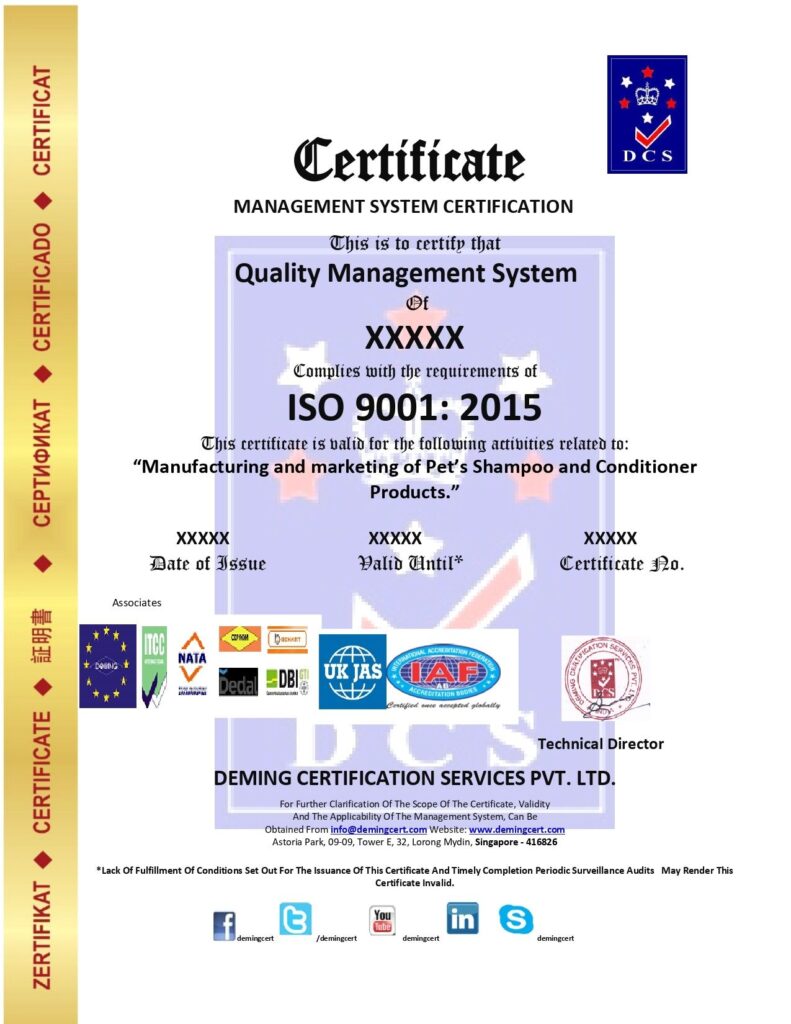
For Fr Pet International Company Limited, the ISO 9001:2015 certification issued in 2023 represents an important quality milestone. It provides formal recognition of the company’s certified Quality Management System within the defined certification scope. The certification period supplied for this corporate story extends to 2026.
The importance of this achievement goes beyond displaying a certificate at the company’s office. A meaningful quality management system must be reflected in everyday activities. From the initial planning of pet-care products to sourcing materials, manufacturing operations, quality inspections, packaging, storage, marketing and customer feedback, every relevant process should contribute towards consistent product quality and customer satisfaction.
The company’s stated business activity, manufacturing and marketing of pet’s shampoo and conditioner products, requires attention to several interconnected factors. These may include the suitability of ingredients, supplier reliability, manufacturing controls, product specifications, packaging integrity, identification, traceability and customer communication. Each factor can influence the final product and the customer’s experience.
An organised QMS helps management establish responsibilities for these activities. Employees can understand what is expected from them, how their work should be performed and which records should be maintained. Supervisors can evaluate performance using established criteria rather than relying entirely on informal observations.
Another important element is the company’s relationship with customers. Customer satisfaction depends on more than the physical product. Timely responses, accurate information, responsible complaint handling and reliable business communication also contribute to the overall customer experience. ISO 9001:2015 encourages organisations to monitor customer perceptions and use relevant information to improve their processes.
For a developing pet-care business, the value of quality is also connected with brand reputation. Customers may try a product because of its appearance, promotion or recommendation, but repeat purchases are more likely when their expectations are consistently met. This makes product consistency and dependable service important elements of long-term commercial success.
The introduction of a structured QMS also provides an opportunity to strengthen internal coordination. Production, procurement, quality control, marketing, sales and administration must work together. When these functions share information and follow clear procedures, the organisation can reduce misunderstandings and improve operational discipline.
The ISO 9001:2015 milestone therefore represents an important chapter in the development of Fr Pet International Company Limited. It demonstrates the importance attached to systematic quality management and provides a framework for improving business processes.
The company’s future growth will depend on how effectively this quality commitment is maintained and developed. Certification can provide recognition, but sustainable progress requires continuous leadership involvement, employee participation, customer understanding and regular evaluation.
For Fr Pet International Company Limited, the journey towards stronger quality management is not simply about meeting a standard. It is about developing an organisational culture in which quality becomes part of planning, decision-making and everyday work. This commitment can support the company’s ambition to strengthen its position in the pet-care product sector and build lasting confidence among customers and business partners.
#FrPetInternational
Chapter 2 – Understanding the Pet-Care Industry and Customer Expectations
The pet-care industry has developed around the growing importance of animal hygiene, grooming and responsible pet ownership. Pet owners increasingly look for products that help maintain cleanliness and support regular grooming practices. Shampoo and conditioner products are among the important categories within this market because they are used as part of routine pet-care activities.
For a company engaged in manufacturing and marketing pet’s shampoo and conditioner products, understanding customer expectations is essential. Different customers may have different preferences depending on the type of animal, grooming habits, product characteristics, purchasing power and availability of alternatives. A business must understand these differences before developing products and marketing strategies.
Fr Pet International Company Limited operates within this business environment from its Dhaka office at BTI Centara Grand, Green Road, Tejgaon. Its stated business scope connects product manufacturing with marketing activities. This combination requires coordination between product quality, market understanding and customer communication.
Customers purchasing pet-care products may consider several factors. These can include the intended use of the shampoo, product consistency, fragrance, ease of application, packaging convenience, price and clarity of instructions. Professional groomers and retailers may additionally consider supply reliability, product presentation, commercial terms and consistency between batches.
The company must recognise that customers do not evaluate quality through technical specifications alone. Their experience also depends on whether products are available when required, whether information is understandable and whether complaints or questions receive appropriate attention.
ISO 9001:2015 provides a useful framework for understanding these expectations. Clause 4 encourages organisations to understand their context and the needs and expectations of relevant interested parties. In the case of Fr Pet International Company Limited, relevant interested parties may include customers, employees, suppliers, distributors, regulatory authorities and other business partners.
The organisation can use this understanding to establish a more focused business strategy. Instead of assuming that all customers have identical requirements, management can gather feedback through sales discussions, customer interactions, distributor communication, product reviews and complaint records.
Customer feedback can become an important source of improvement. For example, repeated questions about product instructions may indicate that packaging information needs to be clearer. Repeated complaints about leakage may indicate a need to review packaging specifications or transportation arrangements. Delays in fulfilling orders may indicate a need to improve inventory planning or supplier coordination.
These examples demonstrate why customer information should be recorded, analysed and used for decision-making.
Product development also requires a careful understanding of intended applications. Shampoo and conditioner products are not simply general consumer goods. They are used on animals, and their intended formulation, usage instructions and product claims must be responsibly established. Product-related decisions should be supported by appropriate technical evaluation and applicable legal and regulatory requirements.
A quality-oriented company should ensure that marketing statements are consistent with approved product information. Promotional communication should not promise results that have not been adequately established. Accurate descriptions help protect customer confidence and support responsible brand development.
Another important market consideration is competition. The pet-care sector may include domestic manufacturers, imported brands, specialist grooming products and products sold through online platforms. Customers can compare different brands and make purchasing decisions based on price, reputation, product presentation and perceived value.
In this environment, quality management can help a company differentiate its business through consistency and reliability. A manufacturer that systematically controls its processes can work towards delivering products that meet established requirements. A marketing organisation that communicates accurately can strengthen the credibility of its brand.
The company’s leadership can also use market information to identify opportunities for product improvements and business expansion. Customer feedback may highlight demand for different packaging sizes, new product presentations or improved distribution arrangements. Such opportunities should be evaluated carefully before implementation.
ISO 9001:2015 supports this approach through its emphasis on evidence-based decision-making and risk-based thinking. Management can evaluate whether a proposed change is commercially viable, technically appropriate and consistent with customer and regulatory requirements.
The pet-care market also presents challenges relating to changing customer preferences, supplier availability, cost pressures and product competition. A structured management system helps the organisation evaluate these issues systematically rather than responding only after problems occur.
For Fr Pet International Company Limited, understanding the industry is therefore closely connected with maintaining a customer-focused Quality Management System. The company can use market feedback, internal records and supplier information to strengthen its business planning.
Ultimately, the pet-care industry rewards businesses that understand the people purchasing their products and the responsibilities associated with the products themselves. By combining customer awareness with systematic quality management, Fr Pet International Company Limited can create a stronger foundation for customer relationships, product development and sustainable business growth.
#ISO9001
Chapter 3 – The Importance of ISO 9001:2015 Certification

Quality is one of the most important foundations of a successful manufacturing and marketing organisation. A company may introduce attractive products, invest in advertising and develop distribution networks, but its long-term reputation depends on its ability to meet customer requirements consistently. This is particularly important in the pet-care industry, where customers expect products to be manufactured and marketed responsibly.
ISO 9001:2015 is an internationally recognised Quality Management System standard. It provides requirements for organisations that want to demonstrate their ability to consistently provide products and services meeting customer and applicable statutory and regulatory requirements. It also promotes continual improvement and enhanced customer satisfaction.
For Fr Pet International Company Limited, the certification issued in 2023 represents a significant organisational milestone within its stated scope of manufacturing and marketing pet’s shampoo and conditioner products.
The standard is based on several important quality management principles. These include customer focus, leadership, engagement of people, process approach, improvement, evidence-based decision-making and relationship management.
Customer focus means that the organisation must understand customer requirements and work towards meeting them. For Fr Pet International Company Limited, this may involve understanding the expectations of pet owners, retailers, distributors and professional grooming businesses.
Leadership is equally important. Management must establish a clear quality policy, assign responsibilities, provide resources and communicate the importance of meeting requirements. Without leadership involvement, a quality system may become a collection of documents instead of an effective management approach.
Engagement of people recognises that employees at different levels contribute towards organisational performance. Employees responsible for procurement, production, inspections, storage, sales and administration all influence the quality of business operations.
The process approach encourages organisations to identify interconnected activities and manage them as a coordinated system. For example, purchasing decisions can influence manufacturing quality, while manufacturing records can influence product traceability and customer complaint investigations.
Improvement is another important principle. An organisation should not assume that existing procedures will remain effective forever. Processes must be reviewed, weaknesses identified and corrective actions implemented whenever necessary.
Evidence-based decision-making means that management should use relevant information and reliable records when evaluating performance. Production data, inspection results, customer feedback, supplier performance and audit findings can support better decisions.
Relationship management recognises the importance of working effectively with suppliers and other relevant external parties. Reliable suppliers can contribute significantly to product consistency and business continuity.
The ISO 9001:2015 framework helps translate these principles into practical organisational activities. It includes requirements relating to organisational context, leadership, planning, support, operation, performance evaluation and improvement.
For a pet-care products company, operational controls may cover supplier selection, purchasing requirements, material identification, production planning, process monitoring, inspection, product release, packaging, storage and delivery, as applicable to the organisation’s actual operations.
The standard does not prescribe a single manufacturing formula or guarantee that every product is safe or effective. Instead, it establishes a management framework for controlling processes and meeting applicable requirements. Technical product evaluation and compliance obligations must still be addressed through appropriate product-specific arrangements.
The certification milestone can also support business credibility. When customers or business partners evaluate suppliers, a recognised QMS certificate may provide additional confidence that the organisation has established a formal system for managing quality within the certified scope.
However, certification should not be considered an automatic guarantee of increased sales, export approval or market leadership. Its value depends on the effectiveness of the implemented system and the organisation’s ability to maintain it.
For Fr Pet International Company Limited, ISO 9001:2015 can provide a structured foundation for strengthening internal coordination and improving the consistency of business processes.
A documented quality policy can communicate management’s commitment. Quality objectives can translate that commitment into measurable priorities. Internal audits can evaluate implementation. Management reviews can assess system performance, while corrective actions can address identified problems.
The certificate issued in 2023 and its stated validity through 2026 therefore provide an important reference point in the company’s quality journey. The broader achievement lies in maintaining the principles of the standard throughout daily operations.
A quality certificate is most valuable when employees understand why the system exists and how their work contributes towards it. When management and employees treat quality as a shared responsibility, the organisation can move beyond compliance and develop a culture of continual improvement.
For this reason, ISO 9001:2015 certification should be viewed as the beginning of a continuing process of organisational development rather than the final destination of quality management.
#ISO90012015
Chapter 4 – Building Stronger Manufacturing and Operational Processes
Manufacturing performance depends on the coordination of people, materials, equipment, procedures and information. Even when a company has experienced employees and suitable facilities, inconsistent processes can create difficulties in maintaining product requirements. A structured Quality Management System helps an organisation establish controls that support repeatable and reliable operations.
Fr Pet International Company Limited has a stated business scope covering manufacturing and marketing of pet’s shampoo and conditioner products. Manufacturing activities in this sector require attention to material specifications, approved formulations, process controls, equipment suitability, inspection arrangements and packaging requirements, according to the company’s actual operations.
A systematic manufacturing process begins with planning. Before production activities take place, the organisation should establish relevant product requirements and identify the resources necessary to achieve them. Production planning should consider material availability, equipment readiness, employee competence and applicable production instructions.
Raw materials are an important part of product quality. Their suitability can influence the characteristics and consistency of the finished shampoo and conditioner products. Therefore, supplier evaluation and purchasing controls are important elements of the manufacturing process.
The company can establish criteria for selecting suppliers, evaluating their performance and verifying purchased materials. Relevant records may include supplier approvals, purchase specifications, delivery information, inspection reports and material identification records.
Material verification can help ensure that received materials correspond with established purchasing requirements. Where necessary, the organisation can identify materials by batch number, status or other suitable identification methods.
Manufacturing instructions should clearly communicate the approved process requirements. These may cover material quantities, mixing procedures, equipment settings, process conditions and other technical parameters established through appropriate product development and validation activities.
Employees responsible for manufacturing should receive suitable training and understand the procedures relevant to their work. Competence is important because even well-written instructions cannot produce consistent outcomes if employees do not understand how to apply them.
Equipment also requires appropriate attention. Manufacturing equipment, measuring devices and inspection instruments should be maintained and controlled according to their intended use. Where measurement traceability is required, suitable calibration or verification arrangements should be established.
In-process inspections provide opportunities to identify problems before products move to the next stage. Depending on established product specifications, checks may include appearance, consistency, pH or other relevant characteristics. Actual acceptance criteria must be based on approved product requirements and applicable technical obligations.
Finished-product inspection is another important control. The organisation should establish suitable criteria for determining whether products meet the requirements before release. Inspection records can provide evidence that the relevant checks have been completed.
Packaging and labelling are also significant. Product packaging should be suitable for its intended use, while labelling information should be accurate and consistent with approved product details and applicable requirements.
Storage arrangements must protect materials and finished products against conditions that could adversely affect their quality. Identification, stock rotation and suitable handling practices can help maintain product integrity.
The process approach of ISO 9001:2015 encourages management to examine how these activities connect with each other. A supplier issue may affect production scheduling. A production deviation may affect finished-product inspection. A packaging problem may lead to customer complaints. Understanding these relationships helps the company identify the actual causes of operational problems.
Documented information supports process consistency. Procedures, work instructions, specifications and records should be controlled to ensure that employees use the correct information. Unauthorised changes and outdated documents can create confusion and operational risk.
Operational performance can also be monitored through suitable indicators. Examples include production rejection rates, material wastage, order fulfilment performance, customer complaints and corrective action closure. The company should select indicators that are meaningful for its actual business processes.
For Fr Pet International Company Limited, strengthening operational controls can help improve coordination between production and marketing activities. Marketing teams should receive accurate product information, while production teams should understand customer requirements and market expectations.
Such coordination is particularly important when a company plans to increase product variety or production capacity. Changes in formulations, materials, suppliers, packaging or production methods should be reviewed and controlled before implementation.
The purpose of these arrangements is not to make manufacturing unnecessarily complicated. It is to create a clear and practical operating structure that supports product consistency, accountability and improvement.
Through effective implementation of its Quality Management System, Fr Pet International Company Limited can continue developing the operational discipline required for responsible and sustainable growth in the pet-care products sector.
#QualityManagementSystem
Chapter 5 – Leadership, Employees and Organisational Development
A Quality Management System becomes effective when it is supported by people throughout the organisation. Documents, procedures and inspection records are important, but they cannot independently create a quality culture. Leadership and employee participation are essential for translating quality objectives into everyday business practices.
For Fr Pet International Company Limited, management involvement is particularly important because the company’s activities connect manufacturing, marketing, supplier relationships and customer service. These functions must work together to maintain a consistent approach to quality.
The promoters and senior management have an important role in setting the organisation’s direction. They must communicate business priorities, establish quality objectives and provide the resources necessary to achieve them. They should also ensure that employees understand how their individual responsibilities contribute towards customer satisfaction.
ISO 9001:2015 places significant emphasis on leadership. Top management is expected to demonstrate accountability for the effectiveness of the QMS and promote the process approach and risk-based thinking.
A clear quality policy can help communicate the organisation’s commitment. It should reflect the company’s purpose, business context and strategic direction. Employees should understand the policy and how it relates to their work.
Quality objectives make the policy more practical. Depending on the company’s priorities, objectives may relate to product conformity, customer satisfaction, delivery performance, supplier evaluation, complaint handling or process improvement.
Objectives should be measurable wherever practicable. Management can periodically review performance and determine whether the organisation is progressing towards its intended results.
Employee competence is another important factor. Personnel performing work that affects product quality should have suitable education, training, skills or experience. Where gaps are identified, the organisation can arrange training or other appropriate actions.
In a pet-care products business, different departments may require different competencies. Procurement employees need to understand purchasing requirements and supplier communication. Production employees need to understand approved manufacturing instructions. Quality personnel need to understand inspection criteria and documentation. Marketing employees need accurate product knowledge and responsible communication practices.
Training should not be treated merely as an attendance activity. Its effectiveness should be evaluated where appropriate. Management may observe work performance, review records or assess whether employees can correctly apply relevant procedures.
Communication also contributes towards organisational development. Employees should know how to report problems, communicate deviations and raise suggestions for improvement. An open communication environment can help identify operational weaknesses at an early stage.
Responsibilities and authorities should be clearly assigned. When employees understand who approves materials, who releases products, who handles complaints and who reviews records, operational coordination becomes easier.
Another important element is organisational awareness. Employees should understand the importance of meeting customer requirements and the possible consequences of failing to follow established procedures.
The company can encourage employee participation through regular meetings, training sessions, improvement discussions and internal communication. These activities can help employees recognise that quality is not the exclusive responsibility of a quality department.
Leadership should also create an environment in which problems are investigated rather than hidden. If an employee identifies an error in a process, the organisation should encourage timely reporting and appropriate corrective action.
This is important because repeated problems may indicate weaknesses in procedures, training, equipment or planning. Addressing the underlying cause is generally more effective than repeatedly correcting individual mistakes.
Employee development can also contribute towards business continuity. When knowledge is shared and important activities are supported by documented procedures, the organisation becomes less dependent on a small number of individuals.
As Fr Pet International Company Limited continues developing its operations, management can use the QMS to establish a stronger organisational structure. Regular performance reviews, clear responsibilities and systematic training can support coordination and accountability.
A positive quality culture can also improve employee confidence. When employees receive proper instructions, suitable resources and clear feedback, they are better positioned to perform their responsibilities effectively.
The company’s certification journey therefore represents an opportunity to strengthen both its processes and its people. Sustainable organisational development requires leadership commitment, employee competence and shared responsibility for quality.
#PetCareProducts
Chapter 6 – Customer Satisfaction, Brand Trust and Market Development
Customer satisfaction is one of the most important factors influencing the long-term performance of a manufacturing and marketing company. A customer may purchase a product for the first time because of advertising, price or recommendation. However, continued confidence depends on the actual experience received.
For Fr Pet International Company Limited, operating in the pet-care product sector, customer satisfaction is connected with product consistency, reliable information, packaging, availability and service quality.
Pet owners want to understand what they are purchasing and how the products should be used. Retailers and distributors want reliable supply and clear commercial communication. Professional grooming businesses may place particular importance on consistency and product suitability.
A company must therefore understand the requirements of different customer groups and establish suitable processes to address them.
ISO 9001:2015 encourages organisations to monitor customer perceptions and use feedback to evaluate customer satisfaction. This does not require a company to depend on one particular feedback method. Customer surveys, sales discussions, complaint records, distributor feedback and other relevant communication channels may all provide useful information.
Customer complaints should receive particular attention. A complaint may relate to product characteristics, packaging damage, delivery delays, incorrect information or another issue. The company should record relevant details, investigate the circumstances and determine whether corrective action is necessary.
For example, if several customers report similar packaging problems, the organisation should investigate whether the issue originates from packaging material, filling operations, storage or transportation. Correcting the underlying cause can help prevent recurrence.
Customer communication should also be professional and accurate. Employees involved in marketing and sales should understand approved product information and avoid making unsupported technical claims.
Brand reputation is built through repeated experiences. A company that provides consistent products and dependable communication can strengthen the confidence of its customers and business partners.
For Fr Pet International Company Limited, ISO 9001:2015 certification can provide an additional element of business credibility. It demonstrates that a Quality Management System has been certified within the stated scope. This may support discussions with prospective customers who consider quality management when evaluating suppliers.
However, certification alone cannot guarantee customer loyalty or commercial expansion. The company must continue meeting customer expectations and maintaining the effectiveness of its QMS.
Market development requires a combination of quality, customer understanding and business planning. The company can evaluate opportunities in different distribution channels, including specialist pet shops, grooming businesses, distributors and suitable online sales platforms.
Each channel may require different operational arrangements. Retail distribution may require consistent packaging and stock availability. Online sales may require accurate product descriptions, responsive customer support and appropriate delivery coordination.
The organisation can evaluate market feedback to identify opportunities for improvement. Customer preferences may indicate interest in different product sizes, packaging formats or product presentations. Such opportunities should be assessed in terms of technical feasibility, commercial value and applicable requirements.
A structured QMS can help the company manage these changes. Product information, specifications, purchasing requirements and operational instructions should be reviewed whenever significant changes are introduced.
Customer satisfaction also depends on the relationship between marketing promises and actual product performance. Responsible marketing builds credibility because it helps customers make informed purchasing decisions.
For a pet-care company, accurate instructions and suitable product information are especially important. Customers should be able to understand the intended use of products and any relevant precautions.
Management can establish customer-focused objectives and review them regularly. These may include complaint response time, customer feedback trends, repeat-order performance or delivery reliability, where suitable data is available.
Such indicators can help management identify strengths and areas requiring attention.
Through a consistent approach to customer requirements, Fr Pet International Company Limited can strengthen its brand foundation and develop more dependable commercial relationships.
The long-term objective should be to create customer confidence through real operational performance rather than relying only on promotional activities or certification claims.
#PetShampoo
Chapter 7 – Supplier Management, Risk Assessment and Business Continuity
A manufacturing company depends on a network of suppliers and external service providers. The quality of purchased materials, packaging components and supporting services can influence the final product and the organisation’s ability to meet customer requirements.
For Fr Pet International Company Limited, supplier management is particularly relevant because its business scope includes manufacturing and marketing pet’s shampoo and conditioner products.
The company should understand that supplier selection is not simply a purchasing decision based on price. Reliability, conformity, delivery performance, communication and the ability to meet established requirements are also important considerations.
ISO 9001:2015 requires organisations to control externally provided processes, products and services to the extent necessary to ensure conformity with requirements.
A systematic supplier evaluation process can help management identify suppliers capable of meeting the organisation’s needs. Evaluation criteria may include product specifications, quality records, delivery performance, technical capability and previous experience.
Purchasing documents should communicate relevant requirements clearly. Where necessary, these may include material specifications, packaging requirements, identification details, acceptance criteria and documentation expectations.
Received materials should be verified according to established arrangements. If materials do not meet requirements, the organisation should identify and control them to prevent unintended use.
Supplier performance should also be monitored. Repeated delivery delays, inconsistent material quality or inadequate documentation may indicate a need for further evaluation.
Risk-based thinking is another important feature of ISO 9001:2015. It encourages organisations to identify factors that could affect the achievement of intended results and plan suitable actions.
For a pet-care products company, possible business risks may relate to material shortages, supplier dependency, equipment breakdown, inconsistent production conditions, packaging failures, inaccurate product information or changes in applicable requirements.
The company should evaluate these risks according to its actual operating environment rather than assuming that every organisation faces identical challenges.
Risk assessment can help management establish priorities. For example, if a critical material is available from only one supplier, the company may consider evaluating alternative sources or maintaining suitable inventory arrangements.
If production equipment is essential to meeting customer demand, planned maintenance may help reduce unexpected interruptions.
If customer complaints reveal recurring product or packaging issues, corrective action can help address the underlying causes.
Business continuity also depends on information management. Important specifications, supplier records, production information and customer communication should be controlled and available to authorised personnel.
The organisation should consider how changes in market conditions, transportation, supplier availability and operating costs could affect its business.
Supplier relationships should be developed through communication and performance evaluation. Constructive relationships can help resolve problems and support improvements in the supply chain.
For Fr Pet International Company Limited, a stronger supplier management process can support manufacturing consistency and business reliability.
The company can also use management reviews to examine supplier performance, significant risks and opportunities. Decisions should be based on relevant records and the organisation’s actual operational experience.
It is important to recognise that risk management is not limited to preventing problems. It can also identify opportunities. A more reliable supplier, improved purchasing arrangement or better packaging solution may create operational and commercial benefits.
The organisation can evaluate such opportunities before implementing changes.
Through systematic supplier control, risk assessment and business continuity planning, Fr Pet International Company Limited can develop a more resilient operating structure.
#PetConditioner
Chapter 8 – Marketing Strategy, Business Expansion and Competitive Positioning
Business growth requires more than the ability to manufacture products. A company must also understand its market, communicate its value and develop distribution arrangements that allow customers to access its products.
Fr Pet International Company Limited combines manufacturing and marketing activities in the pet-care product sector. This creates an opportunity to connect product quality with market development.
A strong marketing strategy begins with understanding the customer. Pet owners, retailers, grooming professionals and distributors may have different purchasing requirements. The organisation should identify relevant customer groups and develop communication strategies suited to their needs.
Product information should be clear, consistent and accurate. Packaging, catalogues, websites and promotional materials should communicate approved product details. Marketing employees should have access to current product specifications and relevant instructions.
The company’s ISO 9001:2015 Quality Management System can support marketing activities by encouraging control over documented information and customer-related processes.
One important opportunity for a pet-care business is developing a recognisable brand identity. Customers should be able to understand the company’s product range and distinguish its products through consistent presentation and reliable information.
Brand development also requires responsible claims. The organisation should ensure that promotional statements are supported by appropriate evidence and comply with applicable requirements.
Distribution is another important element. The company may evaluate opportunities to work with pet shops, grooming centres, distributors and other relevant sales channels. Each partnership should be assessed according to its commercial suitability and ability to support customer service.
A distribution strategy must also consider inventory management and order fulfilment. Marketing activities that generate demand should be coordinated with production planning and material availability.
If the company promotes a product without sufficient supply planning, it may create customer dissatisfaction. Therefore, sales forecasts and operational planning should be coordinated.
Digital marketing can provide additional opportunities to reach customers. A professional website, suitable social media communication, product information and online customer support may help improve market visibility.
Online communication should remain consistent with the company’s approved product information. Questions and complaints received through digital channels should be handled through suitable procedures.
The company may also evaluate opportunities for geographic expansion. Before entering new markets, management should consider customer requirements, local regulations, product labelling, distribution arrangements and applicable market-entry conditions.
ISO 9001:2015 certification may support business discussions by demonstrating that the organisation has an independently certified Quality Management System within the stated scope. However, it does not automatically provide permission to sell products in every market or establish compliance with all product-specific regulations.
Competitive positioning should be based on genuine business strengths. These may include consistent processes, reliable supply, responsible communication, customer service and effective quality management.
Price competition alone may not provide sustainable differentiation. Customers may value reliability, clear information and confidence in the supplier relationship.
The company’s management can establish market-development objectives and review their performance. Possible indicators include enquiries, conversion rates, order fulfilment, customer feedback and distributor performance.
Such indicators should be interpreted carefully and used to support decisions rather than merely to produce reports.
For Fr Pet International Company Limited, the combination of quality management and market planning can support a stronger competitive foundation.
The company’s future business opportunities will depend on its ability to maintain product requirements, understand customers and develop reliable commercial relationships.
Marketing and quality management should therefore operate as complementary business functions. When both are aligned, the organisation can pursue growth while maintaining its commitment to consistency and customer satisfaction.
#ManufacturingExcellence
Chapter 9 – Continual Improvement, Performance Evaluation and Organisational Excellence
Continual improvement is an essential part of a successful Quality Management System. Organisations operate in changing environments, and procedures that were suitable in the past may require revision as customer expectations, technology, suppliers and market conditions develop.
For Fr Pet International Company Limited, continual improvement can provide a structured approach to strengthening manufacturing, marketing and customer service activities.
ISO 9001:2015 includes requirements for monitoring, measurement, analysis, evaluation and improvement. These activities help management understand whether the QMS is achieving its intended results.
Performance evaluation should begin with the identification of suitable indicators. A company manufacturing and marketing pet-care products may monitor relevant areas such as supplier performance, production conformity, inspection results, customer complaints, delivery performance and corrective action effectiveness.
The indicators selected should reflect the company’s actual processes and objectives.
Internal audits provide another important method of evaluation. They help determine whether the Quality Management System conforms to established requirements and is effectively implemented and maintained.
An internal audit should examine actual activities and supporting records rather than simply checking whether documents exist. Auditors may review procurement records, production documentation, inspection reports, training evidence and customer complaint handling.
Audit findings should be communicated to relevant personnel. Where nonconformities are identified, the organisation should take appropriate corrective action.
Corrective action involves more than correcting an individual problem. The organisation should determine the cause of the nonconformity and evaluate whether similar problems exist elsewhere.
For example, if an inspection identifies repeated errors in product labelling, the company should investigate the underlying cause. It may relate to outdated artwork, inadequate document control, insufficient verification or unclear responsibilities.
Corrective action should address the actual cause and its effectiveness should be reviewed.
Management review is also important. Top management should periodically evaluate the performance and suitability of the QMS. Relevant inputs may include audit results, customer feedback, process performance, supplier performance, nonconformities, risks, opportunities and improvement recommendations.
The outcome of management review can include decisions about resource requirements, process changes and improvement priorities.
The Plan-Do-Check-Act approach provides a useful way to understand continual improvement.
Plan involves establishing objectives and determining the resources and processes required. Do involves implementing the planned activities. Check involves monitoring and evaluating results. Act involves taking actions to improve performance.
This approach can be applied to different business activities, including manufacturing controls, supplier management, packaging improvements and customer service.
Employee suggestions can also contribute towards improvement. Personnel working directly with processes may identify practical opportunities that are not always visible to senior management.
Management should encourage employees to communicate suggestions and participate in suitable improvement activities.
Technology may provide additional opportunities. Appropriate digital systems can support inventory records, customer communication, document control, production monitoring and business reporting.
However, technology should be selected according to actual organisational needs. Introducing software without clear procedures and responsibilities may create additional complexity.
For Fr Pet International Company Limited, organisational excellence should be understood as an ongoing process rather than a single achievement.
The ISO 9001:2015 certificate issued in 2023 provides an important milestone, but the real value of certification depends on continued implementation and improvement.
As the stated certification validity extends to 2026, maintaining the system and addressing surveillance or recertification requirements applicable to the certification arrangement are important considerations.
The company should ensure that its quality policy, objectives, documented information, operational controls and performance evaluation arrangements remain appropriate.
Continual improvement can support greater process consistency, stronger customer relationships and better-informed management decisions.
By developing a culture in which problems are investigated and opportunities are evaluated, Fr Pet International Company Limited can strengthen its ability to respond to changing business conditions.
#QualityAssurance
Chapter 10 – The Future Vision: Sustainable Growth Through Quality
The development of a successful company is a continuing journey. Every stage brings new opportunities, responsibilities and challenges. Organisations that remain committed to quality, customer satisfaction and improvement are better positioned to build a sustainable business foundation.
For Fr Pet International Company Limited, the ISO 9001:2015 certification issued in 2023 represents an important milestone in its development as a company engaged in manufacturing and marketing pet’s shampoo and conditioner products.
Operating from G-5, BTI Centara Grand, 144/1 Green Road, Tejgaon, Dhaka – 1215, Bangladesh, the company has a defined business identity connected with the pet-care product sector.
The future of this business will depend on how effectively its management translates quality principles into daily operations. Certification can provide recognition, but continued business development requires practical action.
One important area is product consistency. The organisation should continue reviewing material requirements, manufacturing controls, inspection arrangements, packaging practices and product information. These activities can help maintain conformity with established requirements.
Another area is customer satisfaction. The company should maintain effective communication channels and use customer feedback to identify opportunities for improvement.
Supplier relationships will remain important. Reliable sourcing, supplier evaluation and appropriate purchasing controls can support operational stability.
Employee development should also remain a priority. As business activities expand, employees may require additional training and competence development. Management should ensure that responsibilities remain clear and resources are appropriate.
The company can also explore suitable market opportunities. The pet-care sector may offer possibilities through retail networks, professional grooming channels, distribution partnerships and digital platforms. Any expansion should be based on proper market research, operational capacity and applicable legal requirements.
Product development may provide further opportunities. Customer feedback and market information can help management evaluate whether new product variations or packaging options are commercially and technically appropriate.
However, innovation should be supported by proper product evaluation and controlled implementation. Changes should not compromise established requirements or applicable product obligations.
A long-term business vision should also consider responsible manufacturing and efficient resource utilisation. Reducing avoidable material waste, improving inventory management and maintaining suitable equipment can support operational efficiency.
The company can review relevant environmental and resource considerations as part of its wider business planning, while recognising that ISO 9001:2015 is specifically a Quality Management System standard.
Digital transformation may also support future development. Suitable software and information systems can help improve coordination between departments, maintain records and support management decisions.
However, the most important element will continue to be leadership commitment. Management must regularly review business performance, evaluate risks and opportunities and provide the resources needed to maintain the QMS.
The promoters and management can strengthen the organisation by establishing a clear long-term strategy that connects quality objectives with commercial priorities.
For example, objectives relating to customer satisfaction, supplier performance, product conformity and delivery reliability can help translate the company’s quality commitment into measurable business activities.
The organisation should also maintain its certification obligations. The supplied certificate details identify 2023 as the issue year and 2026 as the validity year. Management should ensure that the certificate’s actual status, surveillance requirements and renewal or recertification arrangements are appropriately monitored.
A certificate should always be represented accurately in marketing and business communication. Its scope should not be extended to activities or locations that are not covered by the certification.
The company’s journey also highlights a broader message about the importance of quality management for businesses in Bangladesh. Organisations that establish systematic processes, develop employee competence and understand customer expectations can strengthen their business foundations and improve their readiness for changing market conditions.
Fr Pet International Company Limited has an opportunity to build upon its certification milestone by maintaining an effective Quality Management System and continually evaluating its performance.
The true measure of success will not be the certificate alone. It will be reflected in consistent products, responsible manufacturing practices, reliable customer service, effective supplier relationships and the ability to improve over time.
The future vision is therefore clear: to make quality an integral part of business planning, manufacturing, marketing and customer relationships.
Through management commitment, employee participation, customer focus and continual improvement, Fr Pet International Company Limited can work towards a stronger, more reliable and sustainable position in the pet-care products industry.
The ISO 9001:2015 certification journey should be remembered as an important foundation for this development. It represents the beginning of an ongoing commitment to quality, professionalism and customer confidence.
#BangladeshBusiness
Conclusion
Fr Pet International Company Limited’s ISO 9001:2015 certification milestone in 2023 marks an important chapter in its quality management journey. With its defined scope of manufacturing and marketing pet’s shampoo and conditioner products, the company has a framework through which it can strengthen process control, improve organisational coordination, understand customer expectations and support continual improvement.
The long-term success of the company will depend on maintaining the effectiveness of its Quality Management System and translating quality commitments into measurable business performance.
Quality is not merely a certificate. It is a continuous responsibility, a management philosophy and an essential foundation for sustainable business development.
#PetCareIndustry #CustomerSatisfaction #ContinuousImprovement #QualityCertifiedCompany #SustainableBusinessGrowth
Take the Next Step Today
Don’t wait to enhance your business’s quality and efficiency. Partner with Hot Aaj News and experience the transformation that comes with expert consultancy and training. Contact us today to learn more about how we can help you achieve your business goals. Reach out via phone at +91-9322728183, visit our website at hotaaj.com, or email us at info@hotaaj.com Let us be your guide on the journey to excellence and innovation.