


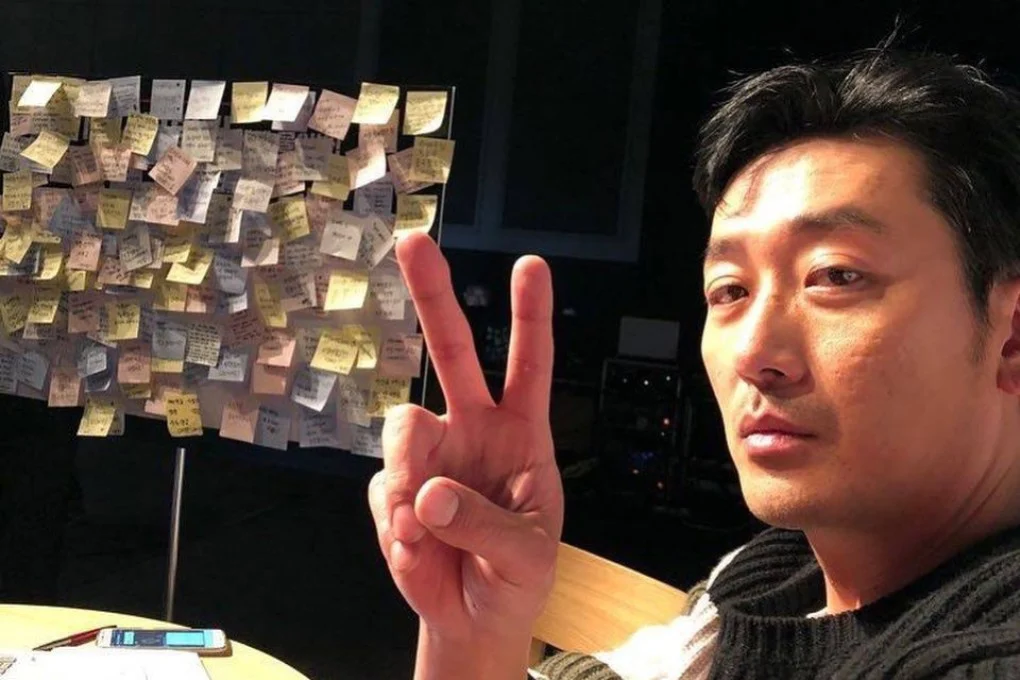
Korean Actor Ha Jung-woo Discusses Nocturnal – A Raw and Intense Thriller Exploring Revenge
In an exclusive interview, renowned Korean actor Ha Jung-woo offers a deep dive into his upcoming film Nocturnal, a gripping thriller that promises to take audiences on a wild ride through a fresh perspective on the age-old theme of revenge. Known for his versatile performances in films such as The Chaser and The Handmaiden, Ha Jung-woo is no stranger to intense and complex roles. However, with Nocturnal, he is set to explore a darker, more visceral side of revenge.
Ha Jung-woo describes Nocturnal as a “raw and intense” thriller, drawing from the familiar revenge narrative but delivering it in an entirely new light. “The concept of revenge is something we’ve all seen before, but Nocturnal takes it to a different place. It’s a reflection of human nature in its rawest form, with emotions so intense that they transcend the conventional. It’s not just about vengeance; it’s about what that pursuit does to a person, and the consequences that follow,” Ha Jung-woo shares.
He credits the film’s director, Kim Jin-hwang, for bringing a refreshing approach to this well-worn genre. “Kim Jin-hwang’s direction is unlike anything I’ve encountered before. He has a unique way of capturing the emotional turmoil of the characters and presenting it in such an authentic and impactful way. He has a vision that is both daring and subtle, making it an exciting experience for both the cast and the audience.”
In the film, Ha Jung-woo plays a complex character whose motivations and actions delve deep into the moral ambiguities of revenge. The actor emphasizes the film’s layered storytelling and the unpredictability of his role, which challenges the audience to think critically about justice, pain, and redemption.
As for his preparation, Ha Jung-woo admits that playing such an emotionally charged character required immense dedication and reflection. “I’ve always been drawn to roles that explore the complexities of human emotion. Nocturnal demanded a lot from me, especially in terms of understanding the mental and emotional space my character occupies. It was challenging, but also very rewarding.”
The actor also opened up about his thoughts on how revenge has been portrayed in Korean cinema, stating, “Revenge stories often show a one-dimensional view of the person seeking vengeance, but Nocturnal offers something much deeper. It’s not just about the act of revenge itself; it’s about the personal transformation that happens along the way. That’s what makes the story so intriguing.”
In today’s world of instant information and social media, Ha Jung-woo also touched on the influence of modern technology on both his career and public perception. “Social media has changed how people connect with films and actors, but I try not to let it interfere with the creative process. My focus remains on the work itself, on creating a connection with the audience through my characters. The story comes first.”
Nocturnal promises to be a standout film in Ha Jung-woo’s impressive career, offering a bold new interpretation of a classic theme. As the film gears up for its release, audiences can expect a film that is as emotionally charged as it is thought-provoking—a true testament to the power of revenge and its consequences.
With his compelling performance and Kim Jin-hwang’s innovative direction, Nocturnal is shaping up to be a must-see for fans of thrilling, character-driven cinema.
Ha Jung-woo Explores Fresh Perspectives in Nocturnal‘s Revenge Plot
In a recent interview, Korean actor Ha Jung-woo shared his thoughts on the timeless theme of revenge and how it can still captivate audiences when approached with a fresh perspective. While revenge stories are a staple in cinema, Ha believes that the impact of such a plot can vary significantly depending on the execution and the context in which it is set.
“The revenge plot isn’t new, but I believe that even the same theme can provide new enjoyment depending on how the works change in form and background,” Ha remarked. He emphasized that while the idea of seeking vengeance has been explored in numerous films, Nocturnal stands apart because of its unique take on the subject matter.
For Ha Jung-woo, the strength of Nocturnal lies in its ability to transform the familiar revenge narrative into something more emotionally raw and gripping. “It’s not just about the act of revenge itself. The film dives deep into the psyche of the characters, showcasing the complexity of their emotions and the consequences of their choices. It’s a story that doesn’t just follow a linear path but explores the darker sides of human nature,” he explained.
Ha’s belief that revenge stories can evolve lies in Nocturnal’s ability to shift the genre into new terrain—through its atmospheric setting, innovative direction by Kim Jin-hwang, and the nuanced performance Ha brings to his character. The actor hinted that while the film is rooted in a well-known theme, it challenges traditional expectations by focusing on the emotional and psychological journey rather than just the external act of revenge.
This philosophy of reinvention is something Ha Jung-woo has always valued in his career, as he looks for projects that provide depth and emotional resonance. Nocturnal, with its bold reimagining of revenge, promises to offer a gripping new layer to the familiar plot device, ultimately reminding audiences that even the most well-worn themes can be made fresh with a change in perspective.
Ha Jung-woo Talks Director Kim Jin-hwang’s Unique Vision Behind Nocturnal
In his recent interview, Ha Jung-woo revealed that one of the key reasons he was drawn to the thriller Nocturnal was the director Kim Jin-hwang’s distinct and innovative approach to storytelling. The actor expressed a deep admiration for Kim’s vision, which he believes brings a fresh, transformative quality to the familiar theme of revenge.
“I was immediately intrigued by Kim Jin-hwang’s unique vision for Nocturnal,” Ha said. “His approach to the narrative and the way he chooses to explore the emotional layers of the characters were key factors in my decision to take on this project. It’s rare to find a director who can reimagine a familiar theme so compellingly, and that was something I wanted to be a part of.”
Ha described Kim Jin-hwang’s direction as a refreshing take on a genre that has been widely explored in cinema. “What sets this film apart is not just the plot, but the depth with which the director has infused the story. He’s not merely telling a tale of revenge—he’s exploring what happens to a person’s soul, their identity, and their morality when vengeance becomes their driving force,” Ha explained.
For Ha, working with a director who could reinterpret such a well-known narrative and infuse it with originality was a significant motivator in choosing the role. “Kim’s vision isn’t just about external action or spectacle. It’s about capturing the inner turmoil, the human conflict, and the emotional depth of the characters. It’s that unique lens through which he tells the story that made Nocturnal so appealing to me,” he shared.
The actor’s enthusiasm for the director’s distinct approach highlights his commitment to choosing roles that offer more than just surface-level thrills. Ha Jung-woo’s decision to join Nocturnal speaks to his dedication to roles that challenge both him and the audience, offering a thought-provoking exploration of vengeance and its consequences.
With Kim Jin-hwang’s visionary direction and Ha Jung-woo’s powerful performance, Nocturnal is poised to stand out as a bold reimagining of the revenge thriller genre.

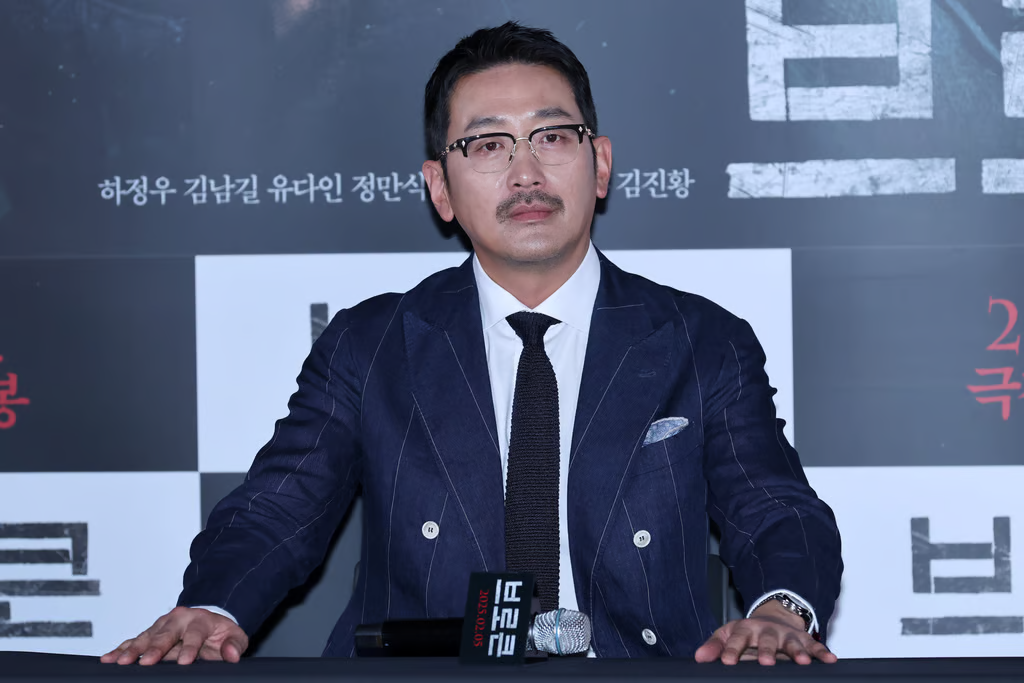
Ha Jung-woo Discusses Director Kim Jin-hwang’s Personal Touch in Nocturnal
In a candid interview, Ha Jung-woo shared what ultimately drew him to Nocturnal—the personal experiences and unique approach of its director, Kim Jin-hwang. The 46-year-old actor explained that it was Kim’s personal connection to the script and his attitude toward the film’s characters that intrigued him the most.
“I was drawn to Kim,” Ha said. “His personal experiences are woven into the script, and I was intrigued by his attitude towards the characters in the film.” Ha emphasized that Kim’s ability to integrate his own life experiences into the storytelling gave the film an authenticity and emotional depth that made it stand out from other thrillers.
For Ha, this personal touch added layers to the characters, making them more complex and relatable. “When a director brings a part of themselves into the story, it doesn’t just create a narrative—it makes the characters feel real. Kim’s approach allows the audience to connect with the characters on a deeper level, as if they are seeing reflections of true human emotions and struggles,” he explained.
Ha also admired Kim Jin-hwang’s sensitivity in shaping the film’s characters, recognizing the subtlety with which he portrays their vulnerabilities and desires. “Kim didn’t just create characters that serve the plot; he created individuals with real motivations, struggles, and contradictions. It’s that balance of depth and complexity that made me excited to join the project.”
The actor’s admiration for Kim’s approach highlights his own dedication to roles that push boundaries and offer something new both for him as an actor and for the audience. With Nocturnal, Ha Jung-woo is stepping into a story crafted through the lens of Kim Jin-hwang’s personal experiences, promising a raw, emotional, and thought-provoking experience.

Courtesy: IOF – Hindi
References
- ^ Jump up to:a b “Table 8: Cinema Infrastructure – Capacity”. UNESCO Institute for Statistics. Archived from the original on 24 December 2018. Retrieved 12 March 2018.
- ^ “Table 6: Share of Top 3 distributors (Excel)”. UNESCO Institute for Statistics. Archived from the original on 24 December 2018. Retrieved 12 March 2018.
- ^ “Table 1: Feature Film Production – Method of Shooting”. UNESCO Institute for Statistics. Archived from the original on 24 December 2018. Retrieved 12 March 2018.
- ^ Jump up to:a b “Table 11: Exhibition – Admissions & Gross Box Office (GBO)”. UNESCO Institute for Statistics. Archived from the original on 24 December 2018. Retrieved 12 March 2018.
- ^ Jump up to:a b c Stamatovich, Clinton (25 October 2014). “A Brief History of Korean Cinema, Part One: South Korea by Era”. Haps Magazine. Retrieved 15 February 2017.
- ^ Jump up to:a b Paquet, Darcy (2012). New Korean Cinema: Breaking the Waves. Columbia University Press. pp. 1–5. ISBN 978-0231850124..
- ^ Jump up to:a b Min, p.46.
- ^ Jump up to:a b Chee, Alexander (16 October 2017). “Park Chan-wook, the Man Who Put Korean Cinema on the Map”. The New York Times. ISSN 0362-4331. Retrieved 13 March 2018.
- ^ Jump up to:a b Nayman, Adam (27 June 2017). “Bong Joon-ho Could Be the New Steven Spielberg”. The Ringer. Retrieved 13 March 2018.
- ^ Jin, Min-ji (13 February 2018). “Third ‘Detective K’ movie tops the local box office”. Korea JoongAng Daily. Retrieved 13 March 2018.
- ^ 오, 승훈; 김, 경애 (2 November 2021). “한국 최초의 영화관 ‘애관극장’ 사라지면 안되잖아요” [“We Can’t Let the First Movie Theater in Korea, ‘Ae Kwan Theater’ Disappear”]. The Hankyoreh (in Korean). Retrieved 10 September 2023.
- ^ 이, 재덕 (7 February 2015). 저당 잡힌 ‘109살 한국 예술의 요람’ 단성사는 웁니다 [Dansungsa, the ‘109 Year Old Cradle of Korean Cinema’, Weeps After Being Mortgaged]. Kyunghyang Shinmun. Retrieved 10 September 2023.
- ^ “Viva Freedom! (Jayumanse) (1946)”. Korean Film Archive. Archived from the original on 14 March 2018. Retrieved 13 March 2018.
- ^ Gwon, Yeong-taek (10 August 2013). 한국전쟁 중 제작된 영화의 실체를 마주하다 [Facing the reality of film produced during the Korean War]. Korean Film Archive (in Korean). Archived from the original on 8 September 2014. Retrieved 13 March 2018.
- ^ Jump up to:a b Paquet, Darcy (1 March 2007). “A Short History of Korean Film”. KoreanFilm.org. Retrieved 13 March 2018.
- ^ Paquet, Darcy. “1945 to 1959”. KoreanFilm.org. Retrieved 13 March 2013.
- ^ McHugh, Kathleen; Abelmann, Nancy, eds. (2005). South Korean Golden Age Melodrama: Gender, Genre, and National Cinema. Wayne State University Press. pp. 25–38. ISBN 0814332536.
- ^ Goldstein, Rich (30 December 2014). “Propaganda, Protest, and Poisonous Vipers: The Cinema War in Korea”. The Daily Beast. Retrieved 15 February 2017.
- ^ Jump up to:a b c d Paquet, Darcy. “1960s”. KoreanFilm.org. Retrieved 13 March 2018.
- ^ Jump up to:a b “Prizes & Honours 1961”. Berlin International Film Festival. Retrieved 13 March 2018.
- ^ Jump up to:a b c Rousse-Marquet, Jennifer (10 July 2013). “The Unique Story of the South Korean Film Industry”. French National Audiovisual Institute (INA). Retrieved 13 March 2018.
- ^ Jump up to:a b Kim, Molly Hyo (2016). “Film Censorship Policy During Park Chung Hee’s Military Regime (1960-1979) and Hostess Films” (PDF). IAFOR Journal of Cultural Studies. 1 (2): 33–46. doi:10.22492/ijcs.1.2.03 – via wp-content.
- ^ Gateward, Frances (2012). “Korean Cinema after Liberation: Production, Industry, and Regulatory Trend”. Seoul Searching: Culture and Identity in Contemporary Korean Cinema. SUNY Press. p. 18. ISBN 978-0791479339.
- ^ Kai Hong, “Korea (South)”, International Film Guide 1981, p.214. quoted in Armes, Roy (1987). “East and Southeast Asia”. Third World Film Making and the West. Berkeley, California: University of California Press. p. 156. ISBN 0-520-05690-6.
- ^ Taylor-Jones, Kate (2013). Rising Sun, Divided Land: Japanese and South Korean Filmmakers. Columbia University Press. p. 28. ISBN 978-0231165853.
- ^ Jump up to:a b Paquet, Darcy. “1970s”. KoreanFilm.org. Retrieved 15 March 2018.
- ^ Min, p.51-52.
- ^ Hartzell, Adam (March 2005). “A Review of Im Kwon-Taek: The Making of a Korean National Cinema”. KoreanFilm.org. Retrieved 15 March 2018.
- ^ Jump up to:a b Chua, Beng Huat; Iwabuchi, Koichi, eds. (2008). East Asian Pop Culture: Analysing the Korean Wave. Hong Kong University Press. pp. 16–22. ISBN 978-9622098923.
- ^ Paquet, Darcy. “The Korean Film Industry: 1992 To The Present” in New Korean Cinema. Edited by Chi-Yun Shin and Julia Stringer, 35. Edinburgh, U.K: Edinburgh University Press. 2005.
- ^ Park, Seung Hyun. 2002. “Film Censorship And Political Legitimation In South Korea, 1987-1992”. Cinema Journal 42 (1): 123. doi:10.1353/cj.2002.0024.
- ^ Paquet, Darcy. 2009. New Korean Cinema: Breaking The Waves (Short Cuts). New York, USA: Columbia University Press.
- ^ Sohn, Hee Jeong. 2020. “Feminism Reboot: Korean Cinema Under Neoliberalism In The 21St Century”. Journal Of Japanese And Korean Cinema 12 (2): 100. doi:10.1080/17564905.2020.1840031.
- ^ Jameson, Sam (19 June 1989). “U.S. Films Troubled by New Sabotage in South Korea Theater”. Los Angeles Times.
- ^ “‘Movie Industry Heading for Crisis'”. The Korea Times.
- ^ Brown, James (9 February 2007). “Screen quotas raise tricky issues”. Variety.
- ^ “Korean movie workers stage mass rally to protest quota cut”. Korea Is One. Archived from the original on 26 May 2006. Retrieved 11 February 2010.
- ^ Artz, Lee; Kamalipour, Yahya R., eds. (2007). The Media Globe: Trends in International Mass Media. New York: Rowman and Littlefield Publishers. p. 41. ISBN 978-0742540934.
- ^ Rosenberg, Scott (1 December 2004). “Thinking Outside the Box”. Film Journal International. Retrieved 16 March 2013.
- ^ Lee, Hyo-won (18 November 2013). “Original ‘Oldboy’ Gets Remastered, Rescreened for 10th Anniversary in South Korea”. The Hollywood Reporter. Retrieved 16 March 2018.
- ^ Jump up to:a b “Box Office: All Time”. Korean Film Council. Retrieved 16 March 2018.
- ^ Pomerantz, Dorothy (8 September 2014). “What The Economics Of ‘Snowpiercer’ Say About The Future Of Film”. Forbes. Retrieved 16 March 2018.
- ^ Kang Kim, Hye Won (11 January 2018). “Could K-Film Ever Be As Popular As K-Pop In Asia?”. Forbes. Retrieved 16 March 2018.
- ^ “PARASITE Crowned Best Foreign Language Film at Golden Globes”. Korean Film Biz Zone.
- ^ Khatchatourian, Klaritza Rico,Maane; Rico, Klaritza; Khatchatourian, Maane (10 February 2020). “‘Parasite’ Becomes First South Korean Movie to Win Best International Film Oscar”.
- ^ Jump up to:a b Peirse, Alison; Martin, Daniel (14 March 2013). Korean Horror Cinema. p. 1. doi:10.1515/9780748677658. ISBN 978-0-7486-7765-8.
- ^ The Playlist Staff (26 June 2014). “Primer: 10 Essential Films Of The Korean New Wave”. IndieWire. Retrieved 18 November 2023.
- ^ Paquet, Darcy. “Film Awards Ceremonies in Korea”. KoreanFilm.org. Retrieved 16 March 2018.
- ^ Steger, Isabella (10 October 2017). “South Korea’s Busan film festival is emerging from under a dark political cloud”. Quartz. Retrieved 16 March 2018.
- ^ “IMDb OSCARS”. IMDb. Retrieved 21 March 2021.
- ^ “Prizes & Honours”. Berlin International Film Festival. Archived from the original on 21 March 2019. Retrieved 16 March 2018.
- ^ “Cannes Film Festival”. IMDb. Retrieved 16 March 2018.
- ^ “History of Biennale Cinema”. La Biennale di Venezia. 7 December 2017. Retrieved 16 March 2018.
- ^ “Announcing the TIFF ’19 Award Winners”. TIFF. Retrieved 29 October 2019.
- ^ “2013 Sundance Film Festival Announces Feature Film Awards”. Sundance Institute. Retrieved 29 October 2019.
- ^ “Telluride Film Festival”. IMDb. Retrieved 29 October 2019.
- ^ “Tokyo International Film Festival”. IMDb. Retrieved 16 March 2018.
- ^ “Locarno International Film Festival”. IMDb. Retrieved 16 March 2018.