









The opening was delayed by two days due to a dispute between Hamas and Israel over Hamas altering the agreed order of hostages to be released in exchange for Palestinian prisoners.
Israel Allows Palestinians to Return to North Gaza Under Fragile Ceasefire
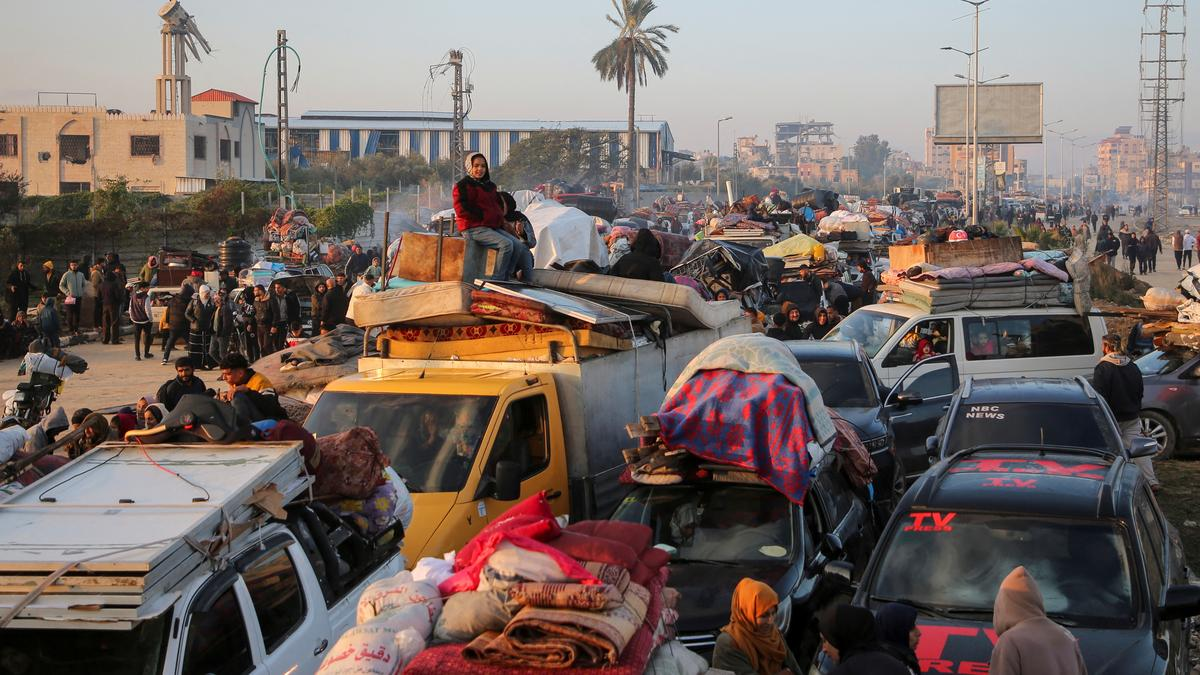
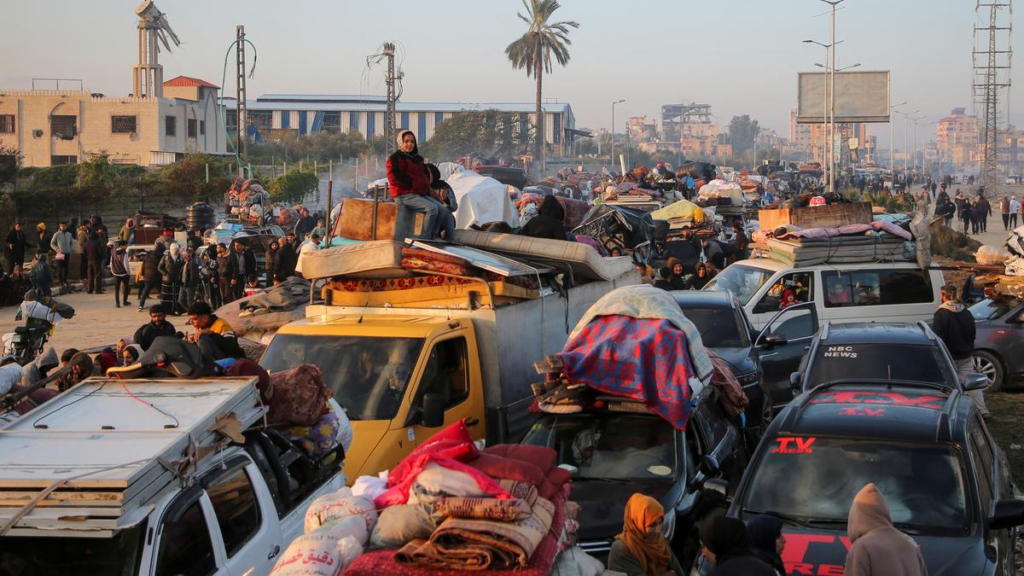
Israel on Monday, January 27, 2025, began permitting thousands of Palestinians to return to the devastated northern Gaza Strip for the first time since the early weeks of the 15-month conflict with Hamas. This decision follows a fragile ceasefire agreement aimed at de-escalating tensions in the region.
The reopening of northern Gaza marks a significant moment in the ongoing crisis, as residents return to an area heavily damaged by airstrikes and ground operations. The ceasefire, while tenuous, has provided a brief window for humanitarian efforts and reconstruction planning.
The process faced delays, with the opening postponed for two days due to a dispute between Hamas and Israel. Israel accused Hamas of altering the agreed sequence of hostages released in exchange for hundreds of Palestinian prisoners, causing further tension before the ceasefire could take effect.
As residents cautiously return, international observers and humanitarian organizations are urging both sides to honor the ceasefire and prioritize the needs of civilians. The situation remains uncertain, with hopes for sustained peace tempered by the challenges of rebuilding and resolving underlying conflicts.
Reuters Report: Israel Allows Palestinians to Return to Northern Gaza
On Monday, January 27, 2025, Israel began allowing thousands of Palestinians to return to the heavily destroyed northern Gaza Strip for the first time since the early weeks of its 15-month war with Hamas. This development is part of a fragile ceasefire agreement aimed at reducing hostilities.
The reopening was delayed for two days due to a dispute between Hamas and Israel. Israel claimed that Hamas altered the agreed sequence of hostage releases in exchange for hundreds of Palestinian prisoners. The dispute was resolved overnight through mediation.
Palestinians, who have spent over a year in overcrowded tent camps and makeshift shelters such as schools, are eager to return to their homes despite the likelihood of extensive damage or destruction. Many expressed fears that their displacement might become permanent. Concerns were heightened by a proposal from President Donald Trump suggesting the resettlement of large numbers of Palestinians in Egypt and Jordan.
The ceasefire, while offering a glimmer of hope, remains precarious as residents return to rebuild their lives amidst the ruins.
Return to Northern Gaza Begins Amid Fragile Ceasefire
Ismail Abu Mattar, a father of four, described “a sea of people” heading north as Palestinians began returning to the heavily damaged northern Gaza Strip under a fragile ceasefire. Mattar and his family waited three days to return to their home in Gaza City, fearing the truce might collapse. “They were three days of hell,” he said. “We were concerned that the truce would collapse and we wouldn’t return.”
Hamas hailed the return as “a victory for our people and a declaration of failure and defeat for the [Israeli] occupation and transfer plans.”
The ceasefire, which aims to de-escalate the deadliest and most destructive war between Israel and Hamas, also seeks the release of dozens of hostages taken during Hamas’ October 7, 2023, attack, which triggered the conflict.
As thousands return to their homes, many face the daunting reality of destruction, uncertainty, and the fragile nature of peace in the region.
Israel Opens Northern Gaza as Ceasefire Holds Amid Complex Conditions
Israel ordered the mass evacuation of northern Gaza during the opening days of the war, sealing off the region as ground troops moved in. Around a million Palestinians fled south in October 2023, while hundreds of thousands who remained in the north endured the heaviest fighting and destruction of the 15-month conflict.
The crossing was delayed over the weekend as Israel demanded the release of a female civilian hostage, Arbel Yehoud, and accused Hamas of withholding information on the status of other hostages set to be freed in the initial phase of the ceasefire agreement.
As the fragile truce holds, thousands of Palestinians are cautiously returning to northern Gaza to assess the damage and attempt to rebuild their lives amid the widespread devastation.
Qatar Mediates Hostage Releases Amid Fragile Ceasefire
Qatar, a key mediator with Hamas, announced early Monday (January 27, 2025) that an agreement had been reached to release Israeli civilian hostage Arbel Yehoud along with two others before Friday (January 31, 2025).
Israeli Prime Minister Benjamin Netanyahu confirmed that the upcoming release, including female soldier Agam Berger, will occur on Thursday (January 30, 2025). This release will be in addition to one already scheduled for Saturday (February 1, 2025), during which three more hostages are expected to be freed.
Hamas has also provided the required list of information about the hostages to be released as part of the ceasefire’s six-week first phase. The agreement marks a critical step in the delicate negotiations aimed at sustaining the truce and easing the humanitarian crisis in Gaza.
Under the first phase of the ceasefire, which runs until early March, Hamas is expected to release a total of 33 hostages in exchange for nearly 2,000 Palestinians imprisoned by Israel. So far, Hamas has freed seven hostages, including four female soldiers, in exchange for more than 300 Palestinian prisoners, many of whom are serving life sentences for deadly attacks on Israelis.
The second phase of the ceasefire agreement, which is expected to be much more challenging, has yet to be negotiated. Hamas has stated that it will not release the remaining 60 or so hostages unless Israel ends the war. However, Israeli Prime Minister Benjamin Netanyahu has expressed that he remains committed to destroying Hamas and ending its nearly 18-year rule over Gaza.
Hamas initiated the war on October 7, 2023, when thousands of its fighters stormed into southern Israel, killing approximately 1,200 people, mostly civilians, and abducting around 250. Approximately 90 hostages are still being held in Gaza, and Israel believes that about a third of them may be dead.
Israel’s air and ground operations have resulted in over 47,000 Palestinian deaths, with more than half of the victims being women and children, according to Gaza’s Health Ministry. The ministry has not specified how many of the casualties were combatants. Israel, on the other hand, claims to have killed over 17,000 militants, although it has not provided evidence to support this figure.
Israeli bombardment and ground operations have displaced around 90% of Gaza’s 2.3 million residents, often forcing them to relocate multiple times. Entire neighborhoods have been flattened, exacerbating the humanitarian crisis in the region.
Courtesy: DW News
References
- ^ Recognition by other UN member states: Russia (West Jerusalem),[1] the Czech Republic (West Jerusalem),[2] Honduras,[3] Guatemala,[4] Nauru,[5] and the United States.[6]
- ^ Jerusalem is Israel’s largest city if including East Jerusalem, which is widely recognized as occupied territory.[7] If East Jerusalem is not counted, the largest city would be Tel Aviv.
- ^ Arabic has a “special status” as set by the Basic Law of 2018, which allows it to be used by official institutions.[9][10] Prior to that law’s passage, Arabic had been an official language alongside Hebrew.[11]
- ^ Jump up to:a b Israeli population and economic data covers the economic territory of Israel, including the Golan Heights, East Jerusalem and Israeli settlements in the West Bank.[338][339]
- ^ The personal name “Israel” appears much earlier, in material from Ebla.[48]
- ^ /ˈɪzri.əl, -reɪ-/; Hebrew: יִשְׂרָאֵל, romanized: Yīsrāʾēl [jisʁaˈʔel]; Arabic: إِسْرَائِيل, romanized: ʾIsrāʾīl
- ^ Hebrew: מְדִינַת יִשְׂרָאֵל, romanised: Medīnat Yīsrāʾēl [mediˈnat jisʁaˈʔel]; Arabic: دَوْلَة إِسْرَائِيل, romanised: Dawlat Isrāʾīl
- Citations
- ^ “Foreign Ministry statement regarding Palestinian-Israeli settlement”. mid.ru. 6 April 2017. Archived from the original on 4 January 2020. Retrieved 15 December 2018.
- ^ “Czech Republic announces it recognizes West Jerusalem as Israel’s capital”. The Jerusalem Post. 6 December 2017. Archived from the original on 3 March 2020. Retrieved 6 December 2017.
The Czech Republic currently, before the peace between Israel and Palestine is signed, recognizes Jerusalem to be in fact the capital of Israel in the borders of the demarcation line from 1967.” The Ministry also said that it would only consider relocating its embassy based on “results of negotiations.
- ^ “Honduras recognizes Jerusalem as Israel’s capital”. The Times of Israel. 29 August 2019. Archived from the original on 3 December 2019. Retrieved 29 August 2019.
- ^ “Guatemala se suma a EEUU y también trasladará su embajada en Israel a Jerusalén” [Guatemala joins US, will also move embassy to Jerusalem]. Infobae (in Spanish). 24 December 2017. Archived from the original on 17 April 2020. Retrieved 25 December 2017. Guatemala’s embassy was located in Jerusalem until the 1980s, when it was moved to Tel Aviv.
- ^ “Nauru recognizes J’lem as capital of Israel”. Israel National News. 29 August 2019. Archived from the original on 11 June 2020. Retrieved 29 August 2019.
- ^ “Trump Recognizes Jerusalem as Israel’s Capital and Orders U.S. Embassy to Move”. The New York Times. 6 December 2017. Archived from the original on 17 June 2020. Retrieved 6 December 2017.
- ^ The Legal Status of East Jerusalem (PDF), Norwegian Refugee Council, December 2013, pp. 8, 29, archived (PDF) from the original on 10 May 2021, retrieved 26 October 2021
- ^ “Constitution for Israel”. knesset.gov.il. Archived from the original on 4 August 2023. Retrieved 9 December 2023.
- ^ Jump up to:a b “Israel Passes ‘National Home’ Law, Drawing Ire of Arabs”. The New York Times. 19 July 2018. Archived from the original on 7 January 2019. Retrieved 19 July 2018.
- ^ Jump up to:a b Lubell, Maayan (19 July 2018). “Israel adopts divisive Jewish nation-state law”. Reuters. Archived from the original on 24 December 2018. Retrieved 19 July 2018.
- ^ Jump up to:a b “Arabic in Israel: an official language and a cultural bridge”. Israel Ministry of Foreign Affairs. 18 December 2016. Archived from the original on 2 August 2020. Retrieved 8 August 2018.
- ^ Jump up to:a b c d “Israel”. The World Factbook. Central Intelligence Agency. 10 September 2024. Retrieved 30 September 2024.
- ^ “Israel”. Central Intelligence Agency. 27 February 2023. Archived from the original on 10 January 2021. Retrieved 24 February 2023 – via CIA.gov.
- ^ “Israel country profile”. BBC News. 24 February 2020. Archived from the original on 24 January 2021. Retrieved 27 January 2021.
- ^ “Surface water and surface water change”. OECD.Stat. OECD. Archived from the original on 24 March 2021. Retrieved 11 October 2020.
- ^ “World Population Prospects – Population Division – United Nations”. population.un.org. Retrieved 29 October 2024.
- ^ “Geographic Areas – Nationwide”. 2022 Population Census Data. Central Bureau of Statistics. Retrieved 31 July 2024.
- ^ Jump up to:a b c d “World Economic Outlook Database, October 2024 Edition. (Israel)”. www.imf.org. International Monetary Fund. 22 October 2024. Retrieved 4 January 2025.
- ^ “Gini Index coefficient”. The World Factbook. Retrieved 24 September 2024.
- ^ Human Development Report 2023-24 (Report). United Nations. 13 March 2024. Archived from the original on 18 March 2024. Retrieved 13 March 2024.
- ^ “When will be the right time for Israel to define its borders? – analysis”. The Jerusalem Post | JPost.com. 12 June 2022. Archived from the original on 25 January 2024. Retrieved 25 January 2024.
- ^ Akram, Susan M., Michael Dumper, Michael Lynk, and Iain Scobbie, eds. 2010. International Law and the Israeli-Palestinian Conflict: A Rights-Based Approach to Middle East Peace. Routledge. p. 119: “UN General Assembly Resolution 181 recommended the creation of an international zone, or corpus separatum, in Jerusalem to be administered by the UN for a 10-year period, after which there would be a referendum to determine its future. This approach applies equally to West and East Jerusalem and is not affected by the occupation of East Jerusalem in 1967. To a large extent it is this approach that still guides the diplomatic behaviour of states and thus has greater force in international law.”
- ^ Jump up to:a b Gil, Moshe (1992). A History of Palestine, 634-1099. Cambridge University Press. p. 14. ISBN 978-0-521-59984-9. Archived from the original on 17 May 2024. Retrieved 17 May 2024.
- ^ Morris, Benny (1999). Righteous Victims: A History of the Zionist-Arab Conflict, 1881–2001 (reprint ed.). Knopf. ISBN 9780679744757. Archived from the original on 22 March 2024. Retrieved 22 March 2024.
The fear of territorial displacement and dispossession was to be the chief motor of Arab antagonism to Zionism down to 1948 (and indeed after 1967 as well).
Also quoted, among many, by Mark M. Ayyash (2019). Hermeneutics of Violence: A Four-Dimensional Conception. University of Toronto Press, p. 195 Archived 22 March 2024 at the Wayback Machine, ISBN 1487505868. Accessed 22 March 2024. - ^ Fildis, Ayse; Nisanci, Ensar (2019). “British Colonial Policy “Divide and Rule”: Fanning Arab Rivalry in Palestine” (PDF). International Journal of Islamic and Civilizational Studies. 6 (1). UTM Press. Archived (PDF) from the original on 10 May 2024. Retrieved 10 May 2024.
- ^ “Zionism | Definition, History, Examples, & Facts”. britannica.com. 19 October 2023. Archived from the original on 25 December 2018. Retrieved 29 October 2023.
- ^ Meir-Glitzenstein, Esther (Fall 2018). “Turning Points in the Historiography of Jewish Immigration from Arab Countries to Israel”. Israel Studies. 23 (3). Indiana University Press: 114–122. doi:10.2979/israelstudies.23.3.15. JSTOR 10.2979/israelstudies.23.3.15. S2CID 150208821.
The mass immigration from Arab countries began in mid-1949 and included three communities that relocated to Israel almost in their entirety: 31,000 Jews from Libya, 50,000 from Yemen, and 125,000 from Iraq. Additional immigrants arrived from Egypt, Morocco, Tunisia, Turkey, Iran, India, and elsewhere. Within three years, the Jewish population of Israel doubled. The ethnic composition of the population shifted as well, as immigrants from Muslim counties and their offspring now comprised one third of the Jewish population—an unprecedented phenomenon in global immigration history. From 1952–60, Israel regulated and restricted immigration from Muslim countries with a selective immigration policy based on economic criteria, and sent these immigrants, most of whom were North African, to peripheral Israeli settlements. The selective immigration policy ended in 1961 when, following an agreement between Israel and Morocco, about 100,000 Jews immigrated to the State. From 1952–68 about 600,000 Jews arrived in Israel, three quarters of whom were from Arab countries and the remaining immigrants were largely from Eastern Europe. Today fewer than 30,000 remain in Muslim countries, mostly concentrated in Iran and Turkey.
- ^ Fischbach 2008, p. 26–27.
- ^ Slater 2020, pp. 81–92, 350, “[p. 350] It is no longer a matter of serious dispute that in the 1947–48 period—beginning well before the Arab invasion in May 1948—some 700,000 to 750,000 Palestinians were expelled from or fled their villages and homes in Israel in fear of their lives—an entirely justifiable fear, in light of massacres carried out by Zionist forces.”
- ^ Ghanim, Honaida (March 2009). “Poetics of Disaster: Nationalism, Gender, and Social Change Among Palestinian Poets in Israel After Nakba”. International Journal of Politics, Culture, and Society. 22 (1): 23–39 [25–26]. doi:10.1007/s10767-009-9049-9. ISSN 0891-4486. JSTOR 40608203. S2CID 144148068. Archived from the original on 6 November 2021.
Around 750,000–900,000 Palestinians were systematically expelled from their homes and lands and about 531 villages were deliberately destroyed.
- ^ Cleveland, William L.; Bunton, Martin (2016). A History of the Modern Middle East. Westview Press. p. 270. ISBN 978-0-429-97513-4.
Not only was there no Palestinian Arab state, but the vast majority of the Arab population in the territory that became Israel-over 700,000 people-had become refugees. The Arab flight from Palestine began during the intercommunal war and was at first the normal reaction of a civilian population to nearby fighting-a temporary evacuation from the zone of combat with plans to return once hostilities ceased. However, during spring and early summer 1948, the flight of the Palestinian Arabs was transformed into a permanent mass exodus… .
- ^ Beker, Avi (2005). “The Forgotten Narrative: Jewish Refugees from Arab Countries”. Jewish Political Studies Review. 17 (3/4): 3–19. ISSN 0792-335X. JSTOR 25834637. Archived from the original on 9 January 2024. Retrieved 23 May 2024.
- ^ Dinstein, Yoram (11 October 2021). Israel Yearbook on Human Rights, Volume 6 (1976). BRILL. p. 282. ISBN 978-90-04-42287-2. Archived from the original on 21 May 2024. Retrieved 23 May 2024.
- ^ Jump up to:a b “How Israel’s electoral system works”. CNN.com. CNN International. Retrieved 14 October 2021.
- ^ “Asia’s Top 10 Most Wealthy Countries by GDP per Capita”. 19 February 2024. Retrieved 5 December 2024.
- ^ “30 Wealthiest Countries by Per Capita Net Worth”. Yahoo Finance. 9 September 2023. Retrieved 15 July 2024.
- ^ Dutta, Soumitra; Lanvin, Bruno; Wunsch-Vincent, Sacha (2022). Global Innovation Index 2023, 15th Edition. World Intellectual Property Organization. doi:10.34667/tind.46596. ISBN 978-92-805-3432-0. Retrieved 10 August 2024.
- ^ Getzoff, Marc (9 August 2023). “Most Technologically Advanced Countries In The World 2023”. Global Finance Magazine. Archived from the original on 8 November 2023. Retrieved 8 November 2023.
- ^ “Top 15 Most Advanced Countries in the World”. Yahoo Finance. 4 December 2022. Archived from the original on 10 January 2023. Retrieved 27 October 2023.
- ^ Noah Rayman (29 September 2014). “Mandatory Palestine: What It Was and Why It Matters”. Time. Archived from the original on 18 May 2019. Retrieved 5 December 2015.
- ^ “Popular Opinion”. The Palestine Post. 7 December 1947. p. 1. Archived from the original on 15 August 2012.
- ^ Elli Wohlgelernter (30 April 1998). “One Day that Shook the world”. The Jerusalem Post. Archived from the original on 12 January 2012.
- ^ “On the Move”. Time. 31 May 1948. Archived from the original on 16 October 2007. Retrieved 6 August 2007.
- ^ Geoffrey W. Bromiley (1995). “Israel”. International Standard Bible Encyclopedia: E–J. Wm. B. Eerdmans Publishing. p. 907. ISBN 978-0-8028-3782-0.
- ^ Barton & Bowden 2004, p. 126. “The Merneptah Stele … is arguably the oldest evidence outside the Bible for the existence of Israel as early as the 13th century BCE.”
- ^ K.L. Noll, Canaan and Israel in Antiquity: A Textbook on History and Religion, A&C Black, 2012, rev.ed. pp. 137ff.
- ^ Thomas L. Thompson, Early History of the Israelite People: From the Written & Archaeological Sources, Brill, 2000 pp. 275–276
- ^ Hasel, Michael G. (1 January 1994). “Israel in the Merneptah Stela”. Bulletin of the American Schools of Oriental Research. 296 (296): 45–61. doi:10.2307/1357179. JSTOR 1357179. S2CID 164052192.
* Bertman, Stephen (14 July 2005). Handbook to Life in Ancient Mesopotamia. Oxford University Press. ISBN 978-0-19-518364-1.
* Meindert Dijkstra (2010). “Origins of Israel between history and ideology”. In Becking, Bob; Grabbe, Lester (eds.). Between Evidence and Ideology Essays on the History of Ancient Israel read at the Joint Meeting of the Society for Old Testament Study and the Oud Testamentisch Werkgezelschap Lincoln Nebraska, July 2009. Brill. p. 47. ISBN 978-90-04-18737-5.As a West Semitic personal name it existed long before it became a tribal or a geographical name. This is not without significance, though is it rarely mentioned. We learn of a maryanu named ysr”il (*Yi¡sr—a”ilu) from Ugarit living in the same period, but the name was already used a thousand years before in Ebla. The word Israel originated as a West Semitic personal name. One of the many names that developed into the name of the ancestor of a clan, of a tribe and finally of a people and a nation.
- ^ Lemche, Niels Peter (1998). The Israelites in History and Tradition. Westminster John Knox Press. p. 35. ISBN 978-0-664-22727-2.
- ^ Tchernov, Eitan (1988). “The Age of ‘Ubeidiya Formation (Jordan Valley, Israel) and the Earliest Hominids in the Levant”. Paléorient. 14 (2): 63–65. doi:10.3406/paleo.1988.4455.
- ^ Rincon, Paul (14 October 2015). “Fossil teeth place humans in Asia ‘20,000 years early'”. BBC News. Archived from the original on 17 August 2017. Retrieved 4 January 2017.
- ^ Winfried Nöth (1994). Origins of Semiosis: Sign Evolution in Nature and Culture. Walter de Gruyter. p. 293. ISBN 978-3-11-087750-2.
- ^ Roger Blench, Matthew Spriggs (2003). Archaeology and Language IV: Language Change and Cultural Transformation. Routledge. p. 70. ISBN 978-1-134-81623-1.
- ^ Bar-Yosef, Ofer (7 December 1998). “The Natufian Culture in the Levant, Threshold to the Origins of Agriculture” (PDF). Evolutionary Anthropology. 6 (5): 159–177. doi:10.1002/(SICI)1520-6505(1998)6:5<159::AID-EVAN4>3.0.CO;2-7. S2CID 35814375. Archived (PDF) from the original on 16 July 2021. Retrieved 4 January 2017.
- ^ Steiglitz, Robert (1992). “Migrations in the Ancient Near East”. Anthropological Science. 3 (101): 263. Archived from the original on 26 March 2023. Retrieved 12 June 2020.
- ^ “Canaanites”. obo. Archived from the original on 3 April 2023. Retrieved 1 December 2023.
- ^ Glassman, Ronald M. (2017), Glassman, Ronald M. (ed.), “The Political Structure of the Canaanite City-States: Monarchy and Merchant Oligarchy”, The Origins of Democracy in Tribes, City-States and Nation-States, Cham: Springer International Publishing, pp. 473–477, doi:10.1007/978-3-319-51695-0_49, ISBN 978-3-319-51695-0, archived from the original on 29 April 2024, retrieved 1 December 2023
- ^ Braunstein, Susan L. (2011). “The Meaning of Egyptian-Style Objects in the Late Bronze Cemeteries of Tell el-Farʿah (South)”. Bulletin of the American Schools of Oriental Research. 364 (364): 1–36. doi:10.5615/bullamerschoorie.364.0001. JSTOR 10.5615/bullamerschoorie.364.0001. S2CID 164054005.
- ^ Dever, William G. Beyond the Texts, Society of Biblical Literature Press, 2017, pp. 89–93
- ^ S. Richard, “Archaeological sources for the history of Palestine: The Early Bronze Age: The rise and collapse of urbanism”, The Biblical Archaeologist (1987)
- ^ Miller, James Maxwell; Hayes, John Haralson (1986). A History of Ancient Israel and Judah. Westminster John Knox Press. ISBN 978-0-664-21262-9.
- ^ Rendsberg, Gary (2008). “Israel without the Bible”. In Frederick E. Greenspahn. The Hebrew Bible: New Insights and Scholarship. NYU Press, pp. 3–5
- ^ Gnuse, Robert Karl (1997). No Other Gods: Emergent Monotheism in Israel. Sheffield Academic Press Ltd. pp. 28, 31. ISBN 978-1-85075-657-6.
- ^ Steiner, Richard C. (1997), “Ancient Hebrew”, in Hetzron, Robert (ed.), The Semitic Languages, Routledge, pp. 145–173, ISBN 978-0-415-05767-7
- ^ Killebrew 2005, p. 230.
- ^ Shahin 2005, p. 6.
- ^ Faust 2015, p. 476: “While there is a consensus among scholars that the Exodus did not take place in the manner described in the Bible, surprisingly most scholars agree that the narrative has a historical core, and that some of the highland settlers came, one way or another, from Egypt.”
- ^ Redmount 2001, p. 61: “A few authorities have concluded that the core events of the Exodus saga are entirely literary fabrications. But most biblical scholars still subscribe to some variation of the Documentary Hypothesis, and support the basic historicity of the biblical narrative.”
- ^ Lipschits, Oded (2014). “The History of Israel in the Biblical Period”. In Berlin, Adele; Brettler, Marc Zvi (eds.). The Jewish Study Bible (2nd ed.). Oxford University Press. ISBN 978-0-19-997846-5. Archived from the original on 9 April 2023. Retrieved 1 December 2018.
- ^ Kuhrt, Amiele (1995). The Ancient Near East. Routledge. p. 438. ISBN 978-0-415-16762-8.
- ^ Finkelstein, Israel; Si