










Table of Contents
Chapter 1 — The Foundation of SKM Industries and Its Commitment to Quality
SKM Industries, located at C-1-815 / 4 & 5, G.I.D.C., Umbergaon, District Valsad, Gujarat 396171, India, represents the type of manufacturing enterprise that serves important industrial needs through metal fabrication, engineered products, and dependable production practices. Its stated activities include the manufacture and export of corrugated steel cable drums and storage systems, along with the manufacture of railway coach racks and bogie spare parts. These products operate in demanding industrial environments where strength, dimensional accuracy, durability, and consistent workmanship are important.
The development of a manufacturing business depends on more than machinery and production capacity. It also depends on the ability to understand customer requirements, maintain reliable processes, train employees, control materials, and deliver products that meet agreed specifications. For a company involved in welded metallic products, these responsibilities become particularly important because the quality of a finished component can depend significantly on the quality of its welded joints. (https://skmindustries.net/)
The story of SKM Industries’ certification journey begins with the recognition that quality must be built into the manufacturing process rather than inspected only at the end. A product may look satisfactory on the outside, but its long-term performance can depend on preparation, material selection, welding parameters, operator competence, inspection, and careful documentation. A systematic approach helps a manufacturer address these factors before they become expensive production problems.
Understanding the importance of welding quality
Welding is a critical manufacturing process in many steel products. It joins metal components to create assemblies that must perform according to their intended application. In corrugated steel cable drums, fabricated storage systems, railway coach racks, and bogie spare parts, welding requirements can vary according to design, thickness, material grade, loading conditions, and service environment.
Poorly controlled welding can lead to defects, unnecessary rework, dimensional variation, delays, and additional costs. In applications where components must withstand mechanical loads or repeated use, inadequate weld quality may also create serious reliability concerns. Therefore, the manufacturer must establish suitable controls for each relevant stage of production.
A structured welding quality system provides a framework for managing these responsibilities. It helps define who is responsible for welding activities, what procedures must be followed, how personnel qualifications are maintained, and how inspection records are preserved. These controls support consistency and help the organization demonstrate that its manufacturing activities are managed in a disciplined manner.
For SKM Industries, the adoption and continuation of a welding quality certification framework can be understood as part of a wider effort to strengthen manufacturing discipline, improve customer confidence, and support the long-term development of its product range.
The role of the promoter and leadership
Every manufacturing enterprise requires leadership that understands the relationship between quality, productivity, customer satisfaction, and sustainable growth. The promoter and management team establish the standards that guide daily operations. Their decisions influence investment in machinery, employee training, inspection facilities, supplier selection, and production planning.
A strong quality culture begins when management treats quality as a shared responsibility rather than the exclusive duty of an inspector. Production employees must understand why approved procedures matter. Supervisors must ensure that work is performed according to the required instructions. Quality personnel must have the authority and competence to identify problems and request corrective action.
Leadership also plays a major role in balancing production targets with technical requirements. Pressure to complete an order quickly should never encourage uncontrolled welding or the use of unapproved materials. Instead, production schedules must be realistic enough to accommodate preparation, inspection, correction, and final release.
When management communicates these expectations clearly, employees gain a better understanding of how their individual work contributes to the overall performance of the company.
Building a reputation through dependable manufacturing
Industrial customers often evaluate suppliers on several factors, including product quality, delivery performance, technical capability, communication, documentation, and the ability to resolve problems. A manufacturer that consistently meets these expectations has a stronger foundation for repeat business and long-term commercial relationships.
SKM Industries’ involvement in cable drums, storage systems, and railway-related components creates opportunities to demonstrate its capabilities across different industrial applications. Although each product category has its own technical requirements, the underlying principles of good manufacturing remain similar: correct materials, controlled fabrication, competent personnel, suitable inspection, and reliable records.
The company’s location in Gujarat also places it within a major Indian industrial environment where manufacturers serve customers with varied domestic and international requirements. In such a competitive setting, dependable quality practices can help distinguish a supplier from businesses that compete mainly on price.
The beginning of a structured quality journey
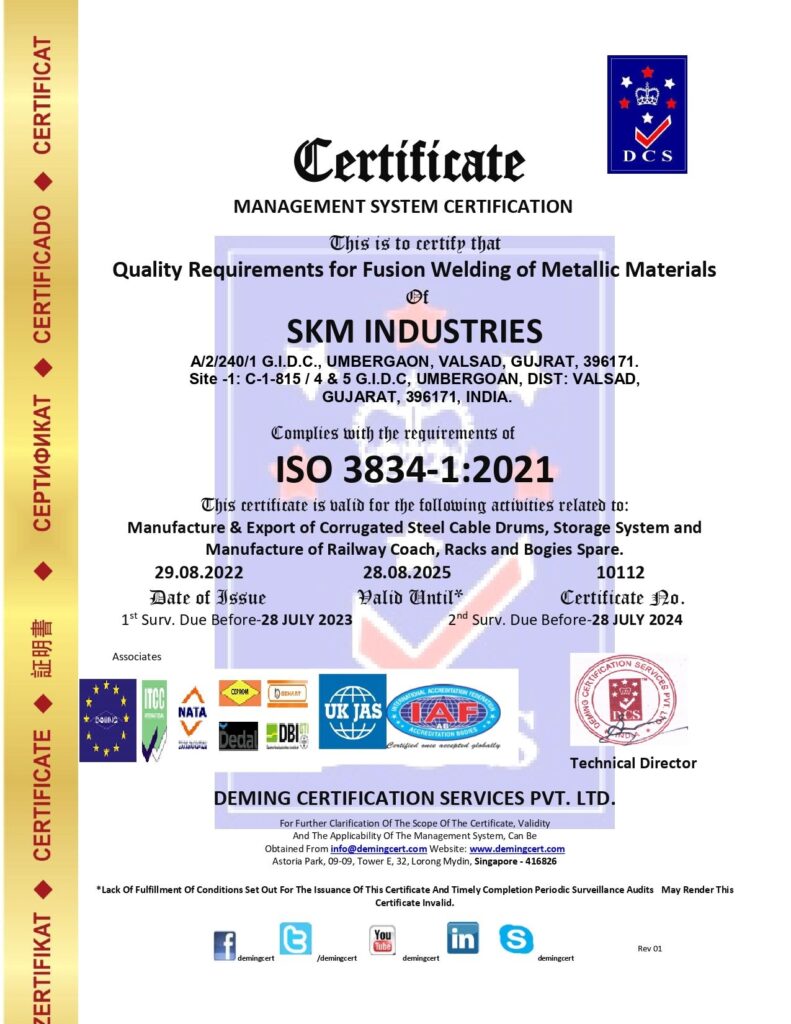
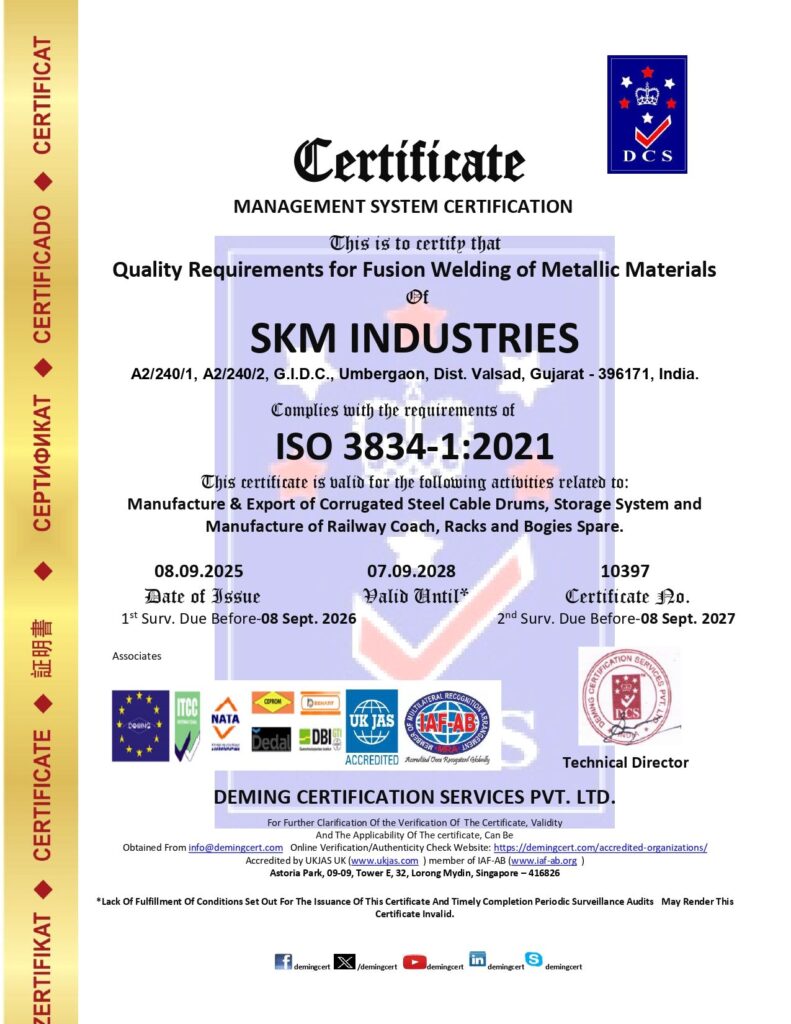
The first certification period supplied for SKM Industries began in 2022 and continued through 2025. The subsequent certification period began in 2025 and is stated to remain valid through 2028. This timeline provides a useful framework for describing a continuing commitment to welding quality rather than a single, isolated achievement.
Certification should not be viewed as the end of improvement. It provides an opportunity to examine whether procedures are being followed, whether employees remain competent, whether inspection arrangements are appropriate, and whether the organization is learning from nonconformities and customer feedback.
For SKM Industries, the central lesson of this journey is that long-term manufacturing growth depends on repeatable performance. The company can strengthen its future by making quality a normal part of every production activity, from the receipt of steel to the inspection and dispatch of completed products.
The foundation of sustainable success is therefore not merely a certificate displayed on a wall. It is the daily discipline that enables people, processes, and equipment to work together toward dependable results.
#SKMIndustries
Chapter 2 — Understanding ISO 3834 and the Importance of Welding Quality
Welding quality is an essential part of modern metal manufacturing because the strength and reliability of a fabricated product depend not only on the quality of the raw material but also on the methods used to join its components. For a manufacturer such as SKM Industries, whose stated activities include steel cable drums, storage systems, railway coach racks, and bogie spare parts, establishing a controlled welding process is an important part of responsible production.
The ISO 3834 series addresses quality requirements for fusion welding of metallic materials. It provides a framework for controlling welding-related activities, including technical preparation, personnel competence, production methods, inspection, and documentation. The precise requirements depend on the applicable part of the standard, the selected quality level, and the nature of the manufacturing work.
The supplied certification reference is ISO 3834-1:2021. In describing the company’s quality journey, it is important to distinguish between the general framework for welding quality requirements and the specific requirements applicable to a particular product or contract. Each manufacturing order may require different controls depending on its design, service conditions, customer specifications, and applicable regulations.
Why a systematic welding approach matters
In metal fabrication, small process variations can affect the final product. Inconsistent joint preparation, incorrect welding parameters, unsuitable consumables, inadequate cleaning, or poor handling may lead to defects. Some problems can be detected through visual inspection, while others may require additional examination using suitable inspection methods.
A systematic approach helps reduce dependence on individual habits and informal instructions. Instead, the organization establishes documented methods and defines responsibilities. Employees can understand the correct process, supervisors can monitor compliance, and inspectors can evaluate the work against established acceptance criteria.
For example, a fabricated storage structure may require joints that provide adequate strength and dimensional stability. A railway component may have additional requirements based on its intended function, loading, and engineering specifications. A corrugated steel cable drum may need suitable structural integrity to support handling and storage requirements. The relevant controls should be selected according to each product’s actual design and intended use.
Welding procedures and technical preparation
Before welding begins, the organization needs to understand the technical requirements of the job. Drawings, material specifications, joint details, dimensions, and acceptance criteria must be available to the people responsible for manufacturing.
Where required, welding procedures should be qualified and approved in accordance with the applicable standards and contractual requirements. These procedures establish important variables such as the welding process, material groups, joint configuration, consumables, and relevant process parameters.
Using an appropriate procedure helps make production more consistent. It also gives supervisors and inspectors a reference against which actual work can be evaluated. If a change is required, it should be reviewed and authorized rather than introduced informally on the shop floor.
For SKM Industries, a disciplined approach to technical preparation can support better coordination between design interpretation, production planning, welding operations, and final inspection.
Competent personnel and supervision
The performance of a welding quality system depends heavily on the competence of the people who operate it. Welders must possess the qualifications or approvals required for their assigned work. Welding coordination and supervision must be provided by suitably competent personnel, and inspection activities must be performed by people with appropriate knowledge and experience.
Competence includes more than completing a training session. It requires an understanding of work instructions, equipment settings, material handling, defect prevention, safety requirements, and the correct response when a problem occurs.
A manufacturer can support its employees through induction, practical demonstrations, refresher training, qualification monitoring, and periodic assessment. Records of relevant qualifications and authorizations help management determine whether personnel are suitable for specific assignments.
This approach also supports workforce development. Employees gain clearer expectations, supervisors can identify training needs, and the organization becomes less dependent on undocumented knowledge held by a small number of individuals.
Inspection, traceability, and documentation
A well-managed welding process requires appropriate inspection and records. Depending on the job, these may include material identification, welding procedure documents, welder qualifications, inspection reports, nonconformity records, and final release documentation.
Material traceability is particularly important when customer specifications require a link between incoming materials and completed assemblies. Clear identification reduces the risk of mixing materials and makes it easier to investigate problems if they arise later.
Inspection should take place at appropriate stages. Checking joint preparation before welding, monitoring work during production, and examining completed welds can help identify problems earlier. The inspection method and acceptance criteria must be appropriate for the product and the governing technical requirements.
Records are valuable because they provide evidence of what was done, who performed the work, which procedures applied, and what checks were completed. They also help the company identify recurring problems and improve its production methods.
Certification as a management responsibility
The 2022–2025 and 2025–2028 periods supplied for SKM Industries suggest a continuing certification timeline. A renewal or subsequent certification period should be accompanied by ongoing attention to the applicable requirements, internal responsibilities, and any findings identified during assessment.
A certificate does not automatically guarantee that every product is defect-free, nor does it replace customer inspection or statutory obligations. Its value lies in the disciplined system behind it and the organization’s ability to demonstrate conformity with the applicable requirements.
When certification is supported by actual operating practices, it can strengthen communication with customers, support supplier evaluations, and help the business organize its technical responsibilities.
Turning technical discipline into business value
The business benefits of welding quality are closely connected to prevention. Fewer avoidable defects can mean less rework, better use of materials, more predictable production, and reduced disruption. Clear documentation can also make customer audits and technical reviews easier to manage.
For SKM Industries, ISO 3834 should therefore be understood as part of a practical manufacturing strategy. By connecting welding procedures, trained personnel, controlled production, and suitable inspection, the company can build a stronger foundation for reliable products and sustainable industrial relationships.
The lasting value of welding quality is achieved when every employee understands that the quality of a finished product begins long before the final inspection. It begins with correct preparation, continues through controlled execution, and is confirmed through appropriate verification and documentation.
#ISO3834
Chapter 3 — Improving Manufacturing Processes and Production Efficiency
Manufacturing growth depends on the ability to produce reliable goods while making effective use of materials, machinery, working time, and employee skills. For SKM Industries, whose product portfolio includes corrugated steel cable drums, storage systems, railway coach racks, and bogie spare parts, production efficiency must be balanced with technical requirements and product reliability.
In a fabrication business, increasing output is not simply a matter of asking employees to work faster. Production becomes more effective when jobs are planned correctly, materials are available when needed, drawings are clear, welding procedures are followed, and inspection activities are coordinated with manufacturing schedules.
A systematic quality approach can help bring these activities together. By identifying where delays occur and understanding why defects arise, the organization can improve productivity without compromising the required quality of its products.
Understanding the complete production cycle
A typical fabricated product passes through several stages. These may include receiving raw materials, checking documentation, cutting, forming, preparing joints, fitting components, welding, finishing, inspection, and dispatch. The exact sequence depends on the product and its engineering requirements.
Each stage affects the next. If cutting dimensions are incorrect, fitting may take longer. If components are not properly aligned, welding may introduce distortion or require additional correction. If inspection is delayed until the end, defects may remain hidden until substantial time and material have already been invested.
A well-organized production process therefore considers the entire workflow rather than treating every department as an independent unit. Planning, fabrication, welding, quality control, stores, and dispatch need to communicate effectively.
For SKM Industries, a practical starting point would be to map the principal production routes for its different product categories. This would help management identify repeated activities, avoidable movement, bottlenecks, and stages where additional controls could prevent errors.
Standardizing work methods
Standardized work instructions help ensure that similar jobs are performed consistently. They provide employees with a common reference for setup, material preparation, equipment use, welding requirements, dimensional checks, and inspection.
Standardization does not mean that every product must be manufactured in exactly the same way. Different products may require different procedures. Rather, it means that each type of work has a defined and approved method appropriate to its technical requirements.
Where drawings or specifications change, the relevant instructions must be updated and obsolete versions withdrawn from use. This reduces the risk of employees relying on outdated information.
Clear work instructions can also improve training. New employees can learn the established method, while experienced employees can identify opportunities for improvement without losing control of the approved process.
Reducing rework and material waste
Rework is one of the most important hidden costs in manufacturing. A weld that must be repaired, a component that requires additional cutting, or an assembly that needs dimensional correction consumes time and resources that could otherwise be used for productive work.
Rework can also disrupt delivery schedules. When a completed item returns to production, it may compete with new orders for machines, employees, and inspection capacity.
The most effective response is to understand the causes rather than simply correcting the visible defect. Possible causes include unclear drawings, poor fit-up, incorrect settings, unsuitable consumables, inadequate training, equipment problems, or insufficient supervision.
A structured corrective-action process can help the company record the issue, investigate its cause, decide what needs to change, and verify whether the action has worked.
For SKM Industries, this approach could be applied across cable drum fabrication, storage systems, and railway component manufacturing. Different products may experience different defects, but the discipline of recording and learning from problems can be used throughout the business.
Managing equipment and production resources
Manufacturing equipment must be suitable for its intended use and maintained in a reliable condition. Cutting machines, forming equipment, welding machines, fixtures, measuring instruments, and handling equipment all contribute to production performance.
Preventive maintenance can reduce unexpected breakdowns and help preserve consistent operating conditions. Equipment issues should be recorded and addressed according to their impact on quality, safety, and production.
Measuring equipment used to verify dimensions or other controlled characteristics should be maintained and calibrated or verified as appropriate to its intended use and applicable requirements. Unreliable measurements can create confusion and lead to incorrect acceptance or rejection decisions.
Production planning should also account for material availability, employee skills, machine capacity, inspection needs, and dispatch requirements. A realistic schedule is more useful than an ambitious target that repeatedly creates delays or encourages shortcuts.
Using production information to make decisions
Management can improve manufacturing performance by reviewing meaningful indicators. Depending on available records, these may include first-pass acceptance, rework hours, material wastage, equipment downtime, delivery performance, customer complaints, and completion against planned production.
The purpose of measurement is not to create paperwork for its own sake. It is to help management understand whether processes are improving and where additional attention is needed.
For example, if repeated dimensional problems occur in a particular product family, the company can review the cutting and fitting stages. If welding repairs increase, management can investigate joint preparation, consumables, process parameters, and personnel competence.
Information becomes more useful when it leads to action. A production meeting can review significant deviations, assign responsibilities, and establish deadlines for corrective measures.
Balancing speed with quality
Fast production is valuable only when the completed product meets the required specification. A job that is completed quickly but requires extensive rework may ultimately cost more than a job manufactured correctly the first time.
For welded products, production pressure must not override approved procedures or necessary inspection. The organization should plan enough time for preparation, execution, verification, and correction where needed.
This balance is especially important for railway-related components, where the applicable engineering specifications and acceptance requirements must determine the level of control.
Creating a culture of continuous improvement
Continuous improvement begins with practical questions. Which process causes the most delays? Which defects occur repeatedly? Which documents are difficult to understand? Which machines require frequent repair? What training would help employees perform their work more consistently?
By encouraging employees to report problems and propose solutions, SKM Industries can use shop-floor experience as a source of improvement. Small changes in layout, material identification, fixture design, or inspection planning may produce useful benefits when they are properly evaluated.
The objective is not to claim unverified production gains but to establish a method for achieving measurable progress.
A disciplined manufacturing process helps SKM Industries connect quality requirements with everyday productivity. Through better planning, standardization, equipment care, defect prevention, and evidence-based decisions, the company can strengthen operational reliability and create a sound basis for future growth.
#WeldingQuality
Chapter 4 — Developing Employee Skills and a Strong Quality Culture
Behind every successful manufacturing operation are people who understand their responsibilities and have the skills needed to perform their work. Machinery, technical documents, and inspection equipment are important, but they cannot deliver consistent results unless employees use them correctly. For SKM Industries, workforce development is therefore an important part of its welding quality journey.
The company’s stated manufacturing activities require coordination among several functions, including material handling, fabrication, welding, inspection, production planning, stores, maintenance, and dispatch. Each function contributes to the finished product, and mistakes at one stage can affect the work of several other departments.
A strong quality culture develops when employees understand both what they must do and why it matters. Instead of treating quality instructions as administrative requirements, workers should see them as practical tools that help prevent defects, protect customers, and improve the reliability of manufacturing operations.
Building competence through structured training
Training should begin with the requirements of the job. Employees need to understand their assigned duties, the equipment they operate, the instructions they must follow, and the quality checks relevant to their work.
For welding activities, competence may include understanding approved welding procedures, material preparation, joint fit-up, consumable handling, equipment settings, defect prevention, and the importance of maintaining appropriate records. The required qualifications and authorization arrangements should be determined by the applicable standards, contracts, and technical requirements.
Training can combine classroom instruction, demonstrations, supervised practice, and assessment. Practical exercises are particularly valuable because they allow employees to demonstrate that they can apply instructions correctly.
The company can maintain records of relevant training and qualifications so supervisors know which employees are authorized for specific activities. Periodic reviews can identify when refresher training or reassessment is needed.
This approach helps make workforce capability more systematic and less dependent on informal assumptions about an employee’s experience.
Creating a shared understanding of quality
A common challenge in manufacturing is that different departments may have different priorities. Production may focus on completing orders, stores may concentrate on material availability, and inspection may focus on conformity. These priorities are all necessary, but they must work together.
Management can support cooperation by explaining how each department contributes to the final product. Purchasing must obtain materials that meet the specified requirements. Stores must preserve identification and prevent mix-ups. Production must follow approved methods. Inspection must verify conformity against suitable criteria. Dispatch must ensure that the correct products and documentation reach the customer.
When employees understand these connections, they are more likely to communicate problems early rather than allowing them to move unnoticed to the next stage.
Regular team meetings can provide an opportunity to discuss recurring defects, production delays, customer feedback, and proposed improvements. The meetings should focus on facts and practical solutions rather than blame.
Encouraging employees to report problems
Employees who work directly with machinery and materials often notice problems before they appear in formal reports. They may recognize an unusual machine sound, an inconsistent fit-up, a confusing drawing, or a recurring difficulty in accessing a work area.
A constructive reporting culture encourages employees to raise these concerns without unnecessary hesitation. Early reporting can help management address problems before they lead to significant rework or delivery disruption.
This does not mean that responsibilities should be ignored. Instead, it means that employees should be encouraged to report errors honestly so that the organization can understand what happened and prevent recurrence.
When a problem occurs, the response should distinguish between an individual mistake, a training gap, an unclear procedure, equipment failure, and a wider process weakness. Different causes require different solutions.
For example, repeating a safety or quality instruction may not solve a problem caused by an unsuitable fixture or outdated drawing. A proper investigation helps identify the most effective corrective action.
Leadership and employee motivation
The promoter and management team influence quality culture through their daily decisions. If supervisors insist on following approved procedures even when production is busy, employees learn that quality is a genuine priority. If management provides time for training and maintenance, employees understand that reliable work matters more than short-term output alone.
Recognition can also support positive behaviour. Employees who identify a recurring defect, suggest a practical improvement, or help organize a work area can be acknowledged for their contribution.
Such recognition need not always involve financial rewards. Constructive feedback, opportunities to learn new skills, and involvement in improvement projects can help employees feel that their knowledge is valued.
A respectful workplace also encourages cooperation between experienced employees and new recruits. Experienced workers can share practical knowledge, while newer employees may bring fresh perspectives on instructions, equipment, or production arrangements.
Connecting quality with workplace safety
Quality and safety often depend on similar habits: preparation, discipline, correct equipment use, clear instructions, and early reporting of problems.
Welding and fabrication activities may involve heat, electrical equipment, fumes, sharp edges, heavy materials, and moving machinery. Appropriate risk assessments, personal protective equipment, ventilation, safe handling arrangements, and emergency procedures are important according to the actual work environment.
Employees should understand that safety requirements are not optional steps to be completed only during inspections. They are part of responsible production.
A clean and organized work area can also support quality by reducing the risk of material mix-ups, contamination, accidental damage, and unnecessary movement.
Developing future supervisors and technical leaders
As a manufacturing business develops, it benefits from employees who can take on greater responsibility. Training suitable workers in supervision, production planning, inspection coordination, documentation, and problem-solving can help create a stronger internal talent base.
Future supervisors need more than technical knowledge. They must also communicate clearly, allocate work fairly, recognize risks, maintain records, and respond appropriately when production does not follow the plan.
A structured approach to development can help SKM Industries build continuity in its operations and reduce dependence on individual employees.
Making improvement part of everyday work
A mature quality culture does not depend on occasional campaigns. It develops through consistent habits: checking the latest drawing, confirming material identification, following approved procedures, reporting deviations, and verifying that corrective actions have worked.
Employees should understand that stopping to clarify an instruction may prevent hours of rework later. Asking for help when a technical issue arises is a sign of responsibility, not weakness.
For SKM Industries, investing in employee competence and engagement can support consistent manufacturing, better communication, and a more dependable working environment. The long-term value of certification is strongest when its principles are understood by the people who carry out the work every day.
#QualityManagement
Chapter 5 — Strengthening Product Reliability Across Multiple Manufacturing Activities
SKM Industries’ stated product range includes corrugated steel cable drums, storage systems, railway coach racks, and bogie spare parts. Although these products serve different applications, they share a common requirement: they must be manufactured according to their intended design and applicable customer specifications.
A company serving multiple product categories must understand that quality controls cannot be identical for every job. A cable drum has different functional requirements from a storage structure, and railway components may be subject to particular engineering, inspection, and traceability requirements. A reliable manufacturing system therefore combines common quality principles with product-specific technical controls.
Quality requirements for corrugated steel cable drums
Cable drums are used to support, store, handle, or transport cables and related materials. Their suitability depends on the intended application, design, dimensions, material properties, loading conditions, and handling arrangements.
Manufacturing controls may include verification of raw materials, dimensional checks, forming accuracy, joint preparation, welding control where applicable, and inspection of completed assemblies. The precise requirements must be established from the product design and customer specifications.
A dimensional problem can affect assembly or handling. A poorly controlled joint may require correction or fail to meet the specified acceptance criteria. Damage during storage or transportation can also affect the condition of the finished product.
For this reason, quality should be considered throughout the manufacturing process. Final inspection is important, but it cannot replace proper control of earlier activities.
Where customers require identification or traceability, appropriate records should connect materials and production information to the relevant order or finished item. This helps resolve questions efficiently and supports confidence in the manufacturing process.
Improving storage system manufacturing
Storage systems may involve fabricated frames, supports, shelves, brackets, and other metal components. Depending on the design, these products may need to support defined loads while maintaining stability and dimensional accuracy.
The manufacturer must follow the approved design and avoid making unauthorized changes to material thickness, joint details, dimensions, or other critical characteristics. Where the customer or engineer specifies testing or verification, the organization should arrange it according to the applicable requirements.
Fabrication accuracy is important because errors in one component may affect the assembly of the entire structure. Accurate cutting, forming, fitting, and welding can reduce adjustment work during assembly and help improve consistency.
The handling and storage of completed components also matter. Parts should be protected against avoidable damage, and their identification should remain clear throughout the process.
A systematic approach allows the company to identify where errors originate and to develop practical improvements for future orders.
Reliability in railway coach racks and bogie spare parts
Railway-related components require careful attention to the specifications that govern their intended function. The exact controls depend on the component, the design authority, customer requirements, and any applicable railway standards or approvals.
For coach racks and bogie spare parts, relevant considerations may include material conformity, dimensional accuracy, welding procedure control, personnel competence, inspection, and documented acceptance. Where required, additional examination or testing should be performed by suitably qualified personnel using the specified methods.
It is important not to assume that every railway component has the same safety classification or acceptance requirements. These must be determined from the applicable technical documentation.
The manufacturer should ensure that the latest approved drawings and instructions are available at the point of use. Any proposed deviation must be reviewed and authorized through the appropriate process.
This discipline supports better control over manufacturing changes and reduces the risk of producing parts according to outdated or incomplete information.
Preventing defects before they occur
Product reliability improves when defects are prevented at their source. This requires attention to material selection, preparation, equipment condition, welding methods, employee competence, and inspection planning.
A practical control plan can identify the important stages of a particular job, the characteristics that must be checked, the person responsible for each check, and the records that must be retained.
For example, an organization may decide that a particular dimension should be verified before welding because correction becomes more difficult after assembly. Similarly, a weld may need an intermediate inspection before finishing or coating makes access more difficult.
The correct control points depend on the product and its requirements. The objective is to identify potential problems early enough to address them efficiently.
Managing nonconforming products
Not every manufactured item will necessarily meet its original requirements on the first attempt. When a deviation is identified, the organization needs a clear method for controlling the affected product.
The process should prevent unintended use or dispatch while the issue is being evaluated. Authorized personnel must determine whether rework, repair, concession, rejection, or another permitted disposition is appropriate.
Where a repair is allowed, it should be carried out under suitable instructions and verified against the applicable acceptance criteria. A product should not be accepted merely because the defect is difficult to correct or the delivery date is approaching.
Nonconformity records also provide valuable information. Repeated problems may reveal weaknesses in training, preparation, equipment, documentation, or supplier controls.
Customer confidence through consistent performance
Customers value suppliers who communicate clearly, understand technical requirements, and respond responsibly when problems occur. A well-controlled manufacturing process can support these expectations by improving the consistency of products and the availability of relevant records.
SKM Industries can use its welding quality framework to strengthen internal coordination across its product lines. Common practices for document control, personnel competence, nonconformity management, and corrective action can support the business, while product-specific controls address the needs of individual orders.
Building a reputation for dependable products
Product reliability is established through repeated evidence that requirements are understood and met. A single successful delivery is valuable, but long-term confidence depends on consistent performance over many orders.
For SKM Industries, the opportunity is to make reliability a recognizable feature of its manufacturing approach. By controlling materials, following approved procedures, verifying important characteristics, and learning from defects, the company can strengthen its ability to serve industrial customers.
The ultimate objective is not merely to complete a product but to deliver an item that conforms to its intended specification and is supported by appropriate evidence of conformity.
#MetalFabrication
Chapter 6 — Export Readiness, Customer Confidence, and Market Development
SKM Industries has identified the manufacture and export of corrugated steel cable drums and storage systems among its business activities. Export-oriented manufacturing can create opportunities to serve a broader customer base, but it also requires attention to technical specifications, communication, documentation, delivery planning, and applicable commercial requirements.
International customers may operate under different purchasing systems and may request particular inspection records, product identification arrangements, packaging methods, or supplier qualification documents. A manufacturer that understands these expectations is better prepared to assess potential orders and respond professionally.
Certification can contribute to this process by providing evidence of a structured approach to welding quality, provided the certification is valid, applicable to the work, and supported by the relevant scope and documentation. It does not, by itself, guarantee export approval or customer acceptance.
Understanding customer expectations
The first step in serving a new market is understanding what the customer actually requires. Product drawings, material specifications, dimensional tolerances, packaging instructions, delivery terms, inspection requirements, and documentation needs should be reviewed before production commitments are made.
When requirements are unclear, the organization should seek clarification rather than relying on assumptions. This is particularly important when the customer uses technical terminology, acceptance criteria, or product standards that differ from those commonly used in the manufacturer’s existing orders.
A formal review process can help determine whether the company has the necessary equipment, personnel, production capacity, and inspection arrangements to meet the order.
For SKM Industries, this process could support better evaluation of export enquiries involving cable drums and storage systems, as well as domestic and international enquiries for other fabricated products where the relevant capabilities and approvals are established.
Documentation as a business advantage
Industrial purchasing often requires more than a physical product. Customers may also need records that demonstrate what was manufactured, which materials were used, which procedures applied, and what inspections were completed.
Depending on the contract, these records may include material certificates, inspection reports, welding documentation, dimensional verification, packaging details, and final release documents.
The company should establish a clear method for preparing, reviewing, storing, and retrieving the required information. Inconsistent documents can cause delays even when the physical product is acceptable.
Accurate records also help employees respond more efficiently to customer questions. Instead of reconstructing the history of an order from scattered notes, the organization can retrieve relevant information from its established records.
Supplier evaluation and certification
Customers may evaluate suppliers based on technical capability, quality arrangements, previous experience, financial and operational reliability, delivery performance, and the certifications relevant to the work.
For welding-related products, the ISO 3834 framework can help demonstrate that welding quality is managed systematically. The exact value depends on the applicable part of the standard, the certified scope, the certification body’s assessment, and the customer’s requirements.
SKM Industries’ supplied certification periods—2022 to 2025 and 2025 to 2028—can be described in company materials as its stated certification timeline. For external publication or tender submissions, the certificate details should be checked against the original documents, including the precise standard designation, scope, issue date, expiry date, and certification body.
This verification is important because customers may rely on certification details when assessing supplier eligibility.
Strengthening customer communication
Successful industrial relationships require reliable communication from enquiry to delivery. Customers need timely responses to technical questions, realistic schedules, and prompt notification if an issue may affect the order.
A defined communication process can help ensure that changes to specifications are reviewed and shared with the relevant departments. Sales personnel should not promise technical features or delivery dates without confirmation from production and quality teams.
When a customer raises a concern, the company should acknowledge the issue, collect relevant evidence, investigate the cause, and provide a clear response. Corrective actions should be tracked until their effectiveness can be evaluated.
This approach demonstrates professionalism even when a problem cannot be resolved immediately.
Packaging, transport, and delivery
Manufacturing quality can be affected after production is complete. Poor packaging, unsuitable storage, incorrect identification, or mishandling during transport can damage products or create confusion at the receiving location.
Packaging requirements should therefore be established according to product characteristics, transport conditions, and customer instructions. Where necessary, the organization should protect components against moisture, impact, corrosion, deformation, or other foreseeable risks.
Dispatch checks can verify that the correct products, quantities, labels, and documents are prepared for the intended destination.
For export orders, the company must also consider the applicable shipping documents, customs requirements, contractual delivery terms, and any relevant product-specific regulations. These matters should be handled by personnel with appropriate knowledge.
Competing through dependable service
Price is an important factor in many industrial purchasing decisions, but customers also consider the cost of delays, defective goods, inconsistent documentation, and unreliable supply.
A manufacturer that reduces avoidable rework and improves schedule predictability may be better positioned to compete on overall value. The objective is not to claim a specific cost advantage without supporting data but to establish operational practices that can create one.
SKM Industries can evaluate its performance through measures such as delivery adherence, customer complaints, repeat orders, first-pass acceptance, and response time for technical enquiries.
These indicators help management understand whether the company’s service is improving and where additional action may be required.
Developing markets responsibly
Market development should be based on a realistic assessment of product capability, capacity, certification scope, customer needs, and applicable requirements. Entering a new market without understanding its technical expectations can create unnecessary risk.
A structured approach begins with identifying suitable customers, reviewing their specifications, assessing production feasibility, and ensuring that commercial commitments are supported by operational capability.
Over time, dependable delivery and consistent product conformity can support repeat business and referrals. Certification may strengthen this process when it is relevant to the customer’s supplier evaluation.
For SKM Industries, export readiness is best understood as the combination of technical competence, reliable manufacturing, accurate documentation, effective communication, and responsible delivery management.
The company’s long-term opportunity lies in building customer relationships through evidence of performance rather than relying on certification alone. When a quality system is translated into consistent service, it can become a meaningful part of the organization’s commercial development.
#SteelCableDrums
Chapter 7 — Leadership, Planning, and Sustainable Business Growth
Long-term manufacturing growth requires a clear direction, disciplined management, and the ability to respond to changing customer requirements. For SKM Industries, the certification journey offers an opportunity to connect welding quality with broader business objectives, including operational stability, customer retention, workforce development, and responsible expansion.
A certificate is one part of a company’s quality framework, but sustained success depends on management decisions made every day. Leadership must ensure that technical requirements are understood, resources are available, responsibilities are defined, and improvements are implemented when performance falls short of expectations.
Establishing a clear business direction
A manufacturing business benefits from a clear understanding of its strengths and priorities. SKM Industries’ stated activities span corrugated steel cable drums, storage systems, railway coach racks, and bogie spare parts. These activities provide a foundation for evaluating which products best match the company’s equipment, employee competence, customer relationships, and manufacturing experience.
Strategic planning should begin with an assessment of existing capabilities. Management can review current product demand, production capacity, machinery condition, workforce skills, supplier reliability, and customer feedback. This assessment helps distinguish opportunities that are realistic from those that require additional investment or technical development.
The company can then establish practical objectives. These may include reducing rework, improving delivery performance, strengthening documentation, increasing employee competence, or improving the consistency of a particular product family.
Each objective should have a responsible person, a reasonable deadline, and a method of evaluating progress. Without these elements, improvement targets may remain statements of intention rather than becoming practical management tools.
Connecting quality objectives with commercial decisions
Quality and business planning should not operate independently. A decision to accept a large order, introduce a new product, or purchase new machinery can affect the organization’s ability to maintain existing commitments.
Before accepting technically demanding work, management should confirm that suitable equipment, competent personnel, approved procedures, materials, and inspection resources are available. If additional capabilities are required, they should be developed before the organization makes commitments that it cannot reliably fulfil.
This is especially important for welded products, where technical requirements may differ significantly between orders. The relevant welding procedures, qualification requirements, and inspection arrangements must be established for the actual work.
Commercial teams should also understand the costs associated with quality. These may include inspection, testing, training, maintenance, documentation, rework, and the correction of nonconforming products. Planning for these activities helps avoid unrealistic pricing and production schedules.
Risk-based decision-making
Every manufacturing operation faces risks. These may involve material shortages, equipment failures, changes in customer specifications, employee turnover, inaccurate drawings, supplier problems, or unexpected inspection findings.
A structured risk review helps management identify which issues are most likely to disrupt production or affect conformity. The organization can then decide which preventive actions are proportionate to the risk.
For example, a critical machine may require a more carefully planned maintenance schedule. A product that depends on specialized welding competence may require stronger qualification monitoring. A customer order with complex traceability requirements may need additional controls over material identification and record retention.
Risk-based planning does not eliminate every problem. It helps the company prepare for foreseeable difficulties and respond more effectively when conditions change.
Reviewing performance through management meetings
Management review is valuable when it considers meaningful evidence rather than relying on general impressions. Depending on the quality framework and the organization’s needs, review topics may include audit results, customer feedback, nonconformities, corrective actions, production performance, resource requirements, and opportunities for improvement.
The review should lead to decisions. If rework is increasing, management may authorize training or process investigation. If documentation delays affect dispatch, responsibilities may need to be clarified. If equipment breakdowns disrupt production, maintenance planning may require revision.
Actions should be assigned and followed up. A decision that is not implemented cannot deliver the intended improvement.
Responsible investment in technology
Manufacturing technology can improve productivity, consistency, and traceability when it is selected according to actual business needs. Potential investments may include improved welding equipment, suitable fixtures, dimensional measuring tools, production-planning software, or systems for controlling technical documents.
However, buying new equipment does not automatically improve quality. Employees must know how to use it, maintenance arrangements must be available, and its capabilities must match the requirements of the work.
Investment decisions should consider the expected benefit, implementation cost, training needs, maintenance requirements, and effect on production capacity.
A staged approach can be useful. The company may begin by addressing the most significant operational problem, measure the result, and then decide whether further investment is justified.
Maintaining certification discipline
The supplied certification timeline identifies a period from 2022 to 2025 followed by a period from 2025 to 2028. Maintaining a certification framework requires continued attention to the applicable requirements and the organization’s actual practices.
Management should ensure that relevant procedures remain current, personnel qualifications are monitored, required records are maintained, and findings are addressed. Changes in products, processes, equipment, or customer requirements should be evaluated for their effect on the welding quality arrangements.
Certification-related claims in tenders and marketing material should accurately reflect the original certificate and its scope. This protects the company’s credibility and helps avoid misunderstandings during supplier evaluations.
Building resilience through people and processes
A resilient manufacturing business does not depend entirely on one individual or one informal method of working. It documents important processes, develops capable employees, maintains equipment, and prepares suitable alternatives for foreseeable disruptions.
Cross-training can help ensure that essential activities continue when particular employees are unavailable. Controlled documents allow authorized staff to access current instructions. Supplier reviews and appropriate inventory planning can reduce the impact of material shortages.
These measures support business continuity and make production less vulnerable to unexpected events.
Planning growth without sacrificing reliability
Growth should be measured not only by the number of orders received but also by the ability to complete them consistently. Expanding too quickly without adequate capacity can create quality problems, delayed deliveries, employee pressure, and customer dissatisfaction.
SKM Industries can pursue sustainable growth by matching new commitments with available resources and verified technical capability. Management should regularly review whether production systems can support the next stage of development.
The central lesson is that leadership transforms quality principles into business results. Through clear objectives, realistic planning, risk management, resource allocation, and continuous review, SKM Industries can strengthen the foundations needed for responsible and durable growth.
#RailwayComponents
Chapter 8 — Customer Satisfaction, Corrective Action, and Continuous Improvement
Customer satisfaction is an important measure of manufacturing performance because customers experience the combined result of product quality, delivery, communication, and after-sales support. For SKM Industries, maintaining confidence among industrial customers requires more than producing metal components. It requires a consistent process for understanding requirements, preventing defects, responding to concerns, and learning from experience.
The company’s welding quality framework can support these objectives by encouraging documented methods, appropriate inspection, defined responsibilities, and systematic corrective action. The greatest benefit emerges when the organization uses these arrangements to improve actual performance rather than treating them as paperwork for certification purposes.
Understanding what customers value
Different customers may have different priorities. One may emphasize dimensional accuracy, another may require detailed traceability, and another may focus on delivery reliability or the ability to respond to urgent technical questions.
The organization should identify these requirements during enquiry and contract review. Relevant details must be communicated to the departments responsible for production, purchasing, inspection, and dispatch.
If a requirement is unclear or technically difficult to meet, it should be discussed before production begins. Resolving uncertainty early is generally more effective than correcting a misunderstanding after the product has been manufactured.
Customer satisfaction also depends on communication. A technically acceptable product can still create dissatisfaction if delivery information is inaccurate or documentation is incomplete.
Creating a reliable feedback process
Customer feedback should be collected, recorded, and evaluated in a consistent way. It may include formal complaints, inspection observations, delivery concerns, requests for clarification, repeat orders, and suggestions for improvement.
The organization should distinguish between different types of feedback. A complaint about a product defect requires a different response from a request for improved packaging or faster communication.
Each significant issue should be reviewed to determine its seriousness, the products or orders affected, and whether immediate containment is required. The company should then decide what investigation and corrective action are appropriate.
A clear process helps ensure that complaints do not remain unresolved simply because responsibility is uncertain.
Investigating the real cause of a problem
Corrective action is most effective when it addresses the underlying cause of a problem. A superficial response may correct one item but allow the same issue to occur again.
Consider a hypothetical example involving dimensional variation in a fabricated assembly. The immediate correction might involve adjusting or replacing the affected component. However, the underlying cause could be an inaccurate fixture, an unclear drawing, an unsuitable measurement method, or a lack of operator training.
If the company addresses only the individual component, future products may experience the same problem. A proper investigation considers the process that produced the deviation.
Tools such as process mapping, cause-and-effect analysis, and structured questioning can help employees organize the investigation. The chosen method should suit the complexity of the issue.
The objective is not to assign blame automatically. It is to establish a credible explanation supported by evidence and then take action that reduces the likelihood of recurrence.
Controlling nonconforming products
When a product or process does not meet a specified requirement, the organization must prevent unintended acceptance or use. The appropriate response depends on the nature of the deviation and the applicable technical requirements.
Possible dispositions may include rework, repair, rejection, or an authorized concession where permitted. Decisions must be made by appropriate personnel, and the resulting work must be verified as required.
For welded products, repair activities may require approved instructions and suitable inspection. The company should not assume that a repaired weld is acceptable without the verification required by the governing specification.
Records should identify the issue, the affected product or order, the decision taken, and the results of any necessary reinspection.
These controls protect customers and provide useful information for future improvement.
Learning from internal audits
Internal audits can help determine whether the organization’s documented arrangements are implemented effectively. They can examine areas such as document control, material identification, welding procedure availability, personnel qualifications, inspection records, and corrective-action follow-up.
An audit should be planned according to the importance and risk of the activities being examined. Its purpose is to collect evidence and evaluate conformity, not simply to complete a checklist.
Findings should be communicated clearly, with enough information for responsible employees to understand the problem. Corrective actions should be proportionate to the issue, and follow-up should determine whether the intended improvement has been achieved.
When employees see audits as opportunities to improve processes, they may be more willing to report weaknesses and participate in solutions.
Measuring continuous improvement
Improvement becomes more meaningful when the organization can evaluate results. Suitable measures may include:
- The proportion of products accepted without rework.
- Welding repair hours or recurring defect categories.
- Customer complaints and response times.
- On-time delivery performance.
- Completion of corrective actions.
- Training and qualification status.
- Equipment downtime and maintenance completion.
These indicators should be selected according to available data and business priorities. The company should avoid collecting large amounts of information that do not lead to useful decisions.
A trend is often more informative than an isolated result. If a particular defect decreases after a process change, management can evaluate whether the improvement is sustained. If a problem returns, the organization may need to reconsider its original analysis.
Improving cooperation between departments
Many quality problems cross departmental boundaries. A purchasing decision can affect material conformity. An engineering change can affect production methods. An inspection delay can affect dispatch. A customer communication failure can result in the wrong specification being used.
Regular coordination between departments helps identify these connections. Shared records, clear responsibilities, and controlled communication reduce the risk of important information being lost.
For SKM Industries, a practical approach would be to review recurring problems across the full production cycle rather than treating each department’s performance separately.
Making the customer relationship stronger
A professional response to a complaint can help preserve a business relationship, particularly when the company communicates openly and demonstrates that corrective action is being taken.
Customers should receive accurate information about the issue, the proposed response, and the expected follow-up. Any technical conclusions should be supported by evidence rather than assumptions.
Where appropriate, the company can also seek feedback after corrective action to determine whether the customer’s concern has been resolved.
Continuous improvement as a long-term habit
Improvement is not a single project with a final completion date. New products, changing customer expectations, employee turnover, and evolving technology continually create new challenges.
For SKM Industries, the value of a welding quality framework lies partly in its ability to support an ongoing cycle of planning, execution, inspection, evaluation, and improvement.
By listening to customers, investigating problems, controlling nonconforming products, and measuring results, the company can turn everyday production experience into better manufacturing practices. Over time, this discipline can strengthen customer confidence and provide a more stable foundation for business development.
#ManufacturingExcellence
Chapter 9 — Future Opportunities, Innovation, and Long-Term Competitiveness
The industrial manufacturing environment continues to evolve as customers demand dependable products, shorter lead times, improved documentation, and greater visibility into production activities. Manufacturers must therefore maintain their existing capabilities while considering how new methods and technologies could improve performance.
For SKM Industries, the combination of steel fabrication, welding quality management, and experience across several product categories creates a basis for reviewing future opportunities. The most appropriate direction will depend on the company’s verified capabilities, available resources, market demand, and customer requirements.
Strengthening existing product capabilities
Before entering a new product category, a manufacturer should understand the performance of its existing operations. Reviewing defects, delivery records, customer feedback, equipment capacity, and workforce competence can reveal areas where improvement would produce the greatest value.
SKM Industries may use such reviews to identify opportunities within its stated product range of cable drums, storage systems, railway coach racks, and bogie spare parts.
For example, improvements in fixture design may help achieve more consistent assembly. Better material identification may simplify traceability. Improved planning may reduce waiting time between fabrication and inspection. The usefulness of each change should be assessed against actual production conditions.
Strengthening existing operations can be a practical first step toward growth because it improves the reliability of the capabilities on which future business will depend.
Evaluating digital tools
Digital systems can help manufacturers control documents, plan production, record inspections, monitor equipment, and analyze performance. However, the choice of technology should be based on a defined problem rather than on the assumption that digitalization automatically creates improvement.
A document-management system, for example, may help ensure that employees access the current approved drawing. A production-tracking tool may help management understand order progress. A structured digital inspection record may make it easier to retrieve relevant evidence during customer reviews.
The organization should consider access controls, data accuracy, backup arrangements, employee training, and the reliability of the chosen system.
Digital records must also remain consistent with the applicable contractual, regulatory, and certification requirements. Introducing software does not remove the need for responsible review and authorization.
Improving traceability and information flow
Traceability becomes particularly valuable when a customer asks about a specific component, material, production order, or inspection result. A well-organized system can help the company retrieve the relevant records without an unnecessarily long search.
The level of traceability should reflect customer specifications and the technical importance of the product. Some orders may require detailed links between material batches and completed assemblies, while others may require a simpler identification arrangement.
Clear product identification can also support stock control and dispatch accuracy. Employees should be able to distinguish completed, pending-inspection, and nonconforming items according to the organization’s procedures.
These controls reduce the risk of mix-ups and help management investigate issues more efficiently.
Exploring process innovation
Innovation in manufacturing does not always require a major capital investment. It can also involve practical changes to fixtures, material flow, job sequencing, inspection planning, and employee training.
A proposed change should be evaluated before implementation. The company should consider whether it affects product conformity, welding procedures, equipment capability, personnel qualification, or customer approval requirements.
Where a change influences a qualified welding procedure or another controlled technical requirement, it must be reviewed and managed in accordance with the applicable rules.
Trials and controlled comparisons can help determine whether a proposed method provides a genuine benefit. The company should document relevant results and retain the controls necessary to maintain quality after the change is introduced.
Developing stronger supplier relationships
Suppliers influence the quality and reliability of manufacturing operations. Delayed deliveries, inconsistent material documentation, or unsuitable products can disrupt production and create additional inspection work.
A structured supplier evaluation process can consider material conformity, delivery performance, responsiveness, documentation quality, and the supplier’s ability to address problems.
When recurring issues occur, the company can communicate its requirements clearly and request suitable corrective action. Alternative sources may also be evaluated where technically and commercially appropriate.
The objective is to build a supply network that supports reliable production without assuming that every supplier will perform equally well under every circumstance.
Supporting environmental responsibility and resource efficiency
Responsible manufacturing includes attention to material use, energy consumption, waste, and the safe handling of industrial materials. These issues can be evaluated alongside productivity and quality.
Reducing unnecessary rework can conserve both material and energy. Better cutting plans may reduce scrap. Preventive maintenance can help equipment operate more reliably. Suitable waste segregation can improve handling and disposal practices.
Any environmental targets should be based on actual conditions and applicable requirements. If the company wishes to make quantified claims about energy savings or waste reduction, it should maintain reliable supporting records.
A practical improvement program can begin by identifying the largest or most frequently observed sources of waste and evaluating realistic measures to address them.
Developing technical partnerships and workforce capability
As customer requirements become more specialized, manufacturers may benefit from technical training, appropriate testing resources, engineering support, and cooperation with qualified external specialists.
Such relationships can help the company evaluate unfamiliar requirements before committing to a project. They can also support employee development and improve the quality of technical decision-making.
Partnerships should be based on clearly defined responsibilities and suitable verification of the capabilities being relied upon. Certification or a supplier’s reputation should not replace technical evaluation where the work requires specific competence.
Preparing for changing customer requirements
Customer expectations may change as industries revise specifications, introduce new designs, or strengthen their supplier qualification processes. A manufacturer needs a method for identifying relevant changes and evaluating their effect on production.
This may involve reviewing customer communications, applicable standards, contract requirements, and market developments. The organization should then determine whether changes to training, procedures, equipment, inspection, or documentation are necessary.
For railway-related work, particular care is needed to confirm the requirements that apply to the actual component and customer. No general certification should be assumed to replace a separate approval where one is required.
Building competitiveness through evidence
A credible manufacturing reputation is supported by measurable performance. Customers may value documented evidence of product conformity, reliable delivery, effective corrective action, and consistent technical communication.
SKM Industries can strengthen its market position by maintaining accurate records of its actual capabilities and achievements. Any published claims about production capacity, export performance, defect reduction, or customer satisfaction should be supported by suitable evidence.
This approach is more sustainable than relying on broad promotional statements that cannot be verified.
Looking toward the future
The future of SKM Industries will depend on how effectively it combines its manufacturing capabilities with disciplined quality management and realistic business planning.
By improving existing processes, adopting useful technology, strengthening supplier relationships, developing employee competence, and responding carefully to new requirements, the company can create a foundation for long-term competitiveness.
The purpose of innovation is not simply to introduce something new. It is to improve the organization’s ability to manufacture products that meet defined requirements, serve customers reliably, and support sustainable business development.
#IndustrialEngineering
Chapter 10 — The Continuing Journey of SKM Industries: From Certification to Sustainable Growth
The journey of a manufacturing organization is shaped by its ability to learn, adapt, and deliver dependable results over time. For SKM Industries, the supplied ISO 3834-1:2021 certification timeline provides a framework for describing an ongoing commitment to welding quality and controlled manufacturing. The company’s stated activities in corrugated steel cable drums, storage systems, railway coach racks, and bogie spare parts provide the industrial context for this journey.
Certification is an important milestone, but its lasting significance depends on what the organization does with it. A certificate can support customer confidence and supplier evaluation, yet the real foundation of business growth remains the company’s ability to manufacture products that conform to their intended specifications.
Reviewing the certification journey
According to the information supplied for this story, SKM Industries received its first certificate in 2022, with validity through 2025, followed by a subsequent certificate issued in 2025 and valid through 2028.
This timeline can be presented as a continuing quality journey, provided the dates, scope, and standard designation are confirmed against the original certificate documents. Maintaining accurate certification information is important for customer communication, tender submissions, company profiles, and other professional publications.
The transition from one certification period to another also provides an opportunity to review the organization’s progress. Management can examine whether procedures remain suitable, employees understand their responsibilities, inspection records are complete, and previous findings have been addressed.
A continuing certification program should encourage the organization to maintain and improve its working practices rather than concentrate only on assessment dates.
Making quality part of every manufacturing decision
The strongest quality culture develops when employees apply the relevant controls naturally during their work. Material identification should be checked before production. Drawings should be verified before fabrication. Welding should follow the applicable approved procedures. Inspection should be completed according to the required criteria, and nonconforming products should be controlled appropriately.
These activities may appear routine, but together they help prevent errors from spreading through the production process.
For SKM Industries, this approach can support consistency across its different product categories. Each product requires its own technical controls, but the principles of planning, competence, verification, and documentation can be applied throughout the organization.
Quality should therefore be treated as a shared responsibility involving management, engineering, production, purchasing, stores, inspection, and dispatch.
The promoter’s role in future development
The promoter and management team play a central role in determining how the organization develops. Their responsibilities include setting business priorities, allocating resources, supporting employee competence, reviewing performance, and ensuring that commercial commitments match technical capabilities.
A sustainable growth strategy should consider both immediate operational needs and longer-term opportunities. Investing in equipment may be useful when it addresses a verified production constraint. Training may be more appropriate when recurring problems arise from a skills gap. Improved documentation may be the priority when customer enquiries or inspections are delayed by incomplete records.
These decisions should be based on evidence and the actual needs of the business.
Because specific information about SKM Industries’ promoter, financial results, and historical expansion has not been supplied, this story does not assign personal achievements or numerical growth figures to any individual. The management lessons described here represent practical opportunities for developing the company’s future.
Building customer relationships through reliability
Customers need confidence that their suppliers understand specifications, control production, and respond responsibly when problems arise. Reliable communication is part of this confidence.
When an enquiry is received, the organization should review its technical and commercial requirements carefully. When an order is accepted, the necessary instructions should reach the relevant departments. When a problem occurs, it should be investigated promptly and communicated honestly.
These practices can support long-term relationships because customers are more likely to value a supplier that takes responsibility and learns from experience.
Repeat business, customer referrals, and stronger supplier relationships may follow from consistent performance, but such outcomes should be evaluated using actual company records rather than assumed from certification alone.
Supporting manufacturing excellence in Gujarat
Umbergaon, in Valsad district, Gujarat, is the location provided for SKM Industries. Its industrial setting offers a relevant context for a business involved in metal fabrication and engineered products.
Manufacturing enterprises contribute to industrial development by supplying products, creating employment, developing technical skills, and supporting relationships with suppliers and service providers. Their wider contribution depends on the quality and sustainability of their operations.
For SKM Industries, strengthening manufacturing discipline can support its role in the industrial supply chain. Proper material control, competent welding, suitable inspection, and responsible delivery management can help the company serve its customers more consistently.
The organization can also support its future workforce by providing training opportunities, maintaining safe working arrangements, and encouraging employees to develop technical competence.
Establishing practical priorities for the next stage
The next stage of development can be guided by a practical improvement plan.
First, the company can review its welding quality arrangements and verify that relevant procedures, qualifications, equipment, and records remain appropriate.
Second, management can identify the most important production problems through available evidence. These might involve rework, delivery delays, material handling, documentation, or equipment reliability.
Third, the company can establish measurable objectives and assign responsibility for achieving them. Progress should be reviewed regularly, and actions should be adjusted when results do not meet expectations.
Fourth, the organization can evaluate new business opportunities against its actual manufacturing capacity, employee competence, technical requirements, and available resources.
Finally, customer feedback should remain an important source of information. Complaints, repeat enquiries, technical questions, and suggestions can all help management understand where the business is performing well and where improvements are needed.
Measuring progress honestly
A credible success story should distinguish between the benefits a quality system can support and the results that have actually been achieved.
For example, controlled welding procedures can help improve consistency, but the extent of improvement must be demonstrated through production evidence. Employee training can strengthen competence, but its effectiveness should be evaluated. Improved inspection planning may reduce delays, but the result should be measured before a quantified claim is published.
SKM Industries can develop a stronger record of progress by maintaining relevant information on production quality, customer feedback, delivery performance, training, corrective action, and operational improvements.
Such evidence can support future management decisions and provide a reliable basis for communicating achievements to customers and other stakeholders.
A continuing commitment to excellence
The central message of SKM Industries’ quality journey is that certification should be connected to everyday manufacturing practice. The real value of a welding quality framework lies in its application: understanding technical requirements, preparing work correctly, using competent personnel, controlling welding activities, performing appropriate inspections, and maintaining reliable records.
These practices can support customer confidence, improve production discipline, and create a stronger basis for sustainable business development.
As the company moves through the stated 2025–2028 certification period, continued attention to implementation, verification, and improvement can help it maintain the discipline established through its quality journey. Its future development will depend on how effectively it applies these principles to existing products and evaluates new opportunities.
The long-term objective is not simply to possess a certificate. It is to build an organization in which quality is understood, responsibilities are clear, decisions are supported by evidence, and customer requirements guide manufacturing activities.
For SKM Industries, this is the continuing path from certification to manufacturing excellence: a path built on technical competence, disciplined processes, responsible leadership, and a commitment to delivering dependable industrial products.
Conclusion — SKM Industries’ Quality and Growth Journey
SKM Industries, based at C-1-815 / 4 & 5, G.I.D.C., Umbergaon, District Valsad, Gujarat 396171, India, has a stated manufacturing and export portfolio that includes corrugated steel cable drums and storage systems, as well as railway coach racks and bogie spare parts.
Its supplied certification history records an initial period from 2022 to 2025 and a subsequent period from 2025 to 2028 under the stated ISO 3834-1:2021 reference.
This growth story highlights the importance of welding quality, competent personnel, process control, product reliability, customer satisfaction, export readiness, and continuous improvement. These elements can help form a practical foundation for long-term manufacturing development.
The company’s future progress should be supported by accurate records, verified technical capability, effective leadership, and measurable operational improvements. By maintaining these priorities, SKM Industries can continue developing its manufacturing processes and strengthening its position in the industrial supply chain.
Publication note: Before publishing, verify the exact standard designation and certificate details against the original documents. ISO 3834-1 provides general criteria for selecting the appropriate level of quality requirements; the applicable requirements for the company’s welding activities should be identified from the relevant parts of the ISO 3834 series.
#ContinuousImprovement
#WeldingCertification #QualityAssurance #SteelFabricationIndia #ExportManufacturing #ValsadGujarat
Take the Next Step Today
Don’t wait to enhance your business’s quality and efficiency. Partner with Hot Aaj News and experience the transformation that comes with expert consultancy and training. Contact us today to learn more about how we can help you achieve your business goals. Reach out via phone at +91-9322728183, visit our website at hotaaj.com, or email us at info@hotaaj.com Let us be your guide on the journey to excellence and innovation.