

Table of Contents
Chapter 1 – Introduction to Tank Wagon Depot, Karachiya and Its Commitment to Quality
Tank Wagon Depot, Karachiya, located in the Vadodara region of Gujarat, represents an important type of railway maintenance establishment where the condition, reliability, and serviceability of railway wagons require continuous attention. Railway wagons play a vital role in transporting industrial materials, fuels, agricultural products, minerals, and other essential commodities. Their availability supports industrial production, commercial activity, and the movement of goods across the country. Maintaining these wagons in a safe and serviceable condition requires a disciplined approach to inspection, repair, maintenance, and quality control.
Among the many activities involved in railway wagon maintenance, welding is particularly important. Metallic structures experience repeated loading, vibration, environmental exposure, and operational wear. Over time, certain components may require repair or replacement, while damaged or worn metallic parts may need to be restored through approved welding processes. These activities demand technical knowledge, suitable equipment, trained personnel, and systematic inspection. A welding operation that appears satisfactory from the outside may still contain defects if the correct procedures, materials, and controls are not followed. Therefore, welding quality must be treated as a fundamental part of railway maintenance rather than as an isolated workshop activity. (https://en.wikipedia.org/wiki/Vadodara)
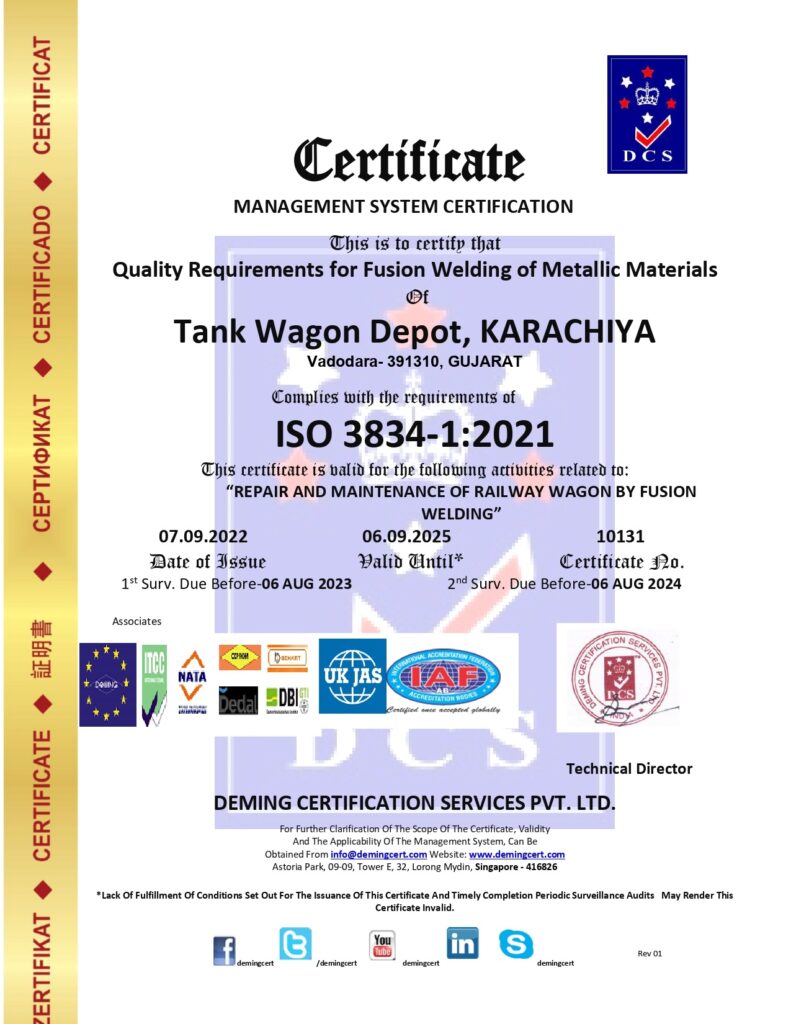
Tank Wagon Depot, Karachiya provided the following certification details for its welding-related activities: ISO 3834-1:2021, covering quality requirements for fusion welding of metallic materials, with the stated scope of repair and maintenance of railway wagons by fusion welding. The certificate was issued in 2022, with 2025 given as the validity end year. This certification framework is relevant to the establishment of organized controls for welding quality, including responsibilities, procedures, competence, inspection, documentation, and the management of welding-related risks.
ISO 3834 is an internationally recognized series of standards addressing quality requirements for fusion welding of metallic materials. Part 1 establishes criteria for selecting the appropriate level of quality requirements. The applicable requirements for an organization depend on the relevant part of the series, contractual conditions, technical specifications, and the nature of the welding work. Consequently, a certification claim should always be understood in the context of the precise standard, scope, and certification arrangements.
For a railway maintenance organization, a structured quality approach can help connect everyday workshop activities with broader operational objectives. The purpose is not simply to maintain documents or prepare for an audit. It is to ensure that welding work is planned correctly, performed using suitable methods, inspected according to defined requirements, and supported by records that demonstrate what was done and who was responsible.
The introduction of a formal welding quality framework can also encourage a more consistent working culture. Employees gain a clearer understanding of their responsibilities, supervisors have better visibility into work progress, and management receives more reliable information for decision-making. When quality expectations are understood throughout the organization, errors can be identified earlier, rework can be reduced, and maintenance activities can be planned more effectively.
The depot’s location in Gujarat also places its work within a major industrial and logistical environment. Railway infrastructure connects manufacturing centres, ports, warehouses, and commercial destinations. Effective wagon maintenance contributes to the reliability of this larger transportation network. Although a single depot cannot control every factor affecting railway performance, it can influence the quality and readiness of the wagons entrusted to its maintenance activities.
A useful growth story for Tank Wagon Depot, Karachiya therefore begins with the relationship between technical workmanship and organizational discipline. Quality depends on the skills of individual welders, but it also depends on the systems surrounding their work. Material identification, equipment condition, welding instructions, inspection planning, defect correction, and accurate records all contribute to the final outcome.
Certification can provide a structured opportunity to review these activities, identify weaknesses, and establish more consistent practices. Its real value emerges when the principles behind the standard become part of everyday work. A documented process is useful only when employees understand it, follow it, and improve it when evidence shows that a change is necessary.
For Tank Wagon Depot, Karachiya, the ISO 3834-1:2021 certification details supplied for 2022 mark a relevant point in the organization’s quality narrative. The certification provides the basis for discussing welding quality, accountability, technical competence, and systematic maintenance. It does not, by itself, prove a particular increase in revenue, productivity, or customer satisfaction. Those outcomes would need to be demonstrated through operational records and other reliable evidence.
The central theme of this case study is that sustainable growth in railway wagon maintenance depends on reliable workmanship, clear procedures, competent people, effective supervision, and continuous learning. By placing welding quality within a structured management approach, a depot can strengthen its ability to deliver consistent maintenance services and support the wider objectives of railway safety and operational reliability.
#TankWagonDepot
Chapter 2 – Understanding ISO 3834-1:2021 and Its Importance in Railway Wagon Maintenance
Welding is one of the most technically demanding activities in metallic fabrication and repair. In railway wagon maintenance, it becomes even more important because repaired components may be exposed to repeated mechanical stresses, vibration, changing environmental conditions, and demanding service requirements. A welding defect can affect the strength or durability of a component, potentially resulting in premature failure, additional maintenance, operational disruption, or safety concerns. For this reason, welding quality must be managed through a planned and systematic approach.
ISO 3834 provides a framework for managing quality in fusion welding. Unlike a general quality management approach that addresses an organization’s overall processes, ISO 3834 focuses specifically on the quality requirements associated with welding. It recognizes that satisfactory welding results cannot be achieved through final inspection alone. Quality must be considered before welding begins, controlled during the operation, and verified through appropriate inspection and documentation.
For Tank Wagon Depot, Karachiya, the stated certification to ISO 3834-1:2021 relates to quality requirements for fusion welding of metallic materials. Its declared scope, repair and maintenance of railway wagons by fusion welding, places welding control at the centre of the organization’s technical activities. Understanding the significance of this framework helps explain how certification can support improvements in maintenance discipline and service reliability.
The first important principle is that welding quality begins with planning. Before work starts, the responsible personnel need to understand the nature of the defect, the condition of the component, the applicable repair instructions, the material involved, and the acceptance requirements. They must determine whether welding is an appropriate repair method and whether the proposed work is permitted by the applicable engineering instructions. Not every damaged component should automatically be repaired by welding. Certain conditions may require replacement, specialist assessment, or authorization from the relevant railway engineering authority.
A structured approach encourages personnel to make these decisions based on documented requirements rather than assumptions. It also creates a clear record of why a repair was undertaken and which instructions governed the activity. This is especially important where components have different functions, materials, dimensions, or loading conditions.
The second principle concerns welding procedures. Welding parameters such as current, voltage, travel speed, electrode selection, joint preparation, and preheating requirements can influence the quality of a weld. The appropriate parameters depend on the material, welding process, joint design, thickness, and applicable technical requirements. A procedure developed for one situation should not automatically be applied to another without confirming its suitability.
A controlled welding procedure provides instructions for carrying out the work consistently. Where required, welding procedure specifications should be supported by appropriate qualification evidence. This helps ensure that welding is performed under conditions demonstrated to be suitable for the intended application.
The third principle is personnel competence. Welding equipment and written instructions cannot compensate fully for inadequate skill or insufficient technical understanding. Welders must have the appropriate qualifications or competence evidence for the work assigned to them, as required by the applicable rules. Supervisors and welding coordination personnel also need sufficient knowledge to plan work, resolve technical questions, and recognize conditions that require further review.
For Tank Wagon Depot, Karachiya, a systematic competence approach can help identify training needs and ensure that assignments match the qualifications and capabilities of available personnel. Competence records can also support workforce planning and reduce dependence on informal assumptions about an employee’s experience.
The fourth principle is equipment suitability. Welding machines, measuring instruments, inspection equipment, and supporting tools must be appropriate for their intended use. Equipment should be maintained, checked, and calibrated or verified where necessary. Poor equipment condition can introduce inconsistency, affect process control, or make inspection results unreliable.
The fifth principle concerns inspection and testing. Inspection should be planned according to the nature of the repair, applicable specifications, risk, and acceptance criteria. Visual inspection may be required for many welds, while additional nondestructive testing or other examinations may be necessary for particular components or applications. The selection of inspection methods must follow the applicable engineering and contractual requirements rather than a general assumption that every repair needs the same tests.
The sixth principle is traceability and documentation. Maintenance records should make it possible to identify the work performed, the component involved, the applicable procedure, the personnel responsible, the materials used where relevant, the inspections completed, and the disposition of any defects. Such information becomes particularly valuable when a recurring problem must be investigated or when a component’s maintenance history needs to be reviewed.
For example, if a repaired joint develops a recurring defect, documented information can help investigators determine whether the issue relates to material condition, joint preparation, welding parameters, workmanship, or service conditions. Without reliable records, the investigation may depend heavily on recollection and incomplete evidence.
Certification also encourages management to assign clear responsibilities. Someone must be accountable for approving welding procedures, ensuring personnel competence, checking material suitability, arranging inspection, and reviewing nonconformities. These responsibilities should be consistent with the organization’s actual authority and the railway’s applicable technical rules.
It is important to distinguish ISO 3834-1:2021 from a blanket guarantee of defect-free welding. Part 1 concerns the criteria for selecting an appropriate level of quality requirements; the applicable requirements for a specific operation depend on the relevant standards and arrangements. Certification is not a substitute for engineering approval, statutory obligations, railway maintenance instructions, or required inspections.
The practical value of this framework lies in the way it connects technical controls into a coherent process. Welding becomes easier to plan, inspect, document, and improve. Employees gain clarity about what is expected, and management can assess performance using evidence rather than informal impressions.
For Tank Wagon Depot, Karachiya, the wider lesson is that welding quality should be built into the entire maintenance process. When the right procedures, skills, equipment, inspections, and records work together, the organization has a stronger foundation for dependable railway wagon repair and long-term operational improvement.
#KarachiyaRailway
Chapter 3 – Improving Railway Wagon Repair Through Standardized Welding Procedures

Railway wagon repair is a combination of inspection, technical evaluation, material preparation, component restoration, welding, finishing, and verification. Each stage influences the quality of the next. If the initial inspection is incomplete, the repair may not address the actual cause of damage. If joint preparation is inadequate, a qualified welding procedure may not deliver the intended result. If inspection is delayed or poorly documented, defects may remain unresolved until a later stage.
Standardized procedures help reduce these inconsistencies. They establish a common method for performing recurring activities and define the conditions under which work should be completed. For Tank Wagon Depot, Karachiya, the development and disciplined use of suitable welding procedures can be an important part of translating a welding quality framework into practical maintenance improvements.
The first step in a standardized repair process is the identification of the wagon and the component requiring attention. Reliable identification helps prevent confusion between work orders and supports the maintenance history of each asset. The depot’s documentation system can record the wagon or component reference, reported defect, inspection findings, repair authorization, and applicable technical instructions.
Once the defect is identified, a competent person should assess the condition and determine the appropriate action. The assessment should consider the extent of damage, the component’s function, the material involved, and any restrictions contained in railway engineering instructions. Welding should be undertaken only where it is technically appropriate and authorized. If the component is outside permissible repair limits, replacement or further engineering assessment may be necessary.
The next stage is repair planning. The work plan should identify the welding process, required materials, applicable procedure, preparation method, equipment, inspection requirements, and acceptance criteria. Where technical approval is necessary, the repair should not proceed until the relevant authorization has been obtained.
Joint preparation is a particularly important stage. Damaged areas may need cleaning, removal of defective material, preparation of edges, and examination of the surrounding metal. Paint, rust, oil, moisture, and other contaminants can affect welding quality. The exact preparation method depends on the repair instructions and material. A standardized checklist can help ensure that essential preparation activities are completed before welding starts.
Material control is equally important. Welding consumables should be suitable for the specified application and stored under the required conditions. Where traceability or batch identification is required, the relevant details should be recorded. Incorrect consumables, unsuitable storage, or the use of unidentified material can create avoidable risks.
During welding, the work should follow the approved procedure and applicable technical requirements. Personnel should observe the specified parameters, joint configuration, and any requirements for preheating, interpass temperature, or post-weld treatment. Not every repair requires every control, but the applicable procedure must clearly establish which controls are necessary.
Supervision is important because actual workshop conditions may differ from those anticipated during planning. Changes in component condition, accessibility, material identification, or repair extent may require reassessment. Personnel should understand when they can proceed and when work must stop for clarification or approval.
After welding, the component should undergo the specified examination and verification. Inspection should confirm whether the weld meets the applicable acceptance criteria and whether the repaired component satisfies relevant dimensional or functional requirements. If a defect is identified, it should be documented and corrected through an authorized method. Repeated repair should not become an informal substitute for investigating the cause of a recurring problem.
Standardized documentation connects these stages. A completed repair record can show the original defect, the procedure used, the personnel involved, the inspection results, any corrective work, and the final disposition. This provides useful evidence for audits, maintenance planning, and technical investigations.
A depot can also use standardized procedures to improve the allocation of work. If common repair activities have clearly defined steps, supervisors can estimate resource needs more consistently, identify suitable personnel, and plan inspection activities before work reaches the final stage. This may help reduce waiting time and avoid situations in which a completed repair remains delayed because the required verification was not arranged.
Standardization does not mean that every wagon should receive identical treatment. Different components and defects may require different technical responses. The objective is to ensure that similar situations are handled consistently while allowing appropriate engineering judgment where conditions differ.
Another benefit is the preservation of organizational knowledge. Experienced employees often possess valuable practical understanding of recurring defects and difficult repairs. By incorporating verified lessons into approved procedures and training, the depot can make this knowledge available to a wider workforce. This reduces excessive dependence on individual memory and helps new personnel learn established practices.
Management can evaluate the effectiveness of standardized procedures through suitable indicators, such as repair acceptance rates, repeated defects, rework hours, missing records, and time between defect identification and final approval. These indicators should be based on actual data and interpreted carefully. A change in reported defects, for example, may reflect improved detection rather than worsening workmanship.
The process should remain open to improvement. If inspections identify recurring problems, the organization should examine whether procedures, training, material controls, or supervision require revision. Changes must be reviewed and authorized before they become part of normal practice.
For Tank Wagon Depot, Karachiya, standardized welding procedures offer a practical path from certification principles to consistent workshop execution. When repair activities follow clear instructions and generate reliable evidence, the organization can strengthen technical control, reduce avoidable variation, and improve confidence in the maintenance process. These benefits contribute to a stronger foundation for dependable railway wagon service.
#ISO3834
Chapter 4 – Developing Skilled Personnel and a Strong Welding Quality Culture
People are the foundation of every successful maintenance operation. Welding machines, inspection tools, written procedures, and quality records are important, but their effectiveness depends on the knowledge and behaviour of the employees who use them. In railway wagon repair, even a well-designed procedure can fail if the assigned worker does not understand its requirements or if supervision does not identify an unsafe or unsuitable working condition.
For Tank Wagon Depot, Karachiya, the quality principles associated with ISO 3834-1:2021 provide a useful basis for examining the relationship between employee competence and reliable welding work. A strong quality culture develops when employees understand not only what they are required to do, but also why each requirement matters.
The first requirement is appropriate assignment of responsibilities. Welders should be assigned work that matches their qualifications, demonstrated competence, and applicable authorization. Supervisors should understand the repair requirements and ensure that employees have the necessary instructions, materials, and equipment. Inspection personnel should be competent in the examination methods they perform, while those responsible for welding coordination should possess the technical knowledge required by the applicable quality requirements.
Clear responsibilities reduce uncertainty. When an employee identifies an unexpected crack, unusual material condition, incorrect consumable, or defect outside the anticipated repair limits, the employee should know whom to inform and whether work must stop. A reporting system that encourages early communication can prevent small concerns from developing into larger problems.
Training is another important element. A training programme can cover welding processes, joint preparation, equipment operation, consumable handling, drawing interpretation, defect recognition, inspection requirements, and documentation. The specific content should reflect the activities performed at the depot and the requirements of the applicable railway maintenance instructions.
Training should not be limited to classroom presentations. Practical demonstrations, supervised work, competency assessments, and reviews of actual maintenance cases can help employees connect theoretical information with workshop conditions. For example, a session on weld defects becomes more useful when employees learn how to recognize relevant defects, understand their possible causes, and follow the correct reporting and corrective-action process.
Competence should also be reviewed periodically. An employee’s qualification may be valid for a defined period or subject to specific conditions, depending on the applicable scheme. The organization should maintain the records needed to confirm that personnel remain authorized for their assigned tasks. Where a gap is identified, suitable retraining, reassessment, or revised work allocation may be necessary.
Experienced workers can play an important role in developing newer employees. Mentoring enables practical knowledge to be transferred through observation, discussion, and supervised work. However, informal experience should complement, not replace, required qualifications and approved procedures. A repair technique that has been used for years should still be evaluated against current technical requirements.
Quality culture also depends on leadership. Managers and supervisors influence whether employees treat quality controls as essential parts of their work or as administrative burdens. If management consistently emphasizes correct preparation, documented authorization, and proper inspection, employees are more likely to understand that quality takes priority over simply completing work quickly.
The handling of mistakes is another important issue. Employees may hesitate to report an error if they expect unfair blame or punishment. Such hesitation can prevent the organization from learning about weaknesses in its processes. A fair approach distinguishes between honest mistakes, inadequate training, unclear procedures, equipment problems, and deliberate disregard for requirements. Appropriate accountability remains necessary, but the purpose of investigation should include identifying the factors that allowed the problem to occur.
Regular quality meetings can support this culture. Supervisors and employees can discuss recurring defects, near misses, inspection findings, and improvements to working methods. The discussions should focus on evidence and practical actions. A short review of a recurring weld defect, for instance, may reveal that preparation instructions need clarification or that a particular consumable storage practice requires attention.
Communication between departments is equally important. Repair personnel, stores staff, inspection personnel, planning teams, and management may each hold information needed for a successful job. If information is not shared, incorrect materials may be issued, inspection may be delayed, or repairs may be completed without the necessary documentation. Clear handovers and accessible records can reduce these problems.
The organization can assess training effectiveness by examining whether the expected improvements occur in actual work. Useful indicators may include fewer repeat defects, better compliance with procedures, more complete records, and improved performance during practical assessments. Attendance at a training session alone does not prove competence.
Employee involvement in improvement activities can also strengthen motivation. Workers who perform a task every day often understand its practical difficulties better than someone reviewing it only from an office. Encouraging suggestions about workstation layout, material handling, inspection access, and document usability can uncover improvements that are both practical and economical.
At the same time, suggestions must be evaluated before implementation. Welding procedures, engineering requirements, and safety controls cannot be changed informally. Proposed improvements should be reviewed by the appropriate competent personnel and approved through the established process.
For Tank Wagon Depot, Karachiya, developing a skilled workforce means creating a system in which competence is planned, verified, maintained, and supported by effective leadership. Employees become active participants in quality rather than simply following instructions without understanding their purpose.
A strong welding quality culture is built gradually through consistent training, fair supervision, reliable communication, and recognition of good workmanship. When these elements are combined with suitable technical controls, the organization can improve its ability to deliver repeatable maintenance quality and preserve valuable expertise for the future.
#ISO3834_1_2021
Chapter 5 – Inspection, Traceability, and Documentation as Foundations of Reliable Maintenance
Inspection and documentation are essential to railway wagon maintenance because they provide evidence that repair work has been performed and evaluated according to the applicable requirements. Welding quality cannot be established merely by assuming that an experienced worker has completed the task correctly. The organization needs appropriate verification and reliable records to demonstrate that the work satisfies the specified acceptance criteria.
For Tank Wagon Depot, Karachiya, the principles of welding quality management can support a more organized approach to inspection, traceability, and documentation. These activities are closely connected. Inspection identifies the condition of the work, traceability links that work to the relevant materials and processes, and documentation preserves the evidence needed for review and future maintenance.
The inspection process begins before welding. Initial examination helps determine the extent of damage and whether the proposed repair is appropriate. Depending on the component and the applicable instructions, this may include visual examination, dimensional checks, review of previous maintenance records, or additional testing. The findings should be recorded clearly enough to support the repair decision.
A well-documented initial assessment also creates a baseline against which the completed work can be evaluated. If a component has experienced deformation, cracking, corrosion, or previous repairs, these conditions may influence the appropriate repair method. Where the condition exceeds authorized limits, the matter should be referred to the relevant technical authority.
During welding, in-process checks can help verify that the work is proceeding according to the approved procedure. Depending on the application, these checks may include joint preparation, fit-up, consumable identification, welding parameters, preheating, interpass conditions, or other specified controls. The inspection plan should identify which checks are necessary, who performs them, and when they must occur.
Final inspection confirms whether the completed repair meets the applicable requirements. Visual examination can identify surface irregularities and visible defects, but it cannot reveal every possible internal discontinuity. Additional nondestructive testing may be required where specified by the governing instructions or risk assessment. Methods must be selected and performed by competent personnel using suitable equipment and applicable acceptance criteria.
Inspection records should contain meaningful results rather than a general statement that a component is satisfactory. Depending on the requirements, a record may identify the component, inspection date, examination method, inspector, relevant findings, acceptance decision, and any corrective work. The record should be sufficient to demonstrate that the required verification took place.
Traceability provides the link between a component and the information associated with its repair. For example, a maintenance record may identify the wagon, repaired component, welding procedure, assigned welder, consumable batch where required, inspection results, and final authorization. Not every job requires the same level of detail, so the organization should determine traceability requirements based on applicable standards, contractual conditions, and railway instructions.
Reliable traceability becomes particularly useful when defects recur. Suppose a repaired area develops a similar problem during a later inspection. Investigators may need to review the material, procedure, workmanship, inspection method, and service conditions. If records are complete, they can compare the current case with earlier repairs and identify patterns that might otherwise remain hidden.
Documentation also supports accountability. Work instructions, procedure approvals, training records, equipment maintenance records, inspection reports, and nonconformity reports establish who performed or authorized particular activities. Such information helps management assess whether responsibilities were properly assigned and whether the required controls were followed.
However, documentation should remain practical. An unnecessarily complicated record system can consume time without improving quality. The objective is to collect information that is accurate, relevant, accessible, and appropriate to the risk and technical requirements. Standardized forms can reduce variation and help employees identify the information that must be captured.
A depot may use paper records, electronic spreadsheets, or a suitable maintenance management system, depending on its needs and available resources. An electronic system can make records easier to retrieve, support searches by wagon or component number, and generate reports on recurring defects. However, digitization alone does not guarantee better control. Access permissions, backups, data accuracy, version control, and appropriate retention arrangements remain important.
Document control is especially significant when procedures change. Employees must be able to identify the current approved instruction and avoid using obsolete copies. Changes should be reviewed and authorized by competent personnel, and affected employees should receive the information and training needed to apply the revised requirements.
Records should also be protected against unauthorized alteration or loss. Clear rules should identify who can create, review, approve, and modify records. Where corrections are necessary, the method should preserve the integrity of the original information and comply with the organization’s document-control arrangements.
Internal reviews can help determine whether records reflect actual work. A sample of completed repairs can be checked against the work orders, procedure requirements, inspection results, and authorization records. Missing information may reveal unclear forms, insufficient training, workload pressures, or weaknesses in supervision.
Management can use the information gathered through inspections and traceability to monitor quality trends. For example, repeated defects associated with a particular repair type may justify a focused technical review. A rise in incomplete records may indicate that documentation requirements are unclear or that the process needs simplification.
For Tank Wagon Depot, Karachiya, inspection and documentation should be viewed as practical tools for improving maintenance reliability. Their purpose is not simply to satisfy an audit. They help establish what happened, whether the repair met the requirements, and what can be learned from the result.
When inspection is planned, traceability is appropriate, and documentation is reliable, the depot has a stronger basis for technical decisions, corrective action, and continuous improvement. These controls help preserve institutional knowledge and provide greater confidence in the quality of railway wagon repair.
#WeldingQuality
Chapter 6 – Operational Efficiency, Cost Control, and Sustainable Organizational Growth
Operational efficiency is an important objective for any railway maintenance establishment. Wagons that remain unavailable for longer than necessary can affect maintenance planning, fleet availability, and the wider movement of goods. At the same time, completing work quickly without adequate technical control can introduce defects and increase the likelihood of rework. Sustainable efficiency therefore requires a balance between timely execution, technical quality, safe working practices, and compliance with applicable railway requirements.
For Tank Wagon Depot, Karachiya, a structured welding quality approach can support this balance by encouraging better planning, more consistent procedures, and earlier identification of problems. The purpose is not to increase output at any cost. It is to ensure that resources are used effectively while the required quality of repair is maintained.
One important source of inefficiency is incomplete repair planning. If personnel begin work without confirming the required procedure, materials, equipment, and inspection arrangements, the activity may be interrupted later. A missing consumable, unavailable inspection resource, or unclear repair instruction can delay the completion of an otherwise straightforward job.
A planned maintenance process can reduce these interruptions. Before work begins, supervisors can review the work order, identify required resources, confirm the availability of suitable personnel, and arrange inspection at the appropriate stage. This approach improves coordination and helps ensure that repair activities proceed in a controlled sequence.
Material management is another factor affecting cost and efficiency. Welding consumables and other repair materials should be selected according to the applicable specifications and stored under suitable conditions. Poor inventory control may result in shortages, unnecessary purchases, expired or unsuitable materials, and delays while the correct supplies are obtained.
A well-managed inventory system can track material availability, consumption, storage conditions, and replenishment requirements. Where traceability is necessary, material records should remain linked to the relevant repair. The objective is to ensure that appropriate materials are available when needed without encouraging excessive stockholding or the use of unsuitable substitutes.
Rework is another important cost factor. A defective weld may require additional preparation, removal of defective material, repeat welding, further inspection, and renewed documentation. Depending on the component and repair, rework may also extend the period during which the wagon remains unavailable.
Reducing avoidable rework begins with understanding its causes. If a particular defect occurs repeatedly, the organization should investigate whether it relates to joint preparation, welding technique, procedure suitability, consumable condition, equipment performance, or inspection arrangements. Corrective action should address the underlying cause rather than simply repairing each defect separately.
For example, if inspection records show recurring defects in a particular type of joint, the technical team could review the relevant procedure and observe the actual working conditions. The review might identify a training need, an access difficulty, an unclear instruction, or a mismatch between the approved method and the repair environment. Any changes should be reviewed and authorized before being introduced.
Maintenance scheduling can also benefit from reliable quality information. Historical records may reveal common repair categories, recurring component problems, and periods of high workload. Such information can support resource planning, although predictions should be based on sufficient data and should account for changing operating conditions.
Workload balancing is particularly important when specialized skills are required. If only a limited number of qualified personnel can perform a certain task, the depot may need to plan assignments carefully and maintain appropriate competence coverage. Training additional personnel, where justified and permitted, can improve resilience and reduce dependence on a small number of individuals.
Equipment maintenance contributes to operational efficiency as well. Welding machines and inspection instruments should be maintained according to their requirements. Planned maintenance can reduce unexpected breakdowns and help preserve reliable process conditions. Equipment records also provide evidence that the necessary checks and maintenance activities have been completed.
The depot can monitor operational performance using indicators such as average repair turnaround time, first-time acceptance rate, rework hours, material wastage, equipment downtime, and the percentage of completed jobs with complete documentation. These measures should be clearly defined so that different reporting periods can be compared meaningfully.
For instance, turnaround time should have a consistent starting point and completion point. Otherwise, a reported improvement may reflect a change in measurement rather than a genuine operational gain. Similarly, a higher first-time acceptance rate should be evaluated alongside the complexity of the repairs being undertaken.
Cost control must never encourage the omission of necessary inspections, the use of unauthorized materials, or the relaxation of engineering requirements. Such shortcuts can create larger costs and greater risks later. Quality-related expenditure should be assessed in relation to the reliability and serviceability it helps protect.
Sustainability is another consideration. Better material control can reduce unnecessary waste, while improved equipment maintenance may extend useful service life. Efficient planning can also reduce repeated handling and unnecessary movement of components. Any environmental or financial benefits should be measured using actual records rather than assumed.
Organizational growth does not necessarily mean expanding the size of the depot. It can also mean improving the capability to perform work consistently, handling complex maintenance activities more effectively, strengthening technical knowledge, and improving the reliability of service delivery.
For Tank Wagon Depot, Karachiya, the principles of welding quality management can support these goals by integrating technical controls with practical operational planning. Better coordination, reduced avoidable rework, reliable records, and suitable performance indicators can help the organization understand where resources are being used effectively and where further improvement is needed.
Over time, this evidence-based approach can support more predictable maintenance operations. The greatest benefit comes when cost control and efficiency are treated as results of good planning and quality workmanship, rather than as reasons to compromise the technical requirements governing railway wagon repair.
#RailwayWagonRepair
Chapter 7 – Customer Confidence, Railway Reliability, and Professional Credibility
Customer confidence is built through dependable service, consistent quality, clear communication, and the ability to demonstrate that work meets agreed requirements. In railway maintenance, confidence has particular importance because the quality of repair can influence equipment reliability, maintenance planning, and the wider transportation system.
Tank Wagon Depot, Karachiya, operates within the broader context of railway wagon repair and maintenance. Its stated scope of repair and maintenance of railway wagons by fusion welding makes technical competence and welding quality central themes in its professional identity. A structured quality framework can help establish greater clarity about how repair work is planned, controlled, inspected, and recorded.
For a maintenance establishment, the immediate beneficiaries of quality are not limited to a single customer or department. Reliable maintenance supports the organizations responsible for operating, managing, or relying on the railway fleet. Wagon availability affects the movement of goods, while consistent repair quality helps reduce the likelihood of avoidable repeat work and unplanned maintenance.
However, the relationship between certification and customer confidence must be understood correctly. A certificate provides evidence of conformity within a defined certification scope and arrangement. It does not independently guarantee that every repair is defect-free, nor does it automatically establish a particular level of customer satisfaction. Confidence grows when the organization consistently applies appropriate controls and demonstrates satisfactory results.
One way to support confidence is through transparent maintenance documentation. Work orders, inspection reports, repair records, and closure documents can help authorized stakeholders understand what work was performed and whether the required verification was completed. Clear records are particularly useful when questions arise about a component’s maintenance history.
Communication is equally important. When a defect is discovered, the responsible team should communicate the findings through the appropriate channels. If the proposed repair falls outside the permitted limits, the organization should seek the necessary technical decision rather than proceeding on the basis of an assumption. Clear escalation procedures help prevent misunderstandings and protect the integrity of the repair process.
Timely communication also supports maintenance planning. If work cannot proceed because materials, authorization, or specialist inspection are unavailable, early notification allows the responsible parties to make informed decisions. Delayed communication can create uncertainty and complicate the allocation of resources.
Another important factor is consistency. A customer or railway authority should not receive substantially different levels of control merely because a particular supervisor or welder is on duty. Standardized procedures, competence requirements, and documented responsibilities help create consistent expectations across shifts and teams.
Internal quality reviews can support this objective by checking whether the approved processes are applied in practice. The results can identify recurring weaknesses and help management determine whether additional training, revised instructions, or better coordination is required.
The depot can also use feedback to improve service. Feedback may concern repair quality, turnaround time, record completeness, communication, or the handling of recurring defects. Complaints and concerns should be recorded and investigated proportionately, with corrective actions assigned and reviewed for effectiveness.
A useful complaint-handling process distinguishes between the immediate correction and the underlying corrective action. Correcting a single defective weld may resolve the immediate issue, but it does not necessarily prevent the same problem from occurring elsewhere. A broader investigation may be required if the defect indicates a weakness in a procedure, training programme, material control, or inspection system.
Professional credibility is strengthened when the organization communicates its capabilities accurately. Certification details should be presented with the correct standard reference, scope, issue date, validity information, and certification status. The organization should not imply that a certificate authorizes activities outside its approved scope or replaces other railway approvals.
For Tank Wagon Depot, Karachiya, the stated ISO 3834-1:2021 certification information can form part of a factual account of its focus on welding quality. Since the provided validity year is 2025, the current status should be verified before the certification is promoted as active in 2026. If renewal or recertification has occurred, the latest documentary evidence should be used. If it has not, the historical certification can still be described accurately without implying current validity.
Credibility also depends on evidence when communicating improvements. Claims such as reduced rework, improved turnaround time, fewer defects, or greater customer satisfaction should be supported by suitable records. Where no reliable measurements are available, it is more accurate to describe the intended benefits of quality management than to claim that specific gains have already occurred.
An organization can strengthen its reputation by demonstrating that it treats quality concerns seriously. This includes investigating defects, documenting findings, implementing suitable corrective actions, and reviewing whether those actions have worked. A transparent approach can be more valuable over time than making ambitious claims that cannot be supported.
The railway environment requires coordination among multiple teams and authorities. Maintenance quality is therefore both a technical responsibility and a communication responsibility. Repair personnel must understand the technical instructions, while supervisors and managers must ensure that information moves effectively between those involved in planning, execution, inspection, and approval.
For Tank Wagon Depot, Karachiya, professional credibility can grow through the consistent application of suitable welding controls, reliable documentation, competent personnel, and clear communication. These practices support confidence because they make maintenance work more understandable, traceable, and accountable.
In the long term, a strong reputation is earned through repeated evidence of dependable performance. Certification can support that process by providing a structured framework, but lasting confidence comes from the way the organization applies the framework in its daily operations.
#RailwayMaintenance
Chapter 8 – Risk Management, Corrective Action, and Continuous Improvement
Every maintenance operation faces risks. In railway wagon repair, these may arise from incorrect defect assessment, unsuitable repair methods, inadequate joint preparation, poor material control, equipment problems, insufficient personnel competence, incomplete inspection, or weaknesses in documentation. Effective risk management requires these possibilities to be identified and controlled before they result in unacceptable outcomes.
For Tank Wagon Depot, Karachiya, a structured welding quality approach can help establish a disciplined method for identifying risks, evaluating their significance, and taking appropriate action. The purpose is not to eliminate every uncertainty, which may be impossible, but to reduce avoidable risks to an acceptable level under the applicable technical and safety requirements.
The first step is to understand the repair process. Management and technical personnel can examine each stage, from defect identification to final release, and consider what could go wrong. For example, incorrect component identification could lead to the wrong repair instructions being applied. An unsuitable consumable could affect weld properties. An inspection performed using an inappropriate method might fail to detect a relevant defect.
Risk assessment should consider both the possible consequences and the likelihood of occurrence. The appropriate depth of assessment depends on the nature of the work, the component’s function, and the applicable engineering requirements. A simple risk register may be sufficient for some process-level reviews, while complex or safety-critical applications may require a more detailed technical assessment.
Controls should follow the relevant standards, approved procedures, and railway instructions. They may include positive component identification, approved repair instructions, verified consumables, competent personnel, suitable equipment, defined inspection stages, and documented authorization. The controls must be practical enough to work consistently under real workshop conditions.
Risk management also requires attention to changes. A repair may become more complicated when the damage is greater than expected or when the component differs from the original description. Employees should understand how to report these conditions and obtain a technical decision before proceeding outside the approved method.
Corrective action becomes important when an actual problem is identified. The first task is to control the immediate issue. If a weld fails inspection, for example, the affected work should be identified and handled according to the relevant procedure. The organization must determine whether the component requires rework, further assessment, replacement, or another authorized disposition.
The next task is to investigate the cause. It is tempting to attribute every welding defect to the person who performed the weld, but the actual cause may involve multiple factors. The investigation should consider whether the procedure was suitable, the instructions were clear, the material was correct, the equipment functioned properly, and the working conditions supported the required method.
Root-cause analysis should be proportionate to the problem. A straightforward issue may require a focused review, while a recurring or potentially serious defect may justify a more detailed investigation involving relevant technical personnel. The objective is to identify the factors that allowed the problem to occur.
Once the cause is understood, corrective actions can be planned. These might include revising a work instruction, providing additional training, improving consumable storage, changing an inspection checkpoint, correcting an equipment issue, or strengthening authorization controls. Changes to technical procedures must be reviewed and approved by the appropriate competent authority.
Corrective action is incomplete until its effectiveness has been evaluated. If training is introduced to address a recurring defect, subsequent work should be reviewed to determine whether the problem has reduced. If a new inspection checkpoint is added, the organization should examine whether it is detecting the intended issue and whether employees can apply it consistently.
Continuous improvement also depends on learning from positive results. If a process consistently produces satisfactory repairs, the organization can examine which controls contribute most to that performance. Successful practices may be shared across similar work areas, provided they remain appropriate to the relevant technical requirements.
Internal audits can support this learning process. Auditors can examine whether the documented arrangements are suitable and whether employees follow them in practice. An audit should not focus exclusively on missing signatures or document formatting. It should also examine whether the system provides effective control over actual welding work.
Management review provides another opportunity to evaluate performance. Relevant information may include audit findings, inspection trends, recurring defects, corrective-action status, equipment performance, competence gaps, resource needs, and feedback from authorized stakeholders. Management can use this evidence to decide which improvements require priority.
Data analysis can reveal patterns that individual repair records may not make obvious. For example, defects may be concentrated in a particular type of joint, shift, material, or repair category. These patterns should be interpreted carefully because differences in workload or repair complexity may influence the results.
Employees should also be encouraged to report near misses and process weaknesses. An incident that does not produce a defective repair may still reveal a vulnerability. Early reporting allows the organization to improve controls before the weakness results in a more serious consequence.
A mature improvement process treats risk management as part of normal operations rather than a separate annual exercise. Risks should be reconsidered when procedures change, new equipment is introduced, staffing arrangements change, or new types of repair are undertaken.
For Tank Wagon Depot, Karachiya, continuous improvement can strengthen the relationship between technical workmanship and organizational learning. Each inspection, defect report, audit, and employee suggestion can provide information about the effectiveness of existing controls.
The most important principle is that improvement should be evidence-based. Changes should address identified needs, preserve compliance with applicable requirements, and be reviewed to confirm that they deliver the intended result. Through this disciplined approach, the depot can develop a more resilient quality system and support dependable railway wagon maintenance.
#FusionWelding
Chapter 9 – Technology, Digital Records, and the Future of Railway Wagon Maintenance
Technology is changing the way industrial maintenance organizations manage information, plan work, and evaluate performance. Digital records, computerized maintenance planning, equipment monitoring, and data analysis can help organizations make better decisions when these tools are introduced carefully and supported by reliable processes.
For Tank Wagon Depot, Karachiya, digitalization offers a potential opportunity to strengthen the management of welding quality and railway wagon repair. The value of technology does not depend on purchasing the most advanced software. It depends on identifying real operational needs and choosing tools that improve traceability, communication, planning, and technical control.
One practical starting point is the digitization of maintenance records. A digital work order can connect the wagon identification, reported defect, inspection findings, approved repair instructions, assigned personnel, material details where required, and final inspection results. This can reduce the time spent searching through paper files and make relevant information easier to retrieve.
Searchable records are especially valuable when a recurring defect must be investigated. If similar repairs have been documented consistently, authorized personnel may be able to compare earlier cases and identify common patterns. This can support more focused root-cause analysis and better-informed maintenance decisions.
Digital documentation can also improve visibility into the status of repair work. A work order may show whether the repair is awaiting inspection, technical approval, materials, or final closure. Supervisors can use this information to identify bottlenecks and coordinate resources more effectively.
However, digital status indicators should reflect actual work. A job should not be marked complete simply because the welding activity has ended if required inspection or authorization remains outstanding. The system must distinguish between the completion of physical work and the completion of all necessary verification and release activities.
Document version control is another potential benefit. Employees need access to current approved procedures and instructions. A digital repository can help ensure that revised documents are distributed consistently and that obsolete versions are identified. Access permissions and approval workflows should prevent unauthorized changes to technical documents.
The transition from paper to digital records should be planned. Before entering historical information, the organization should decide which records need to be retained, how data will be organized, and how inconsistencies will be addressed. Scanning old documents without creating a usable indexing system may preserve information without making it easy to find.
Data quality is essential. Incorrect wagon numbers, incomplete inspection results, duplicate work orders, and inconsistent defect descriptions can undermine the value of digital analysis. Standardized data fields and employee training can help improve consistency.
A digital maintenance system can also support performance monitoring. Management may be able to review repair turnaround times, the frequency of repeated defects, inspection acceptance results, equipment downtime, and the status of corrective actions. Such information can reveal areas requiring attention, provided that the indicators are clearly defined and based on reliable records.
More advanced analytics may help identify relationships between maintenance history and recurring problems. For example, the organization could investigate whether certain defect types are more frequent under particular operating conditions or whether repeated repairs occur in similar component locations. Any conclusions must be checked against engineering knowledge and sufficient data. Statistical patterns alone do not establish the cause of a technical failure.
Automation and artificial intelligence may offer additional opportunities in the future, particularly in document retrieval, scheduling support, trend analysis, and the organization of inspection records. However, automated tools should not replace required engineering judgment, competent inspection, or authorized technical decisions. Any technology used in a safety-relevant process must be evaluated for suitability, reliability, and compliance with applicable requirements.
Equipment monitoring may also help improve maintenance planning. Where suitable sensors or diagnostic tools are available, they may provide information about equipment condition and help identify emerging problems. Their use should be based on demonstrated needs and appropriate technical validation rather than the assumption that all digital monitoring produces worthwhile benefits.
Cybersecurity and information protection become important as records move into electronic systems. Maintenance information should be accessible to authorized personnel while being protected against loss, unauthorized modification, and inappropriate disclosure. Regular backups, access controls, suitable recovery arrangements, and clear responsibilities can help protect the integrity of important records.
Technology should also support employees rather than make their work unnecessarily complicated. Forms and applications should be practical for workshop conditions. If a digital system requires excessive duplicate entry or is difficult to use, employees may develop workarounds that reduce data quality. Consultation with the people who perform the work can help identify a more effective design.
Implementation can proceed in stages. The depot could begin by standardizing a limited set of high-value records, then introduce searchable storage, followed by reporting and analysis once data quality is established. A pilot project can help identify practical issues before wider implementation.
Digitalization should remain connected to the quality framework. Electronic records are useful only when they preserve the necessary approvals, traceability, inspection evidence, and document-control requirements. A digital system does not automatically make an unsuitable repair procedure acceptable.
For Tank Wagon Depot, Karachiya, the future opportunity lies in combining established welding expertise with better information management. Digital records can help preserve maintenance history, improve coordination, and provide evidence for continuous improvement.
The long-term objective is not technology for its own sake. It is a more informed, organized, and responsive maintenance process in which people have access to accurate information when they need it. By selecting appropriate tools and introducing them with care, the depot can strengthen its ability to manage welding quality and support dependable railway operations.
#QualityAssurance
Chapter 10 – Long-Term Growth, Certification Lessons, and a Vision for Excellence
The long-term success of a railway maintenance establishment depends on its ability to deliver reliable work, maintain technical competence, respond to changing requirements, and learn from experience. Certification can contribute to this journey by providing a structured framework for reviewing processes and defining quality responsibilities. However, sustainable growth requires more than achieving a certificate. It depends on how effectively the organization applies the relevant principles throughout its daily activities.
For Tank Wagon Depot, Karachiya, the stated ISO 3834-1:2021 certification, issued in 2022 with validity given through 2025, provides a starting point for examining the role of welding quality in railway wagon repair and maintenance. The declared scope covers repair and maintenance of railway wagons by fusion welding. These details connect the organization’s quality narrative to an activity where technical competence, procedure control, inspection, and traceability are particularly important.
A long-term improvement strategy should begin with a clear assessment of the current position. Management can review the suitability of welding procedures, personnel competence, material controls, equipment maintenance, inspection arrangements, documentation, and corrective-action practices. The review should be based on actual evidence rather than assumptions about how well the system operates.
The next step is to identify priorities. Not every improvement needs to be implemented at once. Issues that could affect safety, technical conformity, or compliance with railway instructions should receive appropriate attention first. Other opportunities, such as improving report formats or simplifying administrative processes, can be scheduled according to their value and available resources.
A practical improvement plan should assign responsibilities, establish realistic timelines, identify necessary resources, and define how results will be measured. Each action should have a clear purpose. For example, if incomplete inspection records are a recurring problem, the plan might include clarifying the required fields, training the relevant personnel, and reviewing a sample of completed records after implementation.
Workforce development should remain a long-term priority. Changes in technology, equipment, materials, and technical requirements may create new training needs. A competence matrix can help identify which personnel are qualified for particular activities and where additional training or assessment is needed. Succession planning can also reduce dependence on a small number of experienced employees.
Technical knowledge should be preserved through approved procedures, training materials, and documented lessons from maintenance cases. When experienced employees retire or change roles, this information can help maintain continuity. Knowledge transfer should include the reasoning behind critical controls, not merely a list of steps to follow.
Operational performance should be reviewed regularly. Indicators such as first-time acceptance, repeat defects, rework hours, repair turnaround time, and documentation completeness can help management understand the effectiveness of the maintenance process. These indicators should be interpreted alongside repair complexity, workload, and changes in inspection practices.
The depot should also maintain an effective relationship between productivity and quality. Increasing the number of completed repairs is not a genuine improvement if it is accompanied by weaker inspection, higher rework, or incomplete records. Performance objectives should encourage employees to complete work efficiently while maintaining the required technical standards.
External requirements may change over time. Railway engineering instructions, contractual conditions, applicable welding standards, and certification arrangements should therefore be reviewed as necessary. A procedure that was appropriate under an earlier requirement may need reassessment when the governing technical conditions change.
Certification status also requires careful management. Because the provided certificate validity ends in 2025, the organization should confirm whether renewal or recertification has taken place. If certification remains current under a subsequent certificate, the latest certificate details should be used in public communications. If it has expired and has not been renewed, the earlier certification should be described as historical rather than active.
This distinction protects professional credibility. Accurate communication is part of quality management because customers and other stakeholders need to understand what the certificate covers and whether it remains valid. Certification should not be presented as proof of results that have not been measured or independently confirmed.
Future development may also involve stronger digital maintenance records, better analysis of recurring defects, improved resource planning, and more systematic feedback from authorized stakeholders. These initiatives should be introduced according to operational needs and available resources. Small, well-controlled improvements can be more valuable than a large technology project that does not address the main problems.
A long-term vision for Tank Wagon Depot, Karachiya can be built around five principles: technical reliability, competent people, controlled processes, trustworthy records, and continuous improvement. Together, these principles support a maintenance environment where repair decisions are based on appropriate evidence, employees understand their responsibilities, and recurring problems lead to practical corrective action.
The depot’s wider contribution should also be understood in the context of railway transportation. Reliable wagon maintenance supports the availability of assets used to move essential goods and industrial materials. Every repair that meets its applicable requirements contributes to the broader objective of dependable railway operations, although overall railway performance depends on many organizations and factors beyond an individual depot’s control.
The most important lesson from the ISO 3834 quality approach is that welding excellence cannot be inspected into a component at the end of the process. It must be planned into the work, supported by competent personnel, protected through suitable equipment and materials, verified through appropriate inspection, and demonstrated through reliable records.
For Tank Wagon Depot, Karachiya, the path toward continued organizational growth lies in turning these principles into consistent working practices. By maintaining technical discipline, reviewing evidence, developing employees, and responding constructively to problems, the organization can strengthen its maintenance capabilities and build a more resilient quality culture.
Ultimately, sustainable growth is not defined solely by certification, the number of repairs completed, or the size of an organization. It is reflected in the ability to perform the right work, follow the right requirements, identify problems honestly, correct them effectively, and preserve the knowledge needed to improve future performance.
Tank Wagon Depot, Karachiya’s quality journey can therefore be presented as a continuing commitment to dependable railway wagon repair through fusion welding. Its most meaningful achievements will be those demonstrated by consistent workmanship, effective process control, verified inspection results, competent personnel, and a sustained focus on quality.
#ContinuousImprovement
#RailwayEngineeringExcellence #WeldingProcessControl #RailwayAssetReliability #MetalFabricationQuality #SustainableRailwayMaintenance
Take the Next Step Today
Don’t wait to enhance your business’s quality and efficiency. Partner with Hot Aaj News and experience the transformation that comes with expert consultancy and training. Contact us today to learn more about how we can help you achieve your business goals. Reach out via phone at +91-9322728183, visit our website at hotaaj.com, or email us at info@hotaaj.com Let us be your guide on the journey to excellence and innovation.